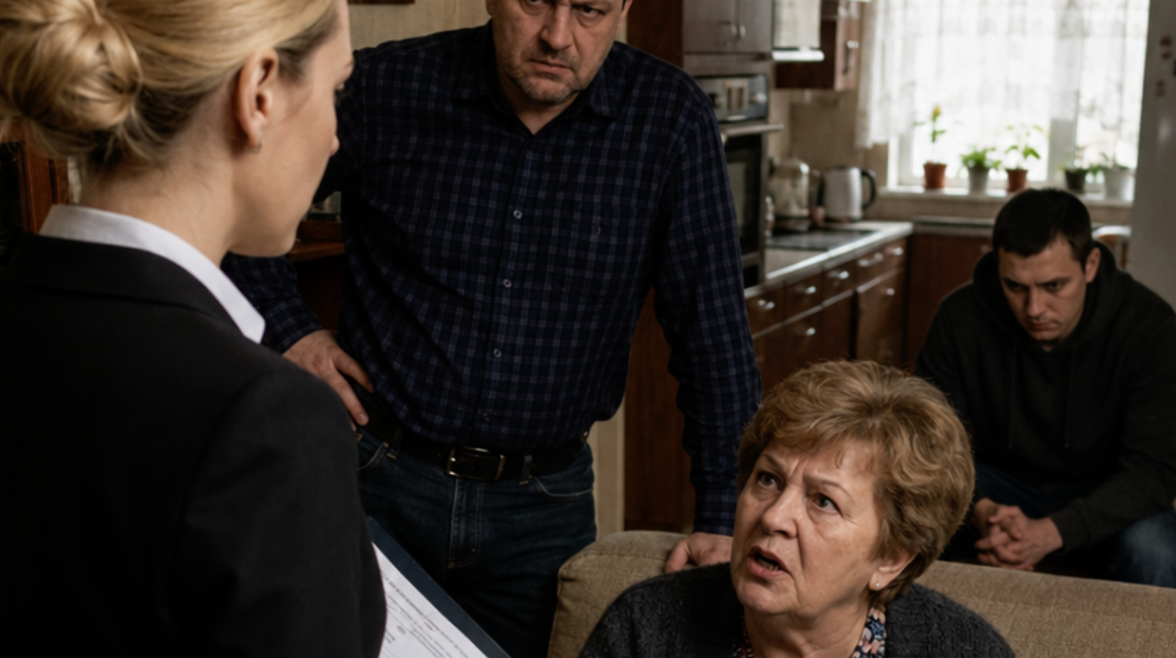
“A Two-Room Apartment Is Enough for You. Pack Your Things,” My Mother-in-Law Declared, Not Knowing I Was a Notary
Igor parked beside the pharmacy and turned off the engine.
“I’ll only be a minute, Lena,” he said, unfastening his seat belt. “My throat has been scratchy since yesterday. I’ll buy some lozenges, and then we’ll go.”
He slammed the door shut. I remained in the passenger seat. The car smelled of his new cologne and faintly of gasoline. The sun was shining directly through the windshield, so I reached for the sun visor.
A plastic discount card fell from behind it and landed somewhere near my feet.
I bent down and felt around the floor mat. The card had rolled underneath the dashboard. I had to open the glove compartment to make it easier to reach.
Among tangled charging cables, old gas station receipts, and packets of wet wipes lay an A4 sheet of paper folded in half. Its corner was sticking out awkwardly and preventing the compartment from closing properly. I pulled it out.
It was an ordinary extract from the Unified State Register of Real Estate. An official document from Rosreestr that people request from a government service center before conducting property transactions.
I unfolded the sheet so that I could put it back more neatly. My eyes automatically moved over the lines—a professional habit.
Property address.
My address.
My three-room apartment in a newly built residential complex.
Area. Cadastral number.
But another person’s name appeared in the “Owner” field.
Vladimir Nikolayevich Smirnov.
My husband’s younger brother.
The extract had been issued the day before yesterday.
I read the line again. Then once more. And again.
The letters did not change.
The document was genuine, complete with an official blue stamp. Someone had transferred ownership of my personal apartment, which I had purchased before my marriage, to Volodya.
My fingers tightened around the edge of the paper. I suddenly felt freezing cold inside.
I looked toward the pharmacy. Igor was standing at the checkout, paying for his lozenges.
I had been working as a notary for fifteen years. I dealt with documents, fraudulent schemes, and forged powers of attorney every day. I knew exactly how people had their homes stolen from them.
But I had never imagined that it would happen inside my own family, behind my back.
“I got the lozenges and some water,” Igor said as he opened the door and dropped into his seat, tossing the bottle into the cup holder. “Why are you so pale? Feeling carsick?”
I carefully folded the extract in half again.
“I was looking for some tissues,” I replied evenly, pushing the paper beneath the cables. “I couldn’t find any. Let’s go home.”
He started the engine.
I turned toward the window.
My work pen case lay inside the handbag resting on my lap. Inside it was a heavy fountain pen filled with rare blue-black ink—the pen I used to sign every official document.
I ran my finger over the smooth leather of the case.
They did not know.
Igor always told his mother, “Lena just moves papers around at the office.”
I had asked him not to advertise my actual position. I did not want calls from his numerous relatives asking me to prepare rental agreements or notarize powers of attorney for free.
During family gatherings, I would simply nod when Tamara Nikolayevna condescendingly referred to me as “our little records clerk.”
It had been more convenient that way.
I had chosen peace over the truth.
And now that choice was lying in the glove compartment, registered in someone else’s name.
That same evening, my living room was filled with noise.
Tamara Nikolayevna had arrived without calling, as usual. She had brought Volodya with her.
Igor’s younger brother sat hunched over on the edge of my light-colored sofa, picking at his salad with a fork.
Two weeks earlier, Volodya had once again failed at some “brilliant business plan.” He had taken out several payday loans, mortgaged his only studio apartment, and the bank had begun foreclosure proceedings.
“Lena, eat some salad,” Tamara Nikolayevna said, pushing the bowl toward me. “You’ve become so thin from shuffling all those papers around.”
I placed my fork on the edge of my plate.
“Thank you. I’m not hungry.”
“You need to eat,” my mother-in-law sighed before looking at Volodya. “Our family is facing such serious problems. Sveta said that if Vova loses his home, she’ll take the children and move in with her mother in Saratov. I’ll lose my grandchildren. Do you understand?”
She looked at me as though I were supposed to solve the problem immediately.
“It’s a difficult situation,” I said, looking directly at Igor.
He was carefully studying the pattern on the tablecloth.
“What’s so difficult about it?” Tamara Nikolayevna exclaimed, throwing up her hands. “The two of you only sleep in this enormous apartment. You leave at eight in the morning and return at eight in the evening. You’re using the third room as a storage closet. It does nothing but gather dust.”
That was true.
The third room was almost empty. I had planned to turn it into a home office, but I had never found the time.
“This is my apartment, Tamara Nikolayevna,” I said quietly. “I bought it before I even met Igor. I worked night shifts, translated documents, and saved every penny.”
“Oh, you bought it, so what?” my mother-in-law said dismissively. “We’re family! Igor contributed to the renovations too.”
He had bought two rolls of wallpaper and a chandelier.
“A two-room apartment is enough for you,” she continued. “Volodya needs to get his life back on track.”
She said it directly while looking into my eyes.
“What exactly do you mean by saying that a two-room apartment is enough for me?” I asked, tilting my head slightly.
“Mom, we agreed that we’d discuss this later,” Igor quickly interrupted, finally looking up.
“Why wait?” Tamara Nikolayevna pursed her lips. “I’ve already found an excellent option. A two-room apartment in a prefabricated building with a quiet courtyard. We’ll sell this place and buy that one for you. We’ll give the difference to Volodya so he can pay off his debts and take out a mortgage on a one-room apartment. Then Sveta won’t leave him.”
I looked at my husband.
“Do you agree with this too?”
Igor cleared his throat.
“Well, Lena… Mom knows best. We need to share with our relatives. Everything belongs to both of us, after all. We’re not strangers.”
“An apartment purchased before marriage is not considered jointly acquired property,” I automatically recited the phrase I used at work. “It cannot be divided.”
“Oh, listen to the lawyer!” my mother-in-law laughed. “You shuffle papers around at your office, and now you’re quoting laws. People should live according to human decency, not according to pieces of paper.”
“Lena, why don’t you go out onto the balcony and get some air?” Igor said, standing and practically pushing me away from the table. “Your blood pressure is probably acting up. Go and breathe.”
I stepped onto the enclosed balcony.
They firmly closed the door behind me.
Through the glass, I could clearly see Volodya becoming more animated. Tamara Nikolayevna took a notebook out of her bag and began sketching something.
I opened the window slightly.
“…we’ll throw out that huge wardrobe,” my mother-in-law’s voice reached me. “We’ll put a proper bed in here for Volodya. Their sofa can go into the children’s room.”
They were already dividing up my furniture.
Inside my apartment.
I stood on the balcony, looking out over the city at night.
There were no tears.
My mistake had been showing them compassion a week earlier. When debt collectors began calling Volodya, I agreed to let him move some belongings into the empty third room.
“Only temporarily, until I find a solution,” Igor had pleaded.
I had given in.
I had allowed them to drop the first anchor.
Now they had decided to take the entire ship.
My anger felt like freezing water.
The extract in the glove compartment meant that the conversation at the dinner table was nothing but a performance. They had already done everything.
They were merely preparing the ground so that they could present me with a finished decision.
The next morning, I arrived at the notary’s office before everyone else.
My assistant, Oksana, was only beginning to boil the kettle.
“Elena Viktorovna, you’re early today,” she said in surprise.
“Oksana, turn on the computer. I need access to the registry. Immediately.”
Five minutes later, I was sitting in front of the monitor.
I entered my cadastral number.
Property: Apartment.
Owner: Smirnov Vladimir Nikolayevich.
Basis for transfer of ownership: Deed of gift.
I clicked on the transaction details.
The deed had been notarized.
The notary’s surname was Petrov. He worked at an old office on the opposite side of the city.
“Request a scanned copy of the agreement and the power of attorney from Petrov’s archive,” I told Oksana.
My voice was perfectly calm.
“Use the internal network. Tell them we need it for verification in a related case.”
Oksana’s fingers moved rapidly over the keyboard.
Fifteen minutes later, the scanned documents arrived in my email.
I opened the first file.
It was a power of attorney supposedly issued by me to Igor Smirnov, authorizing him to give my apartment to Vladimir Smirnov as a gift.
At the bottom was my signature.
I stared at the screen.
They had taken my passport a month earlier while I was ill with a fever.
They had gone to Petrov.
Petrov was almost seventy years old and had poor eyesight. According to rumors circulating in our professional community, his assistants often ignored the fact that a person sitting in the office did not closely resemble the photograph in the passport—as long as the client paid well.
They had brought in a woman with a similar build.
The signature on the power of attorney had been carefully drawn with a ballpoint pen.
It was an ordinary flourish.
I took my pen case out of my handbag and removed my fountain pen.
I drew a line across a clean sheet of paper.
It left a thick, wet trail of blue-black ink.
I signed official documents only with that pen. My real signature had a complex pressure pattern that was impossible to reproduce with a ballpoint pen without knowing the angle at which I held the nib.
They did not know that.
Igor thought I was merely a clerk.
He had seen me sign utility receipts with an ordinary pen and had copied that simple flourish. He had no idea what my official signature looked like in the government registries.
Without saying a word, I printed the scanned documents.
I opened the safe in my office and took out the original ownership documents for the apartment, which I had always kept at work.
“Oksana,” I said, turning toward my assistant, “contact an independent handwriting expert. I need an urgent examination. And prepare a draft claim requesting that the transaction be declared invalid.”
“Has one of our clients gotten into trouble?” Oksana asked, frowning.
“I have.”
Throughout the day, I continued meeting clients, notarizing documents, and processing inheritances.
Inside me, everything was perfectly, crystal clear.
Three years of marriage.
For three years, he had lived in my home and slept in my bed.
And throughout that entire time, he had considered me a foolish little paper-pusher whose home could simply be taken away because “Mom knows best.”
I did not call Igor.
I did not cause a scene.
I ordered the handwriting examination and submitted samples of my genuine notarized signature, along with copies of the registration logs.
By evening, the lawsuit was ready. They did not keep me waiting long.
On Saturday morning, a key turned in the lock.
I was sitting in an armchair in the living room. A neat stack of documents lay on the coffee table in front of me.
Tamara Nikolayevna burst into the hallway carrying two enormous checkered bags. Volodya followed her, panting under the weight of several boxes.
Igor entered last and closed the door.
“Oh, you’re home,” my mother-in-law said, kicking off her shoes directly onto the mat. “We’ve brought Volodya’s things. Sveta took the children and went to stay with her mother, so he’ll settle in here for now. In the third room.”
“He will not be settling in here,” I said without raising my voice.
Tamara Nikolayevna straightened.
Her face assumed the theatrical expression of someone convinced that she owned the world.
“All right, Lena. Let’s not have any hysterics. I’ve already explained everything to you. This is Volodya’s apartment now. We completed everything legally.”
She approached the table and threw the extract from the property registry in front of me.
The same one that had been lying in the glove compartment.
“Here is the document. You’re no longer the owner here, so pack your things. We’ll rent an apartment for you temporarily until we finish buying that place in the prefabricated building.”
Igor stood in the living-room doorway with his hands in his pockets.
“Lena, don’t make this more complicated than it needs to be. We were planning to move into a bigger place eventually anyway. Vova needs this apartment more right now.”
I slowly rose to my feet.
“You executed a deed of gift using a forged power of attorney at Notary Petrov’s office,” I said evenly.
My mother-in-law’s face twitched, but she quickly regained control of herself.
“It wasn’t forged! You signed it yourself! We even have a witness who can confirm that you agreed!”
“I am a notary, Tamara Nikolayevna,” I said clearly, separating each word. “I have been one for fifteen years. My signature is registered with the Ministry of Justice. I sign with a special fountain pen. What you drew with a ballpoint pen at Petrov’s office constitutes a criminal offense.”
Silence descended.
Heavy, thick silence.
My mother-in-law looked at Igor.
He had turned pale.
“A notary?” Volodya repeated, lowering his box to the floor. “Igor, you told me she was a secretary…”
“Shut up, Vova,” my husband hissed.
He stepped toward me.
“Lena, you’re bluffing. We did everything properly. Petrov notarized the documents.”
“Petrov is already giving an explanation to the notarial chamber,” I said, moving the property extract aside and placing my own document on top of it. “This is a copy of the lawsuit. And these are the results of an independent handwriting examination. The signature has been confirmed as a forgery.”
My mother-in-law opened her mouth and then closed it again.
Her confidence disappeared instantly.
She looked helplessly at her checkered bags and then at me.
“Lenochka…” Her voice suddenly became thin and ingratiating. “Why did you immediately order an examination? We’re family. We only wanted what was best. We wanted to save Volodya…”
“Then save him,” I said, nodding toward the door. “But not at my expense.”
“You wouldn’t dare take this any further!” Igor suddenly shouted. “I’m your husband!”
“Ex-husband,” I corrected him.
The doorbell rang.
Two short rings followed by one long one.
I walked over and opened the door.
Two district police officers were standing outside.
“Igor Nikolayevich Smirnov?” the senior officer asked as he entered the hallway. “A report has been filed regarding large-scale real estate fraud.”
Igor stepped backward.
Tamara Nikolayevna sank heavily onto the small bench in the hallway and covered her face with her hands.
She remained silent.
Volodya simply looked away, pretending that none of this had anything to do with him.
“Pack your things, Igor,” I said. “Your mother’s two-room apartment will be enough for you.”
Igor moved out that same day under police supervision.
The lawsuit to invalidate the transaction was resolved quickly. There was no point in disputing the handwriting examination or the testimony of Petrov’s assistant.
The apartment was officially returned to me.
Criminal proceedings for fraud were initiated against Igor and the accomplice who had impersonated me at the notary’s office.
Tamara Nikolayevna was treated as a witness, but the interrogations exhausted her nerves completely.
Igor and I divorced a month later.
I filed a separate claim for emotional damages.
And I won.
I did not celebrate my victory.
When everything was over, I simply returned home.
The hallway smelled dusty. I had not cleaned for a long time.
The third room stood empty.
I walked over to the small cabinet beside the mirror.
A new utility bill was lying on top of it. It was an ordinary sheet of paper from the mailbox—the kind on which they often mixed up the water meter readings.
I picked it up.
In the “Owner” field, it read:
Elena Viktorovna.
Only my name.
I ran my finger over the letters.
The home was mine.
The air was mine.
But growing accustomed to the fact that I no longer needed to expect betrayal from the people who had slept beneath the same blanket as me proved more difficult than winning the court case.
I placed the utility bill back on the cabinet.
I needed to submit the meter readings.
Could this ending have been avoided if I had made my husband respect my profession from the beginning instead of hiding behind a convenient lie?