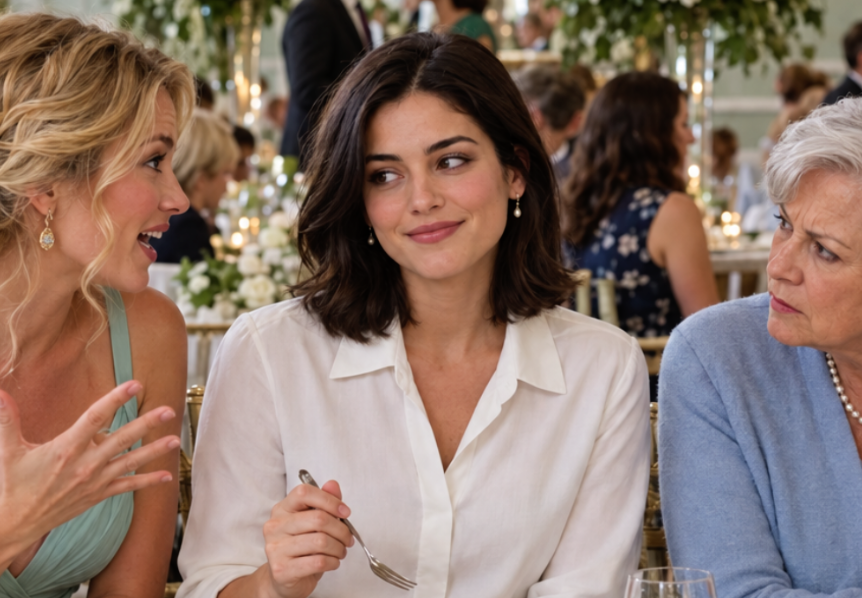
“The cream is heavy again,” Alla said, but immediately helped herself to a second slice.
She tapped her fingernail against her glass, just like she always did when making a pronouncement. A long cherry-red nail, delicate glass, click, click.
It was my mother-in-law’s seventy-ninth birthday. The table smelled of dill and new potatoes, and a wave of June heat drifted in through the open window. I had brought the cake in a simple kraft box, no label at all.
For this family, I baked at home on Sundays—my only day off. In the bakery, every gram is accounted for, but my relatives didn’t like hearing about work in the bakery.
I joined this family fourteen years ago, at thirty-seven. The first cake I baked was for Vasilisa, Alla’s daughter, for her twelfth birthday. Alla tasted it and said she’d get a store-bought one next time—they were at least even.
That store-bought cake never came. Birthdays, New Year’s, Easter, March Eighth, “for the girls at the agency, there’s a deal”—it added up to nine cakes a year. I never counted; I took pictures. I have an album on my phone called “Family,” and it already has one hundred twenty-six photos. I never even got money back for the cream.
Why did I stay quiet? I don’t have any family of my own here, and every time Slava would ask, “Rita, just let it go, she’s been like that since childhood, you’ll only upset her.” But one time I tried anyway. Nine years ago, for my mother-in-law’s milestone birthday, I asked Alla to split the cost of a big cake.
“Money from family?” she repeated then. “Mom, did you hear that?”
After that, my mother-in-law didn’t speak to me for a month. Slava asked me to let it go, and I did.
Three years ago, I left the warehouse, where I’d worked as a logistics manager for twenty years, and rented a space for a bakery. I invited everyone to the grand opening. Alla replied she’d come when there was something normal, not a basement.
That’s how it started—”Rita’s basement.” In reality, my bakery is on the first floor, windows facing the boulevard, but of all my relatives, only Vasilisa ever visited. No one else even asked about the name. I have five employees now and a waiting list for wedding cakes. At the bakery, I’m Margarita Vitalievna. But here? Why am I still just Ritka with a cake at this table?
“By the way, the date’s set,” Alla said, pushing aside her empty plate. “Vasya’s getting married on September nineteenth. Her future in-laws are serious people—they own a construction company.”
Vasilisa, sitting across from me, blushed all the way to her freckles. I remembered her as a little girl, a spoonful of cream in her cheek, and the words just came out.
“The wedding cake will be my gift,” I said.
“Oh, Rita, don’t take it personally, but this is on another level,” Alla replied, adjusting her precisely styled hair. “How about you bring us something to sample, and we’ll see.”
I have working hands: short, unpolished nails, a pale mark from a baking tray on my wrist. Under the table, Slava tapped my knee—a silent plea not to argue. I picked up a napkin and folded it in quarters. That’s what I always do when I need to keep quiet, and by the end of the evening, a whole stack collects by my plate at my mother-in-law’s.
“And wrap up the leftovers for me,” Alla said. “I’ll take them to the girls at the agency tomorrow, we’ve got a deal in progress.”
Half of the cake sat on the platter: a perfect cut showing layers of raspberries, tart enough to keep the cream from being too sweet. It was the exact kind of heavy cake that tomorrow would be served to people looking to buy someone else’s apartment.
The next napkin landed on the tablecloth, unfolded. Suddenly, my mouth felt dry, like biting into an overbaked meringue.
“Alla, that was your second slice,” I said. “You shouldn’t eat this kind of heavy cake like that.”
Alla’s husband hid a chuckle in his fist. Vasilisa bent over her plate, her shoulders shaking.
“And I’m not wrapping up the rest—no one serves clients cake that’s not delicious. The rest is for the birthday girl.”
Her fingernail froze above her glass.
“What’s that, Rita?” Alla stood up a bit. “I thought we were family here.”
“So do I,” I replied, sliding the platter closer to my mother-in-law.
My mother-in-law looked closely at her daughter, then at me, and silently took another piece for herself. Alla opened her mouth, shut it, and quickly reached for her purse.
I washed the dishes alone. The water was cold, my hands smelled of vanilla, and through the wall, I heard Alla telling someone that her daughter-in-law was in a mood today. All these years I’d folded napkins and it took just one sentence. And nothing fell apart.
In the hallway, Vasilisa caught up with me and hugged me from behind, just like when she was a child.
“Aunt Rita, I won’t accept any other cream,” she whispered. “Don’t listen to Mom.”
On the way home, I felt almost cheerful. And Saturday after my shift, I started prepping samples for her wedding: six different fillings, five hours of work.
I didn’t yet know that Alla wouldn’t even open the sample box.
***
I finished the samples just before midnight. Pistachio paste, raspberry layers, pastry cream made with egg yolks—the kitchen smelled so amazing that Slava came twice with a spoon. A set like this for a bride-to-be would run fifteen hundred at the bakery.
On Sunday, I brought the box to Alla. She answered the door with her phone pressed to her ear, brushed me off like a fly, and said, just put it there.
“The apartment’s spotless, just one owner,” she was saying into the phone. “No, haggling won’t work.”
I set the box on the hallway table. Six cups, from pistachio with raspberries to honey cake with sour cream, each with a little spoon and a card with its name. On top, a satin ribbon tied in my signature knot.
“I’ll look later, I have a showing,” Alla threw out without turning around.
Later stretched out until Friday. On Tuesday, I called her myself.
“Rita, I’m at a property, no time for sweets,” Alla replied. “I’ll call you back.”
She didn’t call on Wednesday or Thursday. Pastry cream only keeps three days, and I remembered that. I also caught myself waiting for her call like a schoolgirl waits for her grade. And here I am, fifty-one years old with my own bakery! On Friday after work, I drove to her place.
Alla met me in a bathrobe, a sheet mask on her face. She didn’t remember the box right away.
“Oh, that,” she said. She opened the fridge. “Just a sec.”
The box sat on the bottom shelf, between a pot and a bag of kefir. Alla handed it to me. The cardboard was damp and cold against my hand, and inside it smelled like smoked sausage. The ribbon was still tied in my knot: no one had even touched it.
“Oh, Rita, I totally forgot,” Alla said with no hint of embarrassment. “I’m on a diet, and Vasilisa can’t have anything before her dress fitting. Besides, what’s there to taste anyway?”
“That was a whole evening of work,” I said.
“Exactly, it’s evening now.” She shut the door with her hip. “Don’t take it the wrong way, but Vasya and I decided: we’ll order the cake from a proper bakery. With a name, with a contract.”
“I see.”
“What do you mean, you see? The in-laws will ask where we got it, and what am I supposed to say? That it came from my daughter-in-law’s kitchen? A real wedding cake costs about fifty thousand, Rita. This isn’t like throwing together some cake layers from the neighbors.”
She took the box from me and pressed the pedal of the trash can with her foot. The lid flipped open, and my samples dropped down inside, unopened, landing with a dull cardboard thud.
The lid didn’t close completely. A bit of white satin ribbon stuck out against the black plastic. I stared at it, the chill from the damp cardboard lingering in my fingers.
What could I have done? Dug it out? Tried to explain to a grown woman that you don’t even treat store-bought cookies like that? I was so naive, coming here with that ribbon!
“Fine,” I said. “I’ll take my gift back. You’ll have to find a cake yourselves.”
“No one asked you to, anyway,” Alla replied.
I walked around her and opened the cupboard above the sink. For years dishes, containers, and cake stands would go to Alla’s house with my cakes and never return. Mine were on the top shelf: one glass, one spinning. I took them both down.
“Why are you digging through the cupboards?” Alla stepped toward me, her mask slipping sideways on her face.
“Just taking what’s mine. I need them for work.”
“For what work, Rita? In that basement of yours?”
“Yes, in that basement,” I replied and headed for the door.
She was left standing in the middle of the kitchen. For the second time that summer, Alla was speechless.
I rode the elevator alone, clutching the cool glass. My heart pounded fast, like after running up stairs. The truth was, I didn’t feel sorry for the fillings. Maybe all these years I really hoped she’d try one and finally say: it’s delicious.
So. The gift’s off the table, I’ve got my stands, so what’s next? Next, I stop waiting for her approval.
Slava listened when I got home and stayed quiet for a long time.
“Rita, maybe you shouldn’t have taken the stands? She’ll get upset, tell your mom.”
“Let her,” I said, and he didn’t argue. He just asked if I still had any of that pistachio filling left.
On Monday, I walked into the workshop and felt a sense of relief. The air smelled of burnt caramel, mixers were humming, and the girls were putting stickers on the bottom of boxes: ingredients, expiration date, manufacturer. The tiny print no one ever reads.
“Margarita Vitalyevna, there’s only one slot left for wedding cakes in September,” the manager said. “And Izolda Borisovna called again. She wants forty sets by Friday.”
Above the display case, the sign read: ‘Serafima.’ That was my grandmother’s name, the woman who taught me to make dough. Here, my cakes have always been tasted before they’re judged. Only cakes are shown on our bakery’s page—my face is never there. Maybe that’s why, after all this time, Alla never realized that this ‘basement’ actually is ‘Serafima’?
In August, Alla called as if nothing had happened.
“On Saturday, we’re meeting the in-laws at the restaurant. You and Slava should come. Just dress nicely, and please, don’t start talking about your cakes.”
***
The restaurant was on the riverside. The kitchen smelled of fried fish and lemon. I wore the blue dress I usually save for other people’s weddings, and Alla looked me up and down, just like she would inspect an apartment before a showing.
They seated the eight of us together: Alla and her husband, Vasilisa and Ignat, the in-laws, and Slava and me.
“This is Rita, my brother’s wife,” Alla introduced me. “She bakes cakes in the kitchen and sells them to the neighbors.”
The mother-in-law nodded at me over her glasses, which hung from a chain. Her name had already been mentioned at the door: Izolda Borisovna. Such a rare name, and I only knew one Izolda Borisovna—from the invoices, for the forty cake sets due Friday. Could it really be her?
“So what do you bake, Margarita?” she asked.
“Just honey cakes, apple pies, homemade style,” Alla answered for me and tapped her glass with a fingernail. “She rents out some basement, we don’t ask too many questions. Can you believe she wanted to bake the wedding cake herself? For a wedding like this! Of course we refused. Don’t take it personally, Rita, but homemade is homemade.”
The father-in-law politely smiled into his plate. My ears started burning, and the wine turned sour in my mouth.
“Mom!” Vasilisa said quietly.
“The cake is already taken care of,” Izolda Borisovna said in her deep voice. “I order from ‘Serafima,’ have for three years—both for my company and at home. No one in town does it better. Vasilisa picked out a three-tier one from the catalog.”
The fork in my hand froze halfway to my mouth. I’d heard that name from strangers countless times—but never from Alla.
“Mom can’t imagine a holiday without their pistachio and raspberry,” Ignat laughed.
Pistachio with raspberry. That same little cake that sat for almost a week in Alla’s fridge, wrapped with a ribbon.
“Serafima!” Alla exclaimed, clapping her hands. “Now that’s top tier! I walk clients past their shop on the boulevard—places there book up a month in advance. Rita, have you ever been? Go check it out sometime, see how real pros work.”
“I have,” I said. “They won’t let you down.”
Only two people at that table knew Serafima was mine. Vasilisa stared at me wide-eyed. Slava was about to say something, but I pressed my foot on his.
Why did I stay silent? I could have spoken up right there. But to announce I was the owner right after hearing about my “basement” would have caused a scene in front of the in-laws and Vasilisa. That’s not all. If Alla learned the truth, she’d have insisted on a different bakery out of spite, and the bride would end up without the cake she actually wanted. And to be honest, I wanted one other thing. For fourteen years, this family wrinkled their noses before even tasting anything I made. Let them try it once, without knowing, and I’ll tell the truth after the wedding, at home, without an audience.
“If you really want to help, Rita, bake pies for the second day. For thirty people. Like family,” Alla said.
I just brushed imaginary flour off my sleeve.
“No, Alla. On the second day, I’m a guest. I’m not baking for the family anymore.”
“And why is that?”
I took out my phone, opened the ‘Family’ album, and set it on the tablecloth between the wine glasses.
“There are one hundred twenty-six cakes in here. All for your family, every single one as a gift. That’s enough.”
“How many?” Izolda Borisovna removed her glasses and leaned toward the screen. “Alla, you are one lucky woman.”
Alla twisted the ring on her finger.
“You were counting?”
“I took photos.”
“So now you’re going to start charging family? Saying this in front of everyone?”
“From you,” I replied. “Just like everyone else.”
Ignat was the first to laugh, then the father-in-law. Alla blushed deeply beneath her powder and buried her nose in the menu.
A minute later, I grabbed my phone and stepped out onto the porch. The river air was thick with dampness, and the railing felt cold beneath my hand. It hit me that I’d just said out loud, in front of strangers, something I had kept silent about for years even with family. Maybe I shouldn’t have, not like that, especially with the in-laws around?
My phone pinged—a message from Vasilisa.
“Aunt Rita, why didn’t you mention ‘Serafima’? Mom said you refused to bake it yourself because you had too many orders. That’s why I chose her.”
So that’s how it is. And to me, she said, “Vasya and I decided together.”
“We’ll talk after the wedding,” I wrote back. “At home.”
“In that case, you can put the cake together yourself. I don’t want anyone else’s.”
In the car, Slava was silent for a long time, then finally said:
“You should have done this a long time ago, Rita. I couldn’t have done it myself.”
The next morning, Alla called. Her voice sounded softer than usual.
“Rita, don’t be mad. I said too much in front of the in-laws. We’ll order pies. Afterward, Izolda Borisovna spent half the evening asking about you. At the wedding, you’ll sit at our table—you’re close family, after all.”
I set my phone aside and sat there for a long time over my now-cold coffee. Was it really possible that just one evening and one number could change things? It seemed, for a moment, like people might actually start treating each other decently. I even decided: after the wedding, I’d invite her to the workshop, show her the sign, and tell her myself.
Then on Monday, a new entry appeared in the order book: “Izolda Borisovna. September nineteenth. Three tiers, twelve kilograms.”
I still believed we’d be sitting together at the same table at this wedding.
***
I took care of this order personally. The in-law paid the full forty-three thousand two hundred up front, and I told my manager not to touch that money: after the wedding, I’d return it—a gift is a gift.
When Slava found out, he just shook his head.
“You should tell her before the wedding, Rita.”
“After,” I replied. “Let them eat it first.”
It took me ten evenings to shape thirty-eight sugar peonies. I made the signature heavy cream—the buttery kind, real and rich. And as a little touch from me, I added seventy-four white boxes embossed in gold, each holding a pair of almond pastries for the guests. I don’t bake on command anymore, but gifts—I decide that myself.
Each box had a label, prepared by the girls just as it should be: ingredients, shelf life, and manufacturer. Honestly, there was nothing I was hiding.
On the nineteenth, my team delivered the cake to the restaurant during the day and assembled it in the kitchen. I arrived as a guest just as it started, wearing that same blue dress.
The hall buzzed—smelled of lilies and warm bread, live music played. But they didn’t seat us at ‘our’ table.
“Oh, Rita, please don’t take it personally—the in-laws and Ignat’s bosses are at our table,” Alla tossed over her shoulder as she hurried by. “You’re at table seven.”
Table seven was by the service door. The smell of over-fried oil drifted over, the door kept banging, and waiters kept bumping Slava’s chair with their trays. So much for being ‘close family’. And I almost believed that morning phone call.
The little boxes were already set out at every plate. The woman next to me unwrapped her pastry, took a bite, and closed her eyes in delight. Meanwhile, Alla was making her rounds, telling everyone these were all from ‘Serafima’—they never even considered anyone else, said it was simply a whole different level.
The cake was brought out just before ten. The hall buzzed louder, phones started flashing, and someone applauded. Under the chandeliers, the peonies looked almost real, and for a moment, I didn’t care what table I was sitting at.
“Wasn’t it our Rita who baked that?” my mother-in-law called out for the whole room to hear.
The mother of the bride was giving a toast, and Alla had the microphone. She immediately burst out laughing into it.
“Mom, seriously!” she called out, turning across the tables to me. “We ordered the cake from a real bakery, not yours! From ‘Serafima.’ Rita does homemade cakes, but, you know, this is a different level.”
She picked up a white box from the table and waved it over her head.
“Here, take a good look at what it looks like.”
Laughter filled the nearby tables. Dozens of faces turned toward our corner. My cheeks burned like an oven wide open. My best cake stood in the middle of the hall, and here I was being shown my own box as if I needed a lesson. How many more years was I meant to listen to this?
Slava squeezed my hand under the table. With my free hand, I automatically picked up a napkin and folded it in half. I could have stayed silent yet again. But I left the napkin as it was and stood up.
My legs didn’t want to cooperate, but when I spoke, it was with the same firm tone I use with suppliers.
“Alla, turn the box over. On the bottom, it says who made your top-tier cake. Read it out loud.”
I didn’t need the microphone: the room suddenly fell absolutely silent. Somewhere in the kitchen, a lid clattered, and then not a single sound.
Alla smirked; she liked that someone was expecting to hear a big name. She held the box away from her eyes—it was hard to read the tiny print without her glasses.
“Manufacturer: Sole Proprietor Lykova Margarita,” she read into the microphone and suddenly stopped.
Her lips were still smiling out of habit. The speakers broadcast her breath to the entire hall.
“Vitalyevna,” I added. “Keep reading, Alla—it’s written small. Lykova is my husband’s last name, and your maiden name. And ‘Serafima’—that’s my bakery, going four years now.”
A wave passed through the hall: half the guests here knew the Lykov surname.
“Rita, you could’ve just said so,” Alla managed, not using the microphone.
“I could’ve. But you never once asked what my business was called.”
I turned toward the bride and groom.
“Vasilisa, Ignat, I assembled the cake myself, and those little boxes are my gift for your guests. Wishing you happiness. Gorko!”
Slava stood up first. He clapped so hard the glasses rattled, and then our whole table stood with him.
“I told you, our Rita!” said my mother-in-law.
“So it was you!” Izolda Borisovna made her way toward me through the hall, steadying her glasses. “For three years I’ve been ordering and never knew who to thank. Alla, why didn’t you ever say your family had such a master?”
Vasilisa got to me first, her veil pushed to the side. She smelled of hair spray and champagne.
“Ever since the first cake, I just wanted yours,” she whispered in my ear.
The hall erupted with shouts of “Gorko!” Alla sank onto her chair, the microphone lying on the tablecloth. That night, she didn’t tap her glass a single time more.
Then came the cake-cutting. I sat and felt the tension in my back finally ease—the back that had been ramrod straight since June. I realized my anger was gone. Inside, everything was quiet, like the bakery in the early morning before the ovens heat up.
Alla finished her slice down to the last crumb. Not a word about the heavy cream.
***
Three weeks passed. In the very first week, ‘Serafima’ received eleven orders from wedding guests, and by October, we had no open slots left at all.
I sent the cake money to Izolda Borisovna the morning after the wedding. She immediately returned it to me with a note: “Then let this be a prepayment for New Year’s.” I didn’t argue. Meanwhile, Vasilisa and Ignat sent a photo from their trip and asked if I could make the same cake for their anniversary.
Continued in the comments.
Alla was silent for two weeks: she could have called, but she didn’t. Then an order appeared on the website: two kilos, pistachio with raspberry, “for clients closing a deal.” Seven thousand two hundred, paid in full by card. In the comment, it said: “Cream like at the wedding.” Maybe that’s just her way.
Continued in the comments.
“Should we give her a discount?” the manager asked.
Continued in the comments.
“No. Same as everyone else.”
Continued in the comments.
Have I forgiven her? I don’t know. But the order is accepted, and it’s due Friday.
Continued in the comments.
I don’t bake at home on Sundays anymore. Slava and I go out of town, so my day off finally feels like a real break. He took the simple craft boxes to the garage for tools. Last week, Slava brought his mother to the workshop for the first time. She stood under the sign and asked:
“And who is Serafima?”
“My grandmother. She taught me to bake.”
“Imagine that,” said my mother-in-law, then bought a box of eclairs.
I don’t fold napkins anymore.
On Friday, I packed Alla’s order myself. White box, gold embossing, a sticker with my last name on the bottom. My cakes used to arrive at her place in simple boxes and for free. This one left with a name. And with a receipt.