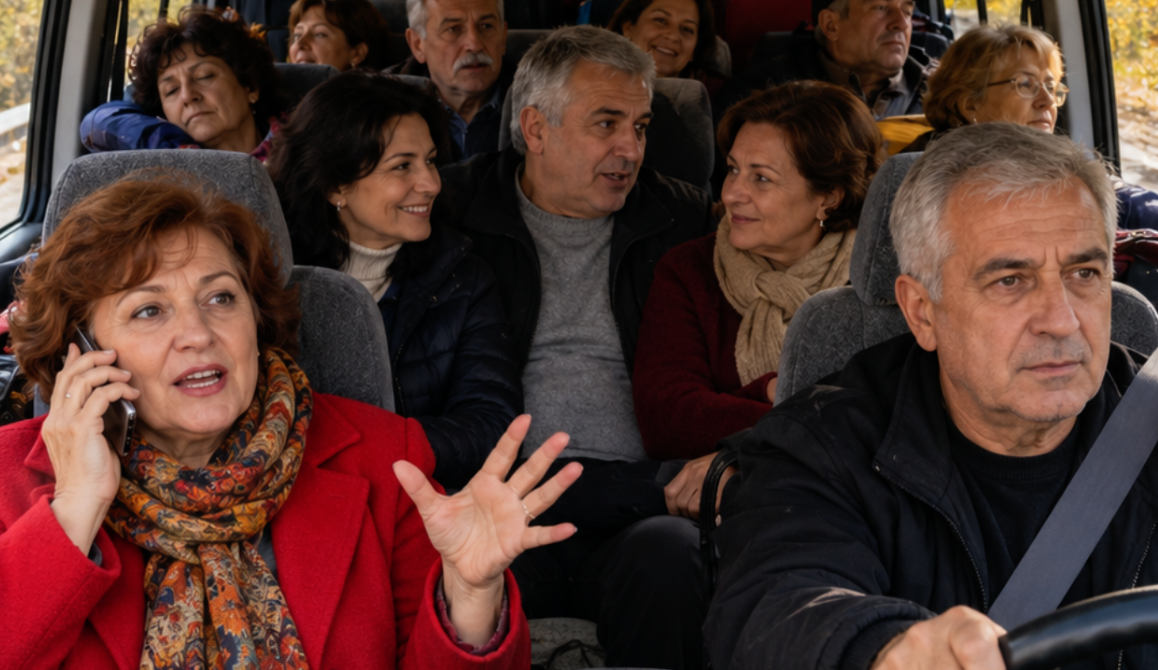
“Eight of us plus the kids are coming, set the table,” my mother-in-law announced from the car. I left the welcoming to the person who had invited her.
Forty minutes before we were supposed to leave the house, Andrey suddenly asked where the large plates were. Not the two ordinary ones we used every day, but the big ones—the ones I only brought out for family gatherings.
I was fastening my son’s jacket and answered automatically:
“They’re in the bottom cupboard, on the right.”
Andrey went back to the kitchen. A minute later, the beginning of a message appeared on the screen of his phone, which he had left on the table:
“We’re on our way…”
I didn’t read any further and asked:
“Who are you expecting?”
Andrey hesitated for barely a second.
“My mom. She might stop by.”
In our family, “might” had long since come to mean one thing: someone had already made arrangements without me, and I would be the last to find out.
At first, it really did seem harmless.
I’m forty-one, Andrey is forty-three. We’ve been married for fourteen years, and our children are twelve and nine. We live in an ordinary three-bedroom apartment, and whenever we have guests, we usually gather everyone in the living room around an extendable dining table.
During the first years of our marriage, we were usually the ones who went to visit Andrey’s relatives. His mother, Lyudmila Petrovna, loved big family gatherings, and at first I even enjoyed their noisy way of spending time together.
The problem wasn’t the guests.
The problem was one particular habit my husband had developed.
He invited people, but somehow I was always the one expected to host them.
The first time it really bothered me was about three years ago.
One Saturday morning, Andrey said that his mother and sister were going to “drop by for tea.” I was about to take our daughter to an activity and then go buy winter boots for our son.
“What time?” I asked.
“Closer to two. They won’t stay long. Don’t prepare anything.”
I believed him.
At half past one, he called and said that his mother wouldn’t be coming alone. Then he added that her sister would also be bringing her son, his wife, and their child.
Another ten minutes later, it turned out that on the way, they had also picked up one of Lyudmila Petrovna’s cousins.
Seven people arrived in total.
By the time we came home, Andrey was already sitting with the guests. There were cups, cookies, and a box of chocolates on the table.
As far as he was concerned, that was “tea.”
Lyudmila Petrovna saw me and immediately asked:
“Do you have anything to eat? We’ve been on the road, and the men are hungry.”
I opened the refrigerator.
There was soup for our family, a few cutlets, and enough groceries for the next two days.
“There isn’t enough hot food for everyone,” I said.
“Well, make some potatoes,” my mother-in-law replied. “You always have potatoes.”
Andrey heard her, but he didn’t get up.
He merely looked at me through the open kitchen door.
“Really, just make something simple. I’ll help you later.”
“Later” came closer to seven in the evening.
By then, I had managed to go to the store, bake potatoes, reheat the cutlets, cut vegetables, bring out more dishes, and pick up the children’s toys from the floor three times because it had become impossible to walk through the hallway.
The guests left happy.
Andrey collected some of the plates, and fifteen minutes later he sat down to answer messages on his phone.
I spent almost another hour cleaning the kitchen and putting leftover food into containers.
That was the first time I said:
“If you invite people over, warn me in advance.”
He didn’t argue.
He kissed me on the temple and said:
“Of course. It just happened unexpectedly today.”
Back then, that was enough for me.
But then things “just happened” several more times.
The next serious conversation happened in the autumn.
On Friday evening, Andrey came home from work, changed his clothes, and casually announced:
“Tomorrow we’re going to celebrate Mom’s sister’s birthday here. Their place is being renovated and it’s cramped.”
I was standing at the kitchen table putting away groceries.
At first, I didn’t even realize that he had already made the decision.
“What do you mean, ‘here’?”
“Well, just our relatives. Maybe ten people.”
“Tomorrow?”
“Yeah. It’s nothing complicated. We’ll buy a cake and order the main course.”
I looked at the two bags of groceries I had just brought home and asked:
“You already invited everyone?”
Andrey looked away toward the window.
“Mom asked me, and I agreed. What’s the big deal?”
That phrase—“What’s the big deal?”—was what I remembered most clearly.
Because to him, there genuinely was nothing unusual happening.
He didn’t think about where ten people were going to sit, whether we had enough plates, how we were going to entertain three children, how many drinks we would need, or who would clean the apartment afterward.
The next morning, Andrey went out to buy the cake and ordered the hot food.
Somehow, everything else quietly became my responsibility.
I moved the drying rack out of the living room, wiped the table, brought out extra plates and cutlery, found a tablecloth we rarely used, and cleared a shelf in the refrigerator.
Then it turned out that one main dish wouldn’t be enough.
Lyudmila Petrovna asked for salads because, as she put it, “You can’t have people sitting at an empty table.”
Andrey agreed with her so easily that you would have thought salads magically appeared as soon as someone mentioned them.
By evening, I had barely sat down.
The children needed water, we kept running out of glasses, and space had to be cleared for the cake.
After the guests left, Andrey began collecting the dishes, but then someone called him and he went into another room.
By the time the conversation ended, I had already loaded the dishwasher, wiped the table, and put the food away.
The next day, I stopped speaking in hints.
“Andrey, if you invite a group of people here without discussing it with me again, you’re going to handle everything yourself.”
He was sitting at the table drinking tea.
“What do you mean, everything?”
“I mean you decide what to feed them. You buy the groceries. You set the table. You clean everything afterward. I can help if we agree on it beforehand, but I’m not going to keep finding out about ten guests the evening before they arrive.”
He was silent for a moment and then shrugged.
“Fine. But you’re talking like I deliberately dump all the work on you.”
“I don’t care whether it’s deliberate or not. The result is the same.”
The conversation ended calmly.
I even thought he had finally understood me.
For several months, things really were quiet.
Whenever Lyudmila Petrovna wanted to visit, Andrey asked whether it was convenient for us, and I assumed the issue had been settled.
As it turned out, the next incident once again seemed “not serious” to him.
“We’re already on our way.”
That Saturday, the children and I had plans.
Our daughter had a class in the city center, our son wanted to go to a bookstore to buy a new encyclopedia, and afterward we were planning to have lunch somewhere in town.
Andrey decided to stay home. He wanted to organize the storage closet and finally put up a shelf he had been postponing since spring.
We were already dressed when he asked about the large plates.
After he mentioned his mother, I became suspicious, but I thought that if my mother-in-law came alone or with her sister, Andrey could handle it.
The phone rang while I was checking whether my daughter had taken her transit card.
Lyudmila Petrovna was calling from the car. I could hear voices in the background.
“Are you home?”
“Andrey is. The children and I are just leaving.”
“Where are you going?”
“We have plans. Did something happen?”
She sounded surprised, as if I had announced that I was leaving in the middle of my own birthday party.
“What do you mean, you’re leaving? There are eight of us plus the children, so set the table,” my mother-in-law announced from the car. “We’re almost on the avenue already. We’ll be there in about forty minutes.”
I looked at Andrey.
He was standing by the kitchen door and had heard everything.
“Eight who?” I asked.
“Eight adults. And three children. Andrey said this morning, ‘Everybody come over, why sit around at home?’ So we all got together.”
Now there was only one question that mattered.
I covered the phone’s microphone with my hand and asked my husband:
“Did you invite them?”
He grimaced.
“I told Mom they could come by. I didn’t know she would gather everyone.”
“She says you told them, ‘Everybody come.’”
“Well, I meant… the relatives. I didn’t count everyone individually.”
I brought the phone back to my ear.
“Lyudmila Petrovna, Andrey is home. He’s waiting for you.”
“What about you?”
“I’m leaving with the children. We already have plans.”
There was a pause on the other end.
“And who’s going to set the table?”
“Andrey invited you. He’ll welcome you.”
My mother-in-law said something about family and about how we could have postponed our plans, but I didn’t argue with her.
I simply wished them a safe drive and ended the call.
Andrey was still standing in the hallway.
“You’re seriously leaving?”
“Yes.”
“Eleven people are about to arrive.”
“You invited them.”
“I didn’t think there would be that many.”
“Then next time, ask before inviting people.”
He walked into the kitchen and opened the refrigerator.
For several seconds he simply stared inside, then asked:
“Do we have any meat?”
I was already buttoning my coat.
“Look on the bottom shelf. I don’t know how much is left.”
“What can I make quickly?”
“Andrey, I didn’t plan a menu for your guests.”
He closed the refrigerator door a little harder than usual but didn’t argue.
He picked up his phone, opened a food delivery app, and started choosing something.
Our son stood nearby, silently waiting.
I didn’t want to create a family scene in front of the children, so I simply said:
“We’ll be back this evening. You have your keys, and you can buy groceries at the store across the street.”
It sounded almost completely ordinary.
That was exactly how I wanted it.
No dramatic door-slamming.
No performance.
We left.
For the first time, he hosted his own guests by himself.
At around two, Andrey texted:
“Where is the large salad bowl?”
I answered:
“In the upper cupboard above the oven.”
Half an hour later, another message arrived.
“How much rice should I cook for this many people?”
I looked at the screen and put the phone away.
A minute later, I finally replied:
“I don’t know. Order something ready-made if you’re unsure.”
He didn’t ask for any more advice.
The children and I spent the day exactly as we had planned.
Our daughter went to her class, our son chose a book, then we had lunch and stopped to buy a few things for school.
We came home at around half past six.
There were shoes everywhere in the hallway.
Some of the guests were already getting ready to leave. Two children were sitting on the ottoman arguing over a toy, and someone was searching for a scarf.
Lyudmila Petrovna came out of the living room.
“Here’s the lady of the house,” she said. “We haven’t seen you all day.”
I took off my coat and hung it up.
“The children and I had things to do.”
“You could have canceled your plans just this once.”
Before I could answer, Andrey appeared from the kitchen carrying two empty plates.
“Mom, not now.”
Lyudmila Petrovna looked at him in surprise.
“What do you mean, ‘not now’? Am I saying something untrue? Guests came over, and the lady of the house wasn’t even home.”
Andrey placed the plates on the kitchen counter and returned to the hallway.
“I invited them myself. She warned me.”
My mother-in-law pursed her lips.
“So now a son has to report to his wife about whom he invites into his own home?”
“Not report. Discuss it.”
It wasn’t me who said that.
It was Andrey.
There was nothing I even needed to add.
Someone called Lyudmila Petrovna from the room, and the conversation ended.
For another twenty minutes, the guests gathered the children’s things and their bags.
My mother-in-law and her sister were the last to leave.
When the door finally closed behind them, I went into the kitchen.
You could tell exactly what kind of day it had been.
There was a large pot of rice on the stove—the rice Andrey had eventually cooked after all.
A spatula lay beside it.
Open food delivery containers covered part of the counter, along with a cutting board covered in bread crumbs and a bowl of chopped vegetables.
The dishwasher was running, but there were still plates in the sink.
Andrey leaned against one of the cabinets.
“I went to the store three times.”
“I believe you.”
“First we ran out of bread. Then the kids drank all the juice. Then Mom decided we needed fruit with the tea.”
I opened the refrigerator and put a closed container inside.
“It happens.”
He gave a humorless little laugh.
“And when the hot food arrived, Mom said I could have baked potatoes myself. Can you imagine?”
I looked at him.
“Oh, I can definitely imagine.”
He stood silently for a while.
Then he picked up the plates from the sink and began loading them into the dishwasher.
“Did you deliberately want me to go through all of this alone?”
“No. I wanted to spend the day with the children, the way we had planned. And I wasn’t going to cancel my plans again because of an invitation I wasn’t even told about.”
“But you knew it would be difficult for me.”
“Of course. It was difficult for me all those other times too.”
He didn’t answer.
He simply wiped the table and gathered the empty boxes into a trash bag.
That evening, we didn’t spend hours arguing.
Andrey cleaned the kitchen, took out the trash, and put the chairs back where they belonged.
I took care of the children and went on with my own things.
The next phone call put everything into perspective.
Two weeks later, on Thursday evening, Lyudmila Petrovna called Andrey.
His phone was lying on the table with the speaker on.
“We wanted to come visit you on Sunday,” she said. “Me, my sister, the others, and the children. We haven’t all sat together properly in a long time.”
Andrey looked at me.
In the past, this was the moment when he would have immediately said:
“Come over.”
Then he would have simply informed me of the decision afterward.
This time, he covered the phone’s microphone with his hand and asked:
“What do we have planned for Sunday?”
“I’ll be home during the first half of the day. After three, I have my own plans. The children are busy too.”
He nodded and returned to the call.
“Mom, then let’s not do this Sunday. After the last gathering, I’m not ready for another big group yet.”
Lyudmila Petrovna replied loudly enough for me to hear:
“Oh, for goodness’ sake, what’s so difficult about it? You just set the table!”
Andrey looked toward the kitchen, then at me, and smiled.
“That’s exactly why I’m not ready. Let’s arrange another day in advance.”
She kept talking, suggesting that they could come “just for a little while” and promising that no one would stay until evening.
Andrey didn’t argue or make excuses.
He simply repeated that Sunday wasn’t convenient.
A week later, they did come over—but only Lyudmila Petrovna and her sister.
Andrey ordered a pie in advance, bought everything we needed for tea, took out the plates, and set the table himself.
I made a salad because I wanted to, not because someone had automatically appointed me responsible for another person’s invitation.
When the guests left, my husband collected the cups, loaded them into the dishwasher, and wiped the table.
And after that, he never again had to ask me where the large plates were kept.