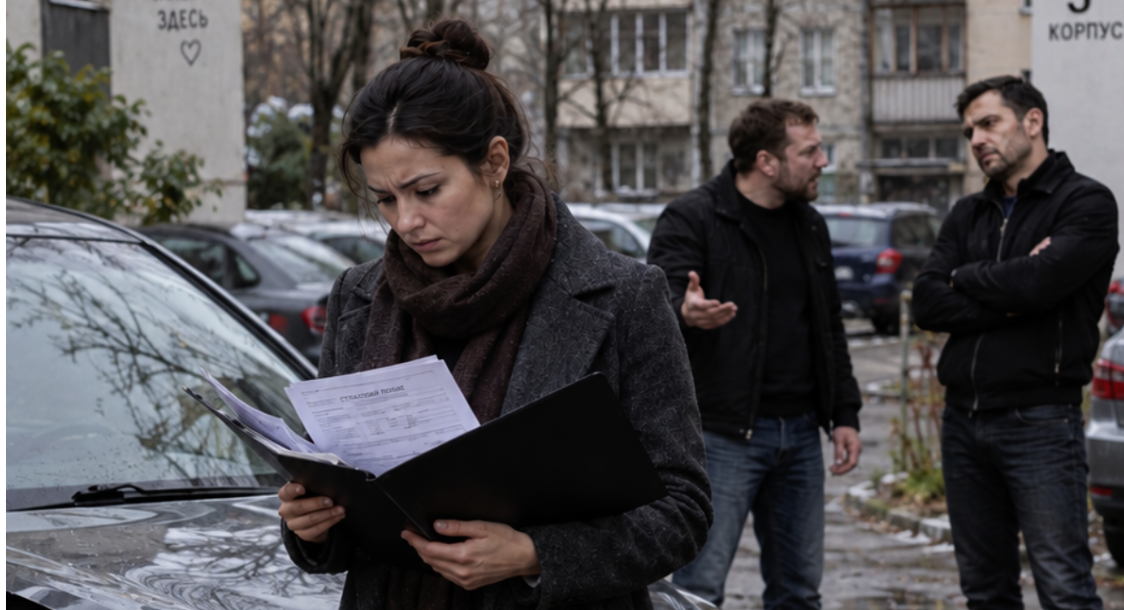
Roman returned my car more than an hour after borrowing it. The right headlight was cracked, the fender was dented, and there was a long scratch along the side.
What shocked me most wasn’t the damage.
It was his reaction.
“Your car, your repair,” my brother-in-law said with complete confidence. “You gave me the keys yourself.”
And my husband, Oleg, agreed with him.
It had started Friday evening when Roman came over while I was getting ready to go shopping.
“Nastya, help me out,” he said pleasantly. “Let me borrow your car for half an hour. I need to pick up some boxes from the warehouse. Mine is in the shop.”
I hesitated.
I hated lending my car to other people, and Roman knew that.
“I was about to go to the store.”
“I’ll be quick. I’ve been driving for twenty years. What could possibly happen in half an hour?”
Then Oleg joined in.
“Natasha, just give him the car. You always turn simple things into a big problem.”
I didn’t want another family argument, so I handed Roman the keys.
“Please be careful.”
He laughed.
“I’ll return it exactly as it is.”
He came back an hour and fifteen minutes later.
From the kitchen window, I immediately noticed something strange. Instead of parking in our usual spot, Roman had left the car farther away, beside some bushes, positioning it so that the right side was partly hidden.
When he entered the apartment, he avoided looking at me.
I picked up the keys.
“Where are you going?” Oleg asked.
“To look at the car.”
Roman suddenly stopped talking.
Outside, I saw the damage immediately.
The headlight was cracked. The fender above the wheel had a deep dent, and a long scratch ran across the paint.
I went back upstairs.
“Roman, what happened?”
He sighed as if I were inconveniencing him.
“Nothing serious. I clipped something while turning. It can be repaired.”
“Fine. Tomorrow we’ll go to a repair shop and you’ll pay.”
Roman stared at me.
“Why should I pay for everything?”
I thought I had misheard him.
“Who should?”
“It’s your car. You gave me the keys voluntarily. Driving always comes with risks.”
I looked at him in disbelief.
“So because I allowed you to drive to the warehouse, I agreed to pay for anything you damaged?”
Oleg stepped in.
“He didn’t do it deliberately.”
“I never said he did. But he damaged the car.”
Roman became irritated.
“Families don’t count every scratch. If you’re so protective of your property, don’t lend it to anyone.”
Then came the sentence that changed everything.
“I damaged your car, so repair it yourself.”
I looked at Oleg, expecting him to correct his brother.
Instead, my husband suggested something else.
“We’ll repair it from our shared budget. Maybe Roma can reimburse us later when he has money.”
“Maybe?”
“He’s renovating his apartment.”
I couldn’t believe what I was hearing.
“So because Roman needs money for his apartment, we’re supposed to pay for damage he caused to my car?”
Oleg told me I needed to be more flexible because “we’re family.”
At that moment, my anger disappeared.
In its place came clarity.
I took my phone and went outside.
I photographed everything: the headlight, the fender, the wheel, the entire side of the car, the license plate, even the mileage.
Roman accused me of turning the situation into an investigation.
“If you’re admitting what happened,” I said, “the photos shouldn’t bother you.”
The next morning, I called the insurance company.
The representative explained that my policy allowed only Oleg and me to drive the car.
Roman wasn’t included.
She advised me to preserve photographs, messages, possible surveillance footage, and details of Roman’s route before making any repairs.
Oleg heard the conversation.
Instead of realizing the seriousness of the situation, he said, “See? Insurance won’t repair it. We should just fix the car ourselves and stop making such a big issue out of it.”
“No,” I replied. “What I heard is that everything needs to be officially documented.”
I went outside and noticed the security camera above our building entrance.
The property management company confirmed that footage was available but stored only temporarily.
I asked them to preserve the recording.
That evening, Roman called me.
“Why are you requesting camera footage? You’re acting like I stole the car.”
“I’m documenting what happened.”
“You’re creating drama over a scratch.”
“A broken headlight and dented fender aren’t a scratch.”
Then Roman changed his story.
“I don’t know what damage was already there before I drove it.”
I froze.
The day before, he had admitted hitting something.
Now he was questioning whether the dent was his.
“So yesterday you admitted damaging my car, and today you think the dent might have already been there?”
“You have to prove what I did.”
That was all I needed to hear.
“Fine,” I said. “I will.”
The building camera showed my car before Roman left.
The headlight was intact.
The fender was smooth.
It showed Roman getting into the car and driving away.
More than an hour later, the car returned, and he deliberately parked the damaged side toward the bushes.
It wasn’t yet proof of the actual collision, but it showed exactly what condition the car was in before his trip.
An official handling the matter asked about Roman’s route.
I remembered that he had gone to a warehouse on Promyshlennaya Street and mentioned hitting something while turning.
There was another camera near the warehouse.
Several days later, I received a call.
“Come and see this yourself.”
On the footage, my car approached a turn near the warehouse.
Roman turned too early.
The front-right side scraped against a metal barrier.
The car stopped.
Roman got out.
He walked around to the damaged side, bent down, examined the headlight, and ran his hand across the fender.
There it was.
The entire truth in one video.
The intact car.
Roman driving.
The impact.
Roman inspecting the damage.
By then, the repair shop had provided an estimate: 81,700 rubles for the headlight, bodywork, painting, mounting parts, and labor.
I invited Roman over.
He refused to come unless Oleg was present.
That evening, the two brothers sat on one side of the kitchen table.
I sat on the other.
I placed the repair estimate in front of Roman.
“Eighty-one thousand?” he snapped. “That’s ridiculous.”
“You can get another estimate from a reputable repair shop. But you’re paying for the repair.”
He immediately became defensive.
“What gives you the right to talk to me like a court has already ruled?”
I took out my phone.
“Because your latest version just ended.”
I played the video.
At first Roman watched with a slight smirk.
Then his expression changed.
The car approached the turn.
It struck the barrier.
He got out and inspected the damage.
When the video ended, nobody spoke.
Finally, Roman said, “So what? Yes, I hit it. I never denied that.”
I almost laughed.
“Yesterday you said the dent might have already been there.”
“I didn’t do it on purpose!”
“I never said you did. I said you have to pay for what you damaged.”
Roman turned to Oleg.
“Explain it to her! I have a loan, renovations, expenses. I can’t just pay eighty thousand.”
Oleg looked at him quietly.
“Roma, the video shows you damaged the car. There’s nothing to argue about anymore.”
Roman stared at his brother.
A week earlier, Oleg had defended him.
Now the evidence left no room for excuses.
Roman fell back on his favorite argument.
“She gave me the keys!”
“Yes,” I said. “I gave you permission to drive to the warehouse and come back. I didn’t give you permission to damage my car and make me pay for it.”
Roman finally admitted he couldn’t pay the full amount immediately.
We agreed that he would transfer 45,000 rubles that day and pay the rest in two installments.
I insisted on writing down the dates.
“You really don’t trust me?” he asked.
“Four days ago, I trusted you with my car. Let’s not pretend that helps your argument.”
The first transfer arrived that evening.
The rest came later, exactly as agreed.
Once the final payment arrived, I took the car to the repair shop.
The headlight was replaced.
The fender was straightened and repainted.
When Oleg saw the finished car, he stood quietly beside me.
Then he said something I hadn’t expected.
“Natasha, I was wrong.”
He admitted that he had tried to solve the problem in the easiest way possible.
He had expected us to pay first because arguing with me was easier than arguing with Roman.
“That was the worst part,” I told him. “Not the money. You immediately decided I should be the one to give in.”
Oleg nodded.
“I understand that now.”
When we returned home, I removed the spare car key from the common hook in the hallway and locked it inside my desk.
Oleg noticed.
“So now only you have the keys?”
“Yes. From now on, if someone wants to use my car, they ask me first. Then we check whether they’re actually allowed to drive it. Then I decide whether they get the keys.”
“And Roman?”
I smiled.
“He can ask.”
Oleg raised his eyebrows.
“The answer will simply be very predictable.”
For the first time in days, he smiled too.
I looked at the empty hook where the spare key used to hang.
I once believed that when relatives said, “We’re family,” they were talking about trust.
Now I understood that sometimes those words mean something very different.
Sometimes they mean:
“You’re family, so you should pay for what I did.”
That was one family tradition I was no longer willing to accept.