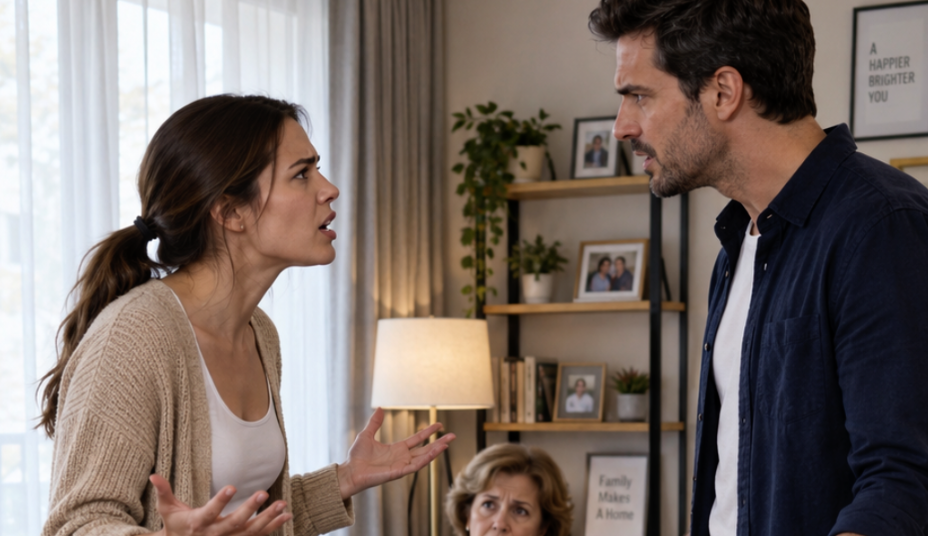
“Your mother has already criticized the renovation, the food, and the way I keep the house! Are you going to show her where the door is, or should I do it myself?” Valeria finally snapped.
She had bought the apartment three years before marrying Vladimir, using money she had saved entirely on her own. It was a modest two-room apartment on the fifth floor of an ordinary building, but everything inside reflected her taste. Light walls, dark floors, shelves filled with books, a few plants, and a small but practical kitchen where every item had its place.
She had renovated it with a friend, spending weeks choosing tiles and repainting the bedroom wall until the color felt right. It was not luxurious, but it was hers.
After the wedding, Vladimir moved in. At first, he often said how comfortable he felt there and praised Valeria for creating such a warm home.
Then his mother began visiting.
Galina Borisovna came every couple of weeks at first, usually with jam, pastries, or fruit. The visits seemed harmless. They drank tea, talked about work and family, and after an hour or two she left.
But Galina Borisovna had opinions about everything.
“The wallpaper is too light. It’ll get dirty.”
“I like it light,” Valeria replied.
“Your choice. You’ll regret it later.”
Then came the shelves.
“So many books. They collect dust.”
“I love books.”
“Then you’ll have to clean more often.”
Vladimir usually sat nearby, staring at his phone.
“Mom, everything is fine,” he would occasionally say before quickly changing the subject.
Valeria told herself that his mother was simply outspoken.
By autumn, the visits became more frequent and the comments more constant.
The sofa was too soft.
The curtains were too thin.
The dishes were stored incorrectly.
The furniture was arranged badly.
One afternoon, Valeria finally said, “Galina Borisovna, I arranged everything this way because it’s convenient for me.”
“When two people live together, you have to consider the other person too,” her mother-in-law replied.
“Vladimir likes it.”
“Vladimir can get used to anything.”
Again, Vladimir said nothing.
After his mother left, Valeria confronted him.
“Could you at least say something when she criticizes everything?”
“She isn’t criticizing. She’s just expressing her opinion.”
“Her opinion is always about what I’m doing wrong.”
“You take things too personally.”
Valeria stared at him, then walked away.
Soon the criticism moved to food.
One Saturday, Galina Borisovna tasted Valeria’s chicken soup.
“Not enough salt.”
“I don’t like salty food.”
“The chicken is tough.”
“I cooked it forty minutes.”
“It needs an hour.”
Then she tried the cutlets.
“Not bad, but there isn’t enough onion.”
Vladimir ate silently.
After lunch, Galina Borisovna started rearranging frying pans in the kitchen.
“This is better,” she said, moving Valeria’s heavy skillet to another burner.
“I prefer it where it was.”
Valeria moved it back.
Her mother-in-law looked at her and commented, “Strong-willed.”
That evening, Valeria asked Vladimir to talk to her.
“Tell her I don’t like being criticized in my own home.”
“She doesn’t mean anything bad.”
“That doesn’t make it pleasant.”
“I’ll talk to her.”
He didn’t.
The next week, Galina Borisovna arrived without warning while Valeria was working from home.
“I was nearby, so I thought I’d stop in.”
“I’m in a meeting,” Valeria told her.
“No problem. I’ll wait.”
From the other room, Valeria heard cupboards opening and dishes being moved.
When the meeting ended, she entered the kitchen and immediately noticed that mugs, knives, and pans had been rearranged.
“It makes more sense this way,” Galina Borisovna explained.
“Please don’t rearrange my things.”
“I was only trying to help.”
“I understand. But please don’t.”
When Vladimir came home, Valeria told him what happened.
“She was helping.”
“No one asked her to. And she came without calling.”
“She’s older. She has her habits.”
“This isn’t about age. It’s about respect.”
Once again, he promised to speak to his mother.
Once again, nothing happened.
In December, Galina Borisovna came for lunch.
Valeria had baked fish.
“I don’t eat fish,” her mother-in-law announced.
“You never told me that.”
Then she examined the bread.
“White bread would be healthier.”
A few minutes later, she pointed under the shelving unit.
“There’s dust there.”
Valeria looked. There was barely anything visible.
“I’ll clean it.”
“I understand you work, but you shouldn’t let the house go.”
Vladimir kept eating.
After she left, Valeria asked him, “Did you hear what she said?”
“Yes.”
“And?”
“She goes too far sometimes.”
“Yet you never say anything.”
“What am I supposed to do? Fight with my mother over dust?”
“It isn’t about dust. It’s about six months of constant criticism.”
“You’re exaggerating.”
That phrase stayed with her.
You’re exaggerating.
You’re too sensitive.
She doesn’t mean it badly.
A few weeks later, Galina Borisovna appeared again without calling, this time carrying tangerines.
She walked into the kitchen and immediately looked around.
“The light is too dim. You should change the bulb.”
Then she pointed at the seam near the sink.
“You’ve got mold starting here. You don’t clean properly.”
Valeria slowly put down her spoon.
Vladimir stood in the doorway.
“Vova,” she said. “Did you hear that?”
“Well, she’s just saying—”
“I know what she’s saying. Did you hear it?”
He shifted awkwardly.
“Mom, enough about the tiles.”
“Why enough? I’m helping! If they don’t clean it properly, fungus will spread.”
Valeria turned toward her.
“Galina Borisovna, you came without being invited, and the first thing you did was criticize my home again.”
“I came to see my son.”
“I live here too. And this is my apartment.”
“And Vladimir’s.”
“No. The apartment is legally mine. I bought it before our marriage.”
Her mother-in-law looked at Vladimir.
“So now I can’t visit my own son?”
“You can visit. But every time you come, you criticize the renovation, the food, the cleaning, or the way I arrange things. I’m tired of it.”
“I’m only expressing my opinion!”
“In someone else’s home, sometimes you keep your opinion to yourself.”
Galina Borisovna’s expression hardened.
“Vova, do you hear how she’s talking to me?”
Vladimir looked at his wife.
“Valeria, don’t be so harsh.”
Something inside her finally broke.
“Harsh? I’ve asked you four times to speak to her. Four times. You promised every time. Now she is standing in my kitchen pointing at my tiles, and you are telling me to be less harsh.”
Vladimir said nothing.
Valeria nodded.
“Fine. Then I’ll handle it myself.”
She turned to her mother-in-law.
“Galina Borisovna, please leave.”
The older woman stared at her.
“What?”
“Leave the apartment. Now.”
“Vova! She’s throwing me out!”
“Yes,” Valeria said calmly. “That is exactly what I’m doing.”
“I have every right to visit my son!”
“You have the right to visit. You don’t have the right to arrive without warning, rearrange my belongings, and criticize me in my own home.”
“Your home?”
“Yes. Mine. I bought it before the marriage with my own money.”
Galina Borisovna looked at her son.
“Say something!”
“Valeria, this is too much,” Vladimir said. “Mom came with fruit.”
“She also came without calling and immediately started criticizing.”
“She wants to help.”
“No. She wants to control.”
Vladimir frowned.
“Apologize to Mom.”
Valeria looked at him in disbelief.
“You want me to apologize?”
“You’re being rude.”
“No. Showing up uninvited and criticizing someone’s home is rude.”
Galina Borisovna grabbed her handbag.
“I knew what kind of person you were.”
Valeria pointed toward the hallway.
“The door is there.”
A minute later, it slammed shut.
The kitchen went silent.
Vladimir stared at his wife.
“Do you understand what you’ve done?”
“Yes. I asked someone to leave my apartment.”
“She’s my mother.”
“I know.”
“You threw her out like a stranger.”
“For six months, I listened to criticism about the wallpaper, curtains, food, dishes, dust, and now the tiles. I asked you repeatedly to intervene. You didn’t. So I did.”
“You need to apologize.”
“No.”
After that, Vladimir barely spoke to her.
Three days later, he said, “Mom won’t come back until you apologize.”
“Okay.”
“You still refuse?”
“Yes.”
He stared at her.
“So you’re fine with my mother never coming here again?”
“If she can visit respectfully, she’s welcome. If not, then yes.”
Vladimir paced across the room.
“You know, maybe you’re right. It is your apartment. That’s exactly why I don’t feel comfortable here anymore. I feel like I’m living on someone else’s territory.”
“You feel uncomfortable because your mother crossed every boundary and I finally enforced one.”
“That’s not how I see it.”
“I know.”
He stopped.
“Are you talking about divorce?”
“I’m talking about whether we can live together when you constantly refuse to support me.”
“I can’t choose between you and my mother.”
“I never asked you to abandon her. I asked you to stand up for me in my own home.”
“To me, that’s the same thing.”
Valeria looked at him quietly.
“Then maybe you should live with her.”
Four days later, Vladimir packed his belongings.
Before leaving for the last time, he asked, “You’re sure you won’t change your mind?”
“No.”
Their divorce was finalized in February.
There was little to divide. The apartment had belonged to Valeria before the marriage, and Vladimir did not contest anything.
Galina Borisovna never called.
Valeria didn’t either.
In March, Valeria bought a brighter bulb for the kitchen.
She scrubbed the tiles beside the sink, not because there had ever been mold, but simply because she wanted to.
Then she placed the frying pan back on the left burner.
Exactly where she liked it.
One Saturday morning, she noticed that a flower on the living-room windowsill had bloomed.
She poured herself coffee and sat by the window.
The apartment was quiet.
No criticism.
No instructions.
No one telling her how to live.
She was the one in charge of her own home.
Exactly as it should be.