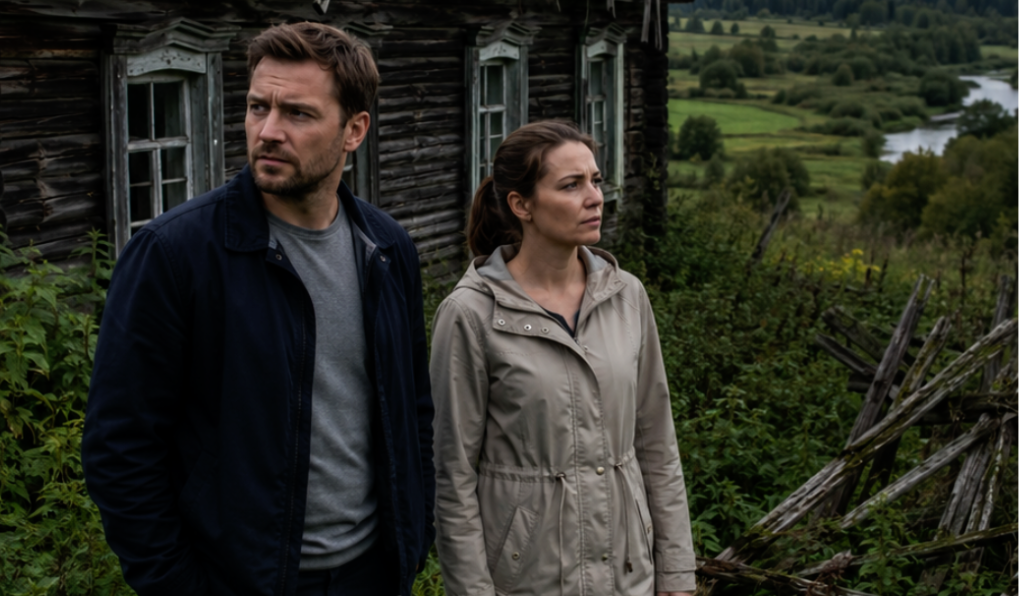
A Young Couple from the City Moved to a Village, Bought an Abandoned House, and Started Something the Whole Area Soon Knew About…
Dima and Alyona stood in front of their new home in silence.
The house looked as though it had been abandoned for decades. The walls were dark from rain and age, the roof sagged in places, and broken glass still clung to the empty window frames. Nettles covered almost the entire yard, growing shoulder-high in some places.
But behind the house, everything changed.
Wide meadows stretched toward the horizon. Beyond them shimmered a river, and behind it stood an old linden grove beneath a huge, clear sky.
“Dima,” Alyona said quietly, “do you really think we can handle this?”
“Of course we can.”
“The roof is almost gone. There are no windows, no fence, and the yard looks like a jungle.”
Dima smiled.
“I warned you it wouldn’t be easy.”
Until recently, their life had been completely different.
Dima, thirty, worked as a programmer. Alyona, two years younger, was an accountant. They had a small mortgaged apartment in the city, long workdays, traffic jams, constant stress, and almost no free time.
Most nights they slept only five or six hours. Weekends disappeared into shopping, cleaning, errands, and preparation for another exhausting Monday.
One evening, sitting in their tiny kitchen, they both admitted what they had been thinking for a long time.
They no longer wanted that life.
What began as a crazy idea gradually became a real plan.
They sold their apartment, paid off the mortgage, and bought an old village house for almost nothing.
Now they had a ruined home, some savings, and a chance to start over.
The villagers were skeptical.
Why would young city people move into an abandoned house? Some believed they would survive one difficult winter and immediately run back to the city.
On the second day, a neighbor known as Aunt Zina came to inspect them.
She watched Dima cutting through the nettles.
“Do you know this house has been empty for twelve years?”
“I know.”
“The stove is almost destroyed.”
“I saw it.”
“The well is full of silt.”
“We’ll clean it.”
“And winter? Sometimes electricity disappears for days. Snow can block the roads completely.”
Dima wiped the sweat from his forehead.
“I know.”
Then he unexpectedly asked:
“Is the honey good around here?”
Aunt Zina stared at him.
“What honey?”
“We want to start an apiary.”
Within an hour, the entire village knew.
Most people laughed.
Only one man did not.
Stepan Ivanovich was seventy-two and had kept bees for forty years. He was considered the best beekeeper in the area. His honey was sold at fairs and bought by customers from neighboring districts.
Three days later, he visited Dima and Alyona.
“I heard you want bees,” he said.
“Yes.”
“How much do you know about them?”
“Not much yet,” Dima admitted. “We’re reading.”
The old man snorted.
“Books are useful. But books are paper. Bees are alive.”
Then he asked which breed they wanted.
“Central Russian bees,” Alyona answered. “Maybe Carpathian bees too. They handle cold fairly well.”
Stepan Ivanovich looked at her with surprise.
“Carpathians need good insulation here.”
“We know. And enough winter feed. Sugar syrup, maybe bee candy.”
“How do you know that?”
“My grandfather had an apiary. I spent summers with him as a child.”
The old man stroked his beard.
“All right,” he said. “We’ll see what comes of you.”
Their first year was difficult.
They repaired almost everything themselves.
Dima fixed the stove, replaced rotten boards, installed windows, and repaired floors. Alyona plastered walls, painted rooms, and sealed cracks.
Their savings disappeared quickly.
Still, before winter arrived, the roof no longer leaked, the windows were solid, the stove worked, and enough firewood had been stacked outside.
In May, they bought three bee colonies.
Dima built the hives himself. Alyona chose a place behind the house near the old linden grove.
In August, they collected their first honey.
Only two large jars.
But when those jars stood on their kitchen table, they looked at them like treasure.
Alyona tasted a spoonful.
“I’ve never had honey this good.”
“Because it’s ours,” Dima laughed.
They gave one jar to Aunt Zina and brought the other to Stepan Ivanovich.
The old beekeeper opened it, smelled it, and slowly tasted the honey.
“Linden,” he said. “And sweet clover.”
Dima and Alyona waited nervously.
Finally, he nodded.
“You did everything right. Good honey.”
Those few words meant more than a long speech.
Then winter came.
February brought terrible frost.
Dima checked the hives every day, listening to the buzzing inside.
Soon one colony began weakening.
Then another.
Some bees died.
Alyona cried. Dima searched books and advice late into the night, desperately trying to understand what they had done wrong.
Nothing worked.
By the fifth day, they feared they would lose two colonies.
Then Stepan Ivanovich appeared.
He arrived wearing a heavy coat and carrying a large sack.
“Where are the hives?”
Behind the house, he inspected each one carefully.
Then he opened his sack. Inside were reed mats, burlap, and twine.
“They’re freezing,” he said. “Not enough insulation.”
“What can we do?” Alyona asked.
“Work. Maybe there’s still time.”
They spent the entire day insulating the hives.
The old man showed them exactly what to do. Dima and Alyona copied him carefully.
By evening, he finally straightened his aching back.
“Now they have a chance.”
Alyona looked at him.
“Why are you helping us? We sell honey too. Aren’t we competitors?”
Stepan Ivanovich smiled.
“The bees don’t care about competition. They collect honey. They don’t ask who sells the jar.”
Then his expression became serious.
“And you aren’t outsiders anymore.”
“What do you mean?”
“You stayed. You repaired the house. You didn’t run away when things became difficult. You take care of the land and respect the bees. You’re locals now.”
He looked toward the hives.
“I’m seventy-two. My son doesn’t want my apiary. My grandchildren don’t care about it either.”
Then he looked at Dima and Alyona.
“But you understand bees. Books can teach many things, but not everything.”
“So what are we, if not competitors?” Dima asked.
Stepan Ivanovich answered simply:
“Successors.”
All three colonies survived the winter.
That summer, their apiary produced around forty kilograms of honey.
They took most of it to a local fair.
By evening, every jar had been sold.
The next year they expanded their apiary by five more colonies.
This time, Stepan Ivanovich helped them choose the bees.
Gradually, beekeeping stopped being an experiment.
It became their life.
Dima eventually left his programming job entirely. Alyona started a blog about village life and beekeeping.
She shared their mistakes, showed the apiary, explained how they prepared bees for winter, and talked about what Stepan Ivanovich had taught them.
Within six months, ten thousand people followed her.
Then people began ordering their honey.
By their third year, their products were known throughout the area.
A local shop started selling them. A school ordered honey. Customers came from other towns after discovering Alyona’s blog.
The villagers now treated them completely differently.
People came to Dima for repairs and asked Alyona for help with documents.
Sometimes neighbors simply visited for tea.
Dima and Alyona were no longer outsiders.
They belonged there.
Then one August morning, Stepan Ivanovich came to their porch.
He sat quietly for a long time, looking toward the apiary.
Finally he said:
“I’ve decided to sell my apiary.”
Dima and Alyona stared at him.
“Why?”
“I’m seventy-three now. My back hurts. My legs aren’t what they used to be. It’s time.”
“Who are you selling it to?”
The old man looked at them.
“You.”
They were speechless.
“But I don’t want your money,” he added.
Dima immediately protested.
“You have more than twenty colonies, hives, equipment. It’s worth a fortune.”
“Don’t argue.”
“But—”
“You’ll keep the bees. That’s payment enough.”
He stared toward the fields.
“I spent forty years building that apiary. I always wondered what would happen to it after me. My family doesn’t want it. Selling it to a stranger would feel like burying something alive.”
Then he looked at them.
“But I trust you. You work hard. You survived the old house, winter, and your first losses. Most importantly, you love the bees, not just the money they bring.”
He stood slowly.
“I only have one request.”
“Anything,” Alyona said.
“Every year, bring me a jar of the first honey. Not for sale. For me. So I can open it, smell it, and know the apiary is still alive.”
Alyona hugged him.
For a moment, the old man stood stiffly, unsure what to do.
Then he gently touched her hair.
And unexpectedly, tears rolled down his face.
A month later, the apiary officially became theirs.
Stepan Ivanovich gave them twenty-four strong bee colonies.
Together with their own, they now had thirty-two.
They hired an assistant, built a proper wintering shelter, bought new equipment, and expanded the land around the hives.
The work was exhausting.
Their days began early and ended after dark.
But they were happy.
The exhaustion felt different from city exhaustion. It came from meaningful work.
That autumn, they attended a large regional fair.
An experienced beekeeper at the next stall tasted their honey.
“Very good,” he said.
“Who taught you?”
“Stepan Ivanovich,” Alyona replied.
The man immediately nodded with respect.
“Of course. A master of the old school. You were lucky.”
Alyona smiled.
“We know.”
When Dima and Alyona returned home that evening, Stepan Ivanovich was sitting on their porch.
Dima carried out a large jar of fresh honey and placed it before him.
“What’s this?” the old man asked.
“Your order.”
“What order?”
“The first honey.”
Stepan Ivanovich carefully lifted the jar toward the setting sun.
The golden honey seemed to glow inside the glass.
He opened it and slowly inhaled.
“Linden,” he said.
Then he smelled it again.
“And fireweed.”
“Exactly,” Dima laughed.
The old man tasted a spoonful.
Suddenly, his face changed.
A wide, almost boyish smile appeared.
“My honey,” he said.
Then he tasted it again.
“Only somehow it’s better now.”
“Why?” Dima asked.
“I don’t know. Same bees. Same linden trees. Same land. What did you add?”
Alyona looked at him seriously.
“Love.”
For one second, there was silence.
Then Dima laughed.
Alyona laughed.
And finally Stepan Ivanovich laughed too.
The three of them sat on the porch of the restored house while the last bees flew above the apiary.
Behind the hives stood the dark linden grove.
Beyond it shimmered the river.
The evening air smelled of grass, wax, warm wood, and honey.
Dima thought about how they had arrived years ago with almost nothing—an abandoned house, three bee colonies, little money, and a fragile hope of beginning again.
Now they had a home.
An apiary.
Work they loved.
People who had become family.
And an old beekeeper who had trusted them with the work of his entire life.
Stepan Ivanovich looked at the jar once more.
“Good honey,” he said quietly.
Alyona smiled.
“So we’re doing it right?”
He nodded.
“You are. Keep going.”
And that was enough.
The golden evening slowly faded over the village.
The bees hummed.
The air smelled of honey, earth, wood, and summer.
It smelled of life.
And perhaps that was exactly what happiness smelled like.