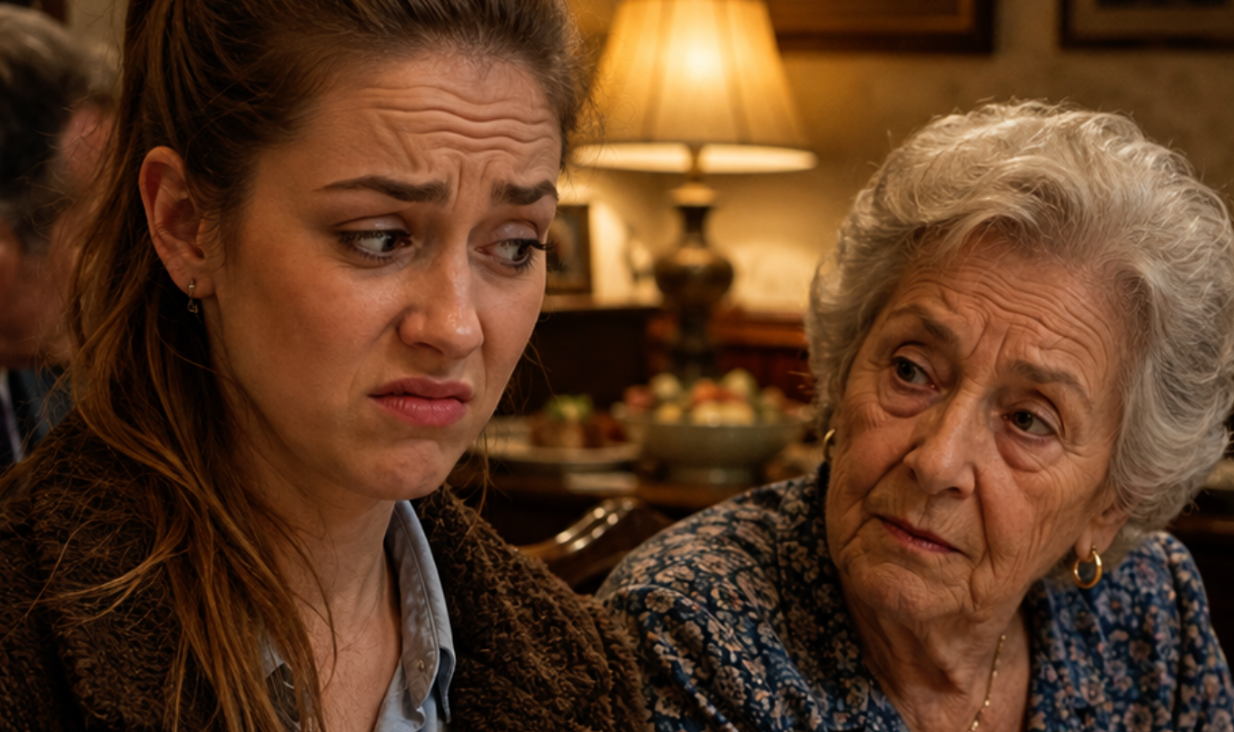
“We’re Not Going to Eat This! Next Time, Warn Us What You’re Serving So We Can at Least Eat at Home,” the Mother-in-Law Said Spitefully
“We’re not going to eat this.”
Valentina Petrovna pushed away the plate of roasted duck as though it were giving off poisonous fumes. Anna froze with a serving spoon in her hand, ready to dish out the side dish. Silence descended over the dining room, broken only by the ticking of the wall clock.
Dmitry coughed awkwardly but said nothing. His sister Marina smirked as she pulled out her phone. The camera shutter clicked—she photographed the table with an unmistakably mocking expression. Anna’s father-in-law, Pyotr Ivanovich, silently studied the tablecloth.
Anna slowly lowered the spoon back into the serving dish. The beautifully laid table was covered with salads she had been preparing since morning, homemade bread baked especially for the celebration, and a pitcher of cranberry fruit drink. Candles flickered in their holders, casting warm reflections across the gold-rimmed porcelain—a wedding gift from her parents.
The festive evening she had been looking forward to so much was beginning to fall apart before her eyes.
A week earlier, Anna had suggested that she and Dmitry celebrate their seventh anniversary at home. No noisy restaurant, intrusive waiters, or loud music—just their closest relatives gathered around the family table. Dmitry had been uncertain at first. “Maybe we should go to a café after all?” he asked while scrolling through menus from nearby restaurants on his tablet.
“Dima, we wanted something intimate and homey. I’ll cook something special. Your parents haven’t visited us in a long time. We’ll invite Marina too,” she said, leafing through cookbooks in the kitchen. “We’ll get together as a family and have a peaceful evening.”
Dmitry agreed, although a flicker of doubt appeared in his eyes. He knew what his mother was like, but he remained silent because he did not want to upset his wife.
Anna knew that her relationship with his family was complicated—not openly hostile, but strained, as though an invisible wall always stood between them. But wasn’t an anniversary a good reason to try to lower that wall, even if she could not tear it down completely?
Anna spent the following days preparing. She planned the menu, taking each guest’s tastes into consideration. She remembered that her father-in-law, Pyotr Ivanovich, loved meat, that Valentina Petrovna preferred simple dishes, and that Marina was constantly dieting. For three days, she went from store to store choosing the freshest ingredients. She ordered the duck from a butcher she knew at the market. She bought the vegetables from a farmers’ stall. She even went to a specialty shop in the city center to purchase the spices.
On the morning of their anniversary, she got up at six o’clock. She prepared the bread starter and marinated the duck with oranges and rosemary, following a recipe from a cooking magazine she had bought especially for the occasion. She chopped vegetables for three different salads.
Dmitry offered to help, but she sent him out to buy wine and flowers.
“Choose something good. And make sure it looks beautiful.”
By six in the evening, the apartment was filled with the aromas of fresh bread and spices. Crystal glasses sparkled beneath the chandelier, the silverware was arranged impeccably, and the napkins were folded into the shapes of swans—Anna had specifically watched a tutorial to learn how to do it.
She changed into a new emerald-green dress, curled her hair, and applied her makeup. A tired but satisfied woman looked back at her from the mirror.
The relatives arrived at exactly seven o’clock. Valentina Petrovna swept an appraising glance around the entryway, immediately noticing the new vase on the chest of drawers. Pyotr Ivanovich silently shook Anna’s hand and presented her with a box of chocolates—the same kind he had brought for their previous anniversary. Marina entered last, without looking up from her phone.
“Come into the living room,” Anna said, trying to sound welcoming, although the first notes of anxiety were already stirring in her heart.
In the living room, Valentina Petrovna inspected the set table. Her eyebrows rose slightly, but she made no comment. She sat in the chair offered to her and folded her hands in her lap. “Mom, Dad, thank you for coming,” Dmitry said, attempting to ease the tension. “Anya and I are very happy to see you.”
“Yes, we can certainly see how happy you are,” Marina muttered as she sat down across from them.
Anna began bringing out the food. The cold appetizers appeared on the table first. Valentina Petrovna picked up her fork, speared a piece of dressed herring salad, sniffed it, and put it back down.
“The herring isn’t fresh,” she declared.
“I bought it this morning,” Anna objected quietly.
“Then they cheated you.”
Pyotr Ivanovich poured himself a glass of vodka and drank it in silence without even proposing a toast to their anniversary. Marina photographed her plate, taking a long time to choose the right angle.
“It’s for Instagram,” she explained, although no one had asked. Then she began typing something on her phone.
Anna’s father-in-law ate silently, occasionally nodding at Dmitry whenever his son tried to start a conversation about work. Anna could feel the festive mood melting away like butter in a hot frying pan.
“Did you bake the bread yourself?” Valentina Petrovna asked, breaking off a tiny piece.
“Yes. I started it this morning.”
“It’s rather heavy. You put in too much yeast.”
Anna bit her lip. The recipe had been measured to the gram, and the bread had turned out light and airy with a crisp crust. Dmitry had already eaten two slices with obvious pleasure, but now he froze with a third piece in his hand.
The duck was supposed to be the culmination of the evening. Anna carried in the platter beneath everyone’s silent stares. Its golden skin gleamed in the candlelight, while the aroma of oranges and rosemary filled the room.
“Duck?” Valentina Petrovna raised her eyebrows. “On an ordinary day?”
“It’s our anniversary,” Dmitry reminded her. “An anniversary is when you’ve had a church wedding—or at least a proper religious ceremony. But this was nothing more than signing some registration papers.”
“Mom, why would you say that?” Dmitry’s face reddened.
“What did I say that was so wrong? It’s the truth. Besides, duck is an extremely fatty bird. I have high cholesterol.”
“So do I,” Pyotr Ivanovich chimed in, even though he had recently devoured a pork chop at his company’s New Year’s party—a story Dmitry had told Anna only a week earlier.
That was when Valentina Petrovna uttered the now-infamous words about how they were not going to eat it. She pushed her plate away. Pyotr Ivanovich glanced at his wife and put down his fork as well.
Marina giggled and raised her phone. The camera clicked. Anna watched her rapidly type something.
“Marina, what are you doing?” Dmitry finally demanded.
“I’m posting a story. I captioned it, ‘When you’re invited to a celebration and there’s nothing to eat,’” Marina replied, turning toward her mother with a smirk.
Her mother gave an approving snort.
“She’s only telling the truth. The duck is as tough as an old shoe, and the salads are tasteless. I’m wondering whether we should order a pizza.”
“Mom!” Dmitry flushed. “Anya worked hard. She spent the entire day cooking!”
“Effort is not the same as results,” Pyotr Ivanovich observed philosophically as he poured himself another shot.
“You should have asked what we eat,” his mother explained. “I would have requested Olivier salad—something simple, without all these fancy ideas.”
Anna felt a lump rising in her throat. She put down the carving knife and went into the kitchen, claiming that she needed to bring out the sauce. Leaning against the refrigerator, she took several deep breaths. The celebration she had looked forward to so much was turning into torture.
She reluctantly returned to the dining room, sat in her chair, and mechanically picked up her fork. The food seemed to stick in her throat. She watched as Valentina Petrovna demonstratively pushed her plate farther away and Marina picked nothing but the cucumbers out of her salad, casting everything else aside in disgust.
“Do you remember how Sveta used to cook, Dima?” Valentina Petrovna suddenly said brightly, addressing her son.
Svetlana had been Dmitry’s first girlfriend, whom he had dated before meeting Anna. His mother never missed an opportunity to bring her up.
“That girl knew how to bake pies and cook meat. And the borscht she made!”
“Mom, that’s enough,” Dmitry said wearily.
“What do you mean, enough? Am I not allowed to tell the truth? Your wife can’t even cook a simple duck properly. It has been seven years, and she still hasn’t made any progress.”
Marina giggled, continuing to type on her phone. Anna rose from the table again.
“I’ll bring out the dessert,” she said hoarsely.
In the kitchen, she stopped beside the window. Snow was falling outside, and the occasional passerby hurried along on their way. Warm lights glowed in the neighboring windows. Someone there was probably having dinner too, perhaps celebrating something important.
But in those homes, no one was likely turning a celebration into a trial.
The rest of the evening passed in oppressive silence. Anna served tea and cleared away the plates. The guests sat with stony expressions, occasionally exchanging a few short remarks about the weather and the price of gasoline.
At nine o’clock, Valentina Petrovna stood up.
“Well, it’s time for us to go.”
As she put on her coat in the entryway, she said loudly to her husband:
“We’ll have to stop somewhere on the way home and get a proper dinner. Otherwise, we’ll be going home hungry.”
“This isn’t how you invite people over,” Marina added as she wrapped her scarf around her neck. “Next time, we’d be better off going to a restaurant. At least the cooks there are professionals.”
Pyotr Ivanovich muttered something about how people had known how to cook in the old days, and he was the first to walk out of the apartment.
Dmitry accompanied them to the elevator. Anna could hear him saying something quietly to his mother, but she answered loudly:
“Don’t defend her, Dima. I don’t mean any harm. She simply needs to learn how to entertain guests.”
When the front door closed, Anna remained standing in the middle of the entryway. A wave began to rise inside her chest—not hurt, no. It was something stronger and far more determined.
She walked into the living room and looked at the table covered with nearly untouched dishes, the extinguished candles, and the crumpled napkins.
Dmitry returned looking pale.
“Anya, forgive them. They…”
“Don’t,” she interrupted. “Just don’t.”
She began gathering the plates. Dmitry silently joined her. The duck she had spent half the day carefully preparing went into the trash—they no longer wanted to eat it. The salads were thrown away as well.
They kept only the bread—the same “heavy” bread Dmitry ate throughout the following week, praising it every time.
When the kitchen had been cleaned, they sat across from each other at the empty table. Anna poured herself a glass of the wine Dmitry had chosen for the celebration.
“I’m never inviting them here again,” she said calmly.
“Anya…”
“Dmitry, listen to me. I have nothing against your family. I really don’t. But I refuse to be humiliated in my own home. Meet them wherever you like—in a café, at their house, or in the park. But they are not coming here.”
He remained silent, turning his empty glass between his hands.
“Do you know what hurts the most?” Anna continued. “I really did try. I thought about each of them. I remembered their tastes and habits. But they didn’t even try to appreciate anything. They came here already convinced that everything would be terrible.”
“They’ve always been like that,” Dmitry said quietly. “I remember it from childhood. Mom could criticize any gift or achievement. I got the highest grade? Why didn’t I get extra credit? I received a certificate for second place? Then I obviously hadn’t tried hard enough.”
“And do you want our children to see that?”
Dmitry flinched. They often talked about children, making plans and dreaming about their future.
“No. I don’t.”
He walked around the table and embraced her from behind.
“I’m sorry. I should have defended you more strongly. I should have said something to them. I don’t know what, but I should have said it.”
“You tried. But they don’t listen. They don’t want to listen.”
They remained that way for a long time, until the sounds of the city settling down for the night faded beyond the window. Then Dmitry poured himself some wine, raised his glass, and said softly:
“To our family—our real family.”
For the first time that evening, Anna smiled.
That night, she reached the most important conclusion of all: hospitality does not mean being obligated to tolerate rudeness. It means choosing whom you are willing to welcome through your door.