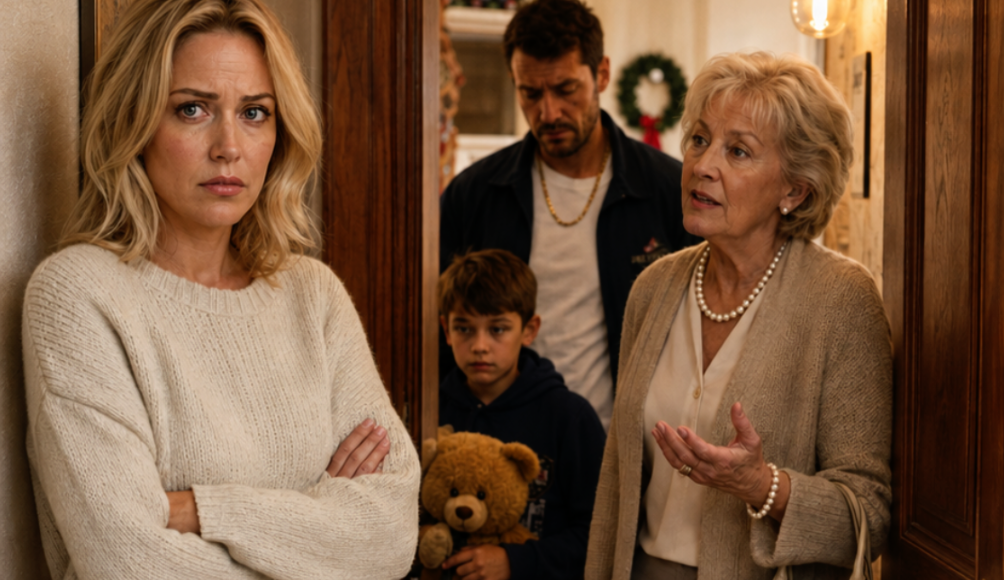
The key turned in the lock with difficulty, as though the mechanism itself were resisting the idea of letting the owner inside. Inga, exhausted after a twelve-hour shift, dreamed of nothing but a shower and silence. She worked as an industrial arborist—caring for centuries-old trees and removing dangerous branches at dizzying heights. Her entire body throbbed from the strain, resin stains covered her jacket, and tiny wood chips were tangled in her hair.
The moment she crossed the threshold, the thick, sickly-sweet scent of lily of the valley struck her. It was the smell of someone else’s presence. In the entryway, which was normally kept in perfect order, stood bulky suitcases tied with clotheslines and someone else’s worn-out shoes.
The clatter of spoons and loud, shameless laughter came from the kitchen. Inga walked into the living room. Her mother-in-law, Elena Petrovna, was enthroned on Inga’s favorite sofa, which was now covered with some gaudy knitted blanket. Beside her, curled up in an armchair with her feet tucked beneath her, sat her husband’s aunt Raisa—a woman whose face always seemed to express a personal grievance against the entire universe.
“Oh, look who finally showed up,” Raisa said instead of greeting her, biting into a piece of pie. “We’re having tea. Zhorik said you’d be home late.”
Inga slowly removed the heavy equipment backpack from her shoulders. A dark, cold wave was beginning to boil inside her.
“Who gave you the right to bring your relatives into my home?” the daughter-in-law asked her satisfied mother-in-law.
Elena Petrovna theatrically rolled her eyes and took a sip from her cup—Inga’s favorite cup, made of fine porcelain, which she had brought home from a business trip.
“Your sarcasm is inappropriate, darling,” her mother-in-law replied, brushing crumbs directly onto the carpet. “Georgy is the master of this house. And the master’s mother is sacred. Dear Raya needs to undergo some medical examinations at a clinic, and my apartment is being renovated. Zhora invited us to stay here. Three months at most.”
“Stay here?” Inga’s voice became hollow. “In my apartment? Without asking me?”
Georgy appeared in the doorway. He was wearing the robe he had bought with his last bonus and looked like a padishah presiding over a small harem. He worked as a curator of sensory exhibitions—the fashionable nonsense where people wandered around in darkness, smelling strange scents and touching incomprehensible objects.
“Inga, don’t start,” her husband said with a grimace. “Mom and Aunt Raya are family. You spend all your time with those trees of yours. You’ve practically gone feral. Look at yourself—sawdust and dirt everywhere. Meanwhile, we’ve created a cozy home and baked pies.”
“Cozy?” Inga repeated, staring at the tea stain on the pale carpet.
“You should be grateful,” Aunt Raisa interjected. “We’ll put your household in order. Your refrigerator is empty except for containers filled with weeds. A woman is supposed to be the keeper of the home, not climb around on branches like a monkey.”
Georgy walked over to his mother and kissed the top of her head.
“Don’t pay attention to her, Maman. Inga is simply tired. She’ll take a shower, calm down, and prepare a proper dinner for us. The pies were only a warm-up.”
Inga stared at them and felt anger, dense and heavy as the trunk of an oak tree, expanding inside her chest. They had not merely arrived. They were animals marking their territory.
“I’m not preparing dinner,” she said quietly. “I want you to collect your suitcases and leave my apartment.”
“Well, listen to her!” her mother-in-law exclaimed, throwing up her hands. “Zhora, do you hear this? She’s throwing me out! Your own mother, the woman who raised you!”
Georgy spun toward his wife. His normally pampered, soft face twisted with disgust.
“Shut up, Inga. You aren’t the only person who lives here. If you don’t like it, you can go sleep in your garage with your saws and helmets. My guests are staying.”
He ostentatiously turned his back on her and switched on the television at full volume. Inga stood in the middle of the room, gripping a bundle of carabiners inside her jacket pocket. She wanted to scream, but she understood that they would interpret screaming as weakness.
Something else was required here.
Something primal.
The next day, Inga decided to visit her husband at work. The Ether Gallery was located in a semibasement in the city center. The space was shrouded in dim light and smelled of ozone and burned rubber. Pieces of rusty metal mixed with nylon stockings hung along the walls—another supposedly brilliant installation.
Georgy stood surrounded by admiring young women holding glasses of sparkling wine. He was lecturing them about “the tactility of existence” and “olfactory catharsis.” When he noticed his wife, who was wearing jeans and a sweater this time, he frowned but immediately forced his professional smile back onto his face.
“Colleagues, this is my wife. She is far removed from art and prefers crude physical reality,” he introduced her with a trace of mockery.
Inga pulled him aside, toward an installation made of bent pipes.
“Georgy, we need to talk. Seriously. Your mother and aunt rearranged the furniture in the bedroom. They threw away my technical drawings.”
“Here you go again,” Georgy said, clicking his tongue in irritation. “They’re putting the place in order. Your papers were lying everywhere. It was garbage.”
“Those were rigging diagrams for a job in the park. That is my work, Georgy.”
“Your work is a misunderstanding,” he hissed, moving so close that he was almost pressed against her. He smelled of expensive cologne and arrogance. “Do you know why they’re staying with us? Because I’m renting out my mother’s apartment. I need the money. This gallery requires investment. Maintaining my status costs money. Your salary is barely enough to pay for food and utilities, while I was made for greater things.”
“You’re renting out your mother’s apartment and keeping the money for yourself? And they’re living in my home at my expense?” Inga felt another string of patience snap inside her.
“We’re a family. We have a shared budget,” he declared shamelessly. “And yes, Aunt Raisa has also made her contribution. She sold her little house in the countryside and gave the money to me to manage. So show them some respect. You are merely an accessory to my talent.”
“I have been supporting you for three years, Georgy. Your exhibitions lose money.”
“They are investments in the future!” he shouted, attracting the attention of the people nearby. “With your primitive lumberjack mentality, you could never understand that. And remember this: if you ever open your mouth against my family again, I will make you regret it. I have connections in bohemian circles. I’ll give you such a reputation that no respectable client will ever hire you again. I’ll tell everyone you’re mentally unstable. A psychopath with a chainsaw. How do you like that performance?”
He smirked, confident that he would face no consequences. In his world of words and intrigue, physical strength and honest labor meant nothing. He considered Inga a simple beast of burden who would make some noise and eventually submit.
Inga looked at him as though she had just discovered mold on a piece of bread.
She felt no fear.
Only understanding.
This man was a parasite.
And arborists did not waste time negotiating with parasites.
They cut them out.
Knowing that hell awaited her at home, Inga spent her day off at the country house—an old house with a large plot of land that she had inherited from her grandmother. It was her place of strength. Oak trees grew there that remembered her as a child.
As she approached the gate, she noticed an unfamiliar vehicle. A dirty gray SUV was parked directly on her lawn, crushing the hydrangea bushes beneath its tires.
An unfamiliar man was walking around the property with a measuring tape while Aunt Raisa followed him, waving her arms and issuing commands.
“We’ll put the gazebo here, and we’ll cut down those sticks for firewood,” she said, pointing toward a rare variety of juniper that Inga had spent five years nurturing.
Inga got out of the car.
The door slammed behind her.
“What is going on here?” Her voice was low and threatening.
Raisa turned around without the slightest trace of embarrassment.
“Oh, you finally dragged yourself here. We’re planning the layout. Zhorik said the country house will now be our summer estate. I need fresh air. And these overgrown bushes of yours are a disgrace. Vitalik,” she said, nodding toward the man, “this is the daughter-in-law. Don’t pay attention to her. There’s plenty of room here. We’ll build a bathhouse too.”
Uncle Kolya, the neighbor, peered through the gate of the adjoining property. He was a former military officer and a man of strict principles. He winked at Inga.
“Inga, my dear, I was beginning to think you had sold the property to this traveling circus. They’ve been walking around since morning, marking the trees with red paint. They say they’re all going to be cut down.”
Inga looked at the trunk of her favorite oak. A thick red cross had been painted across its bark. These people had not merely invaded her life. They intended to destroy everything she loved.
“Get out,” Inga said.
“What did you say?” Raisa planted her hands on her hips. “Is that any way to speak to your elders? We have every right to be here. Zhora is preparing documents to transfer a share of the property. He says a wife is supposed to share. If you refuse to obey him, he’ll leave you with nothing. He’s an intelligent, cunning man. And you’re nothing but a fool with a saw.”
Inga walked straight up to Raisa. She was a full head taller than the older woman, and her shoulders, accustomed to carrying heavy equipment, were broad and powerful.
“I said get off my land. Right now.”
“Vitalik, deal with her!” Raisa shrieked.
The man, some distant relative of Raisa’s, stepped toward Inga.
“Listen, woman, don’t cause trouble—”
Inga did not wait. Her reflexes moved faster than thought. She caught the hand reaching toward her shoulder and, with the strength developed through years of handling heavy tools, twisted it behind his back.
Vitalik howled and doubled over.
She shoved him toward the gate with such force that he crashed into the fence.
“Get in the car,” she growled, staring at the now-pale Raisa. “Both of you. And I never want to see either of you here again.”
Muttering curses, Raisa backed away.
“You’ll pay for this! Zhora will make you sorry! He’ll have you committed to a psychiatric hospital, you lunatic!”
When the dust from their vehicle had settled, Inga walked over to the oak and pressed her forehead against its rough bark.
The anger inside her was no longer hot.
It crystallized, transforming into a sharp blade of ice.
There would be no more discussions.
The roar of a rotary hammer drowned out every thought. This was where Gleb, Inga’s older brother, worked among stone slabs and statues. Marina—Georgy’s biological sister—was sitting on an old leather sofa in the corner.
Marina was the black sheep of their family. She worked as a tattoo artist, wore several piercings, and despised the hypocrisy of her mother and brother.
Gleb switched off the machine and wiped his hands with a rag.
“So they’ve already reached the country house,” he said after listening to his sister’s story. “Inga, let me come over and throw them down the stairs. Suitcases included.”
“No.” Inga was sitting on a toolbox, turning a heavy wrench in her hands. “If you interfere, they’ll file a police report. That’s exactly what they’re waiting for. Georgy threatened me. He said he would make everyone believe I was unstable.”
Marina inhaled from her vape and released a cloud of vapor.
“He isn’t bluffing, Inga. I overheard them talking on the phone. Mother has made an arrangement with a doctor friend of hers. They want to provoke you into having a public outburst in front of witnesses, call an emergency psychiatric team, and have them officially document an ‘episode of aggression.’ Then Zhora will be able to obtain guardianship or something similar and take control of your property. They want your apartments and your land. Zhora is drowning in debt. He lost everything on crypto—oh, I’m not supposed to say that word. Anyway, he invested in something worthless, and now he owes money.”
“So that’s what this is about,” Inga said with a smile.
The smile was terrifying.
“He decided to sell me to save his own skin.”
“They’re holding a ‘dinner party’ tonight,” Marina continued. “They’ve invited some influential people and potential investors. They’ll pretend to be the perfect family while introducing you as a sick relative whom they nobly tolerate. They want to humiliate you in public and finally break you.”
“Break her?” Gleb clenched a fist that resembled a sledgehammer.
Inga stood up. Her eyes burned with a cold, furious fire.
“There’s no need to hit anyone, Gleb. Not yet. I’m going there.”
“Have you lost your mind? There will be a whole crowd of them,” Marina exclaimed.
“Let them believe they’ve won. Anger is fuel, Marina, and my tank is filled to the top. I’m not simply going to throw them out. I’m going to destroy their world. I have a plan, but I’ll need your help, Gleb. And yours too, Marina.”
“What do you need us to do?” her brother asked.
“At eight o’clock, when they sit down at the table, I need the apartment doors to… disappear.”
Gleb raised one eyebrow in surprise.
Then he burst out laughing.
“Understood. We’ll do it.”
The living room was brightly illuminated. The table groaned beneath food purchased with the money Inga had been saving for new safety equipment.
Georgy sat at the head of the table in a snow-white shirt. Beside him sat Elena Petrovna in pearls, Raisa, three unfamiliar men, and two women—the so-called investors and useful connections.
Inga entered the apartment quietly. She had changed out of her work clothes, but she was not wearing a dress. She wore black coveralls made of thick fabric, heavy steel-toed boots, and fingerless leather gloves. Her hair was pulled tightly into a ponytail.
The conversations around the table fell silent.
“Oh, and here is our poor… sufferer,” Georgy announced with exaggerated sympathy. “Ladies and gentlemen, please forgive me. My wife sometimes dresses rather strangely. It’s the result of hard physical labor and… problems with her nerves.”
Elena Petrovna pursed her lips.
“Come in, sweetheart. Sit quietly in the corner. We left some soup for you. Don’t interrupt the adults while they’re talking.”
Inga walked up to the table.
She did not sit down.
She stopped directly across from her husband.
“Stand up,” she said.
Her voice did not tremble.
It rang like metal.
“Inga, don’t cause a scene,” Georgy said tensely. “You’re embarrassing me.”
“I said stand up!” she roared.
Georgy jumped to his feet, red blotches spreading across his face.
“You’re sick! Mom, call the doctor! She’s about to attack someone!”
“Yes, I am,” Inga whispered.
Leaning across the table, she grabbed the tablecloth and everything resting on top of it in one swift motion.
She jerked it violently.
Salads, roasted meat, wine, and the expensive dinnerware flew onto the floor, into the guests’ laps, and across Georgy’s snow-white trousers.
“What are you doing?!” Raisa shrieked.
The guests leaped to their feet and began brushing food from their clothes. Inga did not look at them. She walked around the table and approached her husband.
He backed away.
“Stay away from me! I’ll call the police!”
Inga grabbed him by the collar of his shirt. The fabric crackled. She was stronger than he was. Years of climbing trees and working with saws and ropes had turned her arms into iron.
“You wanted money? You wanted power over me?” She shook him like a rag doll.
Georgy tried to strike her, but Inga caught his arm and twisted it behind him. He howled in pain and dropped to his knees.
“You’re pathetic, Zhora. You’re a coward who hides behind his mother’s skirt.” Inga spoke loudly, nearly shouting. Her voice carried so much accumulated pain and fury that her mother-in-law flattened herself against the wall. “You brought these vultures into my home. You sold my life.”
She seized the front of his shirt and ripped it open. Buttons flew in every direction.
“Out!” she screamed. “Everyone, get out!”
“She’s insane! Restrain her!” Elena Petrovna screeched.
But the guests, seeing the wild strength in the homeowner’s eyes, were already crowding toward the exit.
Georgy tried to stand, but Inga kicked him back down. She was not afraid. She grabbed his expensive clothing and dragged him across the floor toward the door. He clutched at the carpet and whimpered in a humiliatingly high-pitched voice.
“Mom, help me!” he cried.
But his “loving” Maman had already rushed onto the landing to save her mink wrap.
Inga literally threw her half-naked husband, covered in salad, out onto the landing.
Raisa’s suitcases and her mother-in-law’s bags flew out after him.
“Inga! Forgive me! We’ll leave! Just let me get dressed!” Georgy whined, using his torn shirt to cover his bare chest.
Then something happened that none of them had expected.
Gleb appeared on the landing with an angle grinder in his hands. The grim-faced neighbor, Uncle Kolya, stood beside him, along with a couple of other strong-looking men. Behind them waited a rather distinctive-looking group of people carrying large bags and accompanied by several children.
“What is happening?” her mother-in-law stammered.
Inga stepped into the doorway. She was breathing heavily. Her hands trembled, not from fear, but from adrenaline.
“Nothing unusual,” she said, wiping her hands. “Georgy, you wanted to make money from real estate. I decided to help you.”
She pointed toward the group standing behind Gleb.
“Allow me to introduce you. These are the new owners of the apartment. I sold it this morning. And since the apartment was my premarital property, I did not require your consent.”
“What?!” Georgy’s face turned white. “Where are we supposed to live? We already rented out Mom’s apartment!”
“That is your problem,” Inga said with a smirk. “By the way, Gleb…”
Her brother switched on the angle grinder.
“The doors,” he said briefly. “The new owners want to install their own. Right now.”
As the tool screamed, the men began dismantling the front door.
“The new residents are a very close, musical, and extremely large family,” Inga added, looking directly into the eyes of her defeated husband. “They promised not to throw you out of the building for at least… five minutes.”
Georgy sat on the dirty concrete in torn clothing, surrounded by his frightened “mommies.” He watched strangers enter his former “temple of comfort” carrying mattresses while children began running through the hallway.
He understood that his life, his plans, and his arrogance had all collapsed.
He had not merely been thrown out.
He had been stripped of his dignity, his home, and his future and left there for the neighbors’ amusement.
Inga stepped over her mother-in-law’s legs, took the keys to her brother’s car from Gleb, and walked down the stairs without looking back.
She felt empty.
But she was completely free.