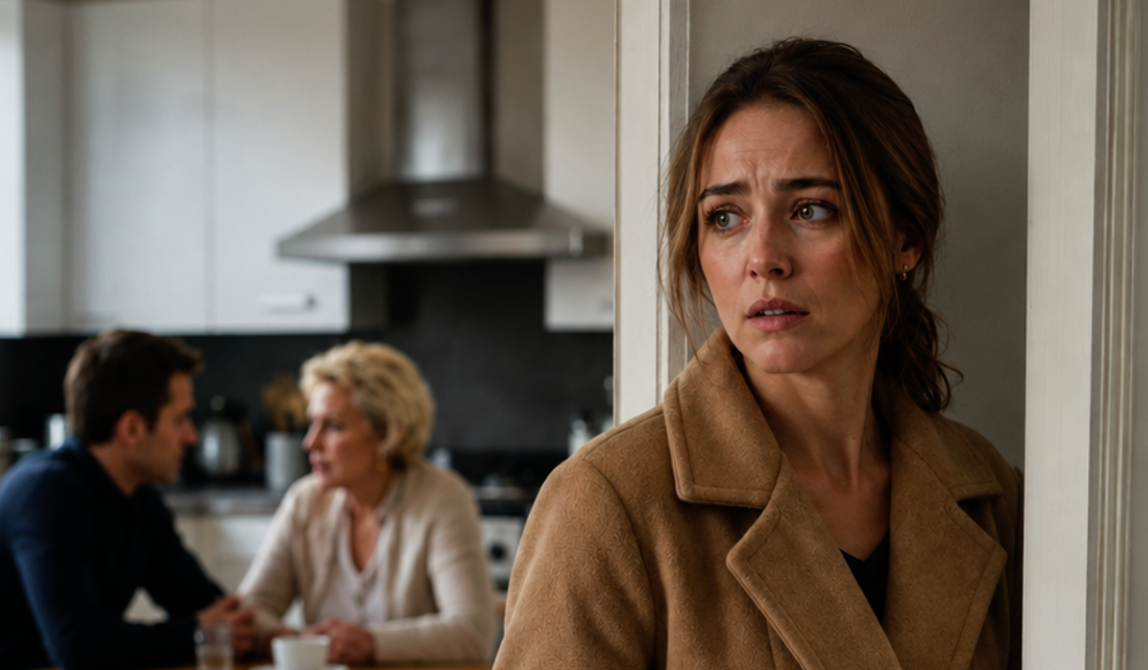
“Let Her Sign and Move Out—She’s Nothing but a Barren Flower in Our Family,” the Mother-in-Law Sneered, Unaware That Her Daughter-in-Law Was Standing Behind the Door
“Let her sell her grandmother’s apartment, and a year later she’ll find herself out on the street with nothing but one suitcase,” the mother-in-law said calmly in the kitchen.
Natalia froze in the hallway, still clutching the keys between her fingers.
She had returned twenty minutes early. Just twenty minutes. The line at the pastry shop had been shorter than usual, so instead of taking a walk through the park, Natalia decided to go straight home. Her arms were aching from the weight of the cake she had bought for Sunday lunch.
She opened the door quietly.
Not deliberately. She had simply been trained long ago to be quiet in this family.
“Mom, that’s enough,” Sergei’s voice drifted from the kitchen. It sounded lazy and slightly irritated. That was how he spoke only to his mother. “She isn’t stupid, you know.”
“She is, son. A kindhearted fool. And that’s even worse.”
Natalia slowly placed the cake box on the entryway cabinet. Everything inside her tightened into a hard, icy knot.
“Look,” her mother-in-law continued, and Natalia could hear her tapping a spoon against her cup. “She inherited the apartment from her grandmother. It’s her personal property, and legally there’s no way to get your hands on it. You could live together for twenty years or thirty, but in a divorce, you wouldn’t get a single square meter.”
“So what are we supposed to do?”
“We need to turn the apartment into money. Money is like water—you can make it flow wherever you want. Let her sell it. We’ll tell her we’re investing in a shared family home, for our future and for the grandchildren. We’ll register the house in my name. I’m retired, so I have benefits and pay lower taxes. She’ll swallow the whole story. She doesn’t understand any of this.”
Natalia leaned against the wall. Her legs no longer felt like her own.
“And if she refuses?” Sergei asked.
“She won’t. Spend two months pouring honey into her ears. Tell her how wonderful and hardworking she is, how much we all need her, how this family wouldn’t be a family without her. She’s desperate for affection, like a kitten. Call her ‘my dear daughter,’ and she’ll give you the last thing she owns.”
The mother-in-law chuckled, and the sound sent a chill down Natalia’s spine.
“A year later, we’ll arrange the divorce. Quietly and civilly. The house will belong to me, her money will already be invested, and she won’t have signed any agreements protecting herself. What will she present as evidence? Words? Let her sign the papers and move out. She’s nothing but a barren flower in our family—no children, no use to anyone. She’s only taking up space.”
That was when the full force of it struck Natalia.
Not because of the apartment.
Not because of the money.
Because of that single phrase: “barren flower.”
For three years, she and Sergei had gone from doctor to doctor. For three years, she had swallowed her tears after every conversation with this woman, who would sigh sweetly and say, “Don’t worry, dear Natasha. Everything happens in its own time. God willing.”
But behind Natalia’s back, her mother-in-law had already evaluated her, weighed her worth, and written her off.
“Mom, why would you say something like that?” Sergei asked weakly.
Weakly.
Not indignantly. Not angrily. He spoke as though he were brushing away a fly.
“What else should I say?” his mother raised her voice. “I’m telling you the truth. You’re my only son. You’re the one I rely on. I won’t allow you to reach forty and be left with nothing because you married some quiet little woman with her grandmother’s apartment. She’s had a comfortable life with you. Now it’s time for her to contribute.”
“Just don’t rush her. She’s already stressed because she’s looking for a new job.”
“Good. Let her keep looking and not find one. An unemployed woman is much easier to persuade.”
Natalia could not remember how she made it back onto the landing. She remembered only holding the latch so that the door would close silently. Then she went down one floor, sat on the windowsill, and remained there for what seemed like an eternity.
She wanted to cry so badly that her jaw ached.
But she did not cry.
Something inside her clicked and settled into place.
Like a lock.
“If I go back upstairs now and make a scene,” she thought, staring at her white fingers, “they’ll talk their way out of it. My mother-in-law will clutch her heart, and Sergei will say I misunderstood everything, that his mother was merely thinking out loud. They’ll call me hysterical. Then they’ll become more careful, and I’ll never be able to prove anything.”
No.
From now on, she would be the clever one.
Natalia went downstairs, left the building, walked to a small park, and spent ten minutes simply breathing. Then she returned, climbed the stairs, deliberately rattled her keys, and called cheerfully from the hallway:
“I brought the cake! Honey cake, just the way you like it, Tamara Ivanovna!”
Her mother-in-law floated out of the kitchen wearing her warmest smile—the same smile that had once made Natalia love her.
“Natasha, dear! What a wonderful girl you are. Sergei and I were just talking about life.”
“What were you discussing?”
“Oh, nothing in particular. The future.”
The first three days were the hardest.
Natalia lay beside the man who had been the closest person in her life for eight years and stared into the darkness. He wrapped his arms around her in his sleep.
He embraced her while already calculating how much money her grandmother’s two-room apartment on Sadovaya Street would bring.
Natalia learned to smile.
She learned to ask, “How was work?” in exactly the same voice she had always used.
She turned out to be a surprisingly talented actress. Apparently, eight years of training in this family had not gone to waste.
On the fourth day, Natalia called Elena.
They had been friends since university. Elena had become an attorney specializing in family disputes. She was sharp-tongued and snub-nosed, with perpetually disheveled hair and logic made of iron.
They met at a café near the train station. Natalia deliberately chose a place far from home.
“All right,” Elena said after listening to the entire story without interrupting once. “Breathe. Now let’s discuss the facts. Is the apartment registered solely in your name?”
“Yes. My grandmother left it to me in her will.”
“Is your husband registered there?”
“No. We live in his mother’s three-bedroom apartment. He’s registered there.”
Elena leaned back in her chair and suddenly smiled—a cold, lawyerly smile.
“Natasha, do you realize that they haven’t actually done anything yet? They don’t have a single document. They have nothing. Their entire fortune depends on your signature, and that signature doesn’t exist.”
“So I simply refuse to sign?”
“You could. But then you’d keep your apartment while being left with the feeling that they wiped their feet on you. Meanwhile, they’d keep their happy family and tell themselves that the plan simply didn’t work out.”
Elena leaned forward.
“Or we could do this differently. We could allow them to build some momentum. Let them invest in their scheme themselves—with their own money, their own loans, and their own deposits.”
Natalia blinked.
“You mean…”
“You don’t refuse. You agree enthusiastically. You hurry them along. You say, ‘We must act quickly before someone else buys the house!’ Then you watch them dig their own hole.”
“Elena, that’s… cruel.”
“Natasha.”
Elena placed her hand over Natalia’s.
“Cruel is calling a woman a barren flower while sitting at her table. What I’m suggesting is simply not interfering while people run toward the pit they dug themselves.”
Natalia remained silent for a long time, staring at her cold coffee.
Then she nodded.
The conversation took place the following Saturday.
Her mother-in-law had prepared thoroughly. The table was overflowing with food, her famous cabbage pie had been baked, and even Sergei’s sister, Irina, had arrived, looking very businesslike with a folder tucked under her arm.
“Natasha, dear,” her mother-in-law began, placing the most golden slice of pie on her plate, “the whole family has discussed something, and we’ve decided to share an idea with you.”
“What idea?”
“We’re getting older, my dear. I’m beginning to feel my age. And do you know what I dream about? Having a house of our own. A large house with a garden. You and Sergei could live downstairs, I could live upstairs, and Ira could bring the children on weekends. The whole family would be together.”
Natalia listened in amazement.
Her mother-in-law sounded completely sincere. Her eyes had even grown moist.
That was her greatest talent: she genuinely believed whatever she was saying for precisely as long as she was saying it.
“A house is expensive,” Natalia said cautiously.
“It is,” Sergei agreed. “But listen. There’s a place in Zarechensky. One and a half stories, with a nine-hundred-square-meter lot. It’s inexpensive because the owner is leaving urgently. I went to see it. It’s solid, and the foundation is excellent. If we add the money from your grandmother’s apartment, we’ll have almost exactly enough.”
There it was.
Natalia lowered her eyelashes so no one could see what was in her eyes.
“And whose name would the house be registered under?”
“Mom’s,” Irina answered quickly without looking up from her phone. “Retirees have a lower tax burden. There’s a whole system for it.”
“That would be best for the family, Natasha,” her mother-in-law confirmed gently.
Natalia raised her head and smiled with the same smile they had spent eight years teaching her to wear.
“My goodness, Tamara Ivanovna! I thought you were going to tell me something terrible!”
Her mother-in-law looked confused for a second.
“Terrible?”
“Well, I could tell you’d been acting mysterious all week. I imagined all kinds of things.”
Natalia laughed and clapped her hands.
“Of course I agree! A house with a garden—I’ve dreamed about that since I was a child!”
A brief silence fell over the table.
Her mother-in-law and Sergei exchanged a quick, triumphant glance between conspirators—the kind of glance Natalia had once mistaken for family warmth.
“That’s my clever girl,” her mother-in-law breathed. “That’s the right decision.”
“But we must act quickly,” Natalia said, leaning forward with manufactured excitement. “Sergei, you said yourself that the owner is leaving urgently. Houses like that are sold within a week! We need to pay a deposit before someone else gets it.”
“A deposit…” Sergei said slowly. “Natasha, we don’t have the money right now…”
“Why wait for me? It could take two or three months to sell the apartment. By then, the house will be long gone.”
She looked at her mother-in-law with innocent eyes.
“Tamara Ivanovna, you said you had savings for an emergency, didn’t you? You could pay the deposit, and I’ll return the money as soon as the apartment is sold. I’m family, after all.”
Her mother-in-law froze with a piece of pie in her hand.
Natalia felt something both wicked and joyful rising inside her.
“Well, if you aren’t certain about the house,” she sighed, “then perhaps we shouldn’t do it. I’m only afraid we’ll regret it later.”
“I’m certain!” her mother-in-law exclaimed sharply. “Of course I am. We’ll pay it.”
After that, everything began rolling forward on its own.
They paid the deposit a week later—four hundred thousand rubles under a preliminary agreement that stated in black and white that if the buyer withdrew from the transaction, the seller would keep the money.
Her mother-in-law brought the cash in a sugar bag and then spent three days telling everyone how painful it had been to part with her savings.
Two weeks later, Sergei took out a loan.
Natalia did not push him into it.
He managed all by himself. It turned out that they were short of money because the house cost more than they had originally calculated. They also needed to pay for the paperwork, a cadastral engineer, and a gas connection.
“I’ll take the loan in my name,” Sergei said proudly. “I’m the man of the family. As soon as we sell your apartment, we’ll pay it off.”
Natalia stroked his hand.
“You’re so dependable.”
He beamed.
She looked at him and thought about how convenient it was to be a weak man when your mother was always standing behind you.
Not one independent decision in eight years.
His mother had told him to get married.
His mother had told him to quit the factory and work for her company.
Now his mother had told him to take from his wife.
Every daughter-in-law eventually asks herself the same question: Did I marry him, or did I marry his mother?
Natalia had finally received her answer.
Meanwhile, she pretended to prepare the apartment for sale. She walked through the rooms with a measuring tape. She took photographs. She even brought in a “real estate agent” once.
In reality, it was Elena’s husband, who spent an hour walking around the apartment with a serious expression and clicking his tongue thoughtfully.
Her mother-in-law called every day.
“Natasha, dear, how is it going? Have you found any buyers?”
“People are looking, Tamara Ivanovna. Two came to see it.”
“Don’t take too long, dear. The owner of the house is getting nervous.”
“I’m not delaying anything. How could I possibly let the family down?”
Natalia would hang up and sit for a long time with her eyes closed.
Sometimes she was frightened.
Sometimes her own behavior made her feel sick.
But at night, she would remember the phrase “barren flower,” and everything would fall back into place.
The final phase began with a call from Elena.
“Natasha, sit down.”
“I’m sitting.”
“I ordered a property extract for your mother-in-law’s apartment. The three-bedroom place where you’re all living.”
“And?”
“It doesn’t belong to her anymore. There’s a deed of gift. It was transferred four months ago. The owner is now Kuznetsova Irina Vladimirovna.”
Natalia did not understand immediately.
“Irina? Sergei’s sister?”
“Exactly. Your mother-in-law transferred the entire apartment to her daughter before this whole house scheme even began. Your husband received nothing—not a share, not even a corner.”
Natalia slowly sank onto a chair.
So that was how it was.
Her mother-in-law had been building a trap for her daughter-in-law while using her own son as bait.
All the property would go to the daughter.
The son would be left with a loan, a house belonging to his mother, and total dependence for the rest of his life.
“You’re the one I rely on. You’re my only son.”
“Elena,” Natalia said in an oddly calm voice. “Does he know?”
“Based on everything you’ve told me, I doubt it.”
Natalia looked out the window.
For a moment, she almost felt sorry for Sergei.
Almost.
Pity was for people who had stumbled.
Sergei had not stumbled. He had sat at the table listening to his mother call his wife a barren flower and had merely said, “Why would you say something like that, Mom?”
“Thank you, Elena,” Natalia said. “Order one more extract and start gathering the documents. I know what I’m going to do.”
On the appointed day, all four of them gathered at the notary’s office.
Her mother-in-law wore her best blouse with a brooch. Sergei looked solemn and nervous and kept adjusting his collar. Irina arrived with her folder.
The seller, a thin elderly man, sat in a corner silently looking out the window.
Natalia arrived last, carrying a small shoulder bag.
She was not alone.
Elena walked beside her in a strict gray suit.
“Who is that?” her mother-in-law asked warily.
“My lawyer,” Natalia replied simply. “You said yourself, Tamara Ivanovna, that serious matters should be handled seriously.”
Her mother-in-law blinked several times but managed to smile.
“That’s right, dear. We should do everything properly.”
The notary spread the documents across the table.
“So, we have a purchase and sale agreement for a residential house and the adjoining land. The buyer is Kuznetsova Tamara Ivanovna. Payment is to be made on the day the agreement is signed. Natalia Sergeyevna, what is your role in this transaction?”
“I don’t have one,” Natalia said.
Silence descended instantly.
“What do you mean?” Sergei turned his whole body toward her.
Natalia placed her bag on the table.
“I did not sell my grandmother’s apartment. I never even listed it for sale.”
“What do you mean, you never listed it?” her mother-in-law lunged forward. “You told us buyers had visited!”
“My friend’s husband visited. He works in construction and is very good at walking around and clicking his tongue.”
Her mother-in-law’s face turned crimson.
“Natasha! We paid a deposit! Four hundred thousand! Sergei took out a loan!”
“I know,” Natalia said with a nod. “Eight hundred and ninety thousand rubles at twenty-six percent interest, for five years.”
Sergei turned white.
“How did you…”
“You keep your documents in the top drawer of the dresser, Sergei. You always keep everything in the top drawer.”
She removed an envelope from her bag and placed it on the table in front of her husband.
“What is this?” he asked dully.
“An application for divorce. We don’t have children, and we don’t have any shared property. The divorce should be processed quickly.”
“Have you lost your mind?” her mother-in-law shrieked. Nothing remained of her soft, cooing voice. “You set us up! You’ve ruined us! Do you understand that they won’t return the deposit?”
“I understand,” Natalia replied calmly. “That is exactly what the agreement says. If the buyer withdraws, the seller keeps the deposit. You insisted on that wording yourself, Tamara Ivanovna, so the owner wouldn’t back out.”
The seller in the corner coughed discreetly and returned his gaze to the window.
“Mom,” Sergei said, turning toward his mother as his voice cracked. “What am I going to do? I have a loan. Mom, I owe almost nine hundred thousand rubles.”
“We’ll figure something out,” his mother dismissed him. “I still have my apartment. In the worst case—”
“It isn’t yours,” Elena said gently.
It was the first time she had spoken, and everyone turned toward her.
Elena opened her folder and placed an official document bearing the state emblem on the table.
“This is an extract from the Unified State Register of Real Estate. The apartment located at 14 Cosmonauts Street, Apartment 82. The owner is Kuznetsova Irina Vladimirovna. The basis of ownership is a deed of gift registered four months ago.”
The office became very quiet.
Sergei stared at the document without moving.
“Mom,” he said at last. “What is this?”
His mother remained silent.
“Mom. Did you transfer the apartment to Ira?”
“Sergei, dear, you don’t understand…”
“I understand everything.”
He raised his head, and Natalia saw something resembling a child’s fear on his face.
“For six months, you told me I was the one you relied on. You told me everything would eventually be mine. You made me take out that loan.”
“I didn’t make anyone do anything!” his mother snapped. “Ira has two children. She needs it more! And I promised you the house!”
“A house that would have been registered in your name,” Natalia quietly added.
Without looking up from her phone, Irina muttered:
“Mom has the right to do whatever she wants with her property.”
That was when Sergei broke.
He sat with his hands hanging between his knees, staring at the floor.
A forty-year-old man with a loan of nearly nine hundred thousand rubles, no apartment, no wife, and not one independent decision to his name.
Natalia suddenly felt empty.
There was no joy and no triumph.
Only emptiness.
“Sergei,” she said. “I heard everything. That Sunday when I brought the cake. I was standing in the hallway, and I heard every word.”
He looked up at her.
“And you said nothing?”
“Didn’t you remain silent for eight years?”
He did not answer.
Natalia turned toward her mother-in-law. Tamara Ivanovna was clutching her brooch.
For the first time in all the years Natalia had known her, she saw the woman without her mask: a small, angry, bewildered elderly woman who had spent her entire life treating other people’s possessions as her own.
“Tamara Ivanovna, I am not a barren flower. I was simply convenient for you. Quiet, obedient, and the owner of an apartment in the city center. For eight years, you called me your daughter while waiting for the right opportunity.”
“Natasha, dear, you misunderstood…”
“No. I understood correctly. For the first time in eight years, I understood everything correctly.”
She fastened her bag.
“I moved my belongings out yesterday. Everything that belongs to me. Thank you for the lesson.”
Then she left.
Their divorce was finalized a month and a half later.
There was nothing to divide. The apartment had been Natalia’s inheritance from before the marriage, the car was registered in her mother-in-law’s name, and Sergei had taken out the loan solely in his own name before any divorce application was filed.
The court recognized it as his personal obligation.
As the agreement clearly stated, the seller kept the deposit on the house.
Her mother-in-law went from office to office, filed complaints, and even brought a lawsuit. She lost because the law on that particular issue was unusually clear.
Natalia later heard from mutual acquaintances that Sergei’s family home had become very quiet.
Sergei moved back in with his mother, into an apartment that no longer belonged to either of them. Irina had already reminded her brother twice that he was living there only by her permission.
People also said that her former mother-in-law told everyone about the “ungrateful daughter-in-law who destroyed the family.”
Natalia merely shrugged.
Every mother-in-law has her own version of events, and in almost every version, the daughter-in-law is to blame.
Natalia moved into her grandmother’s apartment.
At first, the silence felt strange.
No one entered her room without knocking. No one rearranged her belongings. No one stood sighing beside the stove.
She bought whatever she wanted.
She decided for herself when to go to bed.
Eventually, it began to feel wonderful.
Two months later, she found a job—not the one her husband’s family had been trying to arrange for her, but the work she truly loved.
She returned to the restoration workshop she had left years earlier at her mother-in-law’s insistence. Within a week, her hands remembered everything.
A year later, she rented the neighboring room for her own small workshop and took on her first apprentice.
Natalia also renovated her grandmother’s apartment.
It was the renovation she had postponed for eight years because everyone kept saying, “Why invest money in a place where we don’t live?”
She chose light-colored walls, a wide windowsill covered with cushions, and a round table—the same kind of table where Grandma Vera had once served her tea and said:
“Natasha, remember this: having a place of your own isn’t about square meters. It’s about knowing that no one can throw you out.”
Sometimes, late at night, Natalia still remembered that Sunday.
The keys in her hand.
The box containing the honey cake.
The voices coming from the kitchen.
Every time, she found herself thinking the same thing.
She was grateful for those twenty minutes.
Had the line at the pastry shop been slightly longer, she would have arrived home at the usual time, placed the cake on the table, poured the tea, and sat beside the people who were planning to sell her.
She would have sold the apartment.
She would have lived in someone else’s house, in someone else’s family, under someone else’s conditions, until the very end.
Twenty minutes.
Sometimes an entire life can fit inside twenty minutes.
The following spring, she and Sergei happened to meet outside a metro station.
He had aged and become stooped. He was carrying a bag of groceries.
When he saw her, he hesitated, then finally approached.
“Natasha. You look well.”
“Thank you.”
He remained silent for a moment.
“Back then… I wanted to say that you were right. I should have stood up and left with you.”
“You should have.”
“It’s just that Mom… she raised me alone. I couldn’t do it.”
Natalia looked at him carefully.
She realized that she felt nothing.
No anger.
No resentment.
No pity.
He was still standing in that kitchen, trapped between two women, and it seemed he would never find his way out.
“Sergei,” she said gently, “do you know what the real problem was? You weren’t choosing between your mother and your wife. You were simply waiting to see which one of us would turn out to be stronger.”
He lowered his head.
“Take care of yourself,” Natalia said before walking toward the underground passage.
As she walked, she felt light, steady, and warm inside.
She had defended her apartment.
She had reclaimed her name.
She had reclaimed her life as well.
Most importantly, she had learned once and for all a simple truth that many women discover far too late:
Boundaries are not established by shouting.
They are established quietly and calmly, once and forever.
And if someone behind a closed door calls you a barren flower one day, it is not a sentence.
It is simply a signal that it is time to leave.
And to take what belongs to you.