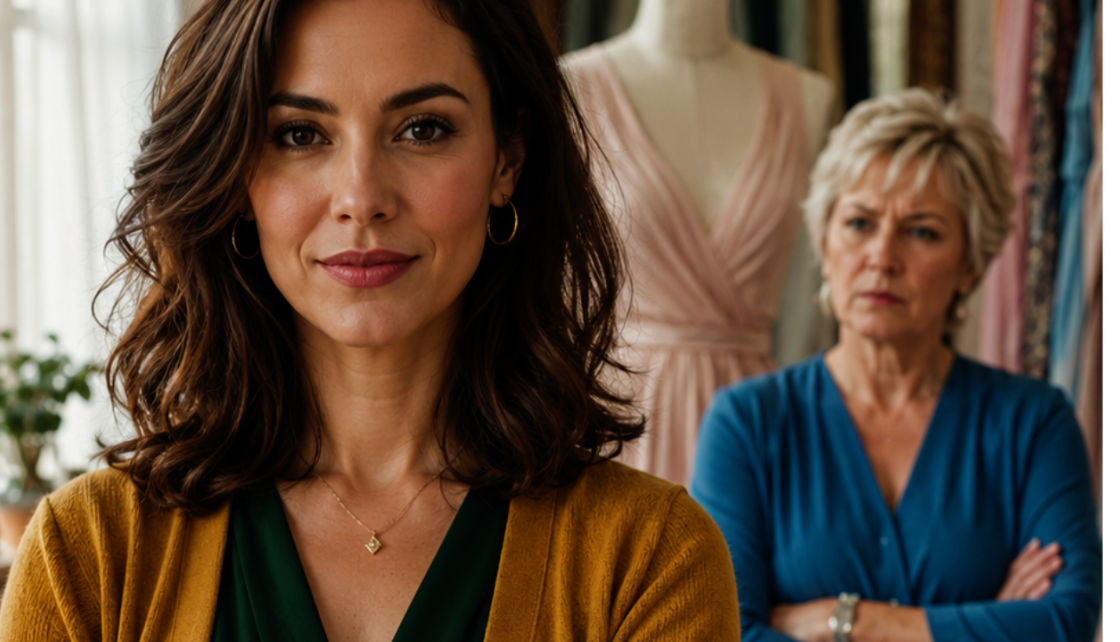
My Mother-in-Law Promised Everyone My Free Labor. But She Was the One Who Had to Pay for Her Generosity
The notebook with its cracked faux-leather cover landed on my cutting table with a wet slap, as if an overfed slug that had completely lost its sense of direction had fallen from the ceiling.
A large bag filled with pieces of cheap, slippery crepe fabric followed it.
“Here’s the situation, Marina. By the twentieth, you need to sew eight stage blouses. I put the design inside. I already told the girls you wouldn’t charge anything for the work. It will be your gift to our ensemble for the anniversary,” my mother-in-law, Valentina Petrovna, announced with the unbearable cheerfulness of a bulldozer flattening someone else’s fence.
Long ago, I had converted one room of our apartment into a professional workshop, where I received clients by appointment only. My schedule was fully booked for the next month and a half, and every hour of my time was worth money.
And now, on a Tuesday morning, someone was trying to place the burden of eight unpaid garments around my neck.
Even if they were identical loose-fitting stage blouses with one-piece sleeves, the job still required individual measurements, pattern drafting, cutting that crawling synthetic nightmare, finishing the seams, fittings, and at least a full week of concentrated work.
My mother-in-law loomed over the table like an octopus accustomed to reaching its tentacles into other people’s wallets and schedules.
“You’ve come to the wrong address, Valentina Petrovna,” I said calmly, pushing the notebook to the edge of the table. “The charity foundation is one floor below. I don’t finance other people’s gifts. My working hours cost money.”
“Have you lost your mind?” Her eyebrows rose in an impressive display of offended virtue. “I’ve already announced it to the whole group! The women bought the fabric and they’re waiting! Are you trying to humiliate me? You have to help. I’ve already promised everyone!”
Family duty is a remarkable kind of currency. For some reason, the people who demand payment in it are always the ones who have never invested a single penny themselves.
“If you promised, then you can sew them yourself,” my husband Pavel said.
He had entered my workshop to pick up some documents and had overheard the conversation. Folding his arms across his chest, he stood in the doorway.
“Mom, Marina is working. Take your rags and leave.”
Valentina Petrovna turned purple, launched into a speech about ungrateful children who could not be bothered to press a sewing-machine pedal a few times for their own mother, and proudly sailed out of the apartment, deliberately “forgetting” the bag on the chair.
She was absolutely convinced that her favorite strategy would work: create a problem, abandon it on someone else’s territory, and wait until the victim solved everything out of embarrassment.
But I did not suffer from rescuer syndrome. Watching Valentina Petrovna fuss around was like watching a dung beetle determinedly roll its ball of manipulation straight toward a cliff.
I did not throw a tantrum.
I opened my laptop.
Ten minutes later, I found the phone number of Nadezhda Ivanovna, the ensemble director, a stern and very practical woman.
“Hello, Nadezhda Ivanovna. This is Marina, Valya’s daughter-in-law. Tell me, did you know that I had absolutely no idea about any blouses until this morning?”
A heavy silence followed on the other end of the line.
Then the director slowly said, “What do you mean? Valya said you volunteered yourself. She told us, ‘My dear Marina can hardly wait to help us. She would do anything for her beloved mother-in-law. You only need to buy the fabric.’ We have already scheduled the first fitting for Thursday at the cultural center! Valya said you would come personally to confirm the measurements.”
So that was the plan.
She wanted to drive me into a hall full of expectant women, hoping the pressure of their disappointment would make me too ashamed to say no.
A forced voluntary donation of someone else’s labor is not generosity. It is domestic extortion.
“I never agreed to sew anything for free, and I am not accepting this order,” I replied evenly. “But by Thursday, I will find a paid alternative and bring you a cost estimate. Do not cancel the meeting. Everyone needs to hear why this has become urgent and who promised my labor without my consent. On Thursday, I will bring you a real solution and a real price.”
During the next two days, I called Silhouette, a tailoring studio that specialized in batch production. I did not place an order in someone else’s name. I only asked whether urgent production by the twentieth was possible, requested that they tentatively reserve an available production slot until Thursday evening, and obtained a written commercial offer.
It listed the basic cost of eight blouses on one line and a forty-percent rush surcharge on another.
The administrator warned me that they would hold the reservation only until eight o’clock on Thursday evening. After that, they would require a deposit from the official customer.
On Thursday evening, Pasha and I entered the echoing foyer of the cultural center.
Eight women in colorful sweaters sat in a semicircle. In the middle, like the queen of a beehive, sat Valentina Petrovna.
When she saw us, her face spread into a triumphant smile.
Of course it did.
The victim had walked into the trap.
“And here are our golden hands!” my mother-in-law sang loudly enough for the entire hall to hear. “Girls, Marina is here! Take out the fabric!”
I walked into the center of the circle, stopped in front of my mother-in-law, and smiled.
It was not an apologetic smile.
It was the kind of smile that usually makes dentists feel a chill run down their backs.
“Good evening, ladies. I came to return a debt. Or, more precisely, someone else’s promise.”
I pulled the same faux-leather notebook from my bag and placed it on my bewildered mother-in-law’s lap.
Every conversation in the room stopped at once.
The women sat in complete silence.
“The problem,” I said clearly, separating every word, “is that Valentina Petrovna disposed of my time without my knowledge. My schedule is full. I never accepted your order, and I do not sew for free.”
The women gasped.
Nadezhda Ivanovna frowned severely and turned toward her soloist.
“How dare you, Marina!” Valentina Petrovna shrieked.
Her face filled with dark red blotches, like fabric scorched by an overheated iron.
“In front of everyone! I made a promise! You are dragging me through the mud because of your greed!”
“This isn’t greed, Mom. This is the bill for someone else’s shamelessness,” Pavel said, stepping forward.
His voice rang like metal.
“You sold my wife’s time so you could look generous. You created this mess, so you can deal with the consequences.”
“But the concert is next Saturday!” one of the women muttered in confusion. “We’ll be left without costumes!”
“You will not be left without a possible solution. But I am not sewing them for free,” I said, taking a printed document from my bag and handing it to Nadezhda Ivanovna. “This is a commercial offer from the Silhouette tailoring studio.”
“They have reserved production time for you until eight this evening. They can finish the blouses by the twentieth. The price includes the basic cost and a separate rush surcharge, which exists because Valentina Petrovna wasted time and lied to the group. If you agree, you need to call them and confirm the order.”
Valentina Petrovna realized that her foil crown had been crushed and was sliding sideways.
Public humiliation filled the air.
Her eyes darted around the room in search of support, but all she saw were the outraged faces of the other women.
The forty-percent rush surcharge was almost equal to the amount my mother-in-law had saved for a health-resort vacation.
“Girls, perhaps we could all just contribute a little more?” the former “queen” squeaked pitifully, shrinking to the size of a frightened woodlouse.
“We will pay for our own clothing,” Nadezhda Ivanovna declared, rising from her chair. “But the group will not pay extra for Valya’s lies. We will divide the basic price among ourselves. You, Valya, will cover the rush surcharge.”
“If you refuse, we will place a non-urgent order and perform at the anniversary concert in our old blouses. Then you can explain to the club director yourself why the new costumes were not ready.”
My husband and I turned around and headed toward the exit to the accompaniment of frantic tapping on a mobile banking app.
Valentina Petrovna’s fingers trembled as she transferred her “penalty” share to Nadezhda Ivanovna under the director’s stern gaze.
On Friday morning, all eight women arrived at the tailoring studio together.
The staff took their measurements and checked the amount of fabric.
A few days later, the women returned for one shared fitting, and by Saturday, all the costumes were completely finished.
At the anniversary concert, the blouses fit perfectly.
During the intermission, Valentina Petrovna tried to start her usual performance in front of the guests.
“Oh, we suffered so much with those outfits,” she boasted loudly. “I barely managed to organize everything!”
Nadezhda Ivanovna, who was passing by with a glass of champagne, stopped and corrected her loudly.
“Yes, Valyusha. If Marina had not exposed you in time and found us a proper tailoring studio, we would have been performing today in old curtains because of your fantasies.”
Six months passed.
The ensemble began discussing another wardrobe update.
From then on, whenever Valentina Petrovna said, “My dear Marina will sew it,” Nadezhda Ivanovna held out her hand.
“Signature, date, and cost estimate.”