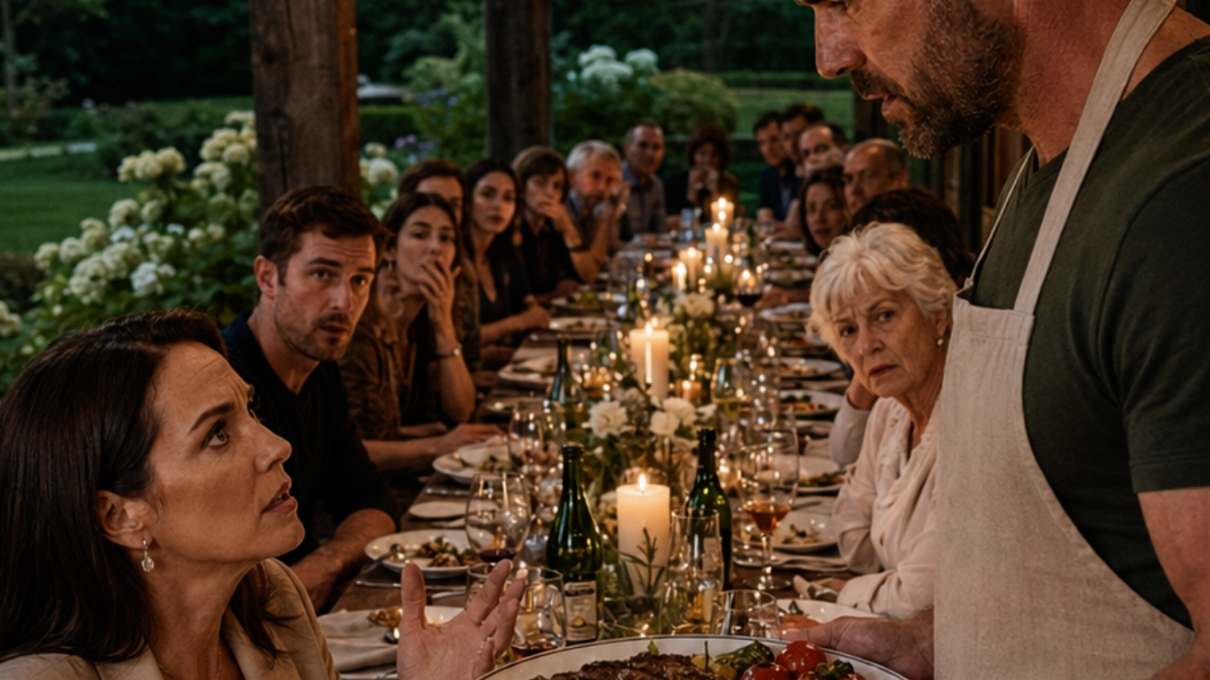
“Servants eat after their masters!” my brother-in-law roared, snatching my plate away in front of twenty-two relatives. Seventeen minutes later, he regretted it.
I stopped the car beside the sagging fence of a summer cottage in a gardening community. The gate stood wide open. Zakhar was standing by the brick barbecue, turning the skewers.
“Took you long enough, Muscovites,” he said without looking around.
My husband, Filipp, got out of the car first. He stretched, cracking his neck, and went over to greet his brother. I opened the trunk. Inside were four heavy grocery bags from Lenta. Pork neck at 520 rubles per kilogram, fresh vegetables, charcoal, and three boxes of my cheese—Camembert, Gouda, and stracciatella. I made them myself. It was my business, tiny but stable.
“Phil, brother, help get the bags out,” Zakhar called.
Filipp obediently picked up one bag. The lightest one, containing herbs and bread. Without saying anything, I lifted the two extremely heavy bags filled with meat and cheese. My fingers immediately turned white from the plastic handles digging into them.
Zakhar finally turned around. He was wearing a grease-stained apron that I had given my mother-in-law for International Women’s Day the previous year.
“Milena, leave the car keys on the table,” Zakhar said, pointing toward the veranda with his barbecue tongs. “I’ll move my car later and reposition yours too, so it isn’t in the way. You’ve left it sticking halfway across the road.”
I looked at my key fob. Zakhar loved driving my car. His old foreign car had needed repairs for a long time, while mine was new. I walked past the barbecue and placed the keys on the wooden table near the entrance to the house.
My mother-in-law, Vera Ignatyevna, came out of the summer kitchen, wiping her hands on a towel.
“Oh, finally!” she exclaimed, throwing up her hands. “Milena, did you bring your cheese? Aunt Tonya has been asking and asking for it.”
“I brought it, Vera Ignatyevna,” I said, setting the bags on a bench.
“Why so little?” Zakhar peered inside one of the bags. “There won’t be enough for twenty people. The relatives are coming. Uncle Vitya from Ryazan, Tonya and her husband, the nephews. We’re celebrating!”
“There are three kilograms,” I replied evenly. “That is enough.”
“Being stingy, are you?” Zakhar smirked. “You produce it yourself. You could have brought a whole crate. We’re family.”
He said it lightly, with a smile. I took a container of marinated meat out of the bag. Zakhar snatched it from my hands.
“Oh, you made a decent marinade,” he said approvingly after smelling it. “You’re learning. Go on, Mother is cutting vegetables in the kitchen. Help her. Phil and I will take care of the men’s work.”
The men’s work consisted of drinking beer from plastic cups and staring at the coals.
I went into the summer kitchen. It smelled of fried onions and old plastic tablecloth. A mountain of unwashed tomatoes and cucumbers lay on the table.
“Milena, take a knife and cut them into large pieces,” Vera Ignatyevna ordered. “Come on, come on. The guests will be here in an hour. The potatoes still need peeling. The bucket is over there.”
She pointed to a plastic bucket beside the washstand. Ten liters of dirty potatoes.
“Vera Ignatyevna, we agreed that everyone would bring a little something,” I said, picking up the knife.
My mother-in-law sighed as heavily as though I had asked her to unload freight cars.
“Milena. We are the hosts. This is my cottage. Zakhar is grilling the meat. All you did was buy the food, and now you’re chopping vegetables. Is it really so difficult to do something for the family?”
I looked through the window. Zakhar was standing beside the barbecue. He was grilling meat that I had bought and marinated. Over charcoal that I had brought. At a cottage whose new roof I had paid for.
I turned away from the window and began slicing tomatoes.
Part 2. The Guests Arrive
Cars began arriving around two in the afternoon. Old Ladas and used Korean sedans. The gate kept slamming without pause.
Twenty-two people. Aunts, uncles, distant cousins, nephews and nieces. Filipp’s relatives gathered like this every summer. They called it a “family tradition.” The tradition consisted of them arriving, sitting down at a large table, eating, drinking, and discussing how expensive everything had become.
I stood by the sink washing herbs. Water trickled from the washstand in a thin stream, so cold that it made my bones ache.
“Milena! Where are the clean towels?” Aunt Tonya shouted from the veranda.
“In the top drawer of the dresser,” I called back.
“Then bring them! My hands are wet!”
I wiped my own wet hands on my jeans, went into the house, took out the towels, and carried them to the veranda.
The men were already seated at the table. Zakhar was pouring vodka into shot glasses. Filipp sat next to him, laughing at some joke.
“And I told him the wreck ought to be sent straight to the scrapyard!” Zakhar proclaimed loudly, waving a skewer. “All the normal guys are switching to Chinese cars now. I’m thinking of selling mine too and getting something decent.”
Uncle Vitya, a thin little man in a checkered shirt, gave a skeptical grunt.
“Zakhar, have you earned enough for a Chinese car? Your auto-parts shop closed back in the spring.”
Zakhar was not embarrassed in the slightest.
“Those are temporary difficulties, Uncle Vitya. That’s business. One day you have nothing, the next you have plenty. Phil can confirm it.”
He slapped my husband on the shoulder. Filipp nodded and looked away.
I stopped beside the table. A month earlier, Filipp had transferred 100,000 rubles to Zakhar through the instant-payment system.
“To help my brother get back on his feet,” he had said at the time.
It was money from my business account that I had transferred to Filipp so he could pay the utility bills for our apartment.
I placed the towels in front of Aunt Tonya.
“Oh, Milena,” Tonya said, grabbing my hand. “Why are you so pale? Working all the time, are you? Our businesswoman.”
She said “businesswoman” with so much condescension that one might have thought I sold sunflower seeds at a railway station.
“I’m working, Aunt Tonya,” I said, carefully pulling my hand free.
“Zakhar says you’re completely buried in money now,” Vera Ignatyevna added as she carried out a huge platter of cucumbers. “You never see the family. You come once a month, throw some groceries at us like charity, and stare at your phone. You could at least spend some genuine time with us.”
I froze. Something inside me became cold and very calm.
“Vera Ignatyevna, I do not throw groceries at you. I buy them. With my own money,” I said evenly.
My mother-in-law pursed her lips. Zakhar banged his shot glass against the table.
“Milena, here we go again,” he said with a grimace. “Why do you always reduce everything to money? We’re talking about relationships, about warmth, and you’re talking about receipts. You always behave as though you couldn’t care less about our traditions.”
I looked at Filipp. My husband was carefully studying the pattern on the plastic tablecloth.
“Yes, Zakhar. I couldn’t care less,” I said quietly, but the whole table fell silent.
Zakhar leaned back in his plastic chair. He looked at me with a strange expression—a mixture of hurt and sincere certainty that he was right.
“I’m the older brother,” he suddenly said, not aggressively, almost calmly. “Father died when Phil was ten. I’m supposed to be the head of the family. I’m supposed to bring everyone together. But my business collapsed, while yours took off. Now you come here and look at all of us as though we’re poor relations. At least here, in Mother’s house, I want to feel like the master. Do you understand that or not?”
It was the truth. A simple, human, twisted truth. He needed a place where he could be in charge. And he made himself important at my expense.
I did not know what to say. I really had been buying them off. It was easier for me to pay for grocery delivery through an app or transfer money for roof repairs than to listen to their whining or take part in their long, pointless conversations about who had said what to whom ten years earlier.
I had given them permission to use my money.
I remained silent and returned to the kitchen. The bucket of unpeeled potatoes was still there.
Part 3. Revelations by the Sink
An hour later, I finished peeling the potatoes, put them on a small gas stove to boil, and began slicing the cheese.
My cheese.
The Camembert was perfect, with a white, velvety rind and a soft, flowing center.
Aunt Tonya came into the kitchen looking for salt.
“It’s on the shelf, in the yellow jar,” I told her while arranging the cheese on a wooden board.
Tonya took the jar and looked at the cheese.
“You make it beautifully, Milena. It’s delicious.” She shifted awkwardly from one foot to the other. “Listen, don’t let Zakhar get away with everything. He’s completely crossed the line.”
I raised my head. Tonya usually remained silent or agreed with Vera Ignatyevna.
“What do you mean?” I asked.
Tonya glanced toward the doorway. On the veranda, dishes clattered and people laughed…
The continuation is just below, in the first comment.
“Servants Eat After Their Masters!” My Brother-in-Law Roared and Took My Plate Away in Front of 22 Relatives. Seventeen Minutes Later, He Regretted It
I stopped the car beside the crooked fence surrounding the family’s country property in a gardening community. The gate stood wide open. Zakhar was beside the brick barbecue pit, turning skewers over the coals.
“Took you long enough, Muscovites,” he said without turning around.
My husband, Filipp, got out of the car first. He stretched, cracked his neck, and went over to greet his brother. I opened the trunk. Inside were four heavy shopping bags from Lenta. Pork neck at 520 rubles per kilogram, fresh vegetables, charcoal, and three boxes of my cheese—Camembert, Gouda, and stracciatella. I made them myself. It was my business, small but stable.
“Phil, brother, help get the bags out,” Zakhar called.
Filipp obediently picked up one bag—the lightest one, containing herbs and bread. Without saying anything, I lifted the two extremely heavy bags filled with meat and cheese. My fingers immediately turned white from the plastic handles digging into them.
Zakhar finally turned around. He was wearing the grease-stained apron I had given my mother-in-law for International Women’s Day the previous year.
“Milena, toss your car keys onto the table,” Zakhar said, pointing toward the veranda with his barbecue tongs. “I’ll move my car later, and I’ll move yours too so it’s not in the way. You left it sticking halfway across the road.”
I looked at my key fob. Zakhar enjoyed driving my car. His old foreign car had needed repairs for ages, while mine was new. I walked past the barbecue and placed the keys on the wooden table near the entrance to the house.
My mother-in-law, Vera Ignatyevna, emerged from the summer kitchen, wiping her hands on a towel.
“Oh, finally!” she exclaimed, throwing up her hands. “Milena, did you bring your cheese? Aunt Tonya has been asking and asking for it.”
“I brought it, Vera Ignatyevna,” I said, placing the bags on the bench.
“Why so little?” Zakhar asked, peering into one of them. “There won’t be enough for twenty people. The whole family is coming. Uncle Vitya from Ryazan, Tonya and her husband, the nephews. We’re having a proper celebration!”
“There are three kilograms,” I replied evenly. “That’s enough.”
“You’re being stingy,” Zakhar said with a smirk. “You make it yourself. You could have brought an entire crate. We’re family.”
He said it casually, with a smile. I took the container of marinated meat out of the bag. Zakhar grabbed it from my hands.
“Oh, you made a decent marinade,” he said approvingly after sniffing it. “You’re learning. Go on, Mother is cutting vegetables in the kitchen. Help her. Phil and I will take care of the men’s work.”
The men’s work consisted of drinking beer from plastic cups and staring at the coals.
I went into the summer kitchen. It smelled of fried onions and old oilcloth. A mountain of unwashed tomatoes and cucumbers lay on the table.
“Milena, take a knife and cut them into large pieces,” Vera Ignatyevna ordered. “Come on, hurry up. The guests will be here in an hour. The potatoes still need peeling. The bucket is over there.”
She pointed at a plastic bucket beside the washstand. It held ten liters of dirt-covered potatoes.
“Vera Ignatyevna, we agreed that everyone would bring a little something,” I said, picking up the knife.
My mother-in-law sighed as heavily as though I had asked her to unload a freight train.
“Milena, we are the hosts. This is my country house. Zakhar is grilling the meat. All you did was buy the food, and now you’re cutting a few vegetables. Is doing something for the family really that difficult?”
I looked through the window. Zakhar was standing beside the barbecue. He was grilling meat that I had bought and marinated, over charcoal that I had brought, at a country house whose new roof I had paid for.
I turned away from the window and began cutting tomatoes.
Cars began pulling up around two in the afternoon. Old Ladas, secondhand Korean sedans. The gate slammed continuously.
Twenty-two people came. Aunts, uncles, distant cousins, and nephews. Filipp’s relatives gathered like this every summer. They called it a “family tradition.” The tradition consisted of everyone arriving, sitting down at a large table, eating, drinking, and discussing how expensive everything had become.
I stood at the sink washing herbs. The water from the washstand flowed in a thin stream, so cold it made my bones ache.
“Milena! Where are the clean towels?” Aunt Tonya shouted from the veranda.
“In the top drawer of the dresser!” I shouted back.
“Then bring them! My hands are wet!”
I wiped my own wet hands on my jeans, went into the house, took out the towels, and carried them onto the veranda.
The men were already seated at the table. Zakhar was pouring vodka into shot glasses. Filipp sat beside him, laughing at some joke.
“And I told him the wreck ought to be sent straight to the scrapyard!” Zakhar declared loudly, waving a skewer around. “All the normal guys are switching to Chinese cars now. I’m thinking about getting rid of mine and buying something decent.”
Uncle Vitya, a thin man in a checked shirt, snorted.
“Zakhar, have you actually earned enough for a Chinese car? Your auto-parts shop closed back in the spring.”
Zakhar did not look embarrassed in the slightest.
“Those are temporary difficulties, Uncle Vitya. That’s business. One day you have nothing, the next day you’re rolling in money. Phil will back me up.”
He slapped my husband on the shoulder. Filipp nodded and looked away.
I stopped beside the table. One month earlier, Filipp had transferred 100,000 rubles to Zakhar through the instant-payment system.
“To help my brother get back on his feet,” he had told me.
It had been money from my business account that I had transferred to Filipp so he could pay the utilities for our apartment.
I placed the towels in front of Aunt Tonya.
“Oh, Milena,” Tonya said, grabbing my hand. “Why are you so pale? Working all the time, are you? Our businesswoman.”
She pronounced the word “businesswoman” with so much condescension that one would have thought I sold sunflower seeds at a train station.
“I’m working, Aunt Tonya,” I said, gently freeing my hand.
“Zakhar says you’re completely buried in money now,” Vera Ignatyevna added as she carried out a huge platter of cucumbers. “You never see your family. You come once a month, toss some food at us like charity, and spend the whole time staring at your phone. You could at least be present with us emotionally.”
I froze. Something inside me became cold and strangely calm.
“Vera Ignatyevna, I don’t toss food at you. I buy it. With my own money,” I said evenly.
My mother-in-law pursed her lips. Zakhar banged his shot glass against the table.
“Oh, here we go again, Milena,” he said with a grimace. “Why do you always reduce everything to money? We’re talking about relationships and warmth, and you’re talking about receipts. You always behave as though you couldn’t care less about our traditions.”
I looked at Filipp. My husband was carefully studying the pattern on the oilcloth.
“Yes, Zakhar. I couldn’t care less,” I said quietly, but the table fell silent.
Zakhar leaned back in his plastic chair. He looked at me with a strange expression—a mixture of hurt and absolute certainty that he was right.
“I’m the older brother,” he suddenly said, without aggression, almost calmly. “Father died when Phil was ten. I’m supposed to be the man in charge. I’m supposed to bring everyone together. But my business collapsed, while yours took off. Now you come here and look at us as though we’re your poor relations. I want to feel like the master somewhere, at least here, in my mother’s house. Do you understand that or not?”
It was the truth. A simple, human, twisted truth. He needed a place where he could feel important. And he made himself important at my expense.
I could not think of anything to say. I really had been buying my way out of dealing with them. It was easier for me to pay for food delivery through an app or transfer money for the roof repairs than to listen to their complaining and participate in their long, pointless conversations about who had said what to whom ten years ago.
I had given them permission to use my money.
I said nothing and returned to the kitchen.
The bucket of unpeeled potatoes was still there.
An hour later, I finished peeling the potatoes, put them on the gas burner to boil, and began slicing the cheese.
My cheese.
The Camembert was perfect, with a white, velvety rind and a soft, flowing center.
Aunt Tonya entered the kitchen looking for salt.
“It’s on the shelf, in the yellow jar,” I told her while arranging the cheese on a wooden board.
Tonya took the jar and looked at the cheese.
“You make it beautifully, Milena. And it’s delicious.” She shifted awkwardly from one foot to the other. “Listen, don’t let Zakhar get away with everything. He’s completely lost all sense of boundaries.”
I raised my head. Tonya usually remained silent or agreed with Vera Ignatyevna.
“What are you talking about?” I asked.
Tonya glanced toward the door. People were laughing and rattling dishes on the veranda.
“He came to see Vera a few days ago. I happened to be delivering some seedlings. I heard them arguing. Zakhar told his mother that you should pay to build a new bathhouse since you had money to spare. Vera said you wouldn’t agree. Zakhar laughed. He said, ‘What choice does she have? Phil can twist her around his little finger.’ Then he said that the house would be his soon anyway. Since Phil’s wife could earn enough for an apartment herself, and the two of you had already paid for the new roof here.”
I stopped slicing the cheese. The knife landed against the board with a dull thud.
“He actually said that?”
“Word for word,” Tonya replied with a sigh. “They see you as a wallet, Milena. Forgive me for interfering. But when I saw you standing by the barbecue with all those bags while Zakhar demanded the keys to your car, I remembered that conversation.”
She took the salt and left.
I looked at my hands. There were still traces of dirt on my fingers from peeling their potatoes. The polish on my index fingernail had chipped.
I had worked without a day off for the previous three months to make my cheese business profitable. I woke up at five in the morning. I delivered orders myself whenever my courier was sick.
I walked over to the small mirror hanging above the washstand.
A tired woman with her hair gathered into a careless ponytail stared back at me. She was thirty-eight years old. She had her own business, her own apartment, and her own car.
And she was standing in someone else’s summer kitchen, listening to people divide up her money without even saying thank you.
They had not forced me to do this.
I had agreed to it.
I had agreed to be convenient. I had agreed whenever they said, “But we’re family.” I had believed that if I was generous, they would accept me.
How foolish.
The water in the potato pot began to boil. I lowered the heat and added salt. Then I washed my hands with soap and dried them with a paper towel.
I picked up the board of cheese and walked onto the veranda.
All twenty-two people were already seated at tables arranged in the shape of a T. Plates of sliced food, salads, jugs of fruit drink, and bottles of cheap vodka covered the white tablecloth.
Zakhar sat at the head of the table. Vera Ignatyevna and Filipp sat beside him.
I placed the cheese board in the center.
“Oh, the cheese has arrived!” Zakhar announced cheerfully. “Mother, bring out the meat! It’s time for the hot food.”
Vera Ignatyevna jumped up and hurried into the kitchen to fetch the platter of shashlik.
I took an empty plate from the edge of the table and sat down in the only available seat, near the door.
My legs were throbbing. My back hurt after standing bent over the sink for an hour. I picked up a fork.
Vera Ignatyevna carried in an enormous platter of steaming meat. She placed it in the center of the table, directly in front of Zakhar.
“Here’s to the family!” Zakhar said, raising his glass. “To us!”
Everyone murmured enthusiastically and clinked their glasses together. Zakhar began distributing pieces of meat—to himself, to Filipp, and to Uncle Vitya.
The platter was far away from me. I stood up, reached across with my fork, speared a nicely grilled piece of pork, and placed it on my plate. Then I sat down and picked up my knife.
I managed to cut off only one small piece.
Someone’s hand suddenly jerked my plate across the oilcloth. It scraped loudly over the table and stopped beside Zakhar.
I raised my eyes.
Zakhar was looking down at me. He was not even angry. He was completely convinced that he had the right to do it.
“Servants eat after their masters!” he roared across the veranda.
Silence fell over the table. Twenty-two people stopped chewing.
“Let the men eat first,” Vera Ignatyevna added as she poured more fruit drink into Zakhar’s glass. “Why are you grabbing food before everyone else, Milena? You can wait.”
I looked at Filipp.
My husband, the man with whom I had lived for eight years, sat across from me. He lowered his eyes to his plate and smirked. He merely pulled up one corner of his mouth.
The silence around the table exploded into laughter.
Uncle Vitya laughed. The nephews giggled. Aunt Tonya lowered her head and began carefully poking at her salad with a fork.
They were laughing.
Genuinely and happily, as though they had just heard a successful joke in a comedy.
I did not shout. I did not turn red.
Something inside me simply clicked into place.
I looked at the wall clock above the door.
It was 3:10 p.m.
I stood up slowly. The chair scraped against the floorboards. The laughter began to fade.
“Where are you going?” Zakhar asked condescendingly. “Are you offended or something? Sit down and stop being hysterical. It was a joke.”
I did not answer.
I walked over to the cabinet beside the door, where my car keys were lying—the same keys he had ordered me to throw onto the table.
I picked up the key fob and slipped it into the pocket of my jeans. The sound of the keys seemed unusually loud.
“Seven thousand eight hundred rubles,” I said evenly.
“What?” Filipp asked, confused.
“The meat you’re eating right now cost 7,800 rubles, Zakhar,” I said, pointing toward his plate. “The vegetables and fruit cost another 4,000. The repairs to this veranda, where all of you are sitting, cost 80,000 rubles last month.”
Zakhar stopped smiling.
“What the hell are you talking about?” he asked threateningly.
I walked past him toward the center of the table and picked up the wooden board containing my cheese.
“Milena, stop making a scene in front of the guests!” Vera Ignatyevna protested, trying to grab my arm.
“This is my cheese. I made it, and I’m taking it with me,” I said, carefully stepping around her while holding the board. “I’m also taking the wine out of the trunk. I bought it for my family. But my family isn’t here.”
“Let her go,” Zakhar snorted, leaning back in his chair. “She’s insane. Phil, tell your wife to calm down.”
Filipp stood up.
“Milena, seriously, this is too much. Sit down and eat. Zakhar just said something stupid.”
“Filipp,” I said, looking my husband directly in the eyes, “you transferred 100,000 rubles of my money to him. You laughed when he called me a servant. Stay here. This is your family. Enjoy your meal.”
I turned around and walked toward the exit.
“Hey!” Zakhar shouted at my back. “Who’s going to move the car? Mine is blocked! Leave the keys!”
I stopped on the porch and turned around.
Zakhar’s face was red. He did not understand. He genuinely did not understand that everything had changed.
He was accustomed to watching me swallow every insult.
“Call a tow truck,” I said.
I walked to my car, opened the trunk, took out the remaining box of cheese, got behind the wheel, and started the engine.
In the rearview mirror, I saw Zakhar rush onto the porch, shouting and waving his arms. Filipp stood behind him.
I shifted into gear and drove out of the yard.
The clock in the car read 3:27 p.m.
Seventeen minutes.
The city greeted me with evening traffic and the smell of sun-heated asphalt. I drove in silence without turning on the radio.
The apartment smelled of dust and air freshener. Filipp’s sneakers stood in the hallway. His windbreaker hung from a hook.
I did not pack his belongings. I did not throw them into the stairwell or stage some dramatic performance with suitcases.
That was unnecessary.
The apartment belonged to me, and legally, he was merely a guest there.
The next day, I would call a locksmith and change the locks.
That evening, I simply wanted silence.
I walked over to the front door, inserted the key into the lock, and turned it twice. Then I left the key in the lock on the inside.
Now the door could not be opened from outside, even if Filipp had his own key.
The phone in my pocket vibrated.
Two missed calls from Vera Ignatyevna.
Four from Filipp.
One message from Aunt Tonya:
“You did the right thing.”
I did not reply.
I placed the phone facedown on the cabinet.
Then I went into the kitchen.
On the counter lay the wooden board with the same cheese I had taken away from the country house.
I cut off a small piece of Camembert and placed it in my mouth. The cheese was at room temperature, creamy, with a subtle mushroom flavor.
Perfect.
I stood in the middle of my own kitchen, chewing the cheese and watching the streetlights come on outside the window.
Tomorrow would bring many difficult conversations, the division of property, and accusations that I had destroyed the family.
But that would be tomorrow.
That evening, I was simply eating my dinner.
First.
What had needed to break inside me during those eight years for me to believe that love had to be purchased with cheese and a new roof?