He Loved Another Man’s Wife and Waited Silently for Ten Years. He Made His Move When Her Husband Left the Family
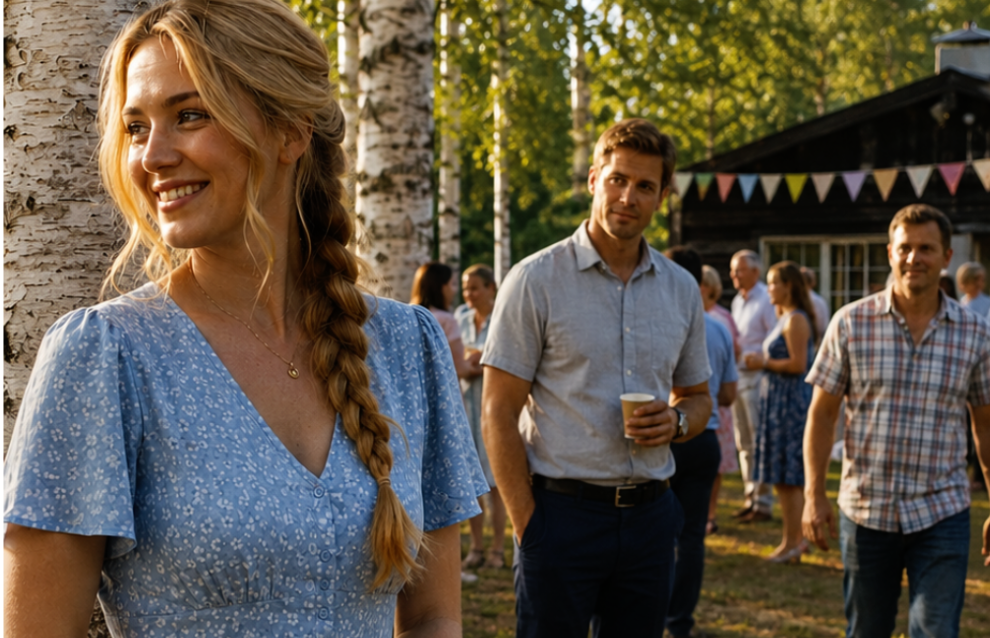
He first saw her at a village wedding. She was the bride’s sister. She stood off to one side near a birch tree, laughing at something—not loudly or for attention, but the way people laugh when they feel happy inside. She wore a blue dress with white polka dots. It was simple, made of cotton, but it fit her so perfectly that it looked as though it had been sewn especially for her. And her braid—thick and light brown—was draped over her shoulder.
Andrey stood with his friends, drinking something from a plastic cup and watching her. He watched and could not look away. Someone nudged him with an elbow.
“Why are you staring? Her husband is right over there.”
He pointed toward a strong-looking man in a plaid shirt who was already crossing the clearing toward her, walking confidently, like a man approaching something that belonged to him.
That was how Andrey learned that she was married. He also learned that her name was Nadezhda and that she already had a daughter—a little one-year-old girl who had been left with her grandmother.
Someone else’s.
Everything about her belonged to someone else: the dress, the braid, the laughter, and the life growing and moving inside her. He understood that clearly and rationally. But the heart cannot be ordered around. The heart is foolish. It chooses—and that is the end of it.
Andrey was not a foolish man. He was an engineer working for the district branch of a large company, and he frequently traveled to villages on business. He lived alone. His mother had died young, while his father lived in the city with a new wife and showed no interest in him. His sister lived somewhere in the south and was married to a military officer.
Andrey was therefore on his own. His house was old and had belonged to his mother. His small farm was modest but well maintained. He had a calm personality, without angry outbursts or dramatic scenes. Women noticed him, but he never responded to any of them.
Because there was Nadezhda.
No, he did not interfere with her family. He did not write letters, wait for her outside the store, or arrange “accidental” conversations. In fact, he barely spoke to her at all. They greeted each other in the street—she nodded pleasantly, he answered reservedly, and that was all.
Sometimes he saw her from a distance at the bus stop, near the village council building, or at the market. She walked with her children—she later had a second child, a boy—pushing a stroller and carrying bags. Andrey watched her walk away and thought, “There goes a human being. I don’t want anything from her. I only want her to be alive and happy. That’s all.”
That was what he told himself.
And he believed it.
But somewhere deep inside him—so deep that he was afraid to look—there was something else. There was hope. Dark, shameful hope, hidden even from himself.
The hope that one day everything would change. That her husband would leave. That something would happen and she would become free.
And then…
He refused to think any further. He forbade himself.
But the hope remained.
And waited.
Nadezhda’s husband, Vadim, was a noticeable man. He was tall and handsome, with white teeth and a loud voice. He worked for the timber company—not as a lumberjack, but in the office as a procurement specialist. He traveled to the city and brought back things no one in the village had ever seen. He dressed his wife well, making the neighboring women envious. He spoiled his children, and their household was prosperous.
But there was something insatiable in him. Some kind of thirst that could not be satisfied by his wife, his children, or his money. He always wanted something new—a new car, new clothes, new experiences, and new women.
The villagers whispered about the women, but Nadezhda knew, of course.
A woman always knows.
She endured it. Not because she was afraid, but because she was proud. She did not want people to say that she had failed to keep her man. She did not want her children to grow up without a father. She did not want to admit that she had made a mistake in her youth when she had chosen Vadim from among all the young men.
She had been the one doing the choosing. Many men had admired her, and she had plenty of options. But she had chosen the brightest one.
The loudest one.
And now she was paying for it.
It continued for ten years.
Andrey saw everything. He saw Nadezhda growing older—not because of age, but because of exhaustion. He saw her laugh less and less. He saw Vadim traveling to the city more and more frequently “on business.”
And he waited.
Without admitting it even to himself, he waited.
Then it happened.
Vadim left.
He did not leave quietly or secretly. He left openly, slamming the door behind him. He had found a younger woman in the city, a supermarket sales assistant.
“I can’t live like this anymore,” he told Nadezhda. “You’ve become boring. The children are always screaming. This house is like a swamp.”
He packed his things and drove away.
For good.
The village buzzed with gossip. Some people pitied Nadezhda.
“Poor woman. What will she do now with two children?”
Others gloated.
“She drove her husband away. She should have tried harder.”
Still others simply waited to see what would happen next.
Andrey heard the news from a neighbor. She stopped by his house on some matter and casually told him what had happened. He listened without saying anything. He showed the neighbor out and closed the door.
Then he suddenly realized that his hands were trembling.
Not from happiness.
No.
They were trembling from excitement. Because it had happened. The thing he had waited ten years for. The thing he had been afraid to believe would ever happen.
She was free.
He did not go to her immediately.
He waited two months so it would not look as though he had been waiting.
Even though he had.
He wanted her to recover from the initial shock. He wanted the gossip to settle down. He wanted the children to become accustomed to their new life without their father.
For two months, he thought about what he would say. He imagined the conversation and rehearsed the words.
He also bought things—not for her, but for the children. Toys, clothing, and sweets. He put everything into a bag.
He laughed at himself.
“Where are you taking all this? Why are you buying it? You haven’t even spoken to her yet.”
But he continued buying things anyway.
Then, one autumn morning, when the sky hung low and gray and the last leaves were falling from the trees, he went to see her.
He put on a clean shirt. He shaved. He picked up the bag of gifts and walked through the entire village toward Nadezhda’s house.
The same house Vadim had walked out of two months earlier.
She opened the door.
Andrey immediately saw that something about her had changed. Not for the worse. She was simply different.
Stronger.
More composed.
Her face had grown thinner and her eyes were sunken, but something new had appeared in them. A kind of fire that had not been there before.
It was the fire of a person who had gone through the worst thing imaginable and discovered that she had survived.
“Andrey?” she asked in surprise. “What are you doing here?”
“I want to talk,” he said. “May I?”
She remained silent for a moment. Then she stepped back from the threshold, but she did not invite him inside. She continued standing in the doorway, leaning against the frame with her arms crossed over her chest.
“Speak.”
He had prepared his words.
So many words.
Beautiful, proper words—the ones he had rehearsed at night. But now that he was standing in front of her, they all vanished from his mind.
So he spoke simply.
“Nadya, I’ve loved you for ten years. You know that. I never interfered, never caused trouble, and never did anything cruel. I simply waited. And now… you’re alone. I want us to be together. I’ll accept your children as my own. I’ll do everything for you. Everything. You only have to say yes.”
Then he fell silent.
She looked at him.
For a long time.
One minute.
Two.
And in her eyes—he could clearly see it—there was no happiness, no gratitude, and not even surprise.
There was something else.
Something bitter.
As though she had expected completely different words from him. Or perhaps she had expected these words, but at another time and from another person.
“Andrey,” she said quietly. “You’re a good man. I know you are. I know everyone in this village, and you’re better than all of them. But…”
She hesitated and pressed her lips together.
“But you waited.”
“What?” he asked, not understanding.
“You waited for me to fall. You waited for ten years. You waited for Vadim to leave me. You waited for me to be alone, with children, without money and without hope. You waited for me to fall, and then you planned to arrive—handsome, kind, a rescuer—and pick me up.”
“Nadya, I didn’t…”
“Wait. Let me finish.”
She straightened, and her voice became firm.
“Do you think I didn’t know? Do you think I didn’t notice the way you looked at me? For ten years—at every market, every celebration, and every accidental meeting in the street. You watched and waited. You waited for me to break. You waited for my husband to leave. You waited for me to crawl to you. But I didn’t break. And I didn’t crawl.”
“I wasn’t waiting for you to break,” he said hoarsely. “I simply… I simply loved you.”
“No, Andrey. You didn’t love me. You were waiting for your turn, like someone waiting at a clinic. You thought, ‘It’s all right. Vadim will have his fun, and I’m patient. I’ll wait.’ And now your turn has finally come, and you’ve arrived with a bag. Do you think I’m going to be happy? Do you think I’ll throw my arms around your neck?”
He remained silent.
He stood there looking at her, feeling something collapse inside him.
It was not his hope.
No.
It was something more important.
His idea of himself.
His belief in his own righteousness.
His belief in his own nobility.
“You waited for me to fall,” she repeated, and there was steel in her voice. “But I didn’t fall. My husband left—yes. I have no money—yes. Life is difficult—yes. But I didn’t fall. I’m still standing. I feed my children, I harvested the garden, and I repaired the roof—by myself, by the way, without any men. I don’t need anyone. Not you, not anybody else. I can manage alone. Do you understand? Alone.”
“Nadya…”
“Go, Andrey. Go away. And don’t come here again.”
She stepped backward and closed the door.
He remained standing on the porch with the bag in his hand. With the flowers he had hidden beneath his jacket and never managed to take out. With a heart that had suddenly become heavy and unfamiliar, like a stone placed where it did not belong.
He returned home and sat down at the table. He placed the bag of gifts in front of him—toys, sweets, and a children’s book.
He stared at them for a long time.
Then he suddenly began to cry.
Not because he felt offended, but because he was ashamed.
Because she was right.
He really had waited.
He had waited for ten years.
He had told himself, “I simply love her. I don’t expect anything. I’m simply nearby.”
But in reality, he had been waiting.
Waiting for Vadim to make a fatal mistake. Waiting for Nadezhda to be left alone. Waiting for fate finally to turn in his direction.
And there had been something deeply wrong in that waiting. It was almost as though he had wanted her entire life to collapse merely so that he could arrive afterward and save her.
And she understood.
Not with her mind, but with her heart.
With the heart of a woman who, after ten years of being silently observed, had learned to recognize subtle differences. She could distinguish love from waiting. The desire to help from the desire to possess.
The real thing from a counterfeit.
And now, sitting alone in his empty house, Andrey saw himself from the outside for the first time in ten years.
He did not like what he saw.
Meanwhile, after closing the door, Nadezhda leaned against it and shut her eyes.
Her heart was pounding.
There was a lump in her throat.
She was not as strong as she had pretended to be in front of Andrey. She was hurting. She was lonely. She was afraid.
And perhaps, if he had come not after two months but after a year, she might have answered differently.
Or if he had arrived without that expression—not the face of a man who believed his waiting had finally paid off, but the face of someone who simply wanted to help.
Simply to be near her.
Simply to support her.
But he had come in the way that he had.
And she had answered in the way that she had.
Because she truly had not fallen.
And she had no intention of falling.
Most importantly, she did not want anyone waiting for her to fall.
Not even out of love.
Not even with the purest intentions.
A year passed.
Andrey left his job and moved to a neighboring district. It was not because he was ashamed—the shame had passed. He moved because he could no longer bear to see that house, that street, and that gate.
He settled in a remote village a hundred kilometers away and found work there. He read in the evenings. Sometimes he drank, but never heavily and never for days at a time.
He lived quietly.
He never became close to anyone.
He thought a great deal.
About her.
About himself.
About the words she had spoken on the doorstep.
As time passed, he understood more and more clearly that she had been right.
She had been right about everything except one thing: he really had loved her.
He had loved her sincerely.
But his love had become entangled with something else—with impatience, secret hope, and the desire to prove, “I’m better than he is. I waited, while he failed.”
And Nadezhda had sensed it.
A woman’s intuition is a powerful thing. It recognizes falsehood before the mind does.
And it does not forgive.
Nadezhda remained in the village. She raised her children. Her daughter entered a technical college, and her son trained as a mechanic.
Vadim returned a couple of times and tried to come back after the supermarket sales assistant threw him out.
But Nadezhda did not let him inside.
“You left,” she told him. “Once you leave, you leave. There is no way back.”
And she closed the door.
She barely socialized with her neighbors. She lived a secluded life and rarely smiled.
But if someone looked closely, they could see that same fire burning in her eyes—quiet, steady, and impossible to extinguish.
The fire of a person who had remained standing.
A person who had refused to be broken.
A person who had never asked anyone for help and would not have accepted it even if it had been offered.
Occasionally, though very rarely, she remembered Andrey.
“Perhaps I was too harsh,” she would think. “Perhaps I should have handled it differently.”
But she immediately answered herself.
“No. I wasn’t wrong. If he had simply come to me without that expression, without that bag, and without ten years of waiting—perhaps things could have been different. But not like that. You cannot love someone while waiting for something terrible to happen to them. That isn’t what love is.”
Then she continued with her work, her garden, and her life.
She walked forward on her own.
Just as she had promised herself on the day she closed the door on the man who had waited for her to fall.
And had waited in vain.