At 62, I Was Offered to Move to the Dacha for the Sake of a Young Family — But I Chose a Different Solution
I was sorting through the seedlings when my daughter took off her shoes in the hallway, walked into the kitchen, and placed two folders on the table. One was blue, with an emblem on it, and the other was transparent.
“Mom, Kirill and I have been calculating things,” Marina said, untying the strings on the transparent folder. “Kirill’s parents are giving us money. Not for the banquet, but for the down payment on a mortgage. But we thought — why get into debt if there’s another way?”
She spoke calmly, as if she were talking about dinner. I wiped my hands on my apron, pulled the elastic band out of my bun, and my hair fell loose. I had to gather it again.
“What other way?”
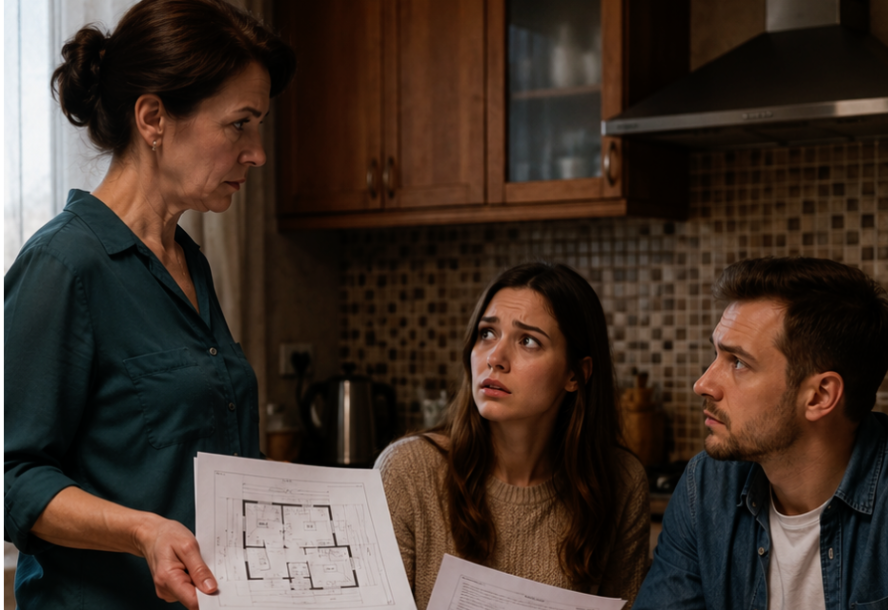
“Well, look.” She opened the folder. There was a plan of our apartment, circled with a red marker, and several photographs. I recognized the yard, the entrance, the second-floor windows. “Kirill works at a real estate agency. He says a two-room apartment in our district now goes for six and a half million. We sell it, use the money as a down payment for a three-room apartment in a new building. And you…”
“And me?”
“You’ll live at the dacha for now. Why do you need to be alone in the city? Last year we installed water there and insulated the utility room. The stove is fine, the roof doesn’t leak. Kirill checked everything himself.”
I stood up and went to the stove. The kettle was already humming. I took it off before it clicked, poured boiling water into a mug, and dropped in a tea bag. Marina doesn’t drink tea bags; she says it’s bad taste. But this time she didn’t notice. She was laying out numbers on the table.
“Look.” She pushed a sheet toward me. “Sale of your apartment: six million five hundred. Down payment for a three-room apartment: three million two hundred. That leaves three million three hundred. Part of it goes to the dacha, so you can live there all year round. And we’ll have some left for furniture.”
“We’ll have some left,” I repeated.
“Well, yes. The apartment is yours, but the initiative is ours. We even decided to have the wedding without a restaurant. Kirill’s parents actually suggested we just register the marriage and go to Crimea with them for a week.”
I took a sip of tea. I had forgotten to remove the tea bag, and the tea tasted bitter.
Marina is twenty-eight. She works in insurance, spending all day on the phone sorting out other people’s accidents. Kirill is thirty-one and deals with commercial real estate. When my brother sold his garage fifteen years ago, it was exactly that kind of specialist who helped handle everything without court and unnecessary paperwork. Kirill knows his business. I never said he was a bad man. He is good. Meticulous, orderly. Whenever they visit, the first thing he does is check the faucet in the bathroom. If it leaks, he shuts off the water: “The gasket needs replacing.”
But now he was sitting on a stool, buried in his phone, only occasionally glancing at Marina. He did not say, “This is our joint decision.” In fact, he tried not to speak at all. I know that look. My husband used to look the same way when I argued with his mother. At such moments, men prefer not to participate. But they are there. They hear everything. And silence is also an answer.
“Marina,” I said. “You want me to sell the apartment, give you the money, and move to the dacha. Did I understand correctly?”
“Mom, it’s not ‘give.’ It’s a joint decision.”
“Whose?”
“The family’s. Ours.”
I put the mug aside. The tea had gone cold.
“Then I have a question in return. Have you ever been at the dacha in winter?”
Marina frowned.
“Of course I have. We came for New Year’s. There was so much snow, Kirill cleared the path.”
“I remember. We sat there for three days with a heater. I lit the stove every four hours. The water in the bucket by the door froze. Then you left because Kirill got a call from a client. I stayed.”
“That was before the insulation. It’s different now.”
I did not answer. I have worked at school for thirty-seven years, ever since getting my diploma. Mathematics, middle school. I know what children look like when they lie with inspiration. My fifth-graders look at the ceiling the same way and say, “I did my homework, honestly, I just forgot my notebook.” Marina was looking the same way now.
There was another sheet in the transparent folder. I reached for it. She tried to cover it with her palm, but I had already taken it.
A draft purchase and sale agreement.
There was no signature. But the seller’s details were filled in, and the amount was written down. “Koshkina Anna Sergeevna.” My surname, my first name, my patronymic. In neat computer print. As if I had already agreed.
“You prepared an agreement?”
“It’s just a draft, Mom. Kirill asked a lawyer at work to sketch it out. So you could see that everything is serious and legal.”
“Legal is when the owner makes the decision. Not when someone brings her a ready-made document.”
Kirill looked up from his phone. Usually he did not look me in the eye, but now he did. Directly and calmly.
“Anna Sergeevna, we are not kicking you out. We’re offering an option. The apartment will have to be dealt with anyway. Either divided or sold. It’s better now, while prices are high.”
“Divided?” I asked again. “On what grounds? The apartment is mine. My husband and I bought it when Marina was one year old. After my husband died, I became the owner. The sole owner.”
“Mom!” Marina threw up her hands. “What ownership? I’m trying for us!”
“For which ‘us’?”
“For the family. You, me, Kirill. Then children will come. Are you against grandchildren?”
I stood up. Not for dramatic effect — my back had gone stiff from sitting.
I walked over to the window. On the windowsill stood cups with seedlings: peppers, eggplants, two kinds of tomatoes. Every year I grow them and take them to the dacha in May. Three garden beds, a greenhouse, an old apple tree. The apples are sour, but they make excellent compote. I love the dacha. I bought it a few years after my husband died: it was too quiet alone in the apartment, and there was always something to do on the land. But I bought it as a dacha. A place for summer. Weekends, soil, fresh air. And then back to the city, to work, to proper heating.
“Marina,” I said without turning around. “You want me to live at the dacha all year round. Do you understand what that means?”
“Mom, people live outside the city. Fresh air, ecology.”
“I’m a teacher. I get up at six. From the dacha to the school is twenty-two kilometers. The bus runs three times a day: at seven in the morning, at one in the afternoon, and at six in the evening. At seven I can make it. But how do I get back after the sixth lesson? Wait until six in the evening? What about class supervision? Parent meetings?”
“You can drive,” Kirill added. “You have a license.”
“I do. I got it a long time ago, back when Marina was still in a stroller. But now I’m sixty-two. My reaction time isn’t the same. In winter there’s ice. I won’t get behind the wheel.”
Marina pressed her lips together. She had had that habit since childhood: when arguments run out, she gets offended.
“You just don’t want to change anything. Your whole life it’s been, ‘I’ll do it myself, don’t interfere.’ And I’m offering a normal option. The apartment is too big for you alone. And we’ve been renting with five people for the fifth year. Do you know how much money has gone into that?”
“I know. You tell me every year.”
“So what? Do you begrudge me?”
I poured more tea. My hands were not shaking, although somewhere inside, something had already begun to ring. Marina knows how to pressure people. A trait from her father — he also believed that if someone was offended by him, it meant he was right.
“I don’t begrudge you. I helped you. We paid for your university. I helped with the down payment for your car. Two years ago, I gave you two hundred thousand. Did you return it?”
Marina flushed.
“I’ll return it! I remember!”
“I’m not asking you to return it. I’m saying this isn’t about greed. It’s about something else.”
“About what?”
“You didn’t ask me.”
It became quiet. Kirill placed his phone face down on the table — I appreciated that. He understood. Marina did not. She had not heard me yet. She was sitting inside her own logic like inside a shell.
“You came with a ready-made plan. Everything had already been calculated: the sale, the down payment, repairs, furniture. A lawyer prepared a draft. You discussed it with Kirill’s parents, with him, maybe with colleagues. But you didn’t ask me.”
“Mom, I thought it was obvious…”
“What was obvious? That I would agree to everything you came up with?”
“I thought you would be willing to do it for me!” Marina shouted. “You’re my mother!”
I turned around. Marina was standing by the table, clutching the folders to her chest. Her eyes were wet, her cheeks red. She truly believed what she was saying.
And that was the whole point. She wasn’t lying. She wasn’t scheming. She had grown up with the belief that motherly love means giving. Time, money, an apartment, a life. That asking a mother to move to the dacha is normal, because she would have enough there alone. That the apartment bought by me and her father was a family resource. That “willing to do it for me” was an ordinary phrase, not manipulation.
“Marina, sit down.”
She did not sit down. I did not insist.
“When we bought this apartment, we were only a little older than you are now. We both worked at school: he was a physics teacher, I was a math teacher. We bought a two-room apartment, got into debt, and paid it off for years. Do you know what that means?”
Marina was silent.
“It means that for several years we bought nothing except food and the absolute necessities. Your father took side jobs: tutoring, checking Olympiad papers, one summer he even worked as a janitor at a neighboring school. I sewed dresses for you out of my own skirts. We finally paid everything off, and a few years later your father was gone. He didn’t even have time to rest.”
“I’ve heard this,” Marina said dully. “You told me.”
“Yes. But you didn’t hear it.”
Kirill stood up and took Marina gently by the elbow, not roughly, but calmingly.
“Anna Sergeevna, we understand you. Let’s put this aside. Think about it. Maybe in a week…”
“Kirill,” I interrupted, “you’re a good person. I respect you. But right now you’re trying to close a deal. Like an agent. And I’m not a client. I’m your future mother-in-law.”
He stopped short and nodded. Briefly, professionally.
“I’m sorry. You’re right.”
“No need. You’re doing what you know how to do.”
Marina sharply snatched the folders off the table and went to put on her shoes. Kirill lingered for a minute — phone, keys, jacket. At the door he turned around.
“Anna Sergeevna, I really didn’t mean to pressure you.”
“I know. But that’s what happened.”
He sighed and left.
Marina did not say goodbye. Our door is heavy, with good sound insulation, but even through it I heard how loudly it slammed.
I returned to the seedlings. The peppers had grown, the eggplants were stretching upward, and the tomatoes had produced their second leaves. I sprayed them with a bottle, checked the soil — it was moist. Then I sat down on the stool where Kirill had been sitting. A sheet of paper remained on the table — the apartment plan, circled in red.
I turned it over. On the back, in Marina’s handwriting, it said: “Mom — dacha. Us — apartment. Move-in — July.” Her handwriting was like her father’s: broad, slanted to the left.
I sat there, probably for an hour. Then I called my brother.
He lives in the neighboring city, two hours away. An engineer at a furniture factory, a man of few words and solid character. After my husband died, it was he who helped with the inheritance: he found a lawyer, drove me to the notary, sat in line with me. Not once did he ask, “Maybe you’ll sell it?” He knew: this apartment was mine. Mine with my husband. Mine with little Marina. Mine now.
“Sasha, are you busy?”
“My shift starts in an hour. What happened?”
I told him about the conversation. My brother listened silently, then asked:
“Was it Marina herself?”
“I think Kirill helped calculate it. But the idea was hers.”
“I see. How are you?”
“I’m fine. I refused.”
“You did the right thing. Do you want me to come over for the weekend? We’ll talk.”
“No need. I’ll handle it myself.”
“All right. If anything happens, call.”
We said goodbye. I put down the phone and suddenly thought: Marina had not even asked what plans I had. What I wanted to do when I stopped working. Whether I wanted to live at the dacha at all. Maybe I dreamed of moving closer to my sister in Ryazan.
She was only interested in the apartment.
That evening I wrote a message. I didn’t call — I knew she wouldn’t answer.
“Marina, I am not selling the apartment. That does not mean I don’t want to help. If you need help with rent, we can discuss it. But I will not give up the apartment. It is mine. And I need it while I am working. We’ll talk when you’re ready to hear me, not just your plan.”
I reread it and sent it.
Marina did not reply after an hour, nor after two. I wasn’t waiting. I know my daughter: when her plans collapse, she needs time.
The next day at school there was a teachers’ meeting about transition exams. I sat in my usual place by the window, listening to the deputy principal. During the break, Svetlana Dmitrievna, the Russian language and literature teacher, came up to me. She is my age. We started working together.
“Anya, you’re pale. Is everything all right?”
“I had a conversation with my daughter yesterday. A difficult one.”
“About the apartment?”
I was surprised.
“How do you know?”
“Anya, I’ve spent thirty years with teenagers and parents. When adult children suddenly become concerned that a parent should move closer to nature, it’s immediately clear what it’s about.”
She sat down beside me and placed her hand on my elbow.
“Last year mine suggested we ‘exchange’: I would move into a studio, and she and her family would move into my three-room apartment. I refused. They didn’t speak to me for a month. Then they got over it.”
“How are things now?”
“Normal. She understood that I’m not obligated. It’s hard to accept. Once they accept it, it gets easier.”
After the meeting, I took the register, went down to my classroom, and sat down to check tests. Twenty-seven papers. Equations with fractions. The same mistakes as always: confusing denominators, forgetting the domain restrictions. I corrected the rules with a red pen, gave grades, and in my head the words kept turning: “She understood that I’m not obligated.”
Kirill called four days later. Without Marina. He asked permission to come by — “for fifteen minutes, about a personal matter.”
I agreed.
He came on Thursday evening. Alone. No folders, no printouts. With a bag of oranges. He took off his shoes in the hallway and came into the kitchen.
“Marina asked me to bring these. She’s still sulking, but less than before.”
“Thank you. Would you like tea?”
“If it’s no trouble.”
I poured tea. He sat on the same stool, but this time he did not take out his phone. He looked different: tired, without a tie, the top button of his shirt undone.
“Anna Sergeevna, I want to apologize. Not on Marina’s behalf — on my own.”
“You already did.”
“Then I apologized for the pressure. Now I want to apologize for something else.”
I waited.
“When I prepared that draft, I really thought I was doing what was best. My mind works that way: I see an object, I look for an option. Professional habit. But that’s not an excuse. I didn’t think that you are a living person.”
“And now you have?”
“I have. I spoke with Marina. She didn’t mean harm. She’s just used to the idea that Mom will always solve everything. But it shouldn’t always be that way.”
“No, it shouldn’t.”
We sat in silence. Kirill took a sip of tea. He did not even grimace, although it was tea bag tea again and bitter.
“I want to suggest something else. Not a sale. Marina and I have saved about half a million. My parents are giving three hundred thousand for the wedding. We’ll refuse the banquet and have dinner at a café instead — that leaves six hundred thousand. It’s not enough for a three-room apartment, but it is enough for the down payment on a studio in a new building on the outskirts. A ten-year mortgage, with a payment slightly higher than what we currently pay for rent.”
“And what does Marina say?”
“She’s not thrilled yet. But I explained it to her.”
“What did you explain?”
“That you have your own life. That the apartment is not an inheritance, but your home. And that we must not build our family by taking away your home.”
I looked at him for a long time. He did not look away.
“Did you come to that conclusion yourself?”
“Almost. I remembered how my father and I built the house. I was in ninth grade, carrying boards. My father used to say, ‘This house is for your mother. I want her to have a place where she is the mistress. Where she decides things herself.’ And I grew up, became an agent, and forgot.”
Kirill finished his tea and stood up.
“I’m not asking you to promise anything. Just know this: we’ll solve it differently. Without selling.”
“Thank you. But I want to wait until Marina says the same thing herself.”
“She will. She just needs a little more time.”
He left. The hallway smelled of oranges. I washed the mugs, put the bag in the refrigerator, and thought: “I almost believed it.” Not his words — him. That he truly cared.
Two weeks later Marina came by herself. Alone. She rang the intercom, and her voice sounded muted. She walked up the stairs instead of taking the elevator. I opened the door: she had no makeup on and was wearing an old windbreaker I had given her about three years ago.
“May I?”
“Come in.”
She took off her shoes, hung the windbreaker on the hook, and went into the room. She saw the seedlings — they had already grown wide, and the tomatoes were begging to be planted in the ground.
“Are you going to the dacha soon?”
“On Saturday. If the weather doesn’t let me down.”
“I can help take them there. Kirill has a car.”
“Thank you. I’ll do it myself. It’s good for me.”
Marina sat down at the table. The very same table. I sat across from her.
“Mom, I was wrong.”
I stayed silent. You must not interrupt. Let her say it herself.
“I was only thinking about myself. Or rather, I thought I was thinking about us. About the family. But I didn’t think about you. And you are family too. The most important family.”
She fell silent and began fiddling with the edge of the tablecloth. Just like in childhood, when she could not solve a problem and asked for a hint.
“I talked to Kirill. He said we’ll manage ourselves. That it’s wrong to ask you for the apartment. That it wasn’t really a request at all, but…”
“A demand,” I prompted.
“Yes. Forgive me.”
I stood up, came over, and placed my hand on her shoulder.
“Marina, I forgave you that same evening. But I will not sell the apartment. Do you understand?”
“I understand. Kirill explained it.”
I shook my head.
“No. You must understand it yourself. Not because Kirill explained it. But because it is true.”
Marina raised her eyes. They were dry, but something trembled in the corners.
“I understand. Truly. The apartment is yours. You earned it. You live in it. You have the right. And if someday later… you decide yourself. I will wait.”
I hugged her. Her windbreaker smelled of rain — it was drizzling outside. We stood by the table with the seedlings, and a drop slid down a leaf on the windowsill.
On Saturday, I went to the dacha. Alone. I took the regular bus to the final stop, then walked a kilometer along the dirt road. The dacha greeted me with silence. The apple tree was blooming, the greenhouse had leaned sideways over the winter and needed straightening. I changed clothes, took a shovel, and went out into the yard.
An hour later, a message came from Marina. I opened it without taking off my gloves.
“Mom, Kirill and I found a studio. In a new residential complex, not far from us. Next week we’re submitting the documents. The wedding will be modest; we booked a café. Will you come?”
I pulled off one glove with my teeth and typed back: “I’ll come. I’ll bring a pie. Apple.”
Marina sent a smiley face.
I put the phone into my pocket and picked up the shovel. My soul felt calm. Not joyful — there was still a way to go before joy — but calm. Like when you solve a difficult equation and suddenly understand: here is the answer. Not the most pleasant one. Not the simplest one. But the correct one.
Because every problem has a solution. And sometimes the hardest thing is not to fit your life into someone else’s formula.