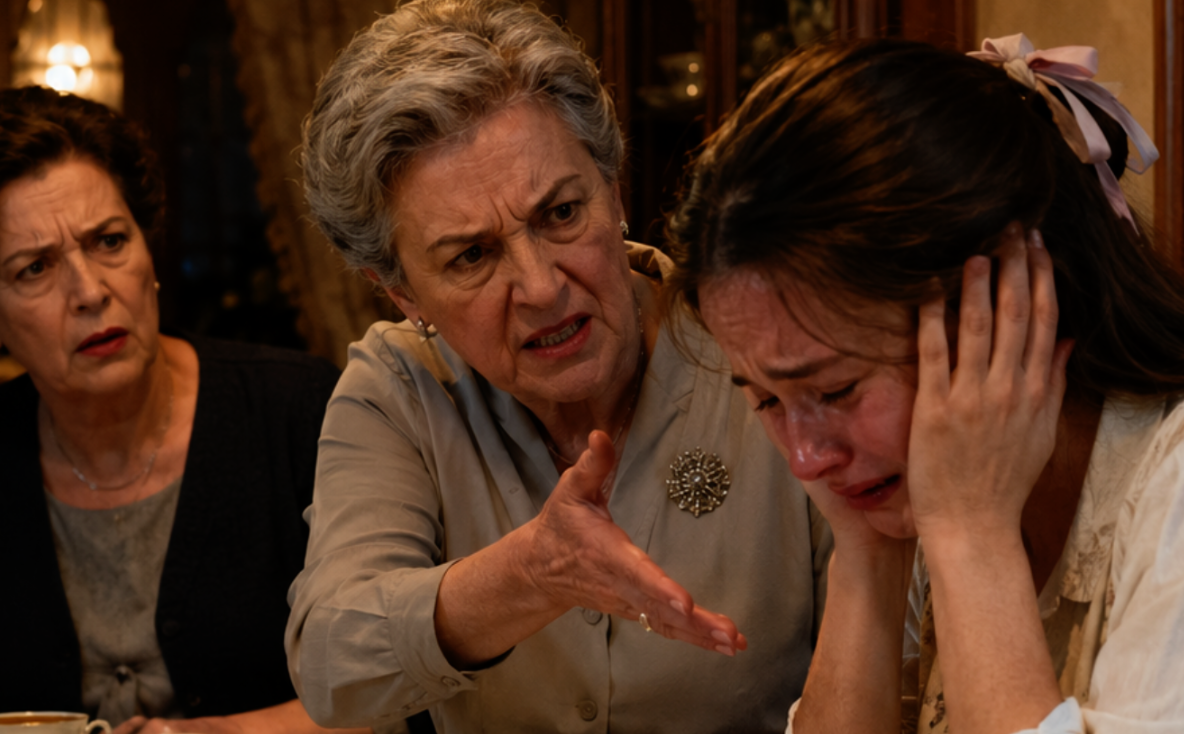
I quietly entered the apartment, unlocking the door with my own key, and heard my husband and mother-in-law talking in the kitchen.
“Mom, don’t worry. Soon I’ll leave her with nothing.”
I quietly entered the apartment, unlocking the door with my own key.
The bag with my things was pulling heavily on my shoulder. The business trip had drained me, and I wanted only one thing: to kick off my shoes, take a shower, and fall into bed. My husband was not expecting me until tomorrow. My mother-in-law even less so. I imagined their faces when I walked into the kitchen and even smiled in the dark hallway.
The kitchen light was on. I took a step forward, and then I heard Galina Stepanovna’s voice.
“Mom, don’t worry. Soon I’ll leave her with nothing. She’ll hand it all over herself, willingly. She’ll bring it to me on a silver platter. You know I know how to wait.”
I froze. My hand pressed itself against my stomach, as if protecting my insides from the blow. Denis’s voice sounded so calm, so ordinary. As if he were talking about the weather or a car loan.
“The main thing is that this upstart signs it,” my mother-in-law replied. “Without a scandal. And then she can go wherever she wants. With all that arrogance of hers…”
A teaspoon clinked. I stood there, not breathing. An icy sweat covered my back. My ears began to ring.
“Leave her with nothing.”
Numbers flashed through my mind. The apartment. My premarital apartment, bought with money from my first business, back when I didn’t even know Denis. The bank account. The flower shop I had built from scratch, taking out loans while he sat at home with a bad back and played computer games. I remembered how, three years ago, pregnant and sick with toxicosis, I had signed documents to expand the business because Denis had said, “I don’t understand any of this. You’re the brains in our family.”
The brains. And now he was planning to cut them off.
“Just don’t drag it out,” Galina Stepanovna continued. “The girl is cunning. If she senses something is wrong, it’ll all be over. And we need that money badly. Seryozha has already agreed to become manager. He’s a modest boy. He’ll listen.”
Seryozha. Some nephew of one of my mother-in-law’s friends. I had seen him once at Galina Stepanovna’s birthday. He sat in the corner, drank vodka, and told jokes about “women in business.” So they already had the staff prepared too. They had already picked the people.
“Don’t lecture me, Mom,” irritation cut through Denis’s voice. “I told you: she’ll bring it herself. I’ve thought everything through. A general power of attorney, then a couple of papers, and she won’t even understand at what moment she was left with nothing. I’m not a monster. I’ll leave her something. For the beginning, at least.”
He would leave me something. How generous.
I stood in the dark hallway and felt something hot and burning begin to boil inside me. Not tears. Tears came later. At that moment, it was rage. Pure, concentrated rage of a person betrayed in her own home.
I wanted to walk in. I wanted to throw my bag on the floor and scream, “I heard everything! Get out of my house!” But my feet seemed rooted to the floor. I imagined them turning around. Denis beginning to justify himself, pouring lies into my ears, lies he was so skilled at preparing. My mother-in-law pursing her lips and saying, “Anechka, you misunderstood everything. We were talking about a surprise for you.”
I knew them too well.
I needed to think. I needed time.
I took a step back toward the door. And then my bag hit the floor vase. The very same one my mother-in-law had given us for our wedding: bulky, ugly, covered in golden monograms. I had hated that vase for five years. And now it shattered loudly into pieces.
The silence in the kitchen broke.
“What was that?” Galina Stepanovna’s voice turned sharp.
“I don’t know. Probably the cat,” Denis answered, but there was no confidence in his tone anymore.
I stood surrounded by shards, staring at the strip of light coming from the kitchen. It was too late to run.
“Anya?” He came out into the hallway. “Is that you? We weren’t expecting you.”
I looked at my husband. Tall, slightly stooped, in a stretched-out T-shirt. His blond hair was messy. His eyes were blue, honest-looking, almost too honest. Once, I had thought those eyes were the most reliable in the world.
“I decided to come back early,” my voice sounded even. “To make a surprise.”
He came closer. Bent over the shards.
“You broke the vase. What bad luck. Don’t cut yourself. Go to the kitchen, Mom is having tea. I’ll clean this up.”
I walked past him. Galina Stepanovna was sitting at the table, straight as a spike, holding a cup in her hand. Not a single muscle moved on her face.
“Hello, Anechka. Tired?”
“A little.”
I sat across from her. I looked at her. And for the first time in a long while, I saw not just a grumbling mother-in-law, but an enemy. A predator waiting for its prey to weaken.
Denis followed me in.
“Tea?” he asked.
“Yes,” I said. “Please.”
And I smiled.
If they thought I was going to scream and smash dishes, then they did not know me at all.
That night, I did not sleep. Denis fell asleep quickly, as always, turning toward the wall and pulling the blanket up to his ears. I lay there staring at the ceiling, replaying every piece of our life together in my memory.
We met six years ago. Back then, I was already firmly on my feet. The flower shop “Anna,” two branches, my own suppliers, my own clients. I was thirty-two. I had grown up in an orphanage, achieved everything myself, and thought I knew everything about life.
Denis worked as a physics teacher at an ordinary school. A widower with an eight-year-old daughter, Masha. His wife had died of cancer when the girl was three. He came into my shop for a bouquet on the first of September — and stayed in my life. Modest, quiet, grateful for any attention. Masha attached herself to me immediately, and I to her. A year later, we got married. Another year later, Tyoma was born.
I thought I had found a family.
Denis left school a month after the wedding. He said he wanted to help me with the business. The help lasted two weeks. Then he realized flowers were not his thing. Then his back started hurting. Then some kind of depression began. I did not pressure him. I understood: the man had lost his first wife; he needed to recover. My business would feed everyone.
Galina Stepanovna moved in with us a year later. Officially, to help with Masha and the future grandson. In reality, to control my every step. What I cooked. How I dressed. Why I stayed late at work. How much I spent on cosmetics.
“A woman should be more modest, Anechka. The husband is the head, and the wife is the neck. But the neck must be flexible.”
I was flexible. I bent for so long that I forgot how to stand straight.
Now they wanted to break me completely.
I turned my head and looked at my sleeping husband. He was breathing evenly, calmly. He was not having nightmares. He did not feel ashamed at all. In their plan, he saw not betrayal, but the restoration of justice. “The husband is the head.” And the head cannot be supported by the wife. So all he had to do was take everything from the wife, and then the balance would be restored.
I closed my eyes.
All right. You want war. You will get war.
In the morning, I woke up before everyone else. I did exercises. I made breakfast. When Denis came into the kitchen, there were already fried eggs, fresh tomatoes, and coffee on the table.
“Wow,” he kissed me on the cheek. “Thank you. Why are you up so early?”
“I couldn’t sleep. I went to the store as soon as it opened.”
He sat at the table and unfolded the newspaper. I looked at his hands, at the long fingers holding the page. Those fingers would slide papers under my hand to sign. Those fingers would take my business from me.
“Denis,” I said. “I want to discuss something.”
He looked up. Wariness flashed in his eyes.
“Yes?”
“I’m tired. The business, the house, the children. I need more rest.”
He put down the newspaper.
“I’ve been telling you that for a long time. You’re wearing yourself out.”
“Could you take over some of my work? I want to transfer some authority to you. So you can help with the documents.”
A pause. Short. Almost unnoticeable. But I caught it.
“Of course,” he said. “I offered before. You just always said you could handle it yourself.”
“I changed my mind. Let’s deal with it this week, all right? We’ll draw up a power of attorney, you’ll go to the tax office…”
“A power of attorney,” he repeated, and I saw a spark light up in his eyes. A small, greedy spark of a person who sees prey walking into his hands on its own. “Yes, excellent idea. A general power of attorney. So I can handle everything while you’re away.”
“Exactly.”
He looked at me with gratitude. Almost childlike joy. And suddenly I understood: he truly believed he had a right to this. That this was not robbery, but a fair redistribution of resources. He was a man. He was the “head.” Why was the business not his? Why was the apartment not his? Why were the accounts not his? Injustice. And the fact that I had worked for twelve years, sixteen hours a day, while he lay on the couch — that was a detail that did not fit into his picture of the world.
“I’m so glad you finally understood this,” Denis said. “A family should be a team.”
“Yes,” I agreed. “A team.”
Galina Stepanovna entered the kitchen as we were finishing coffee. She was wearing a floral robe and curlers. She looked over the set table and nodded with satisfaction.
“Well done, Anechka. A wife should greet her husband with breakfast.”
I smiled. I could have said that for the last five years Denis had been the one making breakfast because I left for work at seven in the morning. But I didn’t need to.
“You are right, Galina Stepanovna. I have worked too much. It is time to give more attention to the family.”
She exchanged a glance with her son. Quickly, almost invisibly. But I noticed.
“A wise decision,” my mother-in-law said and sat down at the table. “Denis, pour your mother some tea.”
That week, I met with Lena, my accountant. We sat in a small café on the outskirts of the city, away from prying eyes. Lena had worked with me for eight years. She knew my business inside out and was the only person I trusted completely.
I told her everything. About the conversation I overheard. About the general power of attorney. About Seryozha, who had already “agreed to be manager.”
Lena listened, and her face changed. From surprise to anger. From anger to cold fury.
“What a scumbag,” she said bluntly. “And his mother is a scumbag too. What are we going to do?”
“I’m thinking.”
“You’re not seriously going to sign a power of attorney, are you?”
“I am.”
She stared at me.
“Have you lost your mind?”
“Lena, I will sign a power of attorney. But not the one they want. My lawyer is already preparing the document. On the outside, it will look impressive, but it won’t give him any right to alienate property. A dummy. And meanwhile, we’ll conduct an audit and prepare.”
Lena was silent for a moment.
“And if they understand?”
“They won’t. They want to believe too badly that I’m a fool.”
I took a sip of coffee. My soul felt dirty.
“You know what hurts the most?” I said. “I loved him. Truly. I thought we were a family. I accepted his daughter as my own. I gave birth to his son. And he looked at me and saw a wallet.”
Lena covered my hand with hers.
“It isn’t your fault, Anya. Some people are just built that way. They don’t know how to be grateful.”
“I know. But it still hurts.”
We sat for another hour discussing the details. I told her that my mother-in-law had casually mentioned “guardianship.” Lena whistled.
“What, do they want to declare you mentally incompetent and take Tyoma away?”
“Looks like it. That’s the backup plan.”
“Then don’t delay with the cameras.”
The next day, I installed a hidden camera at home. Officially, to watch the nanny who stayed with Tyoma. In reality, to record everything that happened in the kitchen while I was away. The camera was small, disguised as a smoke detector. Denis, a man far from technology, would never even suspect such a thing.
The first few days of recordings were calm. Ordinary conversations. Lunches. My mother-in-law complained about the neighbors. Denis watched television.
But I knew: they were waiting for me to bring the signed power of attorney. And when the moment came, they would reveal themselves.
I was not wrong.
On the fourth day, I turned on the recording. The quality was excellent, the sound clear. Galina Stepanovna and Denis were sitting at the table. My mother-in-law was cutting something. Denis was drinking tea.
“Well? Has she signed it yet?” Galina Stepanovna asked.
“She should bring it tomorrow.”
“You’d better make sure. If she suspects…”
“Mom, she won’t suspect anything. She trusts me.”
“Idiot.”
“That’s unfair,” there was offense in Denis’s voice. “She’s not an idiot. She’s just… trusting. She thinks that because we are family, I can’t deceive her.”
“And you can,” my mother-in-law smirked. “And you are doing the right thing. The girl spent her whole life digging through filth, and now she acts like a businesswoman. She put the apartment in her name, the accounts in her name, the business in her name. And who are you? An accessory? A man should not live like that. Your late father would never have allowed such a thing. He knew how to put a woman in her place right away.”
“Dad hit you, Mom. Did you forget?”
A pause. I even held my breath at the screen.
“He did,” my mother-in-law said calmly. “And he was right to. Because I respected him. And this woman of yours does not respect you. She despises you. To her, you are just an attachment. When will you understand that?”
“Soon. Tomorrow she’ll bring the power of attorney, and we’ll start acting. Mom, give me time. I want to do everything carefully. She’s the mother of my son. I don’t want a scandal.”
“You are too soft, Denis. Too soft. Who did you turn out like?”
“You,” he said. “You tolerated Father your whole life. And I tolerate Anna. The only difference is that I won’t wait twenty years. I’ll solve the problem in a month.”
I turned off the recording. My hands were shaking. I stood up, went to the window, and pressed my forehead against the cold glass.
He did not simply not love me. He hated me. He compared me to his tyrant father and believed that I was the one humiliating him. In his picture of the world, I was the aggressor, and he was the patient victim finally rising against the oppressor.
That was the most terrifying thing. He sincerely believed he was right. He was not a thief, not a robber. He was a fighter for justice.
I cried. Not from fear. From pain. From the realization that for five years I had lived with a person who looked at me and saw an enemy. I remembered how I paid for his treatment when he had a spinal hernia. How I found the best speech therapist for Masha and drove her to classes twice a week. How I bought vacation trips to the sea for both of them — my mother-in-law and Masha — while I myself worked in a stuffy office. I thought it was an investment in family. And they saw it as confirmation of my superiority. My “guilt.”
Enough.
I wiped away my tears. Sat down at the laptop. Opened my email. My lawyer had sent the finished power of attorney. Seven pages of legal text, in which there was not a single word allowing Denis to dispose of my property. A beautiful wrapper with emptiness inside.
I reread it three times. Saved the file. And sent it to print.
Tomorrow, I would give him that paper. And the second act would begin.
Three days later, we went out of town. Denis suggested it — “to get some fresh air, to be together.” I agreed. We took Masha with us.
It was the end of April. The snow had already melted, the ground was drying, but the evenings were still cold. We lit a fire on the shore of a small lake. Denis sat with his phone, typing something. Masha threw twigs into the fire and watched them flare up.
“Anya, look, stars,” she said.
I lifted my head. The sky was clear, without a single cloud. The stars hung low, bright, sharp. I found a familiar pattern with my eyes.
“See those three stars in a row?” I pointed. “That is Orion’s Belt. The constellation of the hunter.”
“Why Belt?”
“Because it looks like a belt. Sailors used those stars to check their course. They always hang over the equator, at any time of year. If you see them, you know where south is.”
“Beautiful,” Masha tilted her head back. “Teach me how to find something else.”
I showed her the Big Dipper, Cassiopeia, the North Star. Denis looked up from his phone and listened with half an ear.
“Sentimentality never leads to anything good,” he said when I fell silent. “Business is business. Stars have nothing to do with it.”
“You think so?”
“Mom says you’re too soft for business. Too many emotions.”
I looked at him. In the reflections of the fire, his face seemed unfamiliar.
“You know, Denis, softness is not weakness,” I said. “It is cushioning. A spring that can uncoil so hard it breaks the spine of the one who pressed down on it too much.”
He froze. For a second, something like alarm flashed in his eyes.
“What are you talking about?”
“Nothing. Just thinking out loud.”
I turned away. Masha looked at me curiously. She was a smart girl, too smart for her thirteen years. I knew she felt the tension in the house, even if she did not understand the reasons.
“The most important thing in life, Masha,” I said quietly, “is not to forget where your true north is. No matter what happens. Hold on to what truly matters to you.”
She nodded. And moved closer to me.
Denis buried himself in his phone again.
And a week later, the family dinner happened.
Galina Stepanovna insisted on it. She said she wanted to gather the whole family, that we had not sat together at the table like normal people for a long time. I cooked duck with apples, baked a pie, and took the formal dinner set out of the cabinet. My mother-in-law arrived dressed up: a blouse with a brooch, hair styled, lips painted. Denis put on a shirt. Masha sat dressed neatly, with a bow. I put Tyoma to bed early.
On the outside, everything looked perfect. Family idyll. An advertisement for a happy home.
But I knew what would happen next.
The power of attorney had been signed a week earlier. Denis and his mother thought the matter was done. They had the tool. Now all that remained was to start the process — and Anna would be left with nothing. I saw how Galina Stepanovna glanced at me with poorly hidden triumph. How Denis was nervous but tried to look confident.
We ate duck. Talked about the weather. My mother-in-law praised the pie.
And then it all began.
“Anechka,” Galina Stepanovna said, putting down her fork, “pour the boy some juice. Can’t you see he wants to drink?”
I looked at her. Tyoma was asleep in his room. There were no other “boys” at the table. She was addressing me the way one addresses a servant.
“I’ll do it now,” I started to get up.
“No, wait,” my mother-in-law raised her hand. “Sit down. I want to talk.”
I sat down. Denis tensed.
“Denis and I discussed things,” Galina Stepanovna continued, “and we decided it is time to bring order to your family. You have taken too much upon yourself, Anechka. The business, money, decisions. A woman should not carry such a burden. You are exhausted. You need rest.”
“Rest,” I repeated.
“Yes. Hand the matters over to Denis. He is a man. He will manage. And you should take care of the house, the children. Live calmly, don’t get nervous. It is harmful for you to get nervous.”
I stayed silent. She took my silence for weakness and spoke with more confidence.
“The apartment should also be transferred. Family property should be shared, not hanging on one woman. We have thought everything through. It will be fair.”
“Fair,” I smiled bitterly. “Galina Stepanovna, do you know where this apartment came from?”
“What difference does it make, dear? You are married now. Everything acquired during marriage belongs to both spouses.”
“The apartment was bought three years before marriage,” I said. “With money I earned myself. Without Denis. Without you. Without anyone else.”
She turned crimson.
“What are you implying?”
“I am not implying. I am saying it directly. The business is registered in my name. The accounts are in my name. The apartment is my premarital property. And the power of attorney I signed a week ago does not give Denis any rights to alienate my property. It is a dummy. A fiction. A piece of paper that no court will accept.”
A pause hung in the air, thick as jelly. Denis froze with the knife in his hand.
“What?” His voice turned hoarse. “What did you say?”
“You heard me.”
“You gave me a fake power of attorney?”
“And you wanted to give me fake love,” I looked directly into his eyes. “I heard your conversation that evening when I came back from the business trip. ‘Mom, don’t worry, soon I’ll leave her with nothing.’ Remember? And I also recorded your conversation on the camera I installed in the kitchen. Do you want to listen? There is a lot of interesting material there. About how I despise you, how you are tired of tolerating me, how you want to solve the problem in a month.”
Denis’s face turned white. Galina Stepanovna opened her mouth but made no sound.
“You… you were spying on us?” she squeezed out.
“In my own home?” I shrugged. “Why? Were you hiding something?”
“Denis!” my mother-in-law shrieked. “Tell her! She was eavesdropping on us! That is illegal!”
“And a conspiracy to seize property is legal?” I spoke calmly, though everything inside me was boiling. “Preparing to declare me mentally incompetent and take my child from me — is that legal? Galina Stepanovna, I grew up in an orphanage. I have seen people like you. Do you think I don’t know how to protect myself?”
“You…” she was choking.
And then Masha’s quiet voice sounded.
“Dad, is it true?”
Everyone turned. The girl was sitting there, clutching the edge of the table with her hands. Her eyes were huge, full of tears.
“Masha, go to your room,” Denis said quickly.
“No. I want to know. Did you want to take Anya’s flowers?”
“Daughter, these are adult matters. You won’t understand…”
“I understand everything,” she spoke louder. “I heard Grandma telling Aunt Zina that after Anna ‘leaves,’ they will send me to the village. That I won’t see Anya or Tyoma anymore. Is that true?”
Galina Stepanovna turned pale.
“Mashenka, you misunderstood. Grandma wanted what was best…”
“I don’t want to go to the village!” Masha was almost screaming. “I don’t want to live with you! You scold me all the time! It was Anya who took me to the speech therapist! Anya helped me with my homework! Anya took me to the movies and bought me books! And you and Dad only say that I should be grateful and that I’m ‘not your blood’!”
The room fell silent. So silent that I could hear the clock ticking on the wall.
“Masha…” Denis looked as if he had been hit.
“I heard everything, Dad. I’m not little. I’m not stupid. And I’m not going to the village.”
She burst into tears and ran out of the room.
Galina Stepanovna stood up. Her face twisted.
“This is you,” she jabbed a finger at me. “You turned the child against her family.”
“Get out of my house,” I said.
“What?”
“You heard me. This is my home. My apartment. You are nobody here. Leave immediately, or I will call the police.”
She looked at me, opening and closing her mouth. Then she looked at Denis.
“Tell her. Tell her she cannot throw your mother out.”
Denis was silent. He stared at the table. I saw his hands trembling.
“Denis!” my mother-in-law barked.
“Mom,” he said without raising his eyes. “Leave.”
“What?!”
“Leave. Please.”
He lifted his head, and I saw emptiness in his eyes. Not remorse. Not anger. Just emptiness. That is what a person looks like when his picture of the world has collapsed. He thought he was the main character, but he turned out to be an extra.
Galina Stepanovna grabbed her bag.
“Well, to hell with you,” she spat. “Both of you. You are a rag, Denis. A rag, not a man. Your father was right. You will never become a real person. And you,” she turned to me, “you will cry yet. You will remember me.”
“Close the door behind you.”
She left, slamming the door so hard the glass shook.
Denis and I were left alone.
He sat at the table, shoulders lowered. His hands rested on his knees, fingers intertwined. I looked at him and tried to find even a drop of pity inside myself.
I found none.
“Why did you do that?” he asked dully. “Why didn’t you say something right away?”
“And why didn’t you say something? Why didn’t you come to me and explain what you were unhappy with? Why did you discuss it with your mother and not with me?”
He was silent.
“I would have given everything, Denis. Everything I have. If you had asked. If you had come and said, ‘Anya, I feel worthless. I want to take part in the business. Give me a chance.’ I would have given you one. But you did not ask. You decided to take. You decided to steal. Because asking means admitting my power. And you could not do that. Your pride would not allow it. Or what you call pride.”
“You don’t understand…”
“I understand everything. Your mother beat you in childhood and humiliated you. Your father beat your mother. You grew up in an atmosphere of violence and believe that relationships are always a fight for power. Either you are on top, or people ride on your back. There is no third option. Well, Denis, I will let you in on a secret. There is a third option. It is called partnership. But you would not recognize it even if it hit you on the head.”
I stood up.
“Are you leaving today or tomorrow?”
He looked up.
“You’re throwing me out?”
“Yes.”
“And Masha? And Tyoma?”
“Tyoma will stay with me. Masha will decide for herself who she wants to live with. She is thirteen. The court will take her opinion into account. You know that.”
“I won’t give up the children.”
“That is not for you to decide.”
He stood up. His face distorted.
“You cannot just take me and erase me from life.”
“I can. You erased yourself. I am just putting the signature.”
He looked at me for a long time. There was everything in that look: hatred, fear, resentment, wounded pride. But there was no love. Maybe there had never been any.
“I’ll pack my things,” he said.
“Pack.”
He left the kitchen. I stood by the window, looking at the evening city, listening as he walked around the apartment, opened closets, threw something into a bag. Half an hour later, he appeared in the kitchen doorway with a suitcase.
“Can I take Masha for weekends?”
“If she wants.”
He nodded. Shifted from foot to foot.
“I really thought it would be better this way. For everyone.”
I did not answer. He went toward the exit. In the hallway, he stopped.
“Goodbye.”
“Wait.”
He turned around. I took an envelope from the drawer and handed it to him.
“Here are tickets to Novosibirsk. And the keys to a one-room apartment on Entuziastov. I transferred it to your name. There is also fifty thousand in cash.”
He looked at the envelope, not daring to take it.
“Why?”
“Because I do not want your daughter to see a destitute father. And I do not want my son to be ashamed of your surname. I will not leave you with nothing, Denis. I am simply leaving you alone with your mother. And with the emptiness you created. That is scarier than poverty. Live with it.”
He took the envelope. His hands were shaking.
“You are cruel,” he said. “You have always been cruel.”
“No. I simply stopped being soft.”
He left. The door closed with a quiet click.
I stood for a minute, listening to the silence. Then I went to Masha’s bedroom. She was lying on the bed, face buried in the pillow. I sat beside her and stroked her hair.
“Did he leave?”
“Yes.”
“Did you cry?”
“No.”
“I won’t either.”
She turned over and looked at me with red, swollen eyes.
“And Tyoma?”
“Tyoma is sleeping. He heard nothing.”
“Anya, are we alone now?”
“No. There is you, me, and Tyoma. We are not alone.”
She was silent for a while.
“I don’t want to go to Grandma.”
“You won’t.”
“And I don’t want to go to Dad. He is bad.”
I sighed.
“He is not bad. He is just weak. And confused. Maybe one day he will understand that. Maybe not. But that is not our concern. We have our own life.”
Masha moved closer.
“You won’t abandon me?”
“No,” I hugged her. “I won’t abandon you.”
She sniffled, gradually calming down. I sat in the semi-darkness, listened to her breathing, and thought about how strangely life works. I wanted a family. I built a family. And in the end, my true family turned out not to be the one I entered, but the one I created myself. A teenage girl who chose me instead of her blood relatives. A little boy in the next room who did not know his father had left. A flower shop that would open tomorrow as usual, because life does not stop.
I kissed the top of Masha’s head and went to the kitchen. Poured myself some tea. Sat down at the laptop. Opened the file with the network development plan for the next year. Three new branches. A contract with Dutch suppliers. Entering the wedding décor market.
I worked until midnight. And when I went to bed, I suddenly remembered that night when I stood in the dark hallway and listened as my husband and mother-in-law discussed my future. Back then, it seemed to me that my life was over. That I had been betrayed, trampled, thrown away.
Now I understood: it had been the beginning. The beginning of a new life in which I owed nothing to anyone.
They say revenge is a dish best served cold. No. Revenge is when you let a person go exactly where he was most afraid to end up: into worthlessness. And the tea does not even have time to get cold.
I took a sip. The tea was hot.