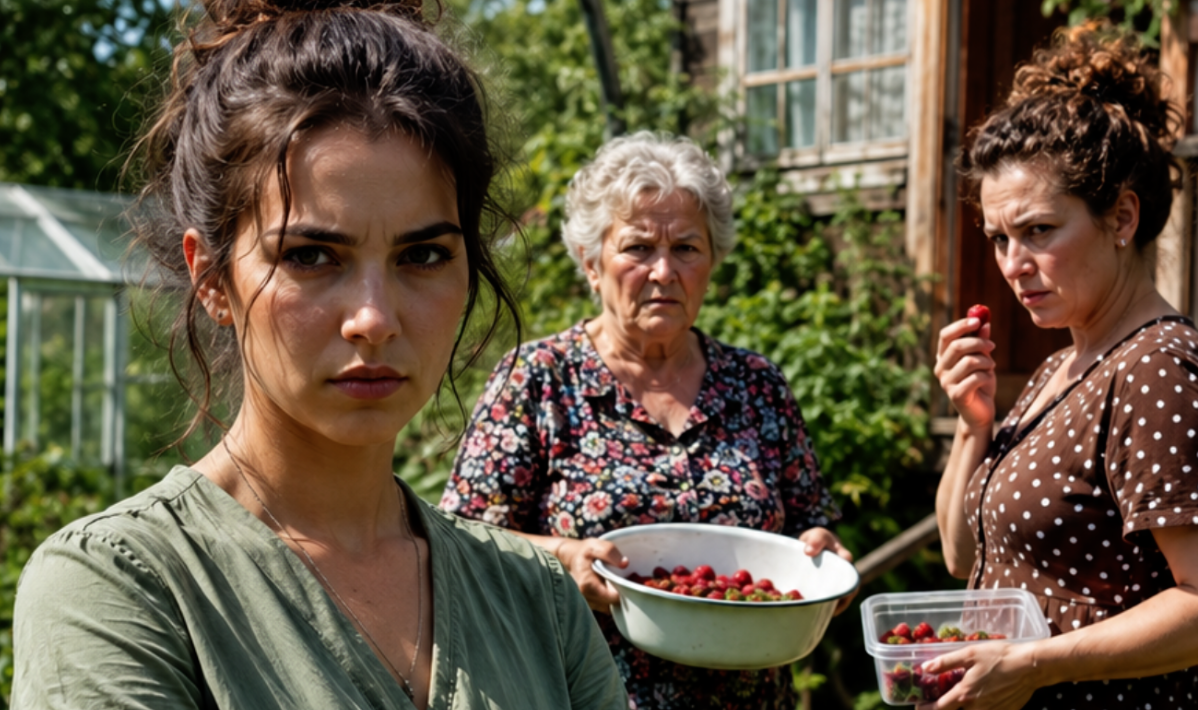
“We’ve already divided everything up,” my mother-in-law and sister-in-law announced when they arrived to collect my first harvest. But they reached for the baskets far too soon.
“We’ve already divided everything up, Irochka. Don’t fuss. We’ll manage everything ourselves. The main thing is, don’t mix anything up.”
I stood on the porch of my dacha with my arms crossed, watching the landing party arrive with a faint smile.
The end of June had turned out hot. The air above the garden beds shimmered, smelling of warm soil and tomato leaves.
From the SUV parked by the gate, my mother-in-law, Galina Petrovna, emerged majestically, like an empress stepping out of a carriage.
Behind her, rattling empty plastic containers, came my sister-in-law Larisa.
In their hands they carried a whole stack of containers, bags with the logos of expensive boutiques, and large enamel bowls. Larisa had even brought a roll of masking tape and a black marker.
“Here’s how it’s going to be,” Galina Petrovna said, adjusting her straw hat and casting a proprietary look over my neat, weeded beds. “The red containers are for Larisa. She needs strawberries for the children for the week, vitamins. The blue ones are for me. Early cucumbers, greens, some dill. And three more baskets of berries are for my girls. I promised Zinaida and Anechka. They’ve been waiting and waiting!”
Neither my mother-in-law nor my sister-in-law had shown up at the dacha once all spring.
In April, when my husband Pasha and I were hauling bags of soil and building new raised beds, Galina Petrovna had “a stabbing pain under her shoulder blade.” In May, when I was on all fours planting seedlings in an icy wind, Larisa was “attending a fashionable training on finding her inner resource.”
Apparently, that resource was found just in time for the first harvest.
Larisa strode businesslike along the plantings, pointing a perfectly manicured finger toward the greens.
“Ira, pull up all this radish. And cut the spinach right down to the root. Young leaves are the healthiest. And in general, strawberries need to be picked according to the lunar calendar. If you pick them during the waning moon, they draw all negative energy and free radicals out of the body. That’s a scientific fact. I read it from some guru online. So come on, hurry up before the phase changes.”
I slowly came down from the porch, feeling a cheerful, tickling anticipation beginning to boil inside me.
“Larisa, radishes bolt and become woody not because of the moon, but because of long daylight hours and insufficient watering,” I replied calmly. “If you don’t water the bed to a depth of at least ten centimeters, the root will taste bitter. And the only thing draining energy here is your habit of reading anti-scientific nonsense.”
Larisa instantly flared up, turning a deep red with indignation.
“You always have to make yourself look like the smartest one. It’s unbearable!” she shrieked.
She puffed out her cheeks and planted her hands on her hips, becoming comically similar to an angry hamster who had forgotten to be informed that he was not the ruler of the universe.
Meanwhile, Galina Petrovna was already inspecting the greenhouse.
“Ira!” came her voice from behind the polycarbonate walls. “Don’t touch those cucumbers hanging on the left! I’ll give them to Zinaida tomorrow. And pick the strawberries right now, in the morning, before they get soft from the sun.”
“Galina Petrovna,” I said, walking up to the greenhouse. “Strawberries are actually not watered for a couple of days before picking so they don’t become watery and rot on the way in your containers. That’s basic gardening technique.”
My mother-in-law waved me off as if I were an annoying fly.
“Oh, don’t act clever. Go get the containers. We’re waiting.”
I nodded, turned around, and went to the shed.
Inside, in the welcome coolness, my husband was busy fixing the well pump. Pasha was smeared with machine oil, tired but satisfied.
“Your family is here,” I said, taking tools down from the top shelf. “They’ve arrived to divide the property.”
Pasha wiped his forehead with the back of his hand and frowned.
“What do you mean? They were supposed to go to their own dacha.”
“They forgot the way,” I smirked. “Come and watch this performance. Just don’t interfere yet.”
I came out of the shed. In one hand, I carried two woven baskets; in the other, two brand-new, sharply honed hoes, with rubberized gloves resting on top of them.
Galina Petrovna and Larisa spread into condescending smiles when they saw the baskets. They had clearly decided I had accepted their authority and was ready to serve them.
“Here,” I said, tossing the baskets onto the grass, driving the hoes into the soil at their feet with one forceful movement, and laying the gloves on the handles. “Take them.”
“What’s this for?” Larisa asked, looking at the garden tools with disgust.
“This is your pass to the harvest,” I said, crossing my arms. “Galina Petrovna, your dacha is exactly fifteen minutes away from here, in the Romashka gardening community. There are strawberries there too, currants, a greenhouse, and garden beds. True, you haven’t been there since last September. Whatever you weed, water, and harvest there today with your own hands, you can divide without me. Give it to Zinaida or to those internet gurus of yours.”
My mother-in-law and sister-in-law froze, digesting what they had heard. For a moment, it became so quiet that you could hear a bumblebee buzzing above the bed.
“How dare you?” my mother-in-law hissed, her face changing. “We are guests! We came to visit our son and brother! We’re family!”
“Family means people who work together and then eat together,” I countered without raising my voice. “You came at the end of June to take everything ready-made, with labeled jars. That’s not how this works.”
“I am not climbing into that waist-high grass!” Larisa shrieked, stepping away from the hoe as if it were a poisonous snake. “There are ticks there! And anyway, since we came all this way, at least give us one basket from your dacha! Did we burn gas for nothing?!”
And then, as if on cue from an invisible director, a white Toyota smoothly rolled up to our gate.
Out of it, chirping happily and clinking three-liter glass jars, fluttered two retired ladies — the very same Zinaida and Anechka.
“Galochka!” Zinaida sang, hurrying toward the gate. “We came right after you! You said the harvest here was unbelievable, that you had nowhere to put the cucumbers, that strawberries were rotting on the bushes! We brought the jars, just like we agreed!”
Galina Petrovna turned pale, and then a crimson blush flooded her cheeks. Her “charity” at someone else’s expense was in danger of being exposed.
“Girls,” my mother-in-law forced out, nervously tugging at the brim of her hat. “Here’s the thing…”
“Good afternoon!” I stepped forward, beaming at my mother-in-law’s friends. “You’ve got the address a little wrong. Galina Petrovna’s unbelievable harvest is in the neighboring settlement. Though right now it is being guarded by two-meter thickets of hogweed and nettles, because its generous owner hasn’t been there since autumn. This plot was planted, weeded, and watered by me. And the harvest here is not rotting, don’t worry.”
The friends froze with their mouths open, looking from my perfect beds to the purple-faced Galina Petrovna, then to the brand-new hoes sticking out of the ground.
“Galya?” Zinaida drawled indignantly. “So you were planning to treat us to someone else’s cucumbers? And you bragged the whole way about how you had broken your back in the garden!”
“How dare you disgrace me?!” my mother-in-law burst out, now shouting at me. “Pasha! Pasha, come here this instant! Your wife has completely lost her mind!”
Pasha came out from behind the greenhouse, wiping his hands with a rag. He calmly took in the picturesque scene: his furious mother, his embarrassed sister, the stunned spectators with empty jars, and me, peacefully leaning on the handle of a shovel.
“I heard everything, Mom,” my husband said, his voice firm and even, without a trace of his usual softness. “Ira is right. We worked ourselves to the bone here all spring. You said you didn’t need the dacha. Larisa said cucumbers were easier to buy at the store. So go buy them. In summer, only those who take part in the work get the harvest.”
“You… you traded your mother for these garden beds!” Galina Petrovna cried tragically, realizing that her manipulation had failed.
“No, Mom. I simply value my wife’s work,” Pavel cut her off. “The tools are right in front of you. Your dacha is to the right along the highway. Have a productive day.”
Larisa angrily kicked an empty plastic container, grabbed her expensive designer bag, and silently headed to the car.
Galina Petrovna, throwing us a scorching look that promised eternal resentment, proudly followed her. Her friends, whispering to each other and shaking their heads disapprovingly, hurried back to their Toyota.
The cars drove away, raising a small cloud of dry dust. The plot became quiet again, with only the bumblebees buzzing over the flowering zucchini.
Pasha came up to me, put his arm around my shoulders, and looked at the two lonely hoes sticking out of the ground.
“Well, have the tribute collectors left?” he smirked.
“They’ve left,” I said, inhaling with pleasure the hot air scented with greenery. “Let’s go pick strawberries. Otherwise, the phase of the moon might change.”