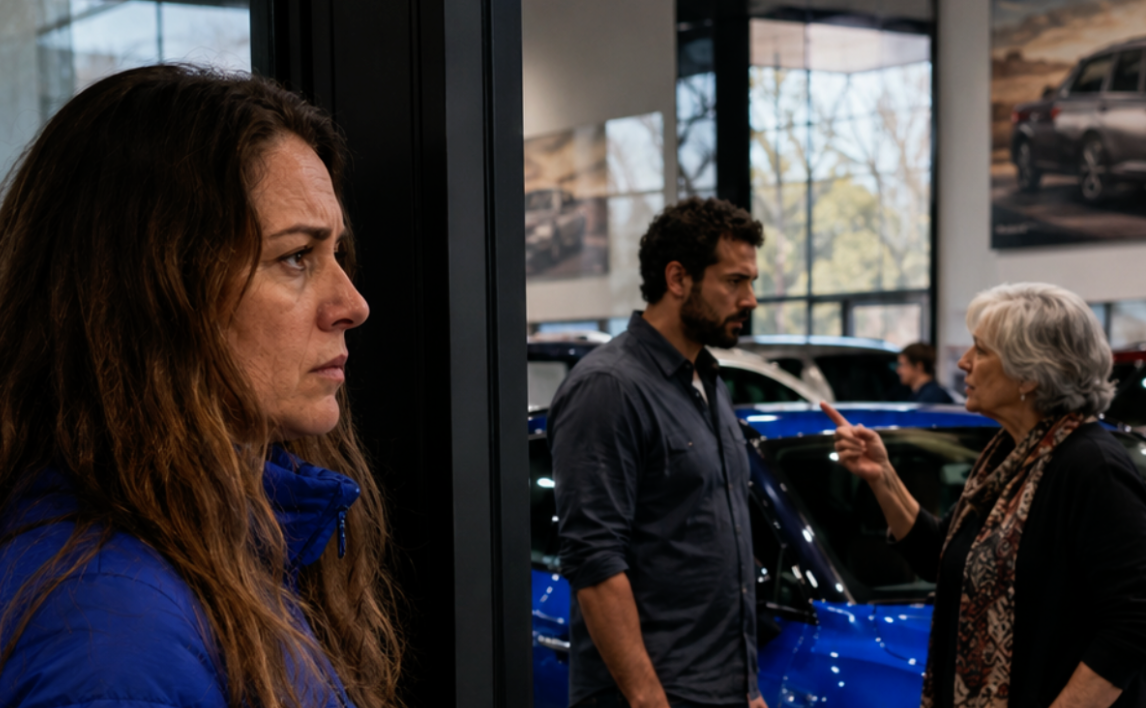
“Let’s take this crossover. The main thing is that Lera gets the loan approved tomorrow. She still thinks the money will be used to pay off the old debts.”
“Once she signs, it’ll be too late to argue,” Maxim replied calmly.
Valeria stood behind the glass near the entrance to the car dealership, motionless. Her husband and mother-in-law were examining the dashboard of a new car, unaware that she was there. All the conversations about family troubles, debts, and their future together—it had all been nothing more than a way to get her signature.
Eight years was more than just a number. It was the mortgage they had been paying together, their son Artyom, who had recently turned six, and thousands of small decisions they had made together at the same table. Valeria had always believed she could tell what was genuine from what was merely for show.
It turned out she couldn’t.
She handled the family finances. Maxim earned a decent salary, but money never seemed to stay in his hands. Something urgently needed to be bought, a friend needed help, or “things just happened.” Valeria never reproached him. She kept spreadsheets, monitored payments, and set aside small amounts for emergencies.
She thought that was simply how a family worked: one person earned the money, while the other kept everything in order.
She discovered his first secret loan by accident three years earlier while sorting through the mail. Maxim explained it calmly: his salary had been delayed, he had urgently needed money, and he hadn’t wanted to worry her.
Valeria believed him.
Then there was a second loan—for car repairs.
A third—because a client had let him down.
Every time there was an explanation, and every time it sounded convincing.
Gradually, the debts began to take on a life of their own. One loan was used to cover another. Then came overdue payments and penalties. Eventually, banks stopped approving Maxim’s applications.
That was when Valentina Pavlovna rang their doorbell.
Her mother-in-law entered without wasting time on small talk, sat down at the table, and immediately got to the point.
“We need to take out one large loan and pay off all the old ones,” she said in the tone of someone who had already made the decision. “Then the interest will stop piling up and you’ll finally be able to live normally. The bank rejected Maxim, but they’ll approve you without any problem. It’s only a temporary measure, Valeria. My son will make the payments.”
Valeria listened in silence.
She did not refuse immediately. That would have seemed rude, and, to be fair, the idea sounded reasonable.
“All right,” she finally said. “Show me all the agreements and calculations. I want to understand exactly how much we owe and precisely where the money will go.”
Valentina Pavlovna pursed her lips slightly but nodded.
Maxim looked away.
Valeria never saw the documents.
The first time, Maxim said he had left them in the car and promised to bring them the next day.
The following day, it turned out the folder was at his mother’s house.
When Valeria suggested they drive over together and get it, he waved the idea away.
“There’s really nothing to look at. It’s a standard amount. Everything’s official.”
“Then why can’t you simply show me?” she asked.
“Why do you have to make everything so complicated?” Maxim frowned. “I already explained it. We take out the loan, pay off the debts, and move on.”
Valeria fell silent.
But a doubt had already begun to grow inside her.
Valentina Pavlovna called almost every day. Her voice remained steady, almost weary—the way people speak to someone who keeps delaying an obvious decision.
“Don’t drag this out. The interest grows every day.”
“A normal wife would have helped already in a situation like this.”
“Do you really begrudge your own family?”
Each time Valeria answered calmly, ended the call, and stared out the window.
The pressure kept increasing, but strangely enough, it was that very pressure that made her think more clearly.
She suddenly realized something very simple.
Not once during all those days had anyone told her the exact amount of the debts.
No one had explained the terms of the new loan, the interest rate, or the repayment period.
Every conversation came down to the same thing—her signature.
Only her signature.
Nothing else.
That feeling—quiet but persistent—would not leave her.
The day before they were supposed to go to the bank, Valeria drove to the shopping center. Artyom needed new sneakers; he had long since outgrown his old pair.
She immediately recognized Maxim’s car in the parking lot.
The silver Ford was parked near the entrance.
Valeria was surprised but decided it could simply be a coincidence.
She went inside, looked around, and spotted her husband through the glass windows of a car dealership on the ground floor.
Maxim was standing next to Valentina Pavlovna.
They were both looking at a dark blue crossover, walking around it and peering inside.
Her mother-in-law was saying something.
Maxim nodded.
Valeria moved closer.
She had almost placed her hand on the door handle when she stopped.
“We’re definitely taking this one,” Maxim said. “The color’s good, and the trim level is nice.”
“The main thing is that Lera gets everything approved tomorrow,” Valentina Pavlovna replied quietly. “She’s convinced the money is going toward the debts. Let her keep thinking that. Once she signs, she won’t be able to change anything. Then you can buy the car without any trouble.”
Maxim smirked and ran his palm across the hood.
Valeria stood behind the glass.
Her legs would not move.
She looked at her husband—at his calm face, at the familiar gesture—and realized that perhaps she was seeing him clearly for the first time in her life.
Then she slowly removed her hand from the door handle, turned around, and walked toward the exit.
She bought Artyom’s sneakers at another store.
The next morning, Maxim was unusually cheerful.
He hurried Valeria through breakfast, asked several times whether she had brought her passport, and spent the entire drive to the bank talking about how much easier everything would become once they finally paid everything off.
Valentina Pavlovna was waiting for them at the entrance.
She gave Valeria a curt nod, barely looking at her.
Inside the bank, the air smelled of air conditioning and freshly printed paper.
The manager—a young man wearing a blue tie—had already arranged the documents on the desk and prepared a pen.
“Just sign quickly. He’s already prepared everything,” Maxim said quietly, pushing the folder closer to her.
Valeria did not take the pen.
She opened the first page and read the heading.
Then she looked up at the manager.
“Could you please tell me what the purpose of this loan is?”
The employee answered evenly and without hesitation.
“It’s a consumer loan for the purchase of a vehicle.”
Behind her, Valentina Pavlovna let out a short breath.
Maxim stepped forward.
“It’s… we were going to explain later. There are some details…”
“There’s no need to explain anymore,” Valeria said calmly. “Yesterday, at the shopping center, I heard your conversation. All of it.”
Silence filled the room.
Maxim said nothing.
Red blotches appeared on his cheeks.
Valentina Pavlovna was the first to speak. Her voice trembled slightly.
“But the car is for the family too, Valeria. You have to understand…”
Valeria closed the folder, carefully placed it back on the desk, and stood up.
The manager stared at his computer screen with deliberate indifference.
She walked out without looking back.
That same evening, Valeria opened her laptop and methodically changed the passwords for all her banking apps.
Then she called her bank and asked them to open a separate account in her name only.
It was not an impulse.
It was not revenge.
It was a decision she should have made a long time ago.
Maxim came home late.
He stood in the hallway for a long time before finally entering the kitchen and sitting across from her.
“You could have just asked,” he said at last.
“I did ask,” Valeria replied. “Several times. Every time, I was told there was nothing worth seeing.”
He said nothing.
The debts had not disappeared. Now Maxim had to deal with them himself.
He put his old car up for sale just one week later.
Then came negotiations with the banks about restructuring, phone calls, paperwork, and miserable hours spent waiting in lines.
The dark blue crossover at the dealership, of course, remained someone else’s car.
For a while, Valentina Pavlovna called relatives and told them that her daughter-in-law had refused to help her son during a difficult time and had abandoned the family to deal with everything on their own.
Valeria heard about it from her sister-in-law, who called her personally, sounding slightly embarrassed.
“Don’t take it personally, but people eventually found out that the whole thing was actually about a car,” she said. “So… there aren’t many people sympathizing with them.”
Valeria thanked her and ended the call.
Outside, evening was falling.
Artyom was asleep in the next room.
She sat quietly for a while, then got up and went to check whether he was properly covered.
After that experience, Valeria adopted one simple rule.
She never again signed a document without reading it completely—from the first line to the last.
It did not matter how long it took.
It did not matter who was waiting beside her or how pointedly they kept checking the time.
One day at work, a colleague asked her to sign a power of attorney.
“It’s all standard. Just a formality,” the woman said, handing her the sheet of paper.
Valeria took the document and began to read.
“Real formalities aren’t hidden from someone until the very last moment,” she replied without looking up from the text.
Her colleague looked slightly surprised but said nothing.
Later, Valeria often thought about how betrayal rarely appears all at once, fully formed.
More often, it develops gradually—from small omissions, from documents that “aren’t worth looking at,” from explanations that sound perfectly reasonable until you finally see the entire picture.
Trust, once broken by things like that, could never truly be put back together again.