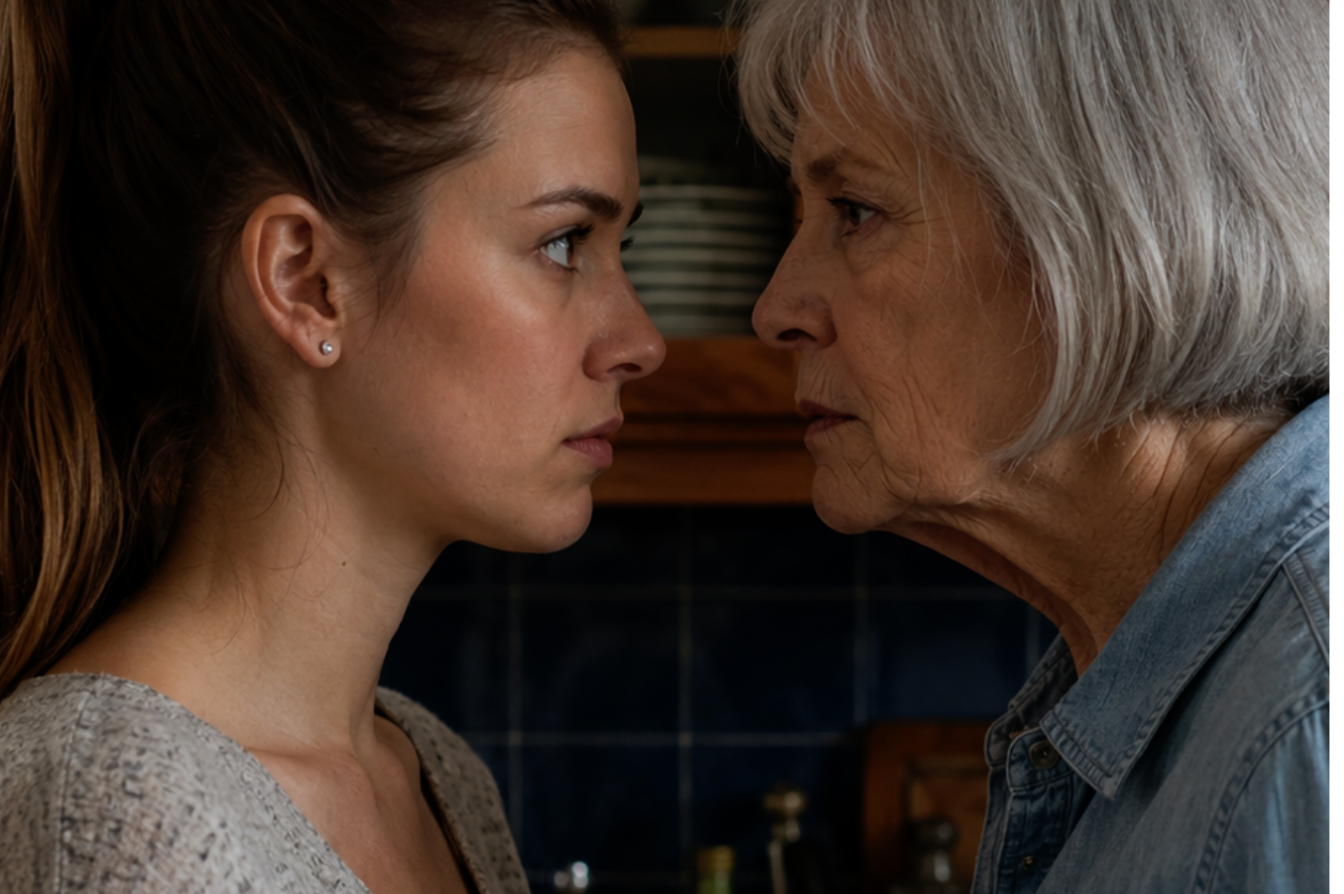
“If you’re as poor and miserable as you claim, then live on crackers and water. You won’t get any more money from us.”
Sveta didn’t go to the bank. She didn’t even go to their usual supermarket near the house. Her car confidently passed the bright signs of familiar stores and turned toward the outskirts of the district, stopping near a squat gray-brick building with a single sign over the entrance: “Groceries.”
It was the lowest kind of discount store, the sort of place people came not for variety, but simply to survive.
Inside, it smelled of damp cardboard and cheap plastic. Dim fluorescent lights buzzed overhead, casting a merciless glare over rows of shelves.
She didn’t take a shopping cart. A large woven basket was enough.
Sveta moved through the store with cold, surgical precision. Her eyes passed over colorful packages, ignoring anything that might offer even the slightest culinary pleasure.
She was looking for something else.
She was looking for the essence of the poverty her mother-in-law loved talking about so much.
There it was—pasta.
Not high-quality durum-wheat pasta in attractive packages decorated with Italian flags, but grayish, brittle elbow macaroni in a plain transparent bag with a crooked label stuck to it. She took the largest package, about two kilograms.
Next came grains.
Not premium rice or buckwheat, but the cheapest pearl barley, with dark specks visible through cloudy cellophane. The bag landed with a dull thud against the pasta in her basket.
Finally, in the bread section, she found exactly what she wanted.
Hard, stale crackers, packed in similarly anonymous plastic bags.
Perfect fuel for survival.
Nothing else.
No butter. No sugar. No tea.
Only the basics.
After paying at the register with a crumpled banknote and receiving her change in small coins, she put everything into one large bag and stepped outside.
After the stuffy atmosphere of the store, the air seemed fresh and clean.
She felt neither anger nor satisfaction.
Only a cold, ringing certainty that she was right.
Tamara Semyonovna did not open her apartment door immediately.
First came the sound of slippers shuffling across the floor, then the long click of the lock.
Her mother-in-law stood in the doorway, leaning against the doorframe. She wore an old robe, her hair was disheveled, and one hand rested theatrically against her forehead.
She looked like a tragic invalid who had just dragged herself up from her deathbed.
“Sveta, dear… Come in… I could barely get up,” she whispered, peering over Sveta’s shoulder, clearly searching for the long-awaited envelope or bag of money.
Sveta silently stepped inside.
She didn’t take off her shoes.
She walked straight through the apartment toward its inner sanctum—the kitchen.
Tamara Semyonovna, surprised by this violation of the usual ritual, hobbled after her. Her “injured” leg seemed to bother her far less than the contents of the bag in her daughter-in-law’s hands.
The kitchen was clean and cozy.
Much cozier than one might expect from the home of a supposedly “destitute” pensioner.
Sveta approached the large dining table, which was covered with fresh oilcloth decorated with daisies.
Tamara Semyonovna stopped in the doorway, her eyes fixed on the bag.
Expectation mixed with poorly concealed impatience.
And then Sveta did it.
She didn’t bother taking the items out one by one.
She simply turned the bag upside down and, with a sharp, dry rustle, dumped everything onto the table.
The gray pasta spilled across the oilcloth with a cheap plastic clatter. The dusty bag of pearl barley landed beside it, and on top of that miserable still life fell the rock-hard crackers with a dry crackling sound.
Tamara Semyonovna froze.
The hand that had just been pressed dramatically to her forehead dropped limply to her side.
The mask of suffering vanished from her face, revealing confusion that quickly turned into anger.
She looked from the scattered groceries to Sveta’s unreadable face.
“What… is this?” she hissed.
Sveta folded her arms across her chest.
Her voice was even and perfectly clear, each word dropping onto the table like another hard cracker.
“If you’re as poor and miserable as you claim, then live on crackers and water. You won’t get any more money from us!”
The silence changed.
It was no longer sympathetic.
It was accusatory.
Tamara Semyonovna’s face turned crimson.
“How dare you! What do you think you’re doing?!” she shouted, stepping toward the table. Her theatrical limp vanished without a trace. “I’ll tell my son! He’ll deal with you!”
“This is the only thing you deserve after spending years draining money from our family. You won’t get anything else,” Sveta repeated just as calmly.
Realizing that the performance was over and that her daughter-in-law could no longer be manipulated, Tamara Semyonovna began to panic.
Her face twisted.
“I… It’s not what you think! I needed the money… for something else! For a friend! She was dying! And the trip to the seaside… Vika invited me! Her vacation package was about to expire! I didn’t pay for it myself!”
She lied desperately and clumsily, tangling herself in her own words like a fly in a spiderweb.
Sveta simply watched her, refusing to dignify the lies with so much as a nod.
And that silence was more terrifying than any shouting.
Unable to bear it, Tamara Semyonovna rushed toward the phone lying on the windowsill.
Her fingers frantically pressed the buttons.
“Son, your wife… she came here and… humiliated me! She dumped some disgusting garbage onto the table as if I were a dog!” Tamara Semyonovna’s voice rang with righteous indignation, rising into shrill, squealing notes.
She spoke rapidly, almost choking on her words, painting a picture of her daughter-in-law’s monstrous cruelty.
“She’s accusing me! She says I’m lying about everything! Do you hear me, Dima?! She’s mocking your sick mother!”
Sveta didn’t move.
She pulled her own phone from the pocket of her jeans.
Her fingers moved quickly and precisely across the screen without the slightest hesitation.
Open the gallery.
Select the right files.
A photograph of her laughing mother-in-law by the swimming pool.
Another photograph of her hugging her niece at sunset.
And the final piece of evidence—a short, ten-second video Sveta had managed to download from Vika’s page, showing Tamara Semyonovna full of strength and energy, dancing enthusiastically to a simple Turkish pop song at a beach disco.
She selected the contact labeled “Husband” and pressed “Send.”
The blue delivery check appeared almost instantly.
The whole thing took no more than fifteen seconds.
All the while, Tamara Semyonovna continued her furious tirade, completely unaware of what was happening.
“…you need to come here and put her in her place! I demand that she apologize! I’m not letting this go! Dima, can you hear me? Hello!”
For several seconds, complete silence came from the other end of the line.
Not the silence of a dropped connection.
The kind of silence that follows a blow.
Heavy.
Stunned.
Then Sveta heard her husband’s voice.
But it wasn’t the Dima she knew.
Not the Dima who, half an hour earlier, had been panicking about his mother’s supposed “operation” and feeling guilty.
His voice was flat and metallic, stripped of all emotion.
It sounded almost unfamiliar.
“Mom. I saw the pictures.”
Just four words.
But they affected Tamara Semyonovna more strongly than if her son had screamed at her.
She froze with her mouth open.
The angry redness drained from her face, leaving behind a sickly pallor.
“What… what pictures?” she stammered, her confidence beginning to crumble like old plaster.
“She did this! She sent you something fake! It’s Photoshop! Slander!”
“And the video is Photoshop too?” Dima’s voice became even harder and colder. “The one where you’re dancing on the beach? Was that rehabilitation after your fall?”
Tamara Semyonovna opened and closed her mouth like a fish thrown onto dry land.
She had no arguments left.
The script had been destroyed.
She tried to return to her old, reliable tactic. Her voice began trembling again, but this time from genuine panic rather than fake suffering.
“Son, it’s not like that… I can explain everything…”
“Don’t. There’s nothing to explain,” Dima interrupted.
There was neither pity nor anger in his voice.
Only exhaustion and finality.
“You lied to us. For years. You took money from us while we counted every penny. You played on my feelings. This was the last time.”
“Dima! Don’t you dare speak to me like that!”
But all she heard in response were short, indifferent beeps.
He had hung up.
Tamara Semyonovna slowly lowered the hand holding the phone.
She looked at Sveta, but her eyes were empty.
There was no anger left in them.
No cunning.
Only a dull, almost animal disbelief at what had just happened.
She had lost.
She had lost everything.
Sveta simply looked at her.
No reproach.
Not even the slightest trace of triumph on her face.
She merely watched the woman’s world collapse.
Then, calmly and without haste, she turned around.
She walked through the hallway toward the front door.
The lock clicked.
The door opened and closed.
No slam.
No abrupt movement.
Just quietly and finally.
Tamara Semyonovna was left alone.
In the middle of her clean, well-kept kitchen.
On the table in front of her, scattered across the bright daisy-patterned oilcloth, lay a lonely handful of gray pasta and stale crackers—a monument to her own lies.
She still clutched the phone in her hand.
A useless piece of plastic through which her son might never answer her again.
Outside the window, the city continued to hum and life went on.
But inside that small apartment, something had just ended.
Absolute, irreversible silence settled over the room.