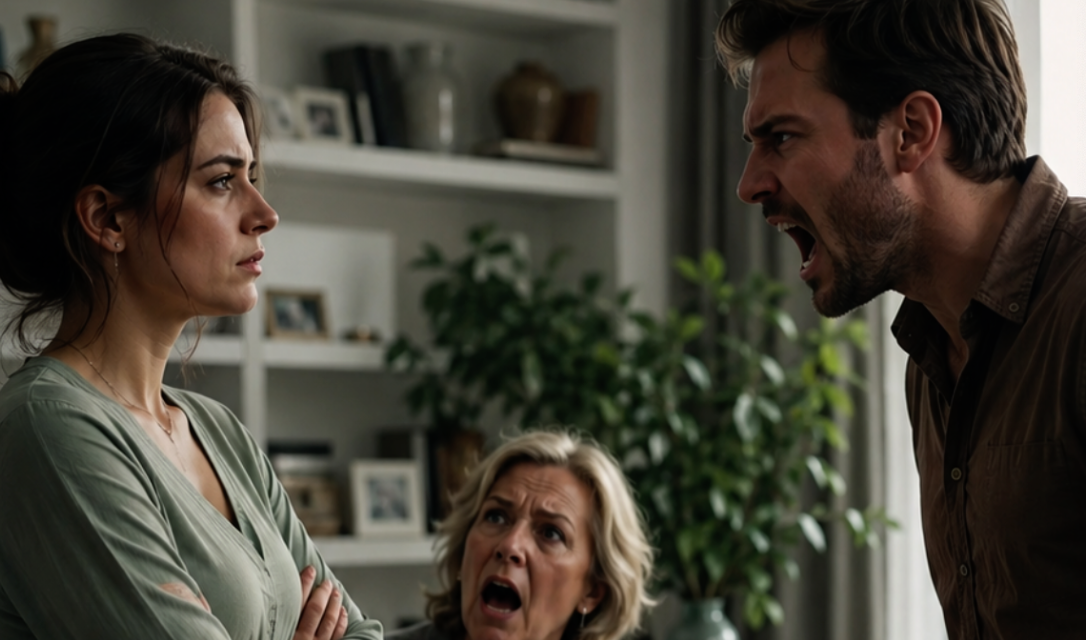
— Cancel your appointment! — Kirill snapped, not even turning away from the television. — Mother is going to the market today. You’ll drive her there and wait for her. It’ll take a while, definitely about three hours.
Nadya stood in the doorway of the living room, looking at the back of his head. Such a straight, confident back of the head — the kind that belonged to a person who never doubted his decisions. Kirill was lying on the sofa with his legs stretched out, clicking the remote from one channel to another.
“I have a doctor’s appointment at eleven,” she said calmly.
“So reschedule it. Big deal.”
Nadya did not answer. She went into the kitchen and put the kettle on. In three years of marriage, she had learned to pause — not out of submission, but so she would not say too much too soon. It was her rule, quiet and hard-earned.
Kirill appeared in the kitchen five minutes later — already holding his phone, already typing to someone.
“Did you hear what I said?”
“I heard.”
“And?”
“And nothing,” she replied, pouring boiling water into a mug. “I understood you.”
He looked at her with that particular narrowed expression Nadya knew by heart. It was the expression of a person used to being understood correctly. Meaning — obeyed.
“Mother will be at the entrance by ten. So get moving.”
And he went back into the living room.
Her mother-in-law’s name was Tamara Nikolaevna, and she carried that name with the dignity of a retired general. Plump, loud, with perpetually pursed lips and a gaze that could pity and condemn at the same time, she appeared in their lives regularly, like utility bills. And with about the same effect.
Tamara Nikolaevna did not go to the market for groceries — she went for the process. She touched every tomato, smelled every bunch of herbs, haggled on principle even if the difference was ten rubles, and demanded an escort — someone to carry the bags and listen to her commentary.
From Tamara Nikolaevna’s point of view, Nadya was the perfect escort: silent, carrying, nodding.
But today was not that kind of day.
Today, Nadya had an appointment. And not with a therapist for a fever, not with a dentist for a toothache.
With a notary.
Three weeks earlier, her aunt had died — her father’s sister, a lonely, childless woman who had lived in a two-room apartment in the city center. The apartment was old, but in a good building, with high ceilings and a view of a small park. And the aunt whom Nadya had visited every Sunday while Kirill watched football and Tamara Nikolaevna called to talk about her blood pressure — that aunt had written a will.
In Nadya’s name.
Nadya had found out about it two weeks earlier, by chance, from her father. He had called in the evening, his voice quiet and slightly guilty, as if he were reporting something awkward.
“Did you know Galya put you in the will? The notary called. The apartment, Nadyusha. All of it.”
Nadya had been silent for a long time then. Then she said, “All right, Dad. I’ll handle it.”
She did not tell Kirill anything. Not a word. It was a conscious decision — not an impulse, not an accident. Nadya had simply understood a long time ago that some things needed to be done first and explained afterward. Because if you explained them first, they never happened.
At ten in the morning, she left the house with her bag and coat. It was April outside, but still chilly and windy.
Tamara Nikolaevna was already standing by the entrance — in her usual floral jacket, with two empty wheeled shopping bags and the look of a person who had been forced to wait.
“Finally,” she said, although Nadya had come out exactly on time. “Let’s go. There are probably already crowds there.”
“Tamara Nikolaevna,” Nadya said, and something in her voice stopped her mother-in-law. “I’m not driving you today. I’m sorry.”
A pause.
“What?” the woman asked slowly, as if the word were unfamiliar.
“I have an important meeting. Kirill got it mixed up. I called you a taxi — it’s already on its way, it will be here in seven minutes. I warned the driver to help you with the bags.”
Tamara Nikolaevna opened her mouth, then closed it. That alone was rare.
“Do you understand that Kirill—”
“He’s home,” Nadya interrupted, softly, without anger. “If you want, go upstairs and he can see you off. Goodbye.”
And she walked toward her car — her small gray car, which she had bought herself before the wedding.
The notary’s office was located in an old building on Oktyabrskaya Street — third floor, heavy wooden doors, the smell of paper and a little coffee. Nadya sat in a chair opposite the notary — a middle-aged woman in glasses with very calm hands — and signed the documents.
Aunt Galya’s apartment was officially becoming hers.
Not theirs. Hers.
That mattered. Because Nadya knew that property received as a gift or inheritance was not divided during divorce. She was not a lawyer, but she had learned that. By heart. Several months earlier, when she had first begun to think that perhaps her story with Kirill was moving somewhere wrong.
The notary stamped the papers and handed her the folder.
“Congratulations. You can register it with Rosreestr. The documents are ready.”
“Thank you,” Nadya said.
And for the first time in a long while, she felt the ground beneath her feet become firm.
Kirill called at half past eleven. Nadya was just leaving the office, walking down the stairs with the folder tucked under her arm.
“Where are you? Mother called. You abandoned her at the entrance!”
“I called her a taxi,” Nadya replied evenly. “Did she get there?”
“That’s none of your business — whether she got there or not! I told you to drive her!”
“Kirill, I was at the doctor’s. Everything is fine, don’t worry.”
“What doctor?! You said—”
“I’ll call you back later,” she said. “I can’t talk right now.”
And she put the phone into her pocket.
Outside, the city was noisy — trams, conversations, someone laughing near the café across the street. Nadya stopped on the steps and lifted her face. The folder of documents was warm in her hands — or maybe it only seemed that way.
She thought about the apartment with high ceilings and a view of the park. About the fact that it was quiet there now. That no one was lying on the sofa there, ordering her time around.
Then she thought about the fact that Kirill still knew nothing. Not about the apartment, not about the fact that she had planned one more visit — not to a notary this time, but somewhere else — for the following week.
To a lawyer.
Lawyer Svetlana Borisovna received clients in a small office on the second floor of a business center — glass partitions, live flowers on the windowsill, a coffee machine in the corner. All of it created the feeling that matters were resolved here calmly and without unnecessary emotions. It was exactly the kind of place Nadya needed.
She had made the appointment two weeks earlier — right after the conversation with her father about the apartment. Not because she had already decided everything. But because she wanted to understand what could be decided at all, and how.
Svetlana Borisovna turned out to be a woman of about forty-five, collected, with short-cropped hair and a habit of looking at the person she was speaking to a little longer than usual. Not in a pressuring way — simply attentively. Like someone accustomed to hearing not only the words, but what stood behind them.
“So,” she said, opening a notebook. “What brings you here?”
Nadya was silent for a second. Then she said simply:
“I want to understand what divorce looks like. In my situation.”
She spoke for about twenty minutes. Without tears, without trembling in her voice — she simply laid out the facts. Three years of marriage. Joint property: a car bought before the wedding with her money, and a one-room apartment under mortgage, which they paid for equally, though the down payment had also been hers. Kirill worked as a manager at a construction firm and earned decently, but he considered his money his own — for shared expenses, he gave exactly as much as he deemed necessary.
Tamara Nikolaevna lived separately, but in practice she was constantly present in their lives — calls, visits, quiet remarks about how Nadya cooked, cleaned, dressed. Kirill never stopped her. On the contrary, he nodded, agreed, and sometimes added something of his own.
Svetlana Borisovna listened, occasionally making notes.
“Do you have children?”
“No.”
“Good. I mean, not good,” she corrected herself, “but from the point of view of the process, it is simpler. Whose name is the mortgaged apartment in?”
“Both of ours.”
“I see.” The lawyer set down her pen. “And the inheritance you mentioned — has it already been formalized?”
“I signed the documents yesterday.”
“In your name alone?”
“Yes.”
“That was correct.” Svetlana Borisovna allowed herself a barely noticeable smile. “So it will not be included in the division. It is your asset, and yours alone.”
Nadya felt something inside her loosen slightly. Not joy — just relief. Like when you have been carrying a heavy bag for a long time and finally set it down.
She returned home at two in the afternoon.
Kirill was in the kitchen, heating something in the microwave and looking at his phone. He did not react to her appearance right away.
“So you finally showed up,” he said at last, without looking away from the screen.
“Hi,” Nadya replied.
She hung up her coat and went into the room. Kirill followed her — plate in hand, still looking at his phone.
“Mother is offended. She says you were rude to her.”
“I called her a taxi and warned the driver that he needed to help with the bags.”
“That’s not the same as driving her yourself.”
“I agree,” Nadya said. “But I made it to my appointment.”
Kirill looked up.
“Who were you seeing?”
“A specialist,” she answered calmly. “Everything is fine.”
He looked at her with slight suspicion — the kind that appears when a person feels something has changed but cannot understand what. Nadya held his gaze. She even smiled — quietly, with the corner of her lips.
“All right,” he said at last, and returned to his plate.
Tamara Nikolaevna called in the evening, around seven.
Nadya answered herself — Kirill was in the shower.
“Nadezhda,” her mother-in-law began in the voice of a person who had been preparing for the conversation for a long time. “I want to tell you that today you behaved disgracefully. I am an elderly person. It is difficult for me alone.”
“Tamara Nikolaevna, did you get there safely?”
“That is not important.”
“It is important to me,” Nadya said. “If you got there and bought everything, then everything worked out. I’m glad.”
A pause.
“You’ve become somewhat…” Her mother-in-law searched for the word. “Insolent.”
“I am trying to be polite,” Nadya replied. “But I have things to do too. That’s normal, isn’t it?”
Tamara Nikolaevna said something else — about respect, about what Kirill had been like before marriage, about her friend Raisa, whose daughter-in-law was worth her weight in gold. Nadya listened with half an ear and looked out the window. Cars moved below, streetlights burned, some man was walking a large red dog.
An ordinary evening. An ordinary city.
Only inside Nadya, something was moving — slowly but confidently. Like the needle of a compass that had finally found north.
That night, when Kirill was already asleep, she lay on her half of the bed and thought.
The lawyer had said the process would take about two months if there were no disputes. The mortgaged apartment was more complicated; they would need to reach an agreement with the bank. But there were options.
Nadya thought about Aunt Galya’s apartment. About the high ceilings. About the fact that her aunt’s furniture was still there — old, a little bulky, but hers. In the kitchen there was a calendar with views of Lake Baikal that her aunt had not had time to take down. In the hallway, it smelled a little of books and a little of cinnamon.
Nadya had last been there a week before her aunt’s death. They had drunk coffee, and Aunt Galya had told her something about a neighbor and laughed. She knew how to laugh — truly, from the belly.
“You are my strongest one,” she had said suddenly then, without any connection to the conversation. She had looked at Nadya attentively, the way people look when they know more than they say. “Just don’t forget that.”
At the time, Nadya had not understood. Now, it seemed, she was beginning to.
She turned onto her side and closed her eyes.
There was still a week ahead. Then — a conversation with Kirill. Then — many things that would not be easy.
But the folder with documents was lying in her bag.
And that was the beginning.
The week passed quietly — suspiciously quietly, the way it does before something happens.
Kirill went to work, watched series in the evenings, and visited his mother on weekends. Nadya made coffee, answered work calls — she was an interior designer and worked from home, which had always irritated Kirill: you sit at home, what does it cost you to go, drive someone, pick something up? As if working from home were not work, but simply a long vacation with a laptop.
On Wednesday, she went to Rosreestr again — she submitted the documents for registration of ownership. A line, a ticket number, a service window, an indifferent girl in uniform who accepted the folder without looking at Nadya. Ordinary bureaucracy, an ordinary day. But when Nadya stepped outside and got into the car, she simply sat there for several minutes, staring straight ahead.
It was happening. Slowly, but it was happening.
Thunder struck on Friday.
Tamara Nikolaevna arrived without calling — as she knew how to do, as she had always done, believing that there was no need to warn a daughter-in-law in advance. Nadya was home, working — printed plans of a client’s apartment lay on the table, her laptop was open, and a mug of coffee stood nearby.
The doorbell rang. Nadya opened it and saw her mother-in-law with a large bag and the expression of a person who had come on business.
“Is Kiryusha home?” she asked, already stepping inside.
“He’s at work.”
“Well, that’s fine. I’ll wait.” Tamara Nikolaevna went into the living room, looked around, and put the bag on the floor. “I brought him his jacket. I fixed the lining. He would never have taken it to the tailor himself.”
Nadya returned to the table, sat down, and looked at the screen. Pretending to work when your mother-in-law is sitting three meters away in silence with that expression is a separate art.
The silence lasted about three minutes. Then Tamara Nikolaevna said, as if in passing:
“I heard your aunt left you an apartment.”
Nadya raised her eyes.
“How do you know?”
“Kiryusha told me.”
So that was it. Her father must have let it slip after all — or someone else had. Nadya mentally followed the chain and understood: most likely, her father had told one of the relatives, and then it had spread, as always.
“Is it a good apartment?” her mother-in-law continued in the same tone people usually use to ask about the weather.
“It’s good.”
“In the center, they say?”
“Nearby.”
Tamara Nikolaevna was silent for a moment and adjusted the bag on her knees.
“Well, that’s good. You’ll sell it and pay off the mortgage. Convenient.”
Nadya carefully closed the laptop. She looked at her mother-in-law.
“We haven’t decided anything yet.”
“What’s there to decide?” the woman was surprised. “Money won’t pay itself off. And Kiryusha needs a new car — he’s been driving this one for three years already.”
It was said so naturally, so domestically — you’ll sell it, pay it off, Kiryusha gets a car — that for a second Nadya lost her breath. Not from anger. From clarity. From how clearly she suddenly saw it: for this woman, everything had already been decided. The apartment was shared. The money was shared. And the fact that Nadya had spent three years visiting her aunt, sitting with her in the hospital, helping with documents, buying medicine — that was just nothing, it did not count.
“Tamara Nikolaevna,” she said evenly, “the apartment is registered in my name. By will. It is my personal property.”
Her mother-in-law looked at her for a long time.
“You say that to Kiryusha.”
“I will,” Nadya replied. “Absolutely.”
Kirill came home at half past seven. His mother was still there — she knew how to wait when it was necessary. Nadya heard them talking quietly in the hallway. Then Tamara Nikolaevna left, and Kirill entered the room.
From his face, Nadya understood: the conversation was going to happen now.
He sat down in the armchair, was silent for a while, drummed his fingers on the armrest.
“Mother says you were rude to her.”
“I told her the truth about the apartment.”
“What truth?”
“That it is my inheritance. Personal. And I will be the one deciding what to do with it.”
Kirill looked at her with that narrowed gaze Nadya had already learned to read. Behind that look came the calm, confident speech — the tone of a person explaining the obvious to someone slow-witted.
“Nadya, we are a family. What does ‘your personal’ mean? We’re sitting under a mortgage, by the way.”
“I know what we’re sitting under.”
“Then what is there to talk about? We sell it, pay off the loan, and live peacefully.”
“I don’t want to sell it.”
A pause. Kirill stood up and paced around the room. He did that when he was irritated — walked as if he needed to release excess movement.
“Listen, are you even normal? Is the apartment more important to you than your family?”
“No,” Nadya said. “But I want to think. It’s normal to think before making a decision.”
“There’s nothing to think about,” he cut her off. “It’s obvious.”
Nadya stood, took her mug from the windowsill, and went to the kitchen. Kirill followed her.
“Where are you going? We haven’t finished talking.”
“Kirill,” she turned near the refrigerator, “I hear you. I will think. But today I’m tired, and you don’t need to pressure me.”
He opened his mouth — and closed it. Something in her voice stopped him. Maybe the fact that she did not raise it. Did not burst into tears. She simply looked at him — calmly and somehow differently. Like a person who had a plan.
Kirill did not know about the plan.
Not yet.
That night, Nadya lay awake and listened to him sleeping. Even breathing, familiar — three years in one bed, three years under one ceiling.
She thought that tomorrow she would call Svetlana Borisovna. She would say she was ready to move forward. That the conversation with Kirill would happen — but not now, not on his terms, and not when he chose.
Outside the window, the city murmured. Somewhere below, the entrance door slammed, and someone’s footsteps ran across the asphalt.
Nadya closed her eyes.
The apartment with high ceilings was waiting for her. Quiet, with old furniture and the smell of cinnamon.
Hers.
Svetlana Borisovna listened to Nadya on the phone without interrupting. Then she said briefly:
“Come on Monday. We’ll start preparing the petition.”
Monday. There were three days until then.
Nadya spent them in her usual rhythm — working, cooking, answering calls. Kirill circled around her with the air of a person waiting for surrender. He brought up the apartment carefully, approaching from different angles. Sometimes he said they could renovate it and rent it out. Sometimes he hinted that his mother could live there temporarily — her neighbors were noisy, after all. Nadya listened, nodded, and promised nothing.
On Sunday evening, her father called.
“Nadyusha, has Kirill said anything to you? I heard Tamara is inciting him — saying you should transfer the apartment to him since you live together.”
Nadya was silent for a moment.
“Dad, everything is fine. I’m handling it.”
“Are you sure?”
“I’m sure.”
She put the phone away and looked out the window. Beyond the glass, the evening city was lighting up — streetlamps, shop windows, someone’s windows across the way. Somewhere there, two blocks away, stood the apartment with high ceilings.
Waiting.
On Monday, she filed for divorce.
Svetlana Borisovna helped prepare everything correctly — including the mortgaged apartment, the car, and all jointly acquired assets. The inheritance was noted separately: personal property, not subject to division.
Nadya signed the papers and put a copy into her bag. She stepped outside.
It felt strangely light. Not joyful — just light, like when you have been postponing the extraction of a tooth for a long time and finally decide to do it.
She told Kirill that same evening. Without preambles, without long approaches — she simply sat opposite him when he came home from work and said:
“Kirill, I filed for divorce. Today. The documents have already been accepted.”
He froze right in the hallway, holding his jacket.
“What?”
“Divorce.” Nadya spoke evenly. “I’ve been thinking about it for a long time. It’s not an impulse.”
Kirill slowly hung up his jacket. He walked into the living room and sat down. For a long time, he looked at the floor. Then he raised his head.
“Because of the apartment?”
“No,” she said. “The apartment was just the moment when everything became finally clear. There are many reasons. You know them yourself, honestly.”
He knew. He did not admit it — but he knew.
Tamara Nikolaevna found out the next day. Kirill, as usual, called his mother immediately — the way he always did when something did not go according to plan. Nadya heard the conversation through the wall: his voice was quiet, complaining. The voice of a boy whose toy had been taken away.
Her mother-in-law arrived the next morning.
Nadya opened the door, saw her face — red, determined, lips pursed — and silently stepped aside, letting her into the hallway.
“Do you even understand what you are doing?” Tamara Nikolaevna began from the threshold. “Kiryusha is beside himself because of you. You are obliged—”
“Tamara Nikolaevna,” Nadya interrupted calmly, “I respect you as a person. But what I owe and to whom is not your question. It is mine.”
Her mother-in-law stepped forward.
“You are nobody without him! He supported you, by the way!”
“We paid the mortgage equally,” Nadya said. “I work and earn my own money. The down payment was mine. So my arithmetic is perfectly fine.”
Tamara Nikolaevna looked at her — and something in her gaze suddenly changed. A pause came, unexpected. Her mother-in-law opened her mouth, then closed it.
“Do you think he’ll disappear without you?” she said at last, and there was less force in her voice now.
“I don’t think so,” Nadya replied. “He is an adult. He’ll manage.”
The divorce was finalized two months later. Without a courtroom scandal — Kirill came in silent, looking away. They decided to sell the mortgaged apartment, pay off the loan, and split the remainder. Svetlana Borisovna’s lawyer worked cleanly — Nadya received her share without unnecessary losses.
The car remained hers — since it had been bought before the marriage with her personal funds.
The inheritance remained hers — without question.
At the end of May, she moved her things into Aunt Galya’s apartment.
The movers carried in the boxes and set them along the walls. Nadya stood in the middle of the living room and looked at the high ceilings — white, with molding in the corners. Outside the window, the park rustled; through the open vent came the smell of leaves. Aunt Galya’s calendar with Lake Baikal was still hanging in the kitchen — Nadya decided not to take it down yet.
She walked through the rooms, touched the old windowsill, opened the balcony door. She stepped out. Below was a courtyard with benches, a playground, and a huge maple tree that had already dressed itself in leaves.
A good place.
Tamara Nikolaevna called a week after everything had ended. Nadya answered — out of politeness, out of a calmness that no longer went anywhere.
“How are you there?” her mother-in-law asked. Her voice was different — without pressure, somehow lower.
“I’m well,” Nadya replied. “Thank you for asking.”
A pause.
“Kiryusha has come back to me. He’s living with me for now,” Tamara Nikolaevna informed her. “I cook for him, wash his clothes.”
Nadya thought that this was exactly where everything had been going. That the son had returned to his main harbor — to his mother, to ready-made cutlets, to a life without the need to consider anyone else.
“I’m glad things are good for you,” she said.
“Listen,” her mother-in-law said after a pause, and her voice became strange — not angry, almost confused. “Do you really regret nothing?”
Nadya looked out the window. The maple in the courtyard swayed in the wind.
“Nothing,” she replied.
And that was the pure truth.
That evening, she called her father and told him she had settled in. He was happy — a little fussy, in a fatherly way. He asked whether she needed help with repairs. Nadya said not yet, but if she did, she would call.
Then she made coffee and went out onto the balcony with the mug.
The city hummed below — alive, indifferent, and beautiful. Somewhere a tram was passing, somewhere children were laughing, and from somewhere came the smell of fresh pastries from the bakery around the corner.
Nadya stood there and drank her coffee.
She was in no hurry. No one demanded anything. Ahead of her was an evening — quiet, her own.
And tomorrow — a new client, a new project, new walls that needed to be turned into a home.
She knew how to do that.
She always had.
August arrived unexpectedly — hot, thick, smelling of warmed asphalt and linden blossoms. Nadya gave the apartment a light cosmetic renovation — painted the walls warm white, changed the curtains, laid a new rug in the bedroom. She kept almost all of her aunt’s furniture, only adding her own things gradually, without rushing.
It turned out beautifully.
Truly.
There were more clients — word of mouth worked better than any advertisement. Nadya went to meetings, created projects, sometimes sat at her laptop until midnight — but it was her midnight, her fatigue, her result.
She heard about Kirill only vaguely — through her father, through mutual acquaintances. He had lived with his mother, then rented a room. They said Tamara Nikolaevna quickly grew tired of having her adult son in her apartment — it turned out that cooking every day, tolerating his moods and his endless evening calls to friends was not at all the same as visiting and handing out advice. Within a month, they were already arguing. Within two, Kirill moved out without leaving an address.
Nadya learned this without gloating. She simply nodded — and forgot.
At the end of August, she bought herself a new laptop and a large ficus in a white pot, placing it by the balcony door. The ficus took root at once and stretched toward the light.
A good sign.
That same evening, she stepped onto the balcony with coffee and looked at the maple tree below — its edges were already beginning to turn yellow, just slightly.
Nadya thought about Aunt Galya. About how she had laughed from the belly. About the words: you are my strongest one, just don’t forget that.
She had not forgotten.
The city lived below — noisy, moving, not stopping for a minute. And Nadya stood above it on her balcony, in her apartment, in her life.
She simply stood there and smiled.