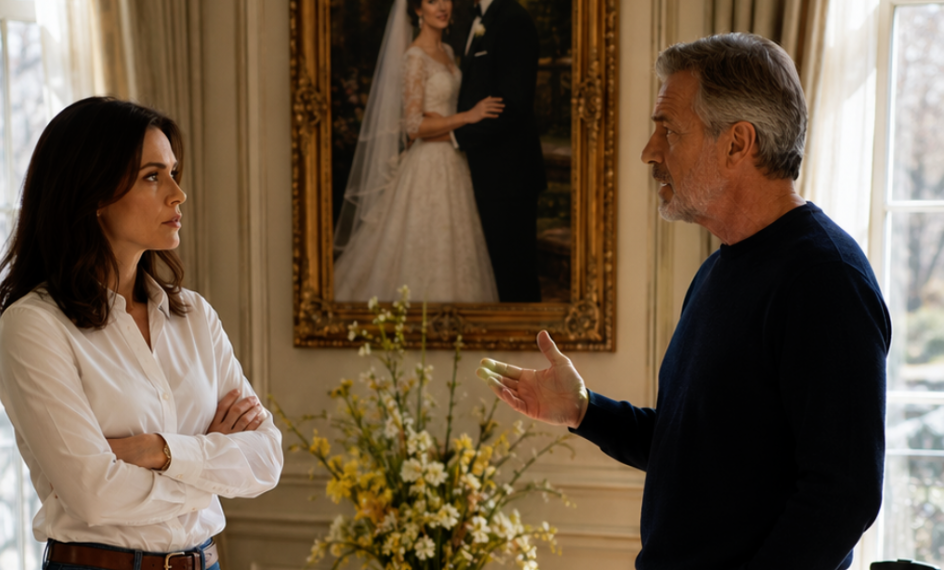
Rita pulled the bills out of the envelope before I had even stepped away from the congratulatory arch. Her fingers, tipped with scarlet nails, counted the cash briskly, and her lips twisted not into a smile, but into an assessment — as if she had just rung up a receipt and found the amount unsatisfactory.
“Uncle Zhenya, are you serious? Ten thousand?”
She said it loudly enough for the guests gathered near the entrance to the hall to hear. The groom, Denis, froze with a glass in his hand and stared at the envelope as though I had pulled out not money, but an expired coupon.
I looked at Rita and did not recognize her. No, outwardly, everything matched: the same doll-like face I remembered from when she was five, the same mole above her eyebrow. But inside that wedding dress embroidered with rhinestones stood a complete stranger.
The little girl I used to read bedtime stories to had turned into a cashier dissatisfied with the day’s takings.
“Rita, I… it’s from the heart.”
“From the heart?” She raised an eyebrow. “We expected close relatives to help. Look at the wedding we arranged. And you bring ten thousand. Come on, seriously?”
The silence around us became almost tangible. Some elderly relative from Pasha’s side gasped behind me, one of the bridesmaids snorted, and Rita’s mother — my sister Sveta — was already hurrying toward us with the expression of someone who had caught a scandal breaking out at a celebration.
I lowered my eyes to my hands, to the crumpled envelope on which, only yesterday, I had written in ballpoint pen: “To Rita and Denis. Live in harmony.”
“If the gift didn’t please you, I’ll take it back,” I said, stepped forward, and carefully took the envelope from her fingers. The edges of the bills were still sticking out.
“What do you mean, take it back?” She blinked in confusion.
“I mean exactly that. A gift is a gesture, not a transaction. If you needed an entrance fee, you forgot to send the price list along with the invitation.”
Sveta had already grabbed my elbow.
“Zhenya, stop it immediately! What are you saying? Put it back!”
I freed my arm and turned to her. My sister and I had always been different: she built a family, mortgages, and vacations on credit, while I had been tightening bolts in elevator shafts since I was twenty, and later retrained as an electromechanical technician.
For many years, I had brought sweets and gadgets for her children. And when Rita got into university, I added exactly half of my bonus to the envelope. Back then, my niece’s face had glowed instead of twisting into a grimace of disappointment.
“Sveta, I’ll put this money somewhere it won’t be counted at the entrance,” I said quietly, slipping the envelope into the inside pocket of my jacket. “Have a good evening.”
And I walked toward the exit.
Behind me, everyone started buzzing like a bird market. Denis shouted, “To hell with him!” Rita began crying loudly, but it was not the cry of hurt — it was the outrage of an owner whose rightful asset had been snatched from under her nose. Sveta shouted something about me “disgracing her in front of everyone,” but I had already pushed open the heavy door and stepped out into the evening air.
The May sunset was fading behind a nine-story panel building, and the wind was dragging poplar fluff along the parking lot. I got into my car, the one I had been driving to service calls for eight years, and for several minutes I simply held on to the steering wheel.
I had given her a laptop for her eighteenth birthday, and she had jumped up and down with joy.
For her twentieth, I had given her a gift certificate to a bookstore, and she had hugged me so tightly my ribs cracked.
Now I had saved ten thousand from two paychecks because it was her wedding — and I had turned out to be stingy.
The engine rumbled, and I drove out of the parking lot. My phone vibrated before I even reached the first traffic light. My sister, of course. I declined the call — I did not want to talk while driving. But Sveta had the persistence of a missile warning system: a minute later, a message arrived, then another, and by the time I turned toward home, she was already calling again.
I parked beside my five-story apartment building — I had bought this apartment with a mortgage six years ago, on my own, without anyone’s help: a one-room place on the fourth floor, overlooking an old apple orchard — and answered the phone.
“Are you out of your mind?!” my sister’s voice rang like a tightened cable. “You took a gift away from the bride! Do you have any idea what people will say now? Rita is crying, Denis is furious, his parents are asking what kind of relatives we have!”
“Sveta, let’s just—”
“No, you listen! You have to come back right now, apologize, and give the money back. I’m embarrassed in front of the in-laws now, do you understand?”
I rested the back of my head against the headrest. The car smelled of machine oil and mint gum.
“Sveta, your daughter opened the envelope before she even said thank you. She looked not at the words I wrote, but at the amount. And she loudly announced, in front of everyone, that it wasn’t enough. Did you hear that?”
“So what? Rita was just upset. She was preparing, she was nervous, and you with your principles…”
“My principles?” I did not raise my voice, but something inside me began to ring like a tightened string. “I’m not an ATM. I don’t go to weddings to sponsor the banquet. I came to congratulate someone dear to me, and I was treated like a failed sponsor. If congratulations are measured in thousands for you, then let’s just start issuing invoices.”
“Oh, don’t start! Ten thousand for a wedding, you know, doesn’t even cover the cost price!”
I interrupted her for the first time in many years. Not because I did not respect her, but because in this conversation, I did not exist as a person. There was only a role: uncle-sponsor.
“Sveta, I earn my money servicing elevator mechanisms. I’m not rolling in millions. I didn’t save this money to cover the cost of a chicken leg and a glass of compote. I saved it because I wanted Rita to be happy. But she wasn’t happy. It wasn’t enough for her. And you think I should apologize after that?”
A pause followed. Heavy breathing came through the receiver.
“You have always been cold,” my sister finally exhaled. “Always. Even when Mom was sick, you called her once a week. Rita and I ran to her every day.”
“Sveta, Mom is alive, and I visit her on Wednesdays and Saturdays. Don’t start with those accusations. You simply don’t want to hear the main point: your daughter treated my gesture like a defective part. And gestures are not inspected for defects. They are either accepted or they are not. Rita did not accept it. I took it back. Period.”
“So family feelings mean nothing to you?”
“And for Rita, family feelings mean her uncle paying according to a price list?” I replied. “If so, then I have no intention of taking part in that kind of family.”
She sobbed, but it was not a remorseful sob. It was the sob of a person trapped between the truth and the need to save face.
“Do you even understand there will be no going back after this? I… I won’t be able to talk to you after this as if nothing happened.”
I was silent for a moment. Outside the car window, the wind rocked the birch tree near the entrance.
“You know, Sveta, when I was younger, I thought family meant the people for whom you would step over your pride. But now I understand: family means the people around whom your pride does not have to be destroyed. Your daughter trampled my pride into the linoleum of that banquet hall. I’m not going to pretend it didn’t hurt. Good night.”
I ended the call before she could answer. Then I sat in silence, watching the first points of satellites light up in the dark sky.
Inside, everything was empty and clean, like a new elevator cabin after a major repair. No anger, no gloating — only the cold realization that some connections are held together not by love, but by a collective agreement of silence: “You give us money, we give you an invitation.”
And if one day you stop playing by those rules, your chair at the family table is quickly removed.
I took the envelope out of my pocket and smoothed it on my knee. The inscription “Live in harmony” had smeared slightly. I decided that in the morning I would stop by the charity foundation — the one that helps children with rare diseases — and transfer those ten thousand there. They would not ask why the amount was not larger. They would simply say thank you.
At home, I was greeted by the silence of my one-room apartment, its windows looking out onto a courtyard with swings. I took off my shoes, went into the kitchen, and put the kettle on. No one rang the doorbell, and the phone remained silent. That meant everything had been decided.
The next morning, I woke up early out of habit — at half past five, even though it was a day off and I could have stayed in bed. The sun was already breaking through the loosely drawn curtains, painting yellow stripes across the linoleum. I lay there for a little while, staring ahead, then sat up and lowered my feet to the floor. Thoughts of the previous evening returned at once, without hesitation, as if they had never gone anywhere during the night.
My phone lay face down on the nightstand. I turned it over: three missed calls from Sveta and one message from my niece.
Rita had written at half past midnight: “Uncle Zhenya, do you really think this is normal? I ended up looking stupid in front of the guests. Everyone talked about only that the whole evening.”
I read the message twice. Not that I had expected any other words — for example, “I’m sorry, I was wrong,” or at least, “Let’s talk calmly.”
No. Rita was an exact copy of her mother at twenty-five: the world revolved around her. And every event was judged only by how it affected her comfort. My feelings did not fit into that coordinate system — they simply had not been included in the design documentation of that family.
I did not reply. I put the phone aside and went to wash my face.
The bathroom mirror reflected a forty-seven-year-old man. I looked at my face and wondered: when exactly had everything taken the wrong turn? Maybe when Sveta married Pasha, a man from the world where “everything has to be top-class”?
Pasha worked for a company that installed stretch ceilings and earned decent money, but his main talent was living large — credit cards, restaurants on Fridays, gifts for his wife and daughter.
Sveta quickly adopted that philosophy, and within a couple of years after the wedding, I stopped recognizing my sister. The girl with whom I had picked raspberries at our grandmother’s dacha in childhood had turned into a woman who, at every meeting, first assessed what I was wearing and what car I had arrived in.
And Rita had grown up in that atmosphere. For her, love was measured in receipts, and respect by the price of the restaurant you were invited to.
It was my own fault: for many years, I had played along with those rules, giving expensive gifts and thinking I was buying affection. But it turned out I had only been renting it. And when the rent was deemed insufficient, I was evicted from the premises.
Only I still do not know at what point a gift stops being a gesture and becomes an entrance fee.
Do you?