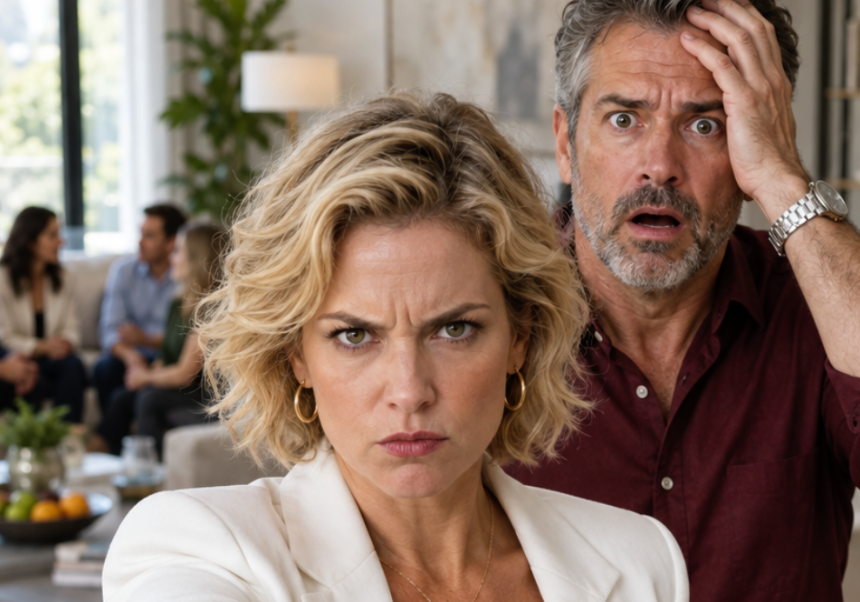
“So, what kind of dowry are you giving the bride?”
Gennady asked this even before the menus came. He folded his hands over his stomach, squinted, and waited for an answer as though he was buying a used car from me and had already spotted the rust.
I adjusted the fork so it was exactly parallel to the knife. That’s a habit from my bakery: when my hands are busy, my mouth doesn’t say anything extra.
“Dowry?” I repeated. “What do you mean?”
“Come on, mother, let’s keep it simple. Apartment, car, money in the account. What’s the girl bringing along?”
Taissia kept her eyes on the tablecloth beside me. Saveliy coughed and said, “Dad, stop.” Maya, his wife, looked at me apologetically, just like a neighbor would after her dog barked all night.
It all happened back in April, at a restaurant on the riverbank where the air smelled of grilled meat and someone else’s perfume. It was our first meeting as families: Taya and Saveliy had decided to marry, and he brought us parents together the proper way.
And here I was, listening to a word I hadn’t heard in twenty-one years. ‘Dowryless.’ My ex-mother-in-law called me that for nine straight years. I got married at twenty-two, moved into her tiny two-room, and every time I bought something, she’d say the same thing: “Whose money are we spending? You came with just one suitcase.”
I complained to my husband, but he just waved it off: ‘She’s old, don’t pay attention.’ In 2005, I laid the keys on the table in the hallway, took six-year-old Taya and that same suitcase, and moved into a rented room. The divorce came later, settled in court.
And now, here we go again.
“We’re simple folks,” Gennady went on, though the only thing simple about him was his voice. “I started with a bucket. Now I own three car washes, haven’t had a day off in twenty-five years. Sava’s got an apartment and a job. The bride, you see, gets everything ready-made.”
“Taya works,” I replied. “She’s a speech therapist.”
“That barely pays anything. And you, Sava said you bake cakes?”
“I run my own bakery.”
“A factory!” he chuckled and looked at his wife, inviting her to share the joke. “My mother baked too. For free, on holidays. I saw what you pulled up in. Largus, what year is that, 2012? And that coat, I see it’s not exactly brand new either.”
I bought the coat in 2016, beige and good quality, and I took great care of it. The van was for work: I used it to deliver four-tier cakes around the city—no regular car could have handled that. I chose not to explain.
“Dad,” Saveliy blushed red as a beet, “I told you, Taya’s mom has a house outside the city.”
“A house outside the city is just a shed with a stove, Sava. When I was your age, I called our dacha a house too.”
I wondered, by his price list, how much was my daughter worth? Less than his cognac?
By the way, the cognac was his idea. A carafe for forty-two hundred, plus steak on the stone. Taya and I ordered salads, a pot of sea buckthorn tea, and one dessert to share. All evening, Gennady talked about car washes, about almost buying a fourth one in 2019, and about how “poverty is all in your head.” Maya nodded. Taya stayed quiet. I drank my sour, hot tea and counted to ten in my mind.
Then the bill arrived. Fourteen thousand six hundred.
Gennady didn’t even glance at it. He nudged the folder over to me with two fingers.
“So, doing it modern style. Going halves.”
My ears started burning. Not my cheeks, just my ears, like when I was twenty-five and my mother-in-law counted out supermarket change right in front of me. My hands lay flat on the tablecloth, and I felt bread crumbs under my palms.
Maya reached for her purse. Gennady covered her hand with his own:
“Sit down. Let the co-mother-in-law chip in. She’s proud—she said it herself: factory.”
I raised my hand and the young woman in a black apron came over to us.
“Could we get a separate bill, please?” I said. “Two salads, sea buckthorn tea, one dessert.”
The waitress stepped away and came back a minute later with my receipt. One thousand eight hundred sixty. I paid by phone, added two hundred as a tip, and set the check on the table in front of Gennady.
“Going halves, Gennady Petrovich, means everyone ate the same. My daughter and I ordered for one thousand eight hundred sixty.”
He opened his mouth, closed it, and jingled his car keys. Maya pressed her hand to her lips, but I caught a glimpse—she wasn’t hiding fear. Saveliy stared at the table, his ears burning just like mine had a minute ago.
“So, proud, are we?” Gennady said finally. “Alright then.”
“Thank you for the evening,” I replied, standing up.
It was chilly in the parking lot; April was only pretending to be spring. I got into my Largus, put my hands on the wheel, and suddenly burst out laughing, softly into my fist. The cargo area still smelled of vanilla—I had delivered a wedding cake to a nearby district that morning.
Taya slammed her door shut and started laughing, too—for the first time that night.
“Mom, did you see his face?”
“I saw it.”
We drove out onto the highway, and my daughter fell quiet. Then, staring out the window, she finally spoke:
“Mom. Please don’t tell them about the house. Let Sava handle his father. I want them to choose me, not the square footage.”
I nodded. I remembered all too well what it was like to be weighed on someone else’s scales.
I just didn’t realize then that Gennady hadn’t even started counting yet.
***
In July, Maya was turning fifty-eight, and we were invited to the dacha.
I spent a long time thinking about what to give a woman I’d only met once. In the end, I decided to gift what I do best: a three-tier cake with vanilla sponge, pitted cherries, mascarpone cream, and topped with fresh berries. Six hours of work and ingredients costing three thousand four hundred. At the bakery, a cake like that costs twelve thousand, but of course, I didn’t mention the price to anyone.
Gennadiy’s dacha turned out to be a two-story cottage with a lawn and white swings. The air smelled of barbecue and freshly cut grass, and mosquitoes buzzed above the table. About nine relatives had gathered, all loud, all wearing the same sunglasses.
I carried the cake in myself, balanced on a tray. Maya threw up her hands in delight, snapped photos of it from three angles, and nearly burst into tears.
“Violetta, this is a masterpiece!”
Gennadiy walked over, gave it a good look, and folded his hands over his stomach.
“It’s all sugar,” he said. “I have high blood pressure, dear. I can’t have this.”
“There’s less sugar in this cake than in your cognac,” I replied calmly.
Someone in the family laughed, but Gennadiy didn’t.
Maya cut herself a slice and closed her eyes as she savored each bite. Taya grabbed a berry from the top tier. The others glanced at their host and avoided the cake, as if it were electrified.
After the main course, Gennadiy tapped his glass with a fork and pulled a piece of paper, folded in quarters, from his pocket.
“Since it’s just family, let’s get down to business. The wedding. Restaurant ‘Imperial’, one hundred twenty guests, eight thousand per person. That’s nine hundred sixty thousand. I’m a fair man: half from us, half from the bride’s side. Four hundred eighty by September. You can pay in installments—I’m not a monster.”
Taya put down her fork. I saw her chin quiver ever so slightly.
“And who are these one hundred twenty?” I asked.
“Partners,” he said, jabbing the paper. “People from the administration, suppliers, guys from the car washes. And your folks. I listed twelve for you. Probably all you’ve got, right?”
“That’s right,” I said. “No more than that.”
“There you go.”
I took the paper, folded it along the old creases, and handed it back to him. I didn’t say yes or no. All evening, Taya held my hand under the table, and I stayed silent for her sake. I already knew these types: if you answer immediately, there will be a scene at his wife’s birthday, and I’ll end up the villain.
We left around nine. I headed to the car first, while Taya lingered at the gazebo to say goodbye to Saveliy. When she caught up with me at the gate, her face was ashen.
“Mom. Turn around.”
By the gate stood a green trash bin with its lid propped open. From inside, the corner of a white box with a “Violetta’s Bakery” sticker was poking out. The box lid was askew, and I could see my cake. Nearly untouched, except for the single slice Maya had taken.
“He took it out himself,” Taya whispered. “I saw. Right in front of me.”
The grass rustled behind us. Maya was hurrying over in her house slippers, breathless.
“Please forgive him, Violetta,” Maya said, grabbing my elbow. “Gena told me to do it. He said he wouldn’t even give it to the dog, her liver can’t handle it. But I saved a piece for myself in the freezer.”
Six hours. I sorted those cherries by hand, every single one. Inside, I felt a silence and cold spread, like the chilled room where our cakes finish baking.
I folded the napkin I’d been holding from the table into a neat square, slipped it into my pocket, and walked back out to the veranda. Gennady was there, smoking by the railing.
“Gennady Petrovich. I wanted to talk about your list.”
He turned around and smirked at me:
“So, you’ve decided to split the cost?”
“I have decided. We have twelve guests. Twelve times eight – ninety-six thousand. I’ll pay for them and will transfer the amount to the restaurant myself when there’s a contract. But whoever invites the partners and administration people, pays for those.”
“Are you sending me a bill now?”
“I’ve done the math for you. At work, I keep track of every gram. And one more thing: the cake cost twelve thousand. You can count that as my contribution. It’s by the gate.”
His cigarette burned all the way down to his fingers. He jerked his hand, his shorts pocket jangled with keys, and he seemed lost for words. For the first time, I saw Gennady without a ready comeback.
“Well, woman,” he finally managed to say. “You’re something else.”
“Good night,” I said.
Taya was silent in the car all the way to the highway. I drove, feeling my shoulders relax as if I’d been holding a tray outstretched all evening. The back seat still had a faint cherry scent.
Late at night, a message came from Maya. A photo of a plate with a slice of cake and the caption: “Delicious. Thank you.” I smiled in the dark and didn’t bother explaining this was actually the first ‘thank you’ I’d ever received from their family.
In the morning, Taya got a voice message from Gennady. She put it on speaker:
“In August, my car washes celebrate their 25th anniversary. That’s when we’ll announce the engagement. Let everyone see who we bring in.”
***
The anniversary for the car washes was celebrated on the last Saturday of August, in a banquet hall with golden curtains. Forty guests, balloons with the number ‘25’, a host in a bow tie. Everyone was handed a magnet with the logo at the entrance.
Taya and I were seated at a table in the back, by a column, next to the car wash guys. The boys were cheerful, treated me to pickled mushrooms, and admitted honestly they were a bit scared of the boss.
There was the scent of lilies, hot julienne, and hair spray. The music was so loud the plates on the table rattled.
Gennady took the toast for himself. He came up to the microphone, thanked partners, suppliers, and some Oleg Sergeevich “for understanding back in 2019” at length. Then he found our table with his eyes.
“And another announcement! My son is getting married.” Applause, Saveliy stood and nodded. “We’re taking a simple girl. No house, no land, her mother gets by with cakes and delivers them around in a Largus. But that’s alright! She’ll be fine with us, we’ll fatten her up!”
The hall burst out laughing. Not everyone, but most did. Next to me, Taya sat straight as a string, staring at a single spot on the tablecloth.
“Violetta!” Gennady beckoned me with the microphone. “Stand up, let everyone get a look at you! Tell us what you’re giving with your daughter!”
Forty heads turned towards the column. Someone at the next table even rose up to get a better look.
Back in ’96, at my own wedding, my mother-in-law raised her glass in just the same way and told the guests: “Well, the bride has no dowry, but she’s got character.” Everyone laughed then, too, and I smiled, because I was twenty-two and thought that’s just how it was supposed to be.
Now I was fifty-two. I pressed my thumb against the edge of the table, feeling the cold rim of the tabletop beneath the tablecloth, and stood up.
They didn’t give me a microphone, but the host had just turned off the music, so it was quiet enough that everyone in the room could hear someone’s fork clink.
“I’m giving my daughter away,” I said. “She’s smart, kind, and hardworking. Every day she teaches children who haven’t spoken before how to talk. People like you, Gennady Petrovich, don’t get paid much for that kind of work. As for the rest, we’ll talk during the official visit. At my house. As tradition dictates.”
For a second, there was silence. Then Gennady let out a laugh into the microphone:
“We’ll see, we’ll see about your mansion!”
A few people laughed again. But the man at the next table, silver-haired and well-dressed, said loudly to his wife, “Gena is always way out of line.” And then everyone started laughing at Gennady. He heard it. He folded his hands on his belly, squinted, and stepped away from the microphone earlier than he meant to.
I sat back down. Under the table, Taya found my hand—her palm was icy cold.
We left early, before the main course. In the parking lot, Saveliy caught up to us, jacketless, sweating.
“Violetta, please forgive him. Forgive me.” He hesitated, then straightened up. “I was at your house in March. I saw everything and told my father. He doesn’t listen, he never listens to anyone. But I don’t care what you do or don’t have. I’m marrying Taya. Not for a dowry.”
Taya burst into tears—the first time all summer. He hugged her right there, among the parked cars, while I walked over to the van and searched for the keys in my purse for a long time, even though they were in my pocket.
A good guy. I guess there was a reason I kept quiet.
In the morning Maya called. She apologized for a long time, stumbled over her words, explained that Gena had been drinking yesterday, that he really isn’t a bad person, and that he felt embarrassed afterward.
That evening, a call came from an unknown number.
“Violetta? It’s Kapitolina, Gena’s older sister. I was at the anniversary, saw everything.” Her voice was deep, smoky, and very firm. “I’m ashamed of my brother. Let’s do this properly. We’ll come as matchmakers, bring bread, just like our mother taught us. If it’s a visit, then let it be a real one. Gena promised to mind his tongue. I’ll keep an eye on him—he knows I don’t mess around.”
“Is he on board with this?”
“He’ll be asking me what he should agree to.”
An hour later, Gennady himself texted: “Lost my temper. No hard feelings. We’ll come on the twelfth.”
I read his message three times. No hard feelings. As if I was the one who was upset with someone.
But I finally felt relief. I believed maybe things would work out. That his sister would really keep him in check, that Saveliy would stand strong, that Taya would get married without a war. I spent the whole week holding onto that hope.
On Friday night I was kneading dough for the ceremonial bread. Yeast dough, rich, made with fresh eggs from home. The kitchen was filled with the smell of milk and warm bread, and the apple trees rustled outside the window. Hanging by the door was a spare house key I had made for Taya back in the spring. She always forgot to take it.
The phone rang while my hands were deep in flour. It was Saveliy. I pressed the speaker with my elbow.
“Violetta, sorry it’s so late. I just didn’t get it. Dad asked today how much it costs to rent a house for a day in your village. I said I didn’t know. He laughed and said, ‘Don’t worry, we’ll find out tomorrow.'”
***
On the morning of September 12th, the house was filled with the smell of yeast and apples. There was a traditional loaf of bread on an embroidered towel, pies with cabbage and lingonberry nearby, and a carafe of fruit drink. I set the table in the big room by the window that looks out onto the garden.
My house is nothing special. It’s made of aerated concrete, with a brick facade, two floors, and 142 square meters. Definitely not a palace. But every single block was paid for with cake orders. I bought the land in 2014 and spent five years building it, order after order. I finally finished paying off a 700,000-ruble loan in 2021.
The guests arrived at noon, pulling up in a silver Toyota. I went out to meet them at the gate. The sign on the gate gleamed after the rain: ‘Sadovaya, 14.’
Kapitolina turned out to be a sturdy woman in a tasseled scarf, glasses hanging from a chain. Maya carried a store-bought cake, looking at me as if she was apologizing in advance. Saveliy looked pale.
Gennady was the last to get out. He glanced at the house, the lawn, and my Largus parked by the garage. He clasped his hands over his stomach, squinted, and said to his sister without lowering his voice at all:
‘Of course they rented it. Just for a day. I’ve seen places like this on Avito, twelve thousand a night. At least the van is theirs, not rented.’
‘Gena,’ Kapitolina said quietly.
‘What, Gena? I can see through people.’
I pretended not to hear and invited everyone inside.
At the table, Kapitolina took charge. She placed her own bread on the tablecloth, also wrapped in a towel, and straightened up.
‘Well, hosts. By tradition: you have the goods, we have the buyer. Show us the bride.’
Taya stood up. She wore a light dress and her hair in a braid she’d spent an hour and a half making herself. As I looked at her, I thought I’d never seen her look better.
And then Gennady burst out laughing. Loudly, until his face went red, slapping his knees.
‘What goods, Kapa! Her only dowry is pride!’
Maya gasped. Kapitolina turned her head to look at her brother.
Taya stayed put. Only her cheeks flushed red.
‘I’m not a commodity, Gennady Petrovich,’ she said.
‘Dad, enough,’ said Saveliy, getting up beside her. ‘I’m marrying Taya, not her dowry. And I already told you about the house back in March.’
‘Sit down, you fool. They’ve tricked you and you’re happy about it.’
I looked at my daughter. My mind was blank and clear. The hallway clock ticked. The room smelled of warm bread, a scent that was mine, just like everything else in that room.
Twenty-one years ago, I handed over my keys and left, because there was nowhere I could bring my child except a stranger’s rented room. And now, at my table, in my own house, my daughter was being weighed and judged again.
I adjusted a fork so it lined up with the knife. A minute must have passed.
‘Gennady Petrovich,’ I said. ‘These introductions are happening in my own home.’
He snorted:
‘Yeah, for a day.’
I took out my phone, opened the government services app, went to ‘Real Estate,’ and showed the property registry. I handed it, not to him, but to Kapitolina.
She put on her glasses and read aloud, syllable by syllable:
‘Residential house. One hundred forty-two square meters. Sadovaya, fourteen. Owner—Violetta Andreevna. Since 2019.’
The silence was so complete, I could hear apples falling outside the window.
‘Gena,’ Kapitolina said. ‘Did you see the sign on the gate?’
Gennady opened his mouth. Closed it. Then he reached into his pocket for his keys and jingled them, as if maybe the keys would say something for him.
“I built this house over five years,” I said. “On my own. No husband, no one’s help. For nine years, they called me a girl with nothing to offer, and I left them with just one suitcase. No one in my family will be scrutinized like that again. You don’t come here just to size up my home. If you came to inspect my square meters, the inspection is over.”
I turned to Saveliy:
“And you, Sava, you’re welcome to stay. You proposed to Taya back in the spring, before any of this was counted up.”
Gennady stood up so abruptly that the chair scraped loudly across the floor.
“Fine then. Maya, let’s go.”
Maya looked from her husband to me, then down at her store-bought cake.
“No, Gena. I haven’t even tried the bread yet.”
“Go on, get some fresh air,” said Kapitolina, still not looking at her brother. “Sava can take us back. And think on your way about what you bring when you enter someone else’s home.”
He left, slamming the veranda door. A minute later, the engine roared under the window, and the silver Toyota sped off down Sadovaya, scattering puddles.
Kapitolina took off her glasses, grabbed the knife, and cut my loaf of bread. She broke off a crust, salted it, and offered it to Taya.
“Eat, bride. Do it right, like people should.”
I sat there, feeling my back relax, vertebra by vertebra. My hands rested calmly on my lap, atop my apron, completely at ease.
***
The wedding was set for November fourteenth. No ‘Imperial’ restaurant, no one hundred and twenty guests—just thirty-four people, a small café by the river. We’re splitting the cost evenly between the newlyweds and me. Gennady’s guest list stayed right in his pocket.
He threatened to fire his son, but didn’t. There’s no one else to manage the car wash. Now Gennady greets me through gritted teeth, and at our last meeting, he muttered off to the side, “A house is a house, what’s the big deal.” I wasn’t expecting an apology, and I didn’t get one. He’ll show up for the marriage registration—Kapitolina has promised to bring him.
Maya called last week and ordered a wedding cake herself. She did it through the bakery, paid as a regular customer, in advance. She said she wanted it just like the one from July, only with an extra tier.
I’ve noticed something strange about myself. Before, visiting the city, I was always explaining things: that the van is for work, that the coat is nice, that I have my own bakery. Now, I don’t explain. The coat’s still the same—beige. The van’s the same. I just don’t need anyone’s approval anymore.
On Saturday, Taya came with Saveliy to choose the cake filling with me. Before she left, she paused at the door, glanced at the nail on the wall, and finally took the spare key down.
“Is this my dowry?” she smiled.
I remembered the little cabinet in my mother-in-law’s hallway and the keys I left on it twenty-one years ago.
“No,” I said. “It’s so you always have a place to come back to.”
She squeezed the key in her fist and tucked it into her pocket, right where you keep the most important things.