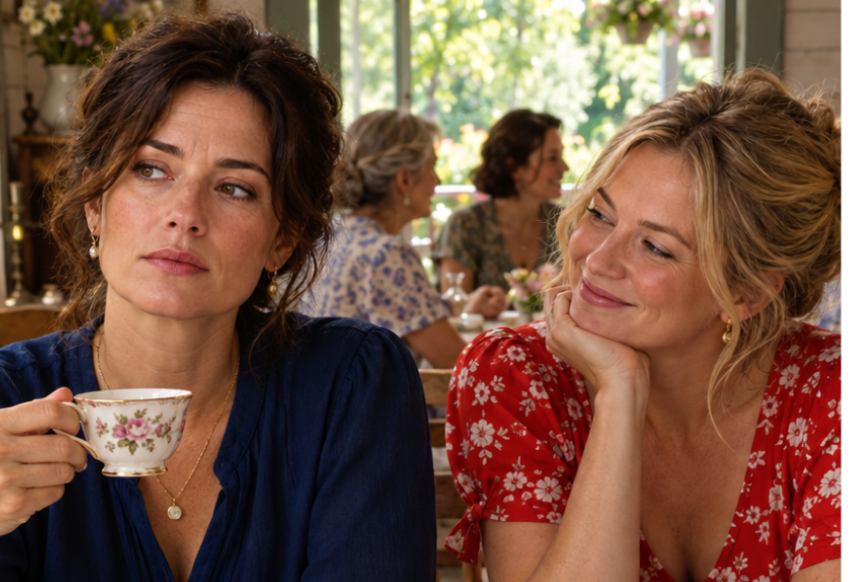
“Irina, can you pass me the salad? No, not that one. The one with the crab sticks. You’re the homemaker here, you should know which is which.”
Avdotya said it as if she was giving a compliment—smiling, tilting her head, her spoon gracefully hovering over her plate. It didn’t sound offensive, really. Still, the table went a bit quieter.
Irina handed over the salad.
It was her father-in-law’s birthday. Vladimir Petrovich was turning sixty-five, and the whole family had gathered at the country house of his older sister, Sofya Arkadyevna. The house was one of those built back in Soviet times, later sprouting verandas, extensions, and siding in an ambiguous color the owner called “coffee with milk,” but everyone else simply called “beige.”
The table was set in a large room with a low ceiling, filled with the scent of fresh cucumbers and old furniture. Twelve people squeezed in so closely their elbows practically overlapped. Sergey, Irina’s husband and Avdotya’s brother, sat between the two women and seemed to be the only one unaware that the air was already starting to crackle.
“This salad is delicious, by the way,” he said, helping himself to a second serving. “Mom, did you make it?”
“I helped,” replied Sofya Arkadyevna. “But Irina did most of the work. She’s been in the kitchen since morning.”
“Well, she has plenty of time,” Avdotya noted, not lifting her eyes from her plate.
That “she has plenty of time” just hung over the table, like a fly above a jar of jam. Everyone noticed it. Nobody tried to catch it.
Irina stayed silent and took a piece of bread. She’d known Avdotya for fourteen years and had learned one thing: her sister-in-law always warmed up slowly. First, a comment about being a “homemaker,” then “she has plenty of time,” and by dessert, you could expect something truly festive.
And Irina was right.
When the hot food arrived, the conversation turned to renovations. Sofya Arkadyevna was telling a story about replacing pipes at her summer house and how the plumber, Gennady, came to fix one pipe but discovered he’d have to replace everything—including his own idea of pricing.
“Thirty-eight thousand for the job!” Sofya was outraged. “I told him, Gennady, for that kind of money I could buy myself a new cottage. And he told me, ‘Not in this region, Sofya Arkadyevna.'”
Everyone burst out laughing. Vladimir Petrovich smacked the table with his palm, and teaspoons rattled in the glasses.
“So, did you finish your renovations?” Sofya turned to Sergey. “You were saying you wanted a new kitchen?”
“We finished,” Sergey nodded. “In November. We put in tiles, a new backsplash. It turned out nice.”
“Bet it was expensive?”
“It was reasonable. We did part of it ourselves.”
Avdotya set down her glass.
“Sergey, you laid the tiles yourself?”
“Yeah,” he replied.
“After work?”
“Yeah, I did it in the evenings.”
“Poor thing,” Avdotya shook her head. “You work all day and then still have to do things at home. And that’s with a wife who’s free all day long.”
That’s when Irina felt something shift inside her. Not anger. More like a familiar, weary feeling, the kind you get from an old alarm clock that rings every morning and whose batteries can’t be taken out.
“Avdotya, I’m not free all day.”
“What do you do all day?” her sister-in-law asked sweetly, as if she was simply curious about a pie recipe.
“I work.”
— Well, in a way, we’re all working, Irochka. Some people go to their jobs, and some people make soup.
Sergey frowned but kept quiet. He always stayed silent in moments like this, truly believing that if you ignored things, they would resolve themselves. In fourteen years, this hadn’t worked even once, but Sergey had a deep and unshakeable faith in the power of silence.
Dessert had to be brought out from the kitchen in two rounds. Sofya Arkadyevna had baked her signature Napoleon—thin, crispy, with a cream she made from her mother’s recipe, which her mother had gotten from her own mother, so this Napoleon was basically a hundred years old.
Irina was helping to set the plates. She leaned over to Sofya in the kitchen and quietly asked:
— Sofya Arkadyevna, you know that I work, right?
— Of course, Irochka. You told me yourself back when we were talking about the pipes. You do accounting, remotely.
— Exactly.
— And Dusya doesn’t know?
Irina shrugged.
— Dusya knows whatever she wants to know.
Sofya looked over the Napoleon at her and sighed. She had a special sigh for situations like this—long, with a slight whistle—meaning, ‘well, I warned you, the rest is up to you.’
— Irochka, you really should explain it to her. She’s been telling everyone for three years that Seryozha supports you. She’s told me, Vladimir, and even our neighbor Nina Pavlovna. Nina Pavlovna, by the way, gets upset.
— Upset because of me?
— Because of Seryozha. She thinks it’s hard for him.
Irina snorted. Nina Pavlovna had seen Sergey exactly twice in her life, and both times he was eating kebabs with such a happy face that only someone extremely empathetic could possibly think he was suffering.
Then something happened that Irina hadn’t planned.
They went back to the table. The Napoleon was sliced, tea poured, and Vladimir Petrovich gave a toast to family, to health, and to everyone doing what their heart desires, not just what their boss tells them to.
Everyone raised their glasses.
And then Avdotya decided it was the right time.
— Seryozhenka, — she began, in that voice she got after her second glass, — I’ve been meaning to say this. In front of everyone, so it’s not behind your back. You’re a wonderful man. You work two jobs. You support the family. You do the repairs yourself. But you need to be tougher.
There was a pause. Teaspoons went silent.
— In what sense? — Sergey asked.
— I mean, you’re the only breadwinner in your family. And you shouldn’t be embarrassed to admit it.
She turned to Irina. Her gaze was sympathetic, and you could see it clearly said: ‘I’m doing this for your own good.’
— Irochka, I’m not trying to upset you. But my brother supports you. You could keep quiet when he decides how to spend the money. You don’t work, you don’t bring in a penny to the family, and everybody knows it.
It got so quiet you could hear the drip from the faucet on the porch—the very one Gennadiy promised to fix for thirty-eight thousand.
Irina put down her cup.
Slowly. Carefully. Exactly in the center of the saucer.
— Everyone knows? — she asked.
— Well, it’s obvious, — Avdotya threw up her hands. — Sergey works at a company and gets a salary. You stay at home. That’s math, Irochka.
Here’s something that Avdotya had no idea about.
Irina worked as an accountant. She did it remotely, from home, sitting at a small desk by the bedroom window with her laptop. She managed the finances for four small companies and had been doing it for eight years. She started when her youngest daughter began school, and she hadn’t stopped since.
Why didn’t Avdotya know? Because Irina didn’t feel the need to report to her sister-in-law. Sergey knew. Sofya Arkadyevna knew. Vladimir Petrovich probably knew, too, though Irina never talked to him about it directly.
Meanwhile, Avdotya lived in her own world, where she was the successful, businesslike one and her sister-in-law was just a freeloader living off her brother.
At the same time, Avdotya worked as a receptionist at a beauty salon. Her salary, as she put it, was “well, normal, not bad for the region.” Translated from Avdotya’s way of speaking, that meant twenty-seven thousand rubles before taxes. She lived in an apartment purchased for her by that same Seryozha three years ago—“she’s my sister, after all, can’t leave her on the street”—and drove a car Seryozha gave her when he bought a new one.
But Avdotya preferred not to remember any of that. She had an amazing talent for forgetting facts that didn’t fit into her worldview, just as easily as other people forget where they’ve put their keys.
Irina looked at her husband. Sergey had the look of someone desperately wishing to sink through the chair, but the chair was sturdy, Soviet-made, and stubbornly refused to budge.
“Seryozha,” Irina said. “Tell her.”
“Tell her what?” Sergey mumbled.
“How much I earn.”
The silence grew thick, as dense as Sofya Arkadyevna’s Napoleon cake.
“Irina, why do this?”
“Seryozha. Just say it.”
He cleared his throat. Rubbed the bridge of his nose. Looked up at the ceiling, as if he hoped for some hint up there. There was no hint—just a patch from last year’s water leak.
“Irina earns her own income,” he began. “She’s an accountant. She works from home.”
“From home?” Avdotya repeated, as if he’d said “from outer space.”
“Yes. Remotely. She has four clients. She keeps complete financial records for them.”
“And just how much does she get for all this… bookkeeping?”
Sergey named the sum.
Avdotya blinked. Then she blinked again. She looked like someone expecting a simple salad at a restaurant only to see a bill for a full banquet.
“Is that per year?” she asked for clarification.
“Per month,” Sergey replied.
“That’s more than you make,” Vladimir Petrovich quietly noted—he was good at mental math and never missed a chance to show it off.
He was talking to Avdotya.
Avdotya opened her mouth. Closed it. Opened it again. It looked for all the world like a fish pulled out of water and asked to discuss a quarterly report.
“Wait,” she said. “Are you… serious?”
“Absolutely,” said Sergey.
“But she just sits at home!”
“She works at home. That’s not the same thing, Dusya.”
But the most interesting thing happened next.
Sofya Arkadyevna, who had been quietly enjoying her Napoleon cake and watching like a front-row spectator, suddenly set down her fork.
“Dusya,” she said. “You were just talking about who supports whom. That Sergey provides for Irina. But tell me, did you buy your own apartment yourself?”
Avdotya blushed. Not much, just a soft flush, as if the room had suddenly gotten warmer.
“That’s different,” she replied.
“Of course it is,” Sofia agreed. “And your car? Is that different too?”
“Aunt Sonya, that’s just not related at all.”
“It’s related, Dusya. Very much so. You just announced to everyone that your sister-in-law is living off your brother. But in reality, Irina earns more than you do, and both your apartment and your car were bought for you by the same Sergey you’re feeling sorry for.”
A pause.
“So,” Sofia continued, thoughtfully poking at her cake with a fork, “it looks like, of all the people here, it’s not Irina living off Sergey. It’s somebody else. But I won’t point fingers since that would be impolite.”
She pointed with her eyes.
Vladimir Petrovich gave a little snort into his tea. Sergey’s cousin, who had come all the way from Tula and had quietly been eating her Olivier, said just loud enough, “Well, I thought as much.” What exactly she meant remained a mystery, but her tone said it all.
Avdotya sat there, bright red. Her ears were glowing so much, you could’ve read a book in the dark by their light.
“Sergey,” she said plaintively, “can’t you say something?”
Sergey looked at her. Then at Irina. Then at the Napoleon cake, as if hoping the cake might give him the right answer.
“Dusya,” he finally said. “I love you. You’re my sister. But what you just said was silly. In front of everyone. If I were you, I’d apologize.”
Avdotya didn’t apologize. At least, not right away.
First, she said everyone misunderstood her. Then she said she’d meant something else entirely. Then she claimed she was just worried about her brother. Then she complained her tea had gotten cold and she needed to step outside.
She went out to the veranda. Through the glass door, you could see her standing there, arms crossed, staring at the fence with such intensity you’d think the fence had done something wrong.
Irina stayed at the table. Sofia Arkadyevna gave her a second slice of Napoleon cake.
“Eat, Irina. You’ve earned it.”
“Sofia Arkadyevna, I haven’t earned anything. I just passed the salad.”
“Exactly. You passed the salad and still got publicly humiliated. You need to balance that with some Napoleon, or you’ll never digest it.”
Irina smiled. The Napoleon cake really was wonderful, with a delicate crunch and creamy layers that melted on the tongue like a sweet memory.
Fifteen minutes later, Avdotya returned. She sat down in her seat. Stayed quiet.
“Irina,” she said, “I’m sorry. I didn’t know.”
Her voice sounded as if the words ‘I’m sorry’ and ‘I didn’t know’ were made from broken glass and she had to force them out very carefully.
“It’s okay,” Irina replied.
“I just thought…”
“I know what you thought.”
“Could you… not rub it in?”
“I could.”
They sat in silence. Sofia Arkadyevna poured fresh tea. The clinking of little spoons rang against the glasses. Vladimir Petrovich turned on the TV, and the announcer’s voice drifted in with news about the weather. Rain was in the forecast.
As the evening drew to a close and guests began to leave, Irina stepped out into the yard. The air was cool, scented with damp earth and apples from the neighbor’s tree, which hung over the fence every year with such boldness, as if it had every legal right to do so.
Sergey came up from behind and wrapped his arms around her shoulders.
“Ira, I should have told you sooner. About work. Shouldn’t have kept quiet like an idiot.”
“You’re not an idiot. You’re an optimist. You thought it would work itself out.”
“It didn’t work itself out.”
“No, it didn’t.”
He stayed silent for a moment.
“I really feel awkward about it.”
“About what?”
“About Dusya. She’s not mean, it’s just…”
“She’s just used to thinking that she’s in control, and I’m just along for the ride.”
“Well, now she knows you have your own horse.”
Irina laughed. Quietly, tiredly, but genuinely.
“Let’s go home, Seryozha.”
“Let’s go.”
He opened the car door for her. The very same car that they had bought with her money last year—though Avdotya would probably find that out later too. Everything in its own time.
On the back seat was a container of Napoleon cake. Sofya Arkadyevna had sent it with them, saying, “This is for you. I didn’t give any to Dusenka. Let her bake her own if she’s so independent.”
Irina placed her hand on the container. It was still warm.
The car started moving. In the rearview mirror, the house with its beige siding flashed by, the veranda with the dripping faucet, and Avdotya’s silhouette in the doorway waving goodbye. Small, lost, in her fancy dress—which, by the way, had also been bought with Seryozha’s card.
But Irina chose not to think about that. She leaned back in her seat, closed her eyes, and listened to the tires hiss on the wet road. It had finally started to rain. The weather report hadn’t lied.