Lyuba never called a taxi in her life. She liked stepping out onto the road, raising her hand, and seeing who would stop. The person who stopped was always someone who needed to talk. Over twenty years, she came up with her own set of rules: people driving old Ladas stopped more often than those in foreign cars, women were more likely to pull over than men, and truck drivers almost never did.
But today, it was a truck driver who pulled over. An old Volvo with a trailer, a clean cab, a paper flag with a crest on the windshield, and a photo of a laughing boy, about seven years old.
Lyuba got in.
“Going far?” the driver asked.
“To the cemetery.”
The driver nodded and didn’t say anything else. The road was flat and dull, gray fields on both sides with rare patches of snow. After about two kilometers, he couldn’t hold back anymore:
“Visiting your husband?”
“My daughter.”
“Ah.” He was quiet for a bit. “A long time ago?”
“Eighteen years.”
He was silent again, then spoke softly:
“I lost my son. He was only eight. Got sick, and that was it. After that I didn’t drive for a whole year. My wife kept telling me, ‘Go, work, or you’ll lose your mind.’ But I just couldn’t. It felt like if I got behind the wheel again, it meant life was back to normal, like I was moving on. But how can you move on when he’s gone?”
Lyuba didn’t offer condolences. She didn’t say, ‘time heals.’ She just looked at the photo on the windshield.
“What was his name?”
“Mishka. Mikhail.”
“Did he like it when you were driving?”
The driver flinched.
“He did. He always wanted to go with me on trips. I used to tell him, ‘When you’re older, I’ll take you.’ He kept asking, ‘How old?’ ‘When is it?’ And I’d answer, ‘After you finish first grade, then we’ll go.’”
“And what happened after first grade?”
“He got sick in the summer. June. We would have gone in September. I’d already picked the route—to Lake Baikal, so he could see it. He’d watched a show about Baikal on TV, always drew it with a blue crayon. He loved that blue crayon; I still keep it.”
Lyuba turned to look out the window.
“So you never got to go together.”
“We never did. Every time I think about it, right here,” he tapped his chest, “it just aches.”
“You should try going alone. Just drive and talk to him. Out loud. He’ll hear you.”
The driver gave a crooked smile:
“You really believe that?”
“I know it,” Lyuba said. “My daughter drowned in a pond. She was with her grandmother. I was at work that day. They called me at four o’clock. I still remember the color of the sky when the call came—it was gray, just like now. And right then I thought: that’s it, nothing else will ever happen. Nothing at all.”
The driver slowed down. He was unsettled, not by her words, but by the calm way she said them.
“How did you…,” he began and couldn’t finish.
“How did I survive?” Lyuba shrugged. “At first, I didn’t. I was lost for a whole year. My husband couldn’t handle it, left after six months. He said, ‘You’ve changed.’ And I had. I stopped understanding why anything mattered—work, money, plans. It all felt gray, like that sky back then. You know what saved me?”
“What?”
“My neighbor. Just an ordinary woman, a cashier at the produce shop. She came over and said, ‘Lyuba, you can keep lying there with your face to the wall, it’s your right. But I have inventory tomorrow and need help. I can’t do it alone. Come at nine.’”
— So, did you go?
— I did. Not because I wanted to, but because she didn’t pity me. Everyone else around me showed pity, and their sympathy made me want to disappear. But she didn’t. She simply said: come, I need you. So I went. I spent the whole day counting cans of peas, and by evening I finally had a proper meal, simply because I was exhausted.
She went quiet for a moment.
— That’s when I realized: it’s not sympathy that saves you. It’s having something to do. And having someone who tells you: get up, you’re needed.
The driver dropped her off at the turn near the cemetery, refused to take any money, and drove off. Lyuba knew he was heading to Baikal someday. Maybe not tomorrow, maybe in a year. But he would go.
She could see right through people.
Lyuba worked at the funeral home ‘Eternity’—the name was a bit tacky, but no one planned to change it. Besides her regular duties, she did things that weren’t in any job description: she stayed with people who had just lost someone dear and talked with them. Not about wreaths or hearses, but about the things they didn’t get to say.
She ended up here by chance. After her daughter died, she tried everything: worked at a grocery store, then at the clinic reception, then cleaned floors. Everywhere it was the same—she saw through people, and it always got in the way. At the grocery store, she once said the wrong thing to a customer and got into trouble. At the clinic, she told an old lady that she didn’t see doctors because she was sick, but because no one was waiting for her at home—the woman burst out crying right there in the line. At a school, she told a boy he fought not because he was mean, but because his parents ignored him. He stopped fighting, but then his mother showed up and demanded they fire “that crazy woman.”
She was let go. And a week later, she was walking past the funeral home, saw an ad, and went inside.
The first time it happened was on her third day of work. A woman was making arrangements for her husband’s funeral. She was steady, listing items from the price list in a flat tone, bargaining for the wreaths. Suddenly, Lyuba said:
— He never asked for forgiveness, did he?
The woman went silent. Looked at her. Then broke down in tears.
— He kept trying, she said through her tears. He always started: ‘Tanya, I need to say…’
— He wanted to say he was sorry.
— How do you know? the woman lifted her tearful eyes to her. Did you know him?
— No, Lyuba replied. — I can just see it. You sit straight, your back is upright, but your hands always reach for your wedding ring. You keep turning it. People do that when they’re remembering something that hurts.
The woman stared at her, mouth open.
— I didn’t realize it was that obvious.
— It’s not obvious. I just notice. Most people have forgotten how to notice things. Everyone’s always rushing.
And that’s how it began. At first, the management was suspicious, then they gave up: clients would leave Lyuba with a strange look on their faces. A funeral home isn’t a place people go willingly, but people would come to see Lyuba. Sometimes just to ‘talk’.
Today there was an old man. Eighty-three years old, neat, pressed shirt. His wife had died last night, his children lived in another city, they’d only come for the funeral, and he was left alone in the apartment where everything reminded him of her.
He sat down across from Lyuba and said, businesslike:
— I need the simplest coffin. Nothing fancy. She didn’t like anything excessive.
“Alright,” Lyuba said, not opening the catalog. “Tell me, what did she love?”
The old man stood still.
“What?”
“What did she love? In her life.”
He was silent for a long time. Lyuba didn’t rush him. She looked at his hands—large, spotted, with neatly clipped nails.
“She loved lilacs,” he finally said. “When they bloomed, she always cut some and put them in a jug. The jug was little and blue, with a crack in it. I told her, ‘Throw it away, we can get a new one.’ But she’d say, ‘No, this one’s from my mom.’”
“And what would you say to her when she put the lilacs in the jug?”
“What do you mean?”
“You know, when she was fussing with the branch, arranging it in the jug. What did you say in those moments?”
The old man thought for a long time. Then his face trembled.
“I would say… I would say she was in my way. That the lilacs gave me a headache. I never knew how to say nice things. Nobody taught me.”
“But she wanted to hear those nice things.”
“She did,” the old man agreed, and suddenly he started to cry—quietly, messily, pressing his fist to his mouth. “Fifty-eight years together. I never told her she was beautiful. Not once. I thought she knew. Now she’s gone and I don’t know if she ever did.”
Lyuba stood up, poured him a glass of water, and waited until he calmed down.
“Let me tell you something,” she began. “I won’t tell you she knew. I really don’t know if she did—maybe she did, maybe not. But I’ll tell you something else: right now, that doesn’t matter. What matters now is what you’ll do next.”
The old man looked up at her with red eyes.
“Next? I’m eighty-three. What do I do now?”
“And that, actually, is the most important thing,” Lyuba said. “Today, you’ll go home and do one thing. Not for her, but for yourself.”
“What thing?”
“You’ll take a sheet of paper and a pen. And write her a letter. Everything you never got to say over fifty-eight years. About the lilacs. About how she smiled. About how you didn’t know how to speak nicely, because no one taught you. About how you loved her. Write all of that. And put it in an envelope.”
“Who do I give it to?”
“No one. Keep it for yourself. And when things get unbearably hard, take it out and read it. And you’ll see, you did say it after all. Maybe late, but you said it. That’s better than never saying it, isn’t it?”
The old man looked at her.
“A letter,” he repeated. “I worked in a factory for forty years. I never wrote letters. Only reports.”
“So write it just like a report,” she said. “Start with: ‘Hello, wife.’ As if she’s right there. Then go on, say anything you want.”
“Valya,” the old man said, his voice breaking. “Her name was Valya. Valentina.”
“That’s a beautiful name.”
The old man wiped his face with his hand. Then he asked:
“And the coffin?”
“The coffin can wait. First, write the letter. I’ll take care of the coffin for you.”
He left. Lyuba watched him go, thinking: maybe he’ll write that letter, maybe he won’t. But something inside him seemed to change. And that’s already a lot.
That evening, Lyuba was riding home. Across from her sat a girl with a backpack, glued to her phone, constantly typing something and then erasing it.
Lyuba had seen people like that before. The girl would type someone a long message, erase it, type it out again, erase it again. Over and over.
“Who are you writing to?” Lyuba asked.
The girl jolted.
“Why do you care?”
“None at all,” Lyuba agreed. “You’re just writing the same thing over and over. It never gets sent. Do you know why?”
“Why?”
“Because you’re not writing to him. You’re writing to yourself. You want to be sure if you have the right to be angry. Or maybe you don’t. And until you decide, the message will just hang there.”
The girl looked at her as if she were crazy.
“I wanted to text my mom. To say I won’t be coming to her birthday.”
“Why won’t you come?”
“Because she’s not waiting for me. She always says, ‘Come if you want.’ ‘If you want’ means ‘I don’t care.’”
“No,” Lyuba said. “‘If you want’ means ‘I’m afraid you don’t want to.’ Your mom’s scared to push you. She’s waiting for you so much, she’s afraid to show it. And you’re waiting for her to show it. Two people waiting for the exact same thing from each other, and neither of you gets it.”
The girl put away her phone.
“What should I write?”
“Write: ‘I’ll come.’ That’s all. You’ll say the rest when you’re there. And hug her, right at the door. That’s when everything will fall into place.”
The girl stood up and walked to the exit, then turned back.
“Who are you?”
“Conductor,” Lyuba said. “You don’t have a ticket. But it’s okay. I forgive you.”
The girl smiled and left.
At home, Lyuba took off her coat, set the kettle on and sat by the window. Wet, heavy snow was falling outside, just like late November. In the window across, she saw a light on—there lived a family with a new baby, and Lyuba knew they fought from exhaustion and didn’t understand what was happening to their love. She planned to visit them tomorrow. Just because.
A photo hung on the wall. A three-year-old girl, with two pigtails, in a yellow dress.
She sat by the window sill and watched the snow. Sometimes, on nights like these, everything felt especially quiet. Not sad—just quiet. As if everything inside switched off, leaving only a gentle hum. So she would look at the photo and talk to her daughter. Out loud. Just as she had taught that driver to do.
“There was an old man today,” she said. “His wife died. Fifty-eight years together. He doesn’t know how to say something nice, just like me. I told him to write a letter. What do you think, will he do it?”
There was no answer.
“And then there was a driver. His son died. Eight years old. He keeps a blue pencil.”
And that’s when Lyuba began to cry. Tears came, just like that. She didn’t wipe them away. Let them fall. That was a conversation, too.
Afterwards, she washed her face, put the kettle on, and took out some apricot jam given to her by a woman whose husband she had once ‘gravely offended’ with words, but later helped reconcile with their daughter.
She ate and gazed out the window.
A week later, Lyuba went back out on the road. The air was dry and frosty, and mist hovered over the field. A Niva stopped, all muddy, with a trailer full of boards. The driver was a young guy, about twenty-five, wearing a cap and a cigarette in his mouth.
“Where to?” he asked.
“To the cemetery.”
“Two hundred rubles.”
“Let’s go.”
They rode in silence. The guy smoked, flicking ash out the window. His eyes were red and his hands trembled on the wheel.
“Is it hard?” Lyuba asked.
“Huh?” he glanced at her, then back at the road. “Yeah. I’m building. Building a house. Been at it for two years now. There’s never enough money, and my wife keeps nagging me. She says, ‘You promised to finish by summer, and it’s already November.’ What can I do? I can’t go any faster.”
“Why a house, though?”
“What do you mean?”
“Well, why do you need a house? You could buy an apartment. It’s easier.”
The guy was silent for a long time. Then he said:
“My dad died when I was sixteen. He always wanted to build a house. He kept saying he would start once I was grown. But he never got the chance. Now I’m building it. Like it’s for him. Like if I finish, then he made it in time after all.”
“And will you tell him that he made it in time?”
“He’s dead. How can I tell him?”
“Do you talk to him?”
The guy looked at her like she was crazy.
“What do you mean?”
“Well, when you’re laying boards, putting up the roof… do you talk to him? In your mind?”
The guy was quiet again. Then he said softly:
“Sometimes. When I’m alone. I say, ‘Dad, look, I did this part straight. Just like you taught me.'”
“And what does he say?”
“Nothing. He’s dead.”
“But what do you think he would say?”
The guy slowed the car down.
“He would say…” the guy swallowed. “He’d say: Good job, son. You’re doing great. The house will stand.”
“See? You know what he’d say. All fathers say things like that, we just don’t hear them.”
The guy turned away to look out the window. He was quiet for a moment, then said:
“Thank you.”
“For what?”
“I don’t know. Just, thank you.”
He dropped her off at the turn to the cemetery and wouldn’t take any money from her.
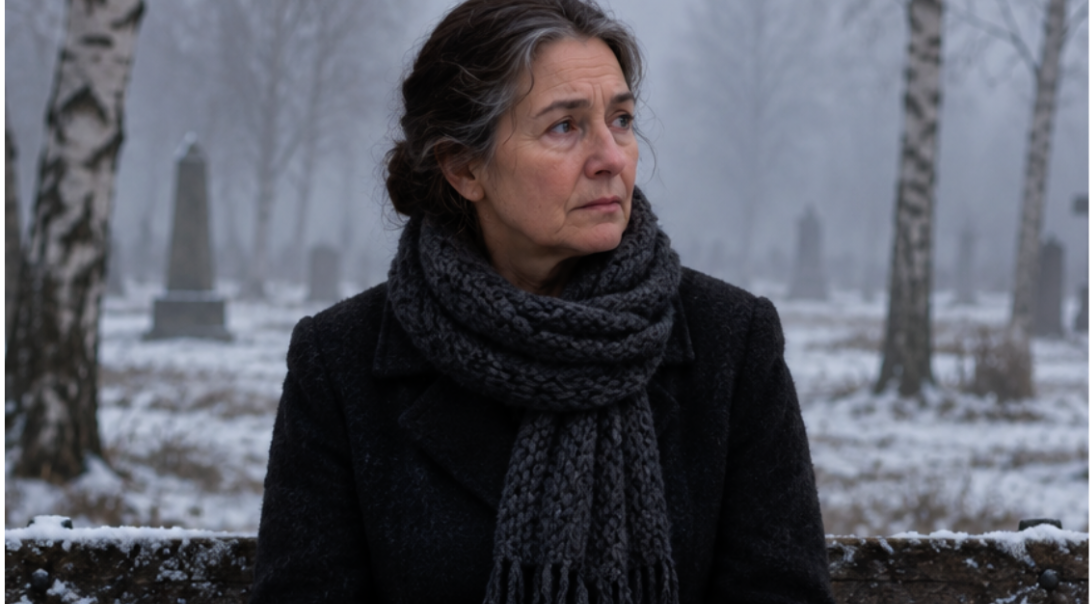
Lyuba got out and walked along the alley. The cemetery was old, with tall birch trees and crooked fences. She knew the way by heart: past the chapel, then left, then straight to the big oak, then twenty more steps.
The grave was well-kept. Lyuba visited every week, even in winter. The snow was untouched—yesterday it wasn’t here, but today it had just started to settle. Lyuba crouched, brushed away the snow, fixed the fence, wiped the nameplate. “Morozova Anechka. To my beloved daughter, from Mom.”
She sat down on the bench nearby and started to talk. Out loud.
“So, Anya, I’m here. How are you doing? Aren’t you lonely? I brought you a candy. Remember ‘Mishka’—the one in the yellow wrapper? I brought it. I put it under the plaque so the wind won’t blow it away.”
She was silent for a moment. The wind rustled the tops of the birches, knocking snow down from the branches.
She pulled a small sheet of paper, folded into quarters, from her pocket.
“Here. I wrote this for you. Remember? The year Dad left. I couldn’t speak then, so I wrote instead. Filled a whole notebook. But in the end, I kept only one page. This one. Want me to read it?”
She unfolded the paper. The letters were uneven, some words crossed out, others written over each other. The kind of writing you do when you’re rushing and crying.
“Anechka. Forgive me. I couldn’t protect you. I should have been there, but I wasn’t. I’ll remember that for the rest of my life. But I want you to know: I haven’t forgotten you. I’ll never forget you. I’ll come visit you as long as I can walk. And even after that, I’ll still find a way. I love you. Mom.”
Lyuba folded the paper and put it back in her pocket.
“That’s it. Everything I said to you back then. So many years have passed, but I still know it by heart.”
She sat a little longer, then got up and headed for the exit.
At the gates, a woman in a black headscarf called out to her.
— Lyuba? Lyuba Morozova?
— Yes.
— I recognized you. Are you Nina Petrovna’s daughter?
— Yes.
— I was her neighbor. We lived in the same building entrance for twenty years. She was a good woman. Before she passed away, she cried all the time.
— She cried?
— She cried. She used to say she was guilty. I asked her: Nina, why don’t you make up with your daughter? And she said: I don’t want to impose. My daughter should want it herself.
Lyuba stood there, looking at her.
— She wanted to, I wanted to. We were both just waiting for the other to say it first.
The woman nodded.
— Everyone waits like that. Everyone. And no one ever gets to hear it.
Lyuba walked to the bus stop. Along the way, she thought that maybe she didn’t just come to the cemetery, but actually spoke with her mother. Even if it wasn’t at her grave—her mother was buried somewhere else, next to her father—she still talked to her.
A cat was waiting for her at home. Gray, striped, with a torn ear. He showed up last winter and now demanded food three times a day.
— I’m coming, I’m coming, — Lyuba said, taking a chicken out of the fridge. — Stop yelling.
The cat rubbed against her legs and purred so loudly it sounded like a little tractor inside him.
While the cat was eating, Lyuba sat down and looked at the photograph again.
— Well, there you go, — she said. — I talked to Grandma. Do you think she heard me?
There was no answer. But Lyuba knew: if her daughter had been there, she would have smiled.
Lyuba was not a kind person. Kind people sit back and feel sorry. Lyuba didn’t pity—she jumped in, stirred things up, pulled things out. Not everyone loved her for it.
But someone had to.
We often think someone is interfering where they shouldn’t. That they’re tactless, harsh, sticking their nose in where they weren’t invited. We don’t realize they’re saying things we’re afraid to say ourselves.
These people don’t decorate life. They fix it. Roughly, painfully, awkwardly. But they fix it.
And then they go home and wait for morning.
The next morning greeted Lyuba with a doorbell ring.
On the doorstep stood the old man from the bureau, holding an envelope.
— Forgive me, please, I got your address from the funeral agency. I really wanted to tell you that I wrote, — said the old man. — I spent all night writing. Ruined five pages. It finally worked on the sixth.
Lyuba took the envelope. It was thin, but felt heavy, as if there was more inside than just paper.
— Come in.
A new day was beginning.
A week later, Lyuba was hitchhiking again on the road.
An old Lada pulled up. Behind the wheel was a woman about fifty, her lips heavily painted.
— Where to?
— To the cemetery.
— Three hundred rubles.
— Let’s go.
They drove in silence. The woman kept both hands tightly on the wheel, as if afraid to let go. Lyuba watched her quietly. She knew: if someone needs to talk, they’ll start on their own.
And the woman did start talking.
— I have a daughter in the city. Haven’t heard from her in three years. I keep writing, writing. But she never replies.
— What do you write to her?
— I write: ‘Call me’, ‘I’m worried’, ‘You’ve completely forgotten your mother’, ‘I raised you, and you…’
Lyuba didn’t interrupt. The woman fell silent, then said:
— Maybe it’s my fault she pulled away. I was always comparing her to others. I’d say: ‘Look at Lenka, she’s got a job, a husband, and you…’ Then she left. And now she stays silent.
— What was the last thing you wrote her?
— ‘You’re ungrateful.’ A week ago.
— Write something else.
— What should I write?
— Just write: “I was wrong.” That’s it. Three words. She’ll say the rest when she comes.
The woman slowed down. She spoke quietly:
— And what if she doesn’t come?
— She will. If you write, “I was wrong,” she will come. Because she’s been waiting her whole life to hear you say those words.
The woman drove her to the turn and didn’t take any money.
Lyuba walked down the road towards the cemetery. A thin layer of snow covered the ground, and her footsteps echoed far around. She wondered if maybe another daughter would get a letter. That would already mean something.
At the grave, she sat down on a bench and took a candy from her pocket.
— Well, Anya, I’m here.
She placed the candy under the nameplate and watched the birch trees. The wind rocked the branches, and the snow was falling slowly, as if it didn’t want to land.
A new day was beginning.