An Old Beekeeper Educated Five Adopted Grandchildren by Selling Honey. When He Grew Old, Who Wanted to Inherit the Apiary?
Grandfather Savely lived in the forest.
Not near the forest or beside it, but in its very depths. From his apiary to the nearest village, there were fifteen verses of impenetrable taiga. In winter, the journey had to be made on skis. In summer, on foot along a trail known only to him and the wild animals.
Strangers never came to these parts. Even the villagers rarely visited. They were afraid.
People said Savely was a sorcerer. They said he had dealings with the forest spirit. They said a bear came to his apiary and took honey directly from his hands.
All of it was a lie—except for the bear.
The bear really did come. But it never took any honey. It simply sat at the edge of the clearing, sniffed the air, and then returned to the forest.
Savely did not bother it, and the bear did not bother him.
Savely’s apiary was the envy of the entire region.
He had one hundred and twenty hives and one hundred and twenty bee colonies. His bees were special—dark forest bees, aggressive but hardworking. Their honey was thick, fragrant, and dark amber, nothing like the watery sweetness produced by southern apiaries.
People bought his honey as quickly as he could sell it.
However, Savely sold it in only one place—at a market in Moscow. Once a year, at the end of August, he loaded his metal cans into a passing truck and traveled to the capital.
People knew him there. They waited for him.
Whenever the old man appeared in his worn quilted jacket, with his gray beard and the permanent scent of beeswax clinging to him, a line formed immediately.
He sold his honey without any fuss. Silently, he placed the cans on the counter. Silently, he scooped out the honey with a ladle. Silently, he poured the money into his old wallet.
“Savely Petrovich, how is it this year? Is the honey good?” people would ask.
“The honey is always good,” he would reply. “Bees don’t make anything bad. People do.”
Then he would turn away.
In three days of trading, he earned as much as some people earned in an entire year.
And none of that money was spent on himself.
It was all spent on his grandchildren.
Savely had five grandchildren.
God had never given him children of his own. His wife had died young while giving birth, and the baby had not survived either. Savely was left alone.
For about ten years, he lived like a hermit, with only the apiary, the forest, and silence for company.
Then tragedy struck in the village. The neighbors, the Petrovs, had a daughter who gave birth to a boy without a husband. A year later, she died from a heart condition. The little boy stayed with his grandmother.
When the grandmother also passed away, Savely came to the family and said:
“Give him to me. I’ll raise him.”
They agreed.
That was his first grandson, Alyosha.
Then word spread through the area that Savely took in orphans. Children began coming to him. Some people arrived with requests, while others simply left children on his doorstep.
That was how he ended up with five of them.
None were related to him by blood, but all were his in his heart: Alyosha, Dimka, Anton, Marina, and the youngest, Tanya.
Tanya had been brought to him when she was one year old, wrapped in an old padded jacket. Someone placed her on the porch, knocked on the door, and left.
To this day, no one knew who had abandoned her.
Savely never refused a child.
He took them in. He raised them. He educated them.
The money from the apiary was just enough to buy clothes and shoes, purchase school notebooks, and eventually send them to university.
When Alyosha was accepted into medical school, Savely sold his reserve supply of honey and sent him all the money for his dormitory expenses.
Then Dimka enrolled in a petroleum engineering program. Anton went to law school, Marina entered a teacher-training institute, and Tanya—the youngest and quietest—studied agriculture.
Savely continued selling honey from his reserves to send the grandchildren money for their education.
“Study,” he would tell them whenever he sent another payment. “Study, my children. The bees will work some more. They don’t mind. That is what they live for.”
And the bees worked.
The years passed.
The grandchildren completed their education and scattered across the country.
Alyosha became a doctor at a regional hospital. He was the head of a department now—an important man with glasses and a large belly.
Dimka entered the oil industry. He traveled from one shift assignment to another and earned enormous amounts of money.
Anton opened a law firm in Moscow, drove an expensive foreign car, and wore tailored suits.
Marina married a military officer, moved to another region, and had two children.
Tanya worked as an agronomist somewhere in the south, managing greenhouses.
All five of them rarely remembered their grandfather.
They called him on New Year’s Day and on his birthday. They sent postcards. Sometimes they sent money.
Savely refused to accept their transfers and sent the money back.
“You’ll need it yourselves,” he would say. “I have everything I need.”
And it was true.
He had everything: a small cabin at the apiary, one hundred and twenty hives, the bees, the forest, the river, and silence.
But the passing years were taking their toll.
At seventy-five, Savely could no longer lift full honey cans because his back was failing him.
At seventy-eight, his eyesight began to deteriorate.
The bees sensed his weakness and stung him more often.
There was less honey each year. The hives were growing old and needed repairs, but he no longer had the strength to fix them.
He understood that in another year or two, the apiary would fall into ruin. The bees would leave. The forest would swallow the trail.
Everything to which he had devoted his life would disappear.
And so he wrote a letter.
It was one letter addressed to all five grandchildren.
“My dear children, come home. We need to talk. It is time to hand the apiary over to someone. Grandfather.”
They came.
They did not arrive at the same time, but they coordinated their schedules for August, when each of them managed to find a couple of free days.
For the first time in many years, they gathered in the same cabin where they had grown up.
Alyosha arrived first.
He stepped out of a black SUV that shone like a grand piano. He wore expensive shoes and a costly watch. He walked around the cabin and frowned.
“Grandpa, there isn’t even any phone reception here. I missed an important call.”
“Go over to the bee yard,” Savely said. “The reception is excellent there. You can talk to the bees.”
Alyosha did not understand the joke.
Then Dimka arrived in a similar SUV, except his was silver.
Anton came next in an expensive sedan with Moscow license plates.
Marina took a taxi from the district center.
Tanya arrived last, on an old bus, carrying a backpack over one shoulder.
They sat around the same table where they had once done their homework by the light of a kerosene lamp.
Savely prepared the samovar, brought out some honey, and sliced a loaf of bread.
“Well, tell me,” he said. “How are you living?”
They began to talk.
Alyosha spoke about the hospital, healthcare reforms, the shortage of doctors, and how useless most of the remaining doctors were.
Dimka spoke about oil contracts, sanctions, and the price of a barrel of oil.
Anton spoke about court cases, his clients, and how everyone around him was an idiot.
Marina spoke about her husband, her children, and how difficult military life was.
Tanya remained silent.
She listened and looked at her grandfather.
Savely listened too. He stroked his beard and nodded.
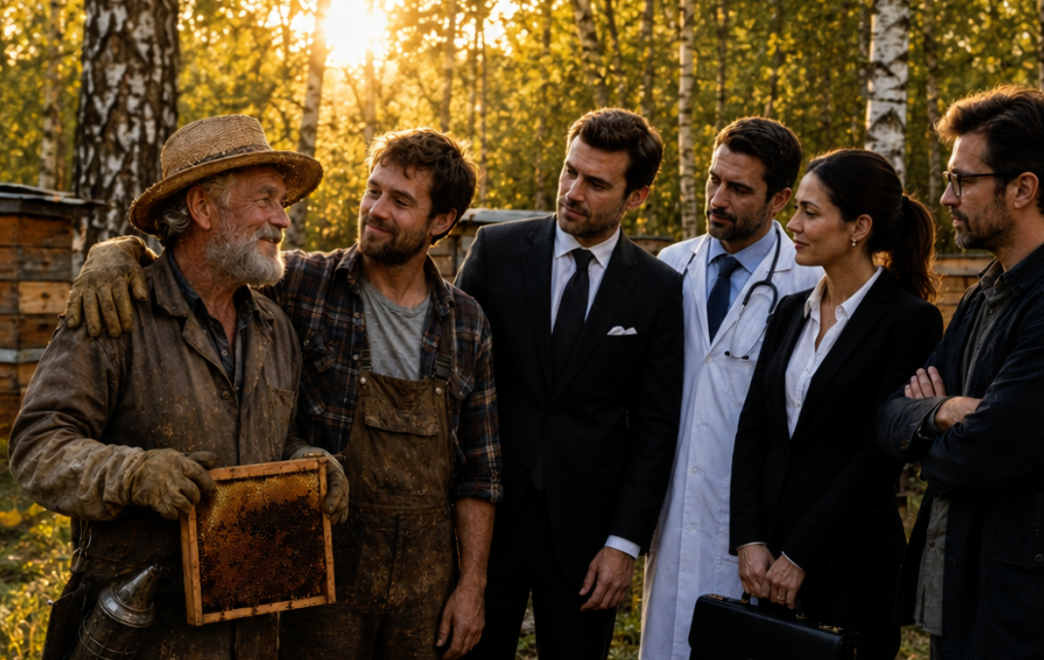
“You’re living well,” he finally said. “Well done. Now let’s discuss the real matter. The apiary. One hundred and twenty hives. The forest. The honey. I’m old now. My hands aren’t what they used to be. Neither is my back. It is time to decide. Who should I give it to?”
Silence fell over the room.
Anton was the first to speak.
“Grandpa, have you ever thought about selling it?”
“Selling what?”
“The apiary. The land. This forest. There are hectares of property here. Do you know how much land is worth now? A road could be built here. You could create a hunting reserve or a holiday resort. You earn pennies from this honey, but the land could bring in millions.”
“Millions,” Savely repeated.
His voice remained calm, but the fingers gripping his mug turned white.
“Millions are good. But what about the bees?”
“What about them?”
“What are you going to do with the bees? There are one hundred and twenty colonies. They are alive. They gather honey. They support this land. Where will you put them?”
Anton shrugged.
“Well… we could give them to another beekeeper for a token price.”
“A token price,” Savely said, putting down his mug. “So I suppose I educated all of you with token money? Was it token honey that I took to Moscow? Were they token bees that helped you become successful people?”
Anton fell silent.
Alyosha joined the conversation.
“Grandpa, why are you talking like that? We only want what is best for you. How old are you now? Eighty? Why do you need an apiary? Sell it and live peacefully. We’ll buy you an apartment in the city. Somewhere warm, with modern conveniences.”
“I have conveniences here,” Savely said darkly. “I have the forest, the river, and the bees. What are you offering me instead? A box in an apartment building, where I can die of loneliness?”
“Grandpa…”
“Be quiet, Alyosha. You’re a doctor. You treat people. What are you trying to treat me with now? Your words? I can’t swallow them. They’re stuck across my throat.”
Dimka sat silently, turning a spoon in his hands.
Then he said:\
“I would take it, Grandpa, but I work in shifts. I can’t do it. Honey requires attention every day, and I spend six months at a time working in the north.”
“I know,” Savely nodded. “You were the same as a child. You were always trying to get away. Anywhere but here. As far away as possible.”
Marina sighed.
“Grandpa, I would gladly take it. But I have children, a husband, and his military service. I couldn’t live in the forest anymore. I’m no longer used to it.”
“No longer used to it,” Savely repeated. “All of you have lost the habit. You’re no longer used to the forest, the bees, or me.”
Then Tanya spoke.
She had been sitting quietly near the window the entire time, looking at the hives outside, the forest, and the evening sky.
After everyone else had finished speaking, she simply said:
“Grandpa, teach me.”
Savely lifted his head.
“Teach you what?”
“Everything. The bees, the honey, how to repair the hives, and how to catch swarms. I want to stay. I won’t leave.”
“What about your greenhouses?”
“The greenhouses belong to someone else. But this belongs to us.”
She looked around at the cabin, the hives, and the forest beyond the window.
“I’ve always wanted to come back. I was just afraid. I thought you would send me away.”
“You foolish girl,” Savely said, his voice trembling. “Why would I send you away? You’re mine.”
Alyosha cleared his throat.
“Tanya, are you serious? You have an education and real prospects, and you want to live in the forest and work at an apiary? That’s degradation.”
“Degradation is forgetting who raised you,” Tanya replied quietly. “And I remember.”
The brothers exchanged glances.
Anton opened his mouth to say something but stopped himself. Dimka waved his hand dismissively. Marina lowered her eyes.
Savely rose from the table, approached Tanya, and placed his large, heavy hand on her head. It was covered with scars from countless bee stings.
“Then get ready,” he said. “Tomorrow, we get up at five in the morning. Bees don’t sleep late.”
The following day, at five in the morning, while mist still hung over the forest, Savely and Tanya walked out to the apiary.
Grandfather placed a protective veil over her head and handed her a smoker.
“Don’t be afraid. They can sense fear, but they don’t bother the brave. Are you brave?”
“I’m brave.”
“Then let’s go.”
They walked between the rows of hives in the morning silence, disturbed only by the hum of the awakening bees.
Savely opened the hives, showed her the frames, and explained where to find the brood, the honey, and the queen.
Tanya listened.
She absorbed everything and committed it to memory.
Her brothers and Marina left that same day.
Alyosha drove away gloomy and offended.
Dimka left in silence, feeling awkward.
Anton was irritated that his potential deal had fallen apart.
Marina left in tears, but without attempting to change anything.
They all returned to the cities, each to their own.
Tanya stayed.
A year passed.
Savely could barely stand anymore. He sat on the porch and watched Tanya manage the apiary.
She had golden hands.
The bees accepted her. They did not sting her and recognized her as their new keeper.
The honey was especially good that year—thick, amber-colored, and fragrant.
Tanya took the metal cans to Moscow herself, to the same market where Savely had always sold his honey.
She stood behind his old counter.
When people saw a young woman in place of the old beekeeper, they were suspicious at first.
Then they tasted the honey, and the same line formed as before.
By autumn, Savely had become extremely weak.
Tanya sat beside his bed, holding his hand.
Photographs hung on the wall—five grandchildren when they were still young, dirty-faced, and happy.
A jar of fresh honey stood on the table.
“Tanya,” Savely said.
His voice was weak and barely audible.
“Don’t abandon them.”
“I won’t, Grandpa.”
“There are one hundred and twenty colonies. One hundred and twenty. Each one is like a person. Each has its own temperament. You know them now.”
“I know them.”
“And the honey… Keep taking the honey to Moscow. Money isn’t the important thing. The important thing is for people to eat real honey instead of the chemicals they sell in stores. Do you understand?”
“I understand, Grandpa.”
He closed his eyes and remained silent for a long time.
Tanya thought he had fallen asleep, but suddenly he spoke again.
“And the other four… don’t judge them. That’s the kind of life they have. A city life. It isn’t their fault. They simply forgot. People forget quickly. But bees don’t. Bees remember. If you treat them with kindness, they will serve you for the rest of your life.”
“I remember, Grandpa,” Tanya said. “I remember everything.”
He smiled and fell asleep.
This time, forever.
Savely was buried at the edge of the forest, in a place from which the apiary, the river, and the taiga stretching all the way to the horizon could be seen.
The entire village gathered for the funeral meal.
The brothers and Marina came as well. They stood beside the grave, confused and subdued.
Anton twisted his expensive hat in his hands.
Alyosha stared at the ground.
Dimka frowned.
Marina cried.
Tanya stood there thinking:
Grandpa, you were right. People forget. But bees don’t.
After the funeral meal, the brothers got into their cars and prepared to leave.
They all had things to do.
They all had their own lives.
Before leaving, however, each of them handed Tanya an envelope.
“This is for the apiary,” Alyosha said. “For the hives and the repairs.”
“If you need more, we’ll send it,” Anton added. “You only have to tell us.”
Then they left.
Tanya remained behind.
Alone with one hundred and twenty hives, the forest, the river, and five photographs on the wall—five grandchildren who had once been nothing more than abandoned children taken in at the apiary.
Now she transported the honey to Moscow herself.
She repaired the hives herself.
She caught the swarms herself.
Whenever someone asked, “Whose apiary is this?” she answered:
“It belongs to Savely Petrovich. I only help him.”
Because an apiary is not its hives.
It is not the land.
It is not the honey.
An apiary is a person.
And as long as that person’s work continues, they remain alive.
They live in the humming of bees in the summer forest.
They glow in the amber honey inside a jar.
They breathe with the taiga.
They remember.