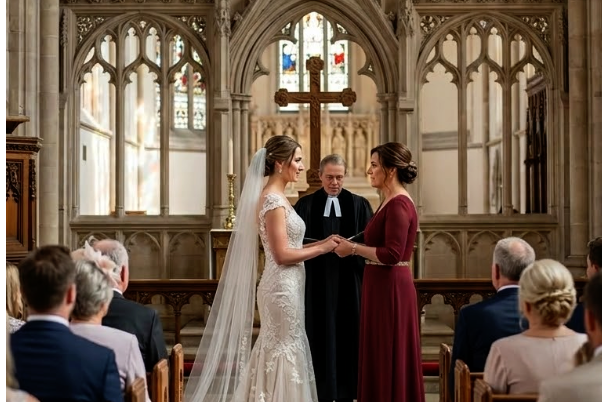
The air inside St. Michael’s Cathedral was thick with the scent of lilies and the heavy, expectant silence of two hundred witnesses. The organ’s deep, resonant notes—a Bach processional that felt more like a dirge than a celebration in my ears—vibrated through the marble floor and up into the soles of my feet. I stood at the altar, a vision in ivory silk and heirloom lace, the very embodiment of the “perfect bride” my mother, Diana, had spent twenty-eight years sculpting. But beneath the beadwork and the fingertip-length veil, I was not a bride. I was a whistleblower in the house of God.
To the guests, I was Celeste Maryanne Darren, the senior editor at Meridian Publishing, marrying the city’s most eligible bachelor, Nathaniel Reed. We were the “Golden Couple” of the D.C. social circuit—a union of intellect, beauty, and ancestral prestige. To my left, Nathaniel stood with a confidence that bordered on the divine, his blue eyes projecting a warmth that I now knew was merely a well-practiced light refraction. In the front pew, my mother was a portrait of emerald elegance, her handkerchief poised to catch tears of joy that were as manufactured as the floral arrangements she had obsessed over for months.
I looked at them both and felt a cold, crystalline clarity. They were not my family or my future; they were architects of a profound duplicity that had sought to bury my dignity beneath the weight of a marriage certificate. Our engagement had been a masterclass in performative romance. Nathaniel Reed, the thirty-one-year-old scion of Judge Harrison Reed, had proposed at the Kennedy Center during the intermission of Swan Lake. It was a moment designed for the cameras—the two-karat diamond catching the light, the hushed gasps of the D.C. elite, the soft press of his lips against mine.
“You’ve done well, sweetheart,” my mother had whispered that night, her eyes not on my face, but on the ring. It was the language of a transaction. I had “done well” for the family brand, securing a seat at the table of the Reeds, whose influence permeated the legal and philanthropic circles of the capital.
My father, Pastor William Darren, had viewed the union through a different lens. To him, Nathaniel was a man of character, a “good man” who would cherish his only daughter. My father’s world was built on the bedrock of traditional morality and the sanctity of the word. He believed in the inherent goodness of people, a beautiful naivety that both my mother and my fiancé had weaponized against him.
For months, the wedding preparations were less about a union of souls and more about an exercise in social dominance. Diana took control of every petal and every seating chart. She insisted on white roses and peonies over the wildflowers I loved; she demanded a full orchestra where I had envisioned a simple string quartet. “Mother knows best,” she would say, her smile a practiced armor.
I watched the way she and Nathaniel interacted—the long kitchen conversations that lasted well after I had retreated to my study to work on manuscripts, the way he knew her favorite vintage of Bordeaux, the way their laughter seemed to harmonize in a frequency I couldn’t quite reach. I attributed it to a blossoming familial bond. I thought I was lucky to have a husband who loved my family so deeply. I was blind, not because the signs weren’t there, but because the truth was too grotesque to contemplate. The first true tremor occurred three weeks before the ceremony. I had returned to my parents’ house unexpectedly to find the air charged with an unfamiliar, frantic energy. My mother was flustered, her hair—usually a rigid crown of perfection—disturbed. The kitchen smelled of an expensive, masculine cologne that did not belong to my father.
“Was someone here?” I had asked, eyeing a warm coffee mug from the “guest-only” china set.
“Just me, darling. I needed the caffeine,” she’d lied, her eyes darting to the floor.
The second crack was more of a fracture. Nathaniel began to drift, citing the pressures of a high-stakes litigation at his firm. He missed cake tastings; he missed rehearsals. When I went to his apartment to check on him, I found the door locked—a first in our three-year history.
“I have food poisoning, Celeste. Don’t come in,” he’d said through the wood.
I stood in the hallway, staring at the mahogany door, sensing the lie like a physical weight. On the coffee table in the living room sat a single wine glass with a smudge of lipstick on the rim—a deep, plum shade that neither I nor any of my friends wore. It was the shade my mother had worn to every charity gala for the last decade. Yet, even then, the mind protects itself. I told myself it was stressful. I told myself I was being paranoid. I told myself that love requires trust, even when trust feels like a leap into the dark. The collapse happened forty-eight hours before the wedding. It was a mundane error that led to the revelation. My mother had asked me to retrieve wedding programs from her car. There, slipped between the leather seats of her Mercedes, was a small black notebook.
I opened it, expecting to find guest lists or vendor contacts. Instead, I found a chronicle of a slow-motion car crash.
“Nathaniel Reed is everything I should have married,” the first entry began, dated three months prior. “He looks at me the way William used to before the routine wore him down… I know what it would do to Celeste if she found out. But when was the last time anyone really chose me?”
The entries were agonizingly detailed. They described “making love” in Nathaniel’s apartment while I was at my book club. They detailed the “last time” they would share before the wedding, planned for the very night my father would be out at a bachelor-party planning meeting. Nathaniel’s words were recorded there, too: he had told her that marrying me was a “social necessity,” a duty to his father’s reputation, but that his “heart belonged to her.”
I sat in the driver’s seat of that car, the suburban afternoon sunlight Mocking me. The sprinklers clicked nearby, watering the manicured lawns of people who lived in a world where mothers didn’t seduce their daughters’ fiancés. I didn’t scream. I didn’t cry immediately. I simply felt the woman I was—the trusting, dutiful daughter—dissolve. In her place, a cold, calculated architect of justice was born.
I checked into a hotel under a pseudonym. I organized the evidence: the journal, the credit card statements showing “business dinners” at five-star hotels, the timeline of lies. I had a choice. I could have a quiet confrontation. I could cancel the wedding with a vague press release about “irreconcilable differences.”
But they hadn’t betrayed me in private. They had built a public facade of virtue while hollowing out my life from the inside. They wanted a grand production? I would give them a finale they would never forget. I woke at dawn on my wedding day feeling a strange, hollow peace. My phone was a graveyard of “Good morning, beautiful” texts from my mother and “I can’t wait to see you” messages from Nathaniel. Each one was a testament to their sociopathic commitment to the lie.
I dressed with the help of my bridesmaids, feeling like I was being prepared for a ritual sacrifice. The dress, chosen by Diana, was a masterpiece of classic elegance. I looked in the mirror and didn’t see a bride; I saw a Trojan Horse.
Before the processional, I found my father. He looked so proud in his tuxedo, the quintessential patriarch. I handed him the journal. I watched his face go from confusion to a devastating, ashen realization. I saw thirty years of marriage and faith shatter in the span of five minutes.
“What do we do?” he whispered, his voice broken.
“We walk,” I told him, my voice like steel. “We let them think they’ve won. And then, we tell the truth.” The walk down the aisle was the longest journey of my life. Every flash of a camera was a reminder of the public humiliation they had prepared for me. Nathaniel stood there, smiling, a wolf in bespoke tailoring. My mother sat in the front row, the picture of maternal bliss.
The ceremony proceeded with agonizing tradition. Pastor Jenkins spoke of “holy matrimony” and “sacred bonds.” I let him finish. I let Nathaniel say his “I do,” watched him look into my eyes and lie before God and two hundred witnesses about “forsaking all others.”
Then, it was my turn.
“Celeste, do you take Nathaniel to be your lawfully wedded husband… for better or worse… until death do you part?”
I looked at the congregation. I looked at the Reeds, the judges and philanthropists. I looked at my mother, who was dabbing her eyes.
“Actually,” I said, my voice projecting with the clarity of a bell through the cathedral’s microphone, “I have something to say first.”
The silence that followed was absolute. It was the sound of a world holding its breath.
“I want to thank you all for coming,” I began, stepping away from Nathaniel’s attempt to grab my hand. “But a marriage cannot be built on a foundation of ash. And today, I realized that the man standing before me and the woman sitting in the front row—my mother—have been engaged in an affair for the past three months.”
The explosion of noise was instantaneous. Gasps, whispers, the sound of a program hitting the floor.
“I have the proof,” I continued, my voice never wavering. “A journal detailing their secret meetings, their nights spent together while my father was at church, and the plan to continue this affair after our ‘socially necessary’ wedding. Nathaniel didn’t want a wife; he wanted a cover. And my mother didn’t want a son-in-law; she wanted a trophy she could steal from her own child.”
I turned to Nathaniel. His face was a mask of pale horror. The “Golden Boy” was tarnished beyond repair in a single minute. I turned to my mother. She was frozen, the emerald silk of her dress suddenly looking like the skin of a serpent.
“Diana,” I said, addressing her by her name for the first time in my life, “you told me ‘mother knows best.’ I suppose you were right. You knew exactly how to destroy the one person who trusted you most. But you didn’t know how well I could fight back.”
The sanctuary, once a place of “sacred union,” was now a courtroom of public opinion. Judge Reed stood up, his face a map of fury, looking at his son with a disgust that signaled the end of Nathaniel’s career and social standing. My father stood beside me, his hand on my shoulder—not as a man giving away his daughter, but as a man standing with his peer.
I didn’t wait for a rebuttal. I didn’t wait for the tears or the frantic apologies that I knew would follow. I turned and walked back down that long, marble aisle. My train swept the floor, but I felt light, as if the silk were wings. I walked through the heavy oak doors and into the crisp October air, leaving the wreckage of their lives behind me. The aftermath was a slow-motion demolition. Within forty-eight hours, the video of the “Altar Revelation” had gone viral. In the age of digital permanence, there is no hiding from a truth that loud.
Nathaniel Reed was placed on “indefinite leave” from his firm, a polite D.C. euphemism for being blacklisted. His father, the Judge, refused to speak to him. The “Old Money” and “High Society” circles they craved so desperately closed their doors. They were no longer the elite; they were the punchline of a national scandal.
My mother fared no better. The social boards she had climbed with such ruthless ambition asked for her resignation. The “friends” she had cultivated disappeared. She moved to Baltimore to live in a small apartment, the architect of a loneliness she had built with her own hands.
My father resigned from his church. He couldn’t preach the sanctity of marriage while his own home was a site of such profound desecration. He moved to a small parish in Vermont, where the air is cold and the people are honest. We speak every week. He tells me he is finally learning what it means to live in the truth, even if the truth is painful. One year later, I stood on a different stage—a keynote speaker at a literature conference in New York. I wasn’t wearing ivory silk. I was wearing a sharp, navy suit and a smile that reached my eyes.
The story of my wedding had become a cultural touchstone, but not for the reasons people thought. It wasn’t about revenge. It was about the moment a person decides that their own dignity is worth more than a beautiful lie. It was about the power of the “Authentic Voice.”
I have a new life now. I have an apartment in Brooklyn filled with books and light. I have a job I love, and a circle of friends who value character over pedigree. But most importantly, I have my own truth.
Sometimes, people ask me if I regret the public nature of the revelation. If I ever feel guilty for “destroying” my mother or Nathaniel.
I tell them the same thing: Truth doesn’t destroy. It simply reveals what was already broken. I look at the vase of wildflowers on my desk—the kind I always wanted—and I realize that the “happily ever after” I was promised wasn’t a marriage to a man of standing. It was the discovery of a woman of substance.
The sermon my father used to give about the “truth setting you free” finally makes sense. It doesn’t mean the truth makes life easy. It doesn’t mean the truth is comfortable. It just means that once you say it, you never have to hide again. And in a world built on emerald dresses and two-karat lies, that is the greatest victory of all.
I am Celeste Darren. I am no one’s victim, no one’s “social necessity,” and certainly no one’s fool. I am simply a woman who walked out of a cathedral and into her own life.