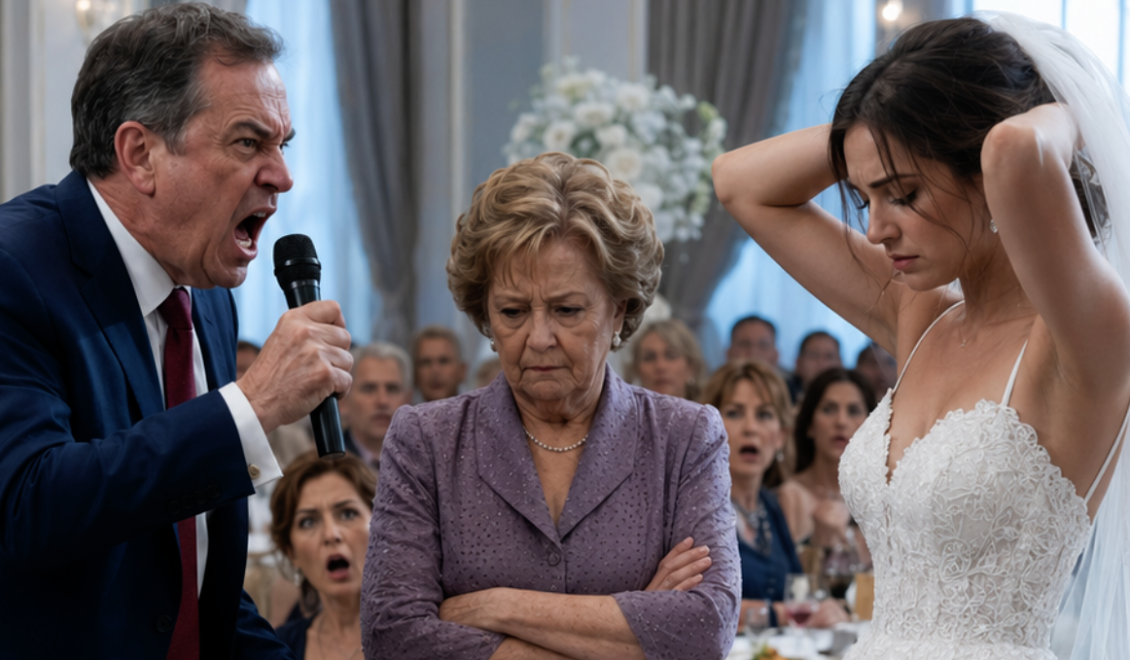
Galina Stepanovna rose from the table as if she were about to announce an amnesty. She adjusted her collar, smoothed her napkin — slowly, with a theatrical pause. Kirill sat beside her, tense and ready. Vera suddenly understood: they had rehearsed this.
“Dear guests! I want to announce our gift to the newlyweds!”
Vera clenched the napkin. Kirill covered her hand with his palm — hot and damp. She tried to pull free, but he held on.
“Kirill and I have decided: let the young couple live in my three-room apartment in the city center! It has everything — renovations, furniture. Why should they struggle?”
The guests applauded. Galina Stepanovna beamed, accepting the applause.
Vera stood up. Kirill tugged at her hand, but she pulled free. She walked over to her mother-in-law and smiled — with her lips, not her eyes.
“Thank you, Galina Stepanovna. That’s very generous. But no.”
Her mother-in-law blinked.
“What do you mean?”
“I have my own house. My grandfather left it to me. Thirty kilometers from the city, by the river. Kirill and I will live there.”
She had not discussed it with him. She had simply said it once, and he had nodded. But now that no longer mattered.
Galina Stepanovna turned pale. Kirill jumped up and grabbed Vera by the elbow — sharply, painfully.
“Quiet!” he hissed, not realizing the microphone was still on. His voice struck the whole hall. “Elena and Pyotr have already moved in there with their three children! We already decided!”
Silence. Even the musicians froze.
Vera looked at Kirill and saw his lips still moving, trying to add something. But there were no more words.
“You gave the keys to my house to your sister?” Vera spoke quietly, but everyone heard her. “To my house?”
Kirill swallowed. Galina Stepanovna lunged forward.
“Vera, dear, family must help one another! Elena and the children were crammed into a one-room apartment, while you have an entire house standing empty! A single woman has no need for that much space!”
“Single?”
Vera removed her veil. Slowly, carefully, freeing the pins. The guests watched without breathing. She placed the veil on the table and picked up her handbag.
“I got married today, Galina Stepanovna. But that can easily be fixed.”
“There, you see! You got married! That means family! And family must—”
“The wedding is canceled. There will be no marriage.”
Kirill grabbed her by the shoulders. His face twisted.
“Have you lost your mind?! Elena is already there! With her things! The children are exhausted!”
“I don’t care.”
She said it so calmly that he let go. Vera turned to the guests.
“I’m sorry for ruining your evening.”
She walked toward the exit. Her shoes clicked against the tiles — loudly, clearly. Kirill shouted something after her, but the words no longer reached her.
Marina arrived twenty minutes later. Vera was waiting outside the restaurant in her white dress, standing beneath a streetlamp.
“Drive to the house. Now.”
Marina — her university friend, a lawyer — nodded and started the car.
They drove in silence. Vera looked out the window at the darkness beyond the city. Marina asked only one question:
“Do you have the documents with you?”
“Yes.”
When they arrived, the lights were on in the windows of the house. Strange shadows moved behind the curtains.
The gate was wide open. Children’s toys lay scattered in the yard. On the porch stood boxes marked “Kitchen.”
Vera pushed the door open. It was not locked.
The hallway smelled foreign — wet jackets, rubber, baby cream. Unfamiliar down coats hung on the rack. On the floor were boots, little shoes, and rubber rain boots with ladybugs on them.
“Who’s there?”
A woman of about thirty came out of the kitchen in a stretched-out T-shirt. Her hair was tied in a messy ponytail, her face drawn. Elena.
She saw Vera in her wedding dress and froze.
“You… what are you doing here?”
“I live here. You don’t.”
Elena came to her senses and stepped forward.
“Kirill gave permission! Mom said so! We have children, three of them! We have nowhere to go!”
“You have twenty minutes. Otherwise, I’m calling the police.”
“Are you insane?!” Elena swung a rag in the air. “We just unpacked! The children are asleep! You’re throwing children out into the street?”
Marina took out her phone.
“Eighteen minutes.”
A man in an undershirt came out of the back room. Large, with a belly. Pyotr.
“What’s all the noise? You’ll wake the child!”
“Vera showed up,” Elena said, pointing a finger. “She’s throwing us out!”
Pyotr smirked.
“Oh, come on. Kirill will sort everything out. You’re family. You’ll settle it.”
Vera looked at him — at this strange man standing barefoot in her house, telling her they would settle it.
“There is no family. Fifteen minutes.”
Elena shrieked. She screamed about ruined lives, about heartlessness, about innocent children. Pyotr puffed out his chest and stepped forward. Marina was already dialing.
“Yes, police. Illegal entry into a private home.”
Elena fell silent. Pyotr clenched his fists, but did not move.
“Are you serious? The cops?”
“Ten minutes.”
Pyotr swore, turned around, and went into the room. His voice was heard from inside:
“Get up! We’re packing! Quickly!”
Children started crying. Feet stomped. Elena rushed around, grabbing things, stuffing them into bags, sobbing.
Forty minutes later, they left. An old car loaded with boxes. The children wailed in the back seat. Elena turned around and shouted through the window:
“You’ll regret this! Kirill will get to you!”
Vera locked the gate.
The kitchen was a mess: dishes in the sink, crumbs on the table, a juice stain. In the room, rumpled bedding lay on the bed. It smelled of someone else’s sweat.
Marina put an arm around her shoulders.
“Will you manage?”
“I will.”
Marina left closer to midnight. Vera changed clothes, took off the dress, and hung it in the wardrobe without looking at it. Then she began cleaning. She washed, scrubbed, changed the bedding. Until three in the morning. When she finished, the house smelled of wood and cleanliness again.
She lay down and fell asleep immediately.
In the morning, she changed the locks. The locksmith came, did the job in half an hour, took his money, and left without a word.
Kirill called all day. Vera declined the calls. After the twentieth call, she blocked him. He wrote from unfamiliar numbers — swearing, pleading, then swearing again. She deleted the messages without reading them.
Galina Stepanovna arrived three days later. She stood by the gate, ringing the intercom. Vera watched from the window and did not come out. Her mother-in-law stood there for twenty minutes, then left, muttering about ingratitude.
A week later, Vera filed for annulment. A union of only a few hours — almost nothing. The paperwork was processed quickly.
Kirill kept watch near the house for another three weeks. Vera called the police twice. After the second report, he disappeared.
She later learned that Elena had moved back in with Galina Stepanovna. Into that same three-room apartment. Five people in three rooms. Her mother-in-law complained to the neighbors about the noise, the mess, the trampled carpets. Kirill tried to move out, but he did not have enough money — everything went to his sister, her children, and Pyotr’s debts. Galina Stepanovna demanded that he pay the utilities. He paid. He grew angry. In the evenings, he drank. The neighbors heard scandals.
Vera did not rejoice. She simply knew: they had received what was theirs. Not her house. Not her life. Their own — cramped, airless, full of complaints.
Vera switched to remote work. Accounting did not require an office — only a laptop and deadlines. Her boss resisted, but she insisted.
She moved into the house permanently. She woke to birdsong, drank her morning drink on the veranda, and looked at the river. She worked when she wanted. She walked in the evenings.
Life became quieter. Without strain.
Egor appeared in the spring. He came to repair the neighbor’s roof. Tall, wiry, with work-worn hands. He greeted her over the fence.
Two days later, he knocked at the gate.
“Your gutter has come loose. I can fix it, if you want.”
“How much?”
“Nothing. Half an hour of work.”
He fixed it. Refused money. Drank some water, thanked her, and left.
Vera watched him go and thought: this is how it should be. No bargaining. Just human decency.
Egor came by again. Sometimes to give advice, sometimes to help with a heavy board. He did not impose himself. He did not pry into her soul. He was simply nearby.
One evening, Vera invited him onto the veranda. They sat in silence, drank something hot, and looked at the river. Egor told her he had been married and had divorced five years earlier. No drama. They had simply parted ways.
Vera told him about the wedding. Briefly.
“You did the right thing by leaving,” he said simply. “Not everyone would have had the courage.”
Vera looked at him. At his calm face, at his hands resting on his knees. At a person who did not demand her house, her life, her consent. Who simply sat beside her.
“Thank you.”
They said nothing more. There was no need.
A year passed. Egor came often, but not every day. He helped around the house, and sometimes simply sat on the veranda. One day he kissed her — carefully, as if afraid to scare her away. Vera did not pull back.
They did not talk about the future. They were simply together. Without stamps, without a wedding, without a mother-in-law making toasts.
Vera no longer thought about Kirill. Sometimes, before sleep, the scene in the restaurant returned to her: the microphone, his shout, the veil on the table. And then she understood: she had not simply left. She had saved herself.
That house by the river was not just walls. It was her boundary, one no one had the right to cross without permission. And she had defended it.
One morning, sitting with Egor on the veranda and looking at the sunrise over the water, Vera suddenly felt gratitude. Not toward Kirill — for showing his true face in time. Not toward Galina Stepanovna — for her audacity. But toward herself. For saying “no.” For taking off the veil and walking away.
For not being afraid to remain alone. Because solitude turned out to be better than life with people who see you as a resource.
Egor sat silently beside her. Vera took his hand. He squeezed her palm in return. Firmly. Calmly.
The way one holds something they do not intend to take away.
If you enjoyed it, please like, leave a comment, and subscribe!