The heat in Phoenix had been a dry, suffocating weight, but it was nothing compared to the coldness that settled in my chest as I stood over my sister Grace’s grave. I had spent six months watching the vibrant woman who raised me wither away, her laughter replaced by the sterile hum of hospital machinery. I had buried her under a sky so blue it felt like an insult.
I flew back to Chicago with my black funeral dress still smelling of damp earth and the faint, citrusy perfume Grace always wore. My body ached from 40 years of cleaning floors—40 years of bending, scrubbing, and saving every penny so that my children would never have to know the sting of poverty.
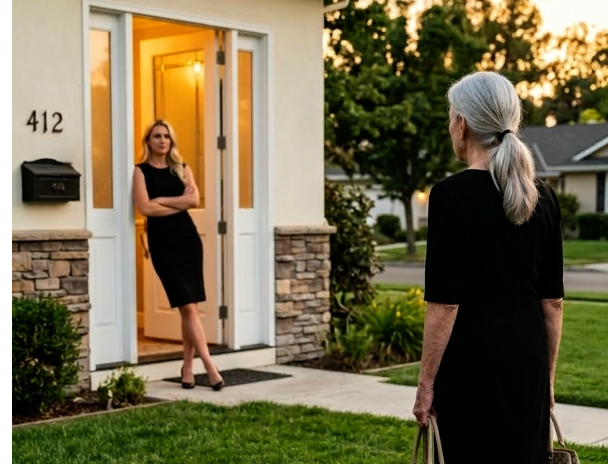
I turned the corner onto Jakaranda Street, expecting the comfort of my pale yellow house. I had painted it that color because life is often gray, and I wanted my home to be a sunbeam. It was the house I had bought with my late husband, Salazar, and the house I had gifted to my son, Robert, when he married Danielle. I thought I was building a legacy of love.
Instead, I found my legacy scattered across the lawn.
My life, condensed into cardboard boxes and plastic bags, sat piled next to the buganvillia plants I had nurtured for a decade. My grandmother’s hand-knitted shawl, my children’s baby records, and the silver-framed photographs of Salazar—all of it was being treated like refuse.
“What is this?” I whispered, my voice lost in the wind.
The front door opened, and Danielle stepped out. She looked immaculate—a $300 dress, a fresh blowout, and a smile that didn’t reach her eyes. She looked like a woman who had never scrubbed a toilet in her life.
“Oh, Mom, you’re back!” she chirped, her voice dripping with a sweetness that tasted like saccharine. “We decided to do a deep clean. All those old things… they were just taking up space. They’re useless now, don’t you think?”
“Useless?” I repeated. My hands began to shake. “Danielle, these are my memories. These are my documents. This is my life.”
“Well, we needed the room,” she said, her tone sharpening. “Robert didn’t tell you? I’m three months pregnant. We’re turning your room into the nursery. We left a spot for you in the back—the utility room. It’s cozy! Just try to stay out of the way; the doctor says I can’t have any stress.”
She led me to the utility room, a 6-by-6 concrete box that smelled of damp cement and old tools. A folding bed with a stained mattress sat in the corner. Something inside me, something I had kept neatly tucked away for decades, finally snapped.
“A woman isn’t strong because of what she has,” my mother used to say. “She is strong because of what she is capable of rebuilding when everything is taken from her.”
I looked Danielle straight in the eyes. Her smile faltered.
“You’re right, Danielle,” I said with a calm that terrified even me. “It is time for a deep clean. I’m going to start cleaning out exactly what is useless to me, too.”
I pulled out my phone. It was time to call in the reinforcements.
The next morning, I stood in the office of Mr. Mendes. It was a room that smelled of old leather and expensive ink—a place where the truth was codified in black and white.
“Carol, I’m so sorry about Grace,” he said, his eyes full of genuine concern.
“Thank you, Arthur. But I’m here for a different kind of death,” I replied. I laid out the photos of my things on the lawn and my bank statements.
As he reviewed the files, his expression shifted from sympathy to professional fury. He pointed at the deed I had brought. “Carol, do you realize what this is? You gave Robert permission to live there. You told everyone it was a gift. But you never actually signed the title over at the notary. Legally, you are the 100% owner of 247 Jakaranda Street.”
A spark of hope ignited in my chest. “And the money?”
Arthur’s pen tapped rhythmically against a statement. “In the eight months you were in Phoenix, $45,300 was withdrawn from your retirement account via electronic transfers. Did you authorize these?”
“Never.”
“Technically, Carol, this is family fraud. Robert had the card for emergencies, but he or Danielle has drained your life savings. And the furniture they sold? Those are assets stolen from your estate.”
I walked out of that office not as a grieving sister or a discarded mother, but as a woman with a plan. That night, I returned to the yellow house. I stayed in the utility room as promised, listening to the sounds of my son’s laughter through the walls. He didn’t come to check on me. He didn’t ask about his aunt’s funeral. He had chosen his side. Three days later, Danielle hosted a dinner party for her parents, the Armstrongs. They were people who wore their wealth like armor—Mr. Armstrong with his boisterous laugh and Ms. Beatatrice with her judgmental silences.
Danielle had insisted I join them. I knew why. They wanted to “civilize” the situation by pressuring me into a nursing home. I wore my black funeral dress again. It felt appropriate for what was about to happen.
“Ms. Carol,” Mr. Armstrong began, swirling a glass of wine that Robert had surely paid for with my money. “We’ve been discussing the future. Young people need their space, especially with the baby. There are some lovely retirement communities—resort-style, really.”
“How thoughtful,” I said, my voice as smooth as glass. “But I’m curious. How will Robert and Danielle afford the fees for such a place, considering they’ve already spent $45,000 of my savings in eight months?”
The table went silent. Danielle’s fork clattered against her plate.
“What are you talking about?” Robert stammered, his face turning a ghostly pale.
“I’m talking about the $6,000 shopping sprees, the trip to Miami, and the sale of my mother’s 70-year-old mahogany furniture,” I said. “And I’m talking about the fact that this house—every brick, every nail—is still legally mine. I never signed the deed over, Robert.”
Danielle erupted. “You old witch! You gave us this house! You can’t take it back!”
“I didn’t take it back,” I replied, standing up. “I simply realized that I was housing people who don’t respect the roof over their heads. Arthur Menddees is filing the eviction papers tomorrow morning. You have 30 days.”
The chaos that followed was a symphony of screeching and accusations. Danielle turned on Robert, screaming that he had lied about owning the house. Robert fell into a chair, his head in his hands. I walked back to my 6-by-6 room and locked the door. For the first time in years, I slept like a baby.
The victory was short-lived. The human body can only take so much betrayal before it revolts. Two days later, a crushing weight landed on my chest. I collapsed in the utility room, my fingers clawing at the concrete floor.
I woke up in a hospital bed to the sound of beeping monitors. My daughter, Marianne, and my youngest son, George, were there. They had flown in from across the country the moment they heard.
“Mom, why didn’t you tell us?” Marianne cried, her eyes red.
“Where is Robert?” I asked.
The silence that followed was my answer. Robert had been notified seven hours ago. He hadn’t come. He was likely at home, dealing with a hysterical Danielle or calculating his mounting debts.
“The doctor says it was a minor heart attack brought on by acute stress,” George said, his voice trembling with anger. “We know everything, Mom. Miss Lucy told us. Marianne and I are taking over. Robert isn’t getting near you again.”
In that hospital bed, I realized I had three children, but I only had two hearts I could trust. Robert was a stranger wearing my son’s face.
A week after I was discharged, a surprising visitor arrived at my new small apartment. It was Ms. Beatatrice—Danielle’s mother. She looked broken, her previous arrogance replaced by a profound shame.
“I can’t sleep, Carol,” she whispered, handing me a thick manila envelope. “My daughter is a compulsive liar. She’s been in debt since she was twenty. She scammed three men before Robert.”
I opened the envelope. Inside were medical records.
“She isn’t pregnant, Carol,” Beatatrice said, her voice cracking. “She had a medical procedure years ago; she can’t have children. She’s been faking the symptoms, buying positive tests online. She just wanted the house so she could sell it and pay off her creditors.”
The depth of the deception was breathtaking. I called Robert. I didn’t want to, but a mother’s last duty is to show her child the truth, even if it burns him.
When they arrived at my apartment, the confrontation was brief and brutal. Marianne laid out the medical records. The look on Robert’s face when he realized there was no baby—that the “priority” he had destroyed his relationship with his mother for was a ghost—is a look I will take to my grave.
“Get out,” Robert whispered to Danielle.
“Robert, honey—”
“GET OUT!” he roared.
The aftermath was a slow, painful reconstruction. Robert filed for divorce. Danielle was eventually arrested for a separate fraud case involving a businessman in Queens—she had tried the same “pregnancy” scam on him, but he had hired a private investigator.
Robert moved into a studio apartment and began paying me back, $1,000 a month, every month. He didn’t do it because of the contract; he did it because he was trying to buy back his soul.
One Sunday, a year after that fateful return from Phoenix, we all sat in the garden of the yellow house. The buganvillia was in full bloom, a riot of purple against the sunny walls.
“I’m sorry, Mom,” Robert said, handing me a glass of lemonade. “For everything.”
“I know, son,” I said.
I had moved back into my master bedroom. The utility room was now used for what it was meant for: storing tools and cement. I had bought new furniture—not the mahogany pieces I lost, but new ones that represented a new beginning.
I looked at my three children. We weren’t a perfect family. We were scarred, and the trust with Robert was a fragile thing, a sapling that needed years of watering. But we were real.
I had learned that you cannot fix people who are determined to break you. You can only protect yourself and wait for the dust to settle. I had lost a sister, but I had gained myself. I was 67 years old, and for the first time in my life, I wasn’t just a mother or a widow or a worker. I was Carol. And Carol was finally, truly, at peace.
Dignity is Non-Negotiable: Never confuse a “gift” with an invitation to be walked upon.
Trust, but Verify: Even with family, keep your names on the deeds and your eyes on the statements.
The Power of ‘No’: Setting a boundary is the highest form of self-love.
Rebirth is Possible at Any Age: Whether you are 27 or 67, you have the right to start over.