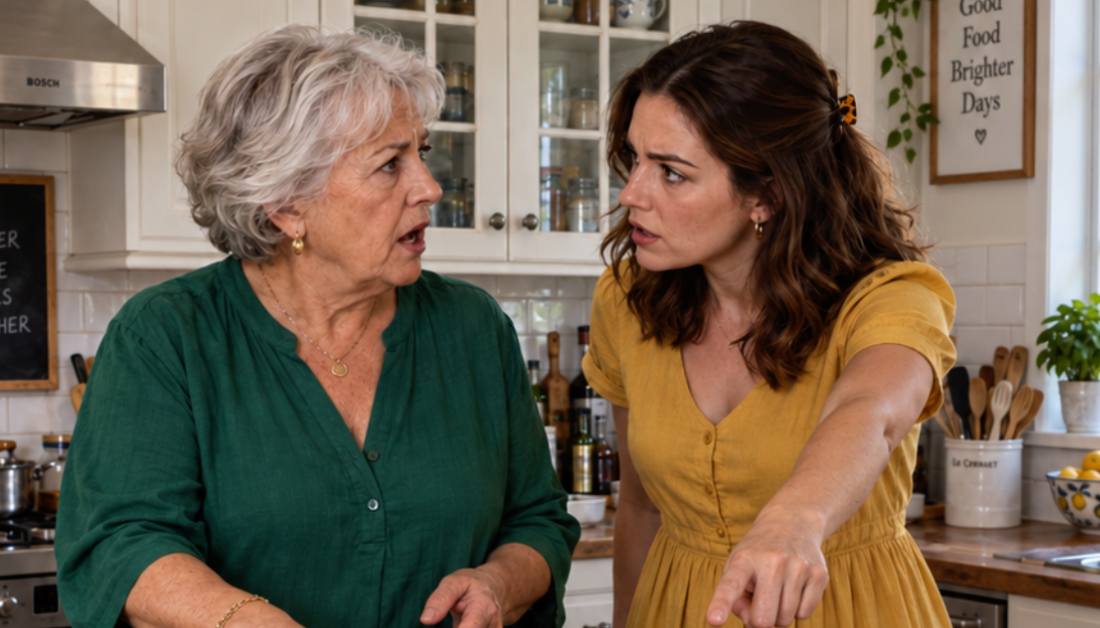
“Mom, Please Don’t Be Upset. At My Wedding, Sit Somewhere Off to the Side Where No One Will Notice You,” Her Daughter Asked
“Mom, please don’t be upset. It’s just that there will be people there in front of whom I really don’t want to have to explain why my mother looks… well, so simple.”
Nina Sergeyevna glanced at the bag of buckwheat lying on the kitchen table. Outside the window, the rain rustled steadily—fine and stubborn, the kind of rain that comes only at the end of August.
“And one more thing,” Alina continued. “It would be better if you didn’t go up to the microphone. And you probably shouldn’t take part in the family photo session either. And don’t sit at the main table—Maxim’s parents and his colleagues will be there…”
Nina listened while staring at the stove. The water in the saucepan had already begun to bubble.
“If you can,” Alina’s voice dropped slightly, “just stay somewhere in the background. So that everything looks beautiful.”
Nina Sergeyevna remained silent.
For the first time, she wasn’t thinking about what to say.
She was thinking about the fact that her daughter hadn’t simply grown up and moved away.
Her daughter had begun to feel embarrassed by the woman who had given birth to her and raised her.
Nina Sergeyevna did not consider herself unhappy.
That was important—she truly didn’t think of herself that way. She didn’t have to convince herself of it every morning or repeat it like a mantra.
She simply lived and didn’t ask unnecessary questions.
She knew the little shop on Lugovaya Street by heart: which shelf creaked, where the draft came through in winter, which regular customers had bad legs, and who needed her to bring their purchases to the register herself.
For her elderly neighbor, Klavdia Ivanovna, she would set aside bars of laundry soap and washing powder because the woman often couldn’t make it to the shop in time.
Sometimes Nina brought home unsold rolls if the manager allowed the staff to take the leftovers.
Her apartment was small, with two rooms and windows overlooking the courtyard.
In the kitchen stood jars of grains labeled in marker: “rice,” “buckwheat,” “millet.”
The old refrigerator hummed at night, but Nina had grown used to it, the way one gets used to a neighbor behind the wall.
In her wardrobe hung one good coat, gray with a herringbone pattern. She had already been wearing it for five seasons.
“Nina, are you bringing those rolls home again?” Tamara would laugh over the phone.
“It would be a shame to throw perfectly good food away,” Nina would answer calmly.
Alina had been a late and only child.
Her father left when she was six.
He left quietly, without scandals. He simply stopped coming home.
Nina didn’t try to hold him back.
She took extra shifts. During the summers, she sold seedlings and cucumbers from her garden at the market. She saved money on herself so habitually that eventually she stopped noticing she was doing it.
When Alina was accepted into university in St. Petersburg, Nina sold a gold chain that had once belonged to her own mother and added the money she had saved from the garden.
Without saying much, she packed her daughter’s things, put her on the train, and waved goodbye from the platform.
For the first three years, Alina called often.
She talked about her studies, her friends, the city.
Then the calls became less frequent.
Eventually, they became very rare.
Nina first saw Maxim over a video call.
He was neat, polite, and spoke well.
He said he would definitely come and meet her.
But he never did.
There was always a business trip, renovations, or something else.
When Alina announced that she was getting married, Nina was genuinely delighted.
One hundred and twenty guests, a countryside restaurant, a photographer, fresh flowers—Nina listened and smiled.
That same week, she went to the market and chose a dress.
It was dark blue and elegant.
She bought an inexpensive pair of shoes and made an appointment at the hairdresser.
For several evenings, she tried the dress on in front of the mirror.
“You look good,” said her neighbor Zoya Pavlovna, who had dropped by to borrow some salt. “Wear those pearl earrings with it.”
Nina smiled.
She had been setting aside part of every paycheck to put money into an envelope for the newlyweds.
For her, it was a considerable amount.
She wanted them to have enough for something important.
She wanted to look beautiful.
For her daughter.
Alina arrived on Friday around lunchtime.
That morning, Nina had baked a cabbage pie because she knew her daughter loved it.
She put the kettle on and took out Alina’s favorite cups with blue rims.
The first hour passed easily.
Alina showed her photos of the wedding dress on her phone—lace, a long train—and talked about the restaurant and the florists who would decorate the hall.
“Beautiful,” Nina said, nodding. “Very beautiful.”
But then something changed.
Alina put down her cup and glanced toward the window.
“Mom, I wanted to talk to you about something.”
“Go ahead.”
“You understand that the wedding is… well, a serious event. There will be people there who are used to a certain standard.”
Nina listened silently, and with every sentence, something inside her slowly tightened.
Apparently, she wasn’t supposed to make a toast.
She shouldn’t approach the microphone.
She shouldn’t participate in the family photo session.
She shouldn’t sit at the main table.
She shouldn’t communicate “too actively” with Maxim’s relatives.
And if possible, she should leave early.
“Alina,” Nina said quietly. “Are you ashamed of me?”
Her daughter was silent a little longer than necessary.
“Mom, this isn’t about being ashamed. It’s just that you’re not used to that kind of society. You understand yourself—you have your life, and we have ours.”
Nina looked at her daughter.
At the unfamiliar haircut.
At the neat manicure.
At the light-colored blazer that Alina hadn’t even taken off at the table.
A well-mannered stranger was sitting in front of her.
“Do you want to take some pie with you?” Nina asked.
“No, thank you. I’m on a diet before the wedding.”
Alina left at three.
Nina washed the cups and wiped the table.
Then she opened the wardrobe and took out the blue dress.
She held it in her hands for a long time before carefully folding it and putting it into a bag.
At the bottom of the wardrobe, behind the winter sweaters, lay a photograph.
Little Alina at her school graduation.
Beside her stood Nina in that same gray coat.
Her daughter was looking straight into the camera and smiling.
“So all of this is something that needs to be hidden now?”
Nina placed the photograph on the windowsill.
Tamara answered after the second ring.
“Tell me what happened,” she said. “I can hear from your voice that something’s wrong.”
Nina told her everything.
Calmly, without tears.
Only toward the end did her voice grow slightly hoarse.
Tamara listened silently, occasionally saying, “Wait,” or, “What do you mean?”
“Well, look,” she finally began cautiously. “A wedding is just one day. For your daughter’s sake, maybe you could…”
“Tamara.”
Nina interrupted her gently but firmly.
“Why should a mother have to sit separately? Why can’t she congratulate her own daughter? Why has the way I look suddenly become a problem?”
Tamara fell silent.
“You know,” she said slowly, “something similar happened to me. Remember Lena’s company party about three years ago? She also asked me not to come. Said I ‘wouldn’t fit in.’ I laughed it off and forgot about it. But now I’m thinking… God, how humiliating that was.”
“Exactly.”
“Listen, Nina. I probably wouldn’t go either.”
She said it simply, without drama.
And perhaps that was why the words struck so precisely.
The next day, Nina ran into Valentina Petrovna outside the store.
She lived in the neighboring building and still remembered Alina as a schoolgirl.
“So, are you getting ready for the wedding?” she asked.
“Not exactly,” Nina replied.
And without really knowing why, she told her what had happened.
Valentina Petrovna listened, adjusted the handbag hanging from her elbow, and said simply:
“You don’t have to prove that you are worthy of being your own daughter’s mother.”
Nina walked home repeating that sentence to herself.
That evening, she called Alina.
“I’m not coming,” she said calmly.
“Mom, please don’t be offended. I explained everything…”
“Alina, you asked me to be invisible.”
Nina paused for a second.
“I’m not going to be invisible. I simply won’t come.”
There was silence on the other end of the line.
Nina didn’t try to fill it.
Alina called the next morning.
Then again at lunchtime.
Then again in the evening.
“Mom, you misunderstood everything. That isn’t what I meant.”
“I understood exactly what you said,” Nina replied evenly.
“You’re making everything about yourself!” Alina’s voice broke. “You want to ruin my wedding! Why can’t you do what I’m asking for just one day?”
Nina was silent for a moment.
Outside the window, the neighbor’s cat sat on the opposite windowsill, squinting in the sunshine.
An ordinary day.
An ordinary life.
“Alina,” she began quietly, “do you remember how I didn’t take a vacation for three years in a row? The manager offered to pay me instead, and I agreed because we needed money for your second year at university.”
“Mom, what does that have to do with—”
“Do you remember the winter when the Niva broke down? I walked to the store for two months because I didn’t want to spend money on the bus. I was saving. You had written to me that you wanted to take a language course.”
Alina was silent.
“Do you remember when I packed your things before you moved? You were in a hurry and nervous. I ironed every single piece of your clothing and folded everything so it wouldn’t wrinkle. Then I sat by the phone all night, just waiting for you to text me that you had arrived safely.”
There was silence on the line.
“I’m not asking for gratitude,” Nina said. “I just don’t want to be hidden away as though you should be ashamed that I’m your mother.”
“I just wanted a perfect wedding,” Alina said quietly, suddenly sounding helpless and almost childlike.
“A perfect wedding shouldn’t begin by making someone feel as though they don’t belong.”
Nina added nothing more.
An hour later, she took the envelope out of the drawer, counted the money, and wrote on it:
“For your first family purchase. With love, Mom.”
She asked her neighbor Zoya Pavlovna to send it to St. Petersburg when she had the opportunity.
There was no additional note.
On the morning of the wedding, Nina woke at half past five, before her alarm, as she always did on anxious days.
For several minutes, she lay staring at the ceiling.
Then she got up, walked into the hallway, took the bag containing the new shoes from its hook, and put it away in the wardrobe.
Instead of going to the restaurant, she went to her country house.
August had been dry, and the tomatoes needed watering.
She worked for a long time, methodically, one garden bed after another.
She cut dill, gathered cucumbers, and repaired the loose door of an old cabinet in the shed.
One of the hinges had needed a new screw for ages, but she had never gotten around to fixing it.
She sent Alina one short message:
“I wish you happiness. I won’t disturb you today.”
Alina did not reply.
Judging by the photographs that appeared in the family group chat that evening, the wedding had been beautiful.
A white hall.
Fresh peonies.
Alina in a lace dress—a true bride.
Maxim was smiling.
Guests raised their glasses.
Nina looked at the photographs for a long time, without anger.
Her daughter was beautiful.
That was the truth.
And that truth didn’t hurt.
There was only one picture that she kept on the screen longer than the others.
A group photograph.
The groom.
The bride.
Maxim’s parents.
Four people.
There happened to be an empty space beside Alina.
Later, Tamara told Nina that during the photo session, the photographer had asked:
“Where is the bride’s mother?”
Alina had answered:
“She couldn’t come.”
She hadn’t said that Nina was ill.
She hadn’t said that Nina had been delayed.
She simply “couldn’t come.”
A vague phrase that explained nothing and obligated no one.
Nina thought that perhaps something had shifted inside her daughter at that exact moment.
She went to bed early that night with a book.
As she was falling asleep, she thought that the tomatoes had grown especially well that year.
Alina arrived without calling on Thursday, ten days after the wedding.
She was holding a bag with a cake and a small box tied with ribbon.
Nina opened the door and silently stepped aside.
Come in.
There was a large bowl of cherries in the kitchen.
A neighbor had brought them from her country house, and Nina needed to sort through them.
Nina was wearing a housecoat with the sleeves rolled up.
A newspaper covered with cherry pits lay on the table.
Alina looked around.
The old refrigerator.
The jars of grains.
The photograph on the windowsill.
Everything was exactly as it had always been.
“Sit down,” Nina said. “I’ll make tea.”
Alina sat.
For a long time, she stared at her hands.
“Mom. When the photographer asked where you were…” She hesitated. “I didn’t know what to say. I said you couldn’t come. And suddenly I realized how that sounded. That I was the one who had asked you…”
Nina silently took a pie from the refrigerator and sliced it.
“I thought I wanted the perfect picture,” Alina continued. “But it turned out I erased you from it.”
“Eat some pie,” Nina said. “It’s apple.”
Alina raised her eyes.
Nina didn’t hug her.
She didn’t cry.
She didn’t lecture her.
She simply placed the cups on the table with the same familiar movements she had made a thousand times before.
They talked for a long time.
At first cautiously, then more easily.
About the country house.
About preserving vegetables for winter.
About the fact that Maxim, as it turned out, knew how to repair faucets.
Nina listened and thought that forgiving did not mean forgetting.
But she wasn’t planning to hold on to the hurt forever either.
Something had simply changed.
Quietly.
And forever.