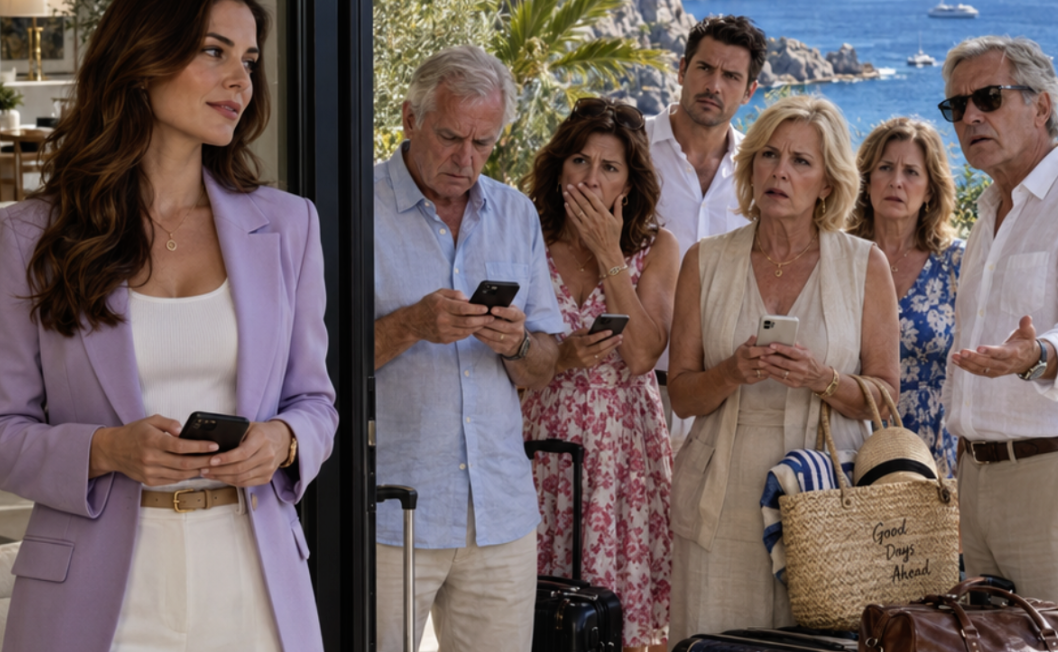
“We’re Coming for the Whole Summer, Get the Rooms Ready,” Our Distant Relatives Announced Cheerfully. My Text Message Canceled Their Visit in Seconds
Saturday morning began exactly the way a perfect morning on the Baltic Sea coast should.
I was standing on the wooden veranda of our house, shivering slightly in the cool breeze that smelled of pine trees and iodine, watching thick coffee foam slowly rise in the cezve. My husband, Pasha, was still asleep upstairs, wrapped in a heavy blanket.
We had two whole days ahead of us.
Silence.
Peace.
Exactly what we had been waiting for.
My phone, lying on the wicker table, vibrated briefly.
I calmly removed the cezve from the portable stove, poured the coffee into my favorite clay mug, and only then picked up my smartphone.
There was a message from Marina, my cousin from Voronezh.
We hadn’t really spoken in almost two years.
Technically, we exchanged the obligatory glittery holiday cards at New Year and Easter, but that was about as far as our family relationship went. So when I saw a long message from her—so long that it didn’t even fit on the screen—I immediately felt a vague sense of unease.
I unlocked the phone, took a sip of scalding coffee, and started reading.
“Hi, Anyuta! We talked it over and decided the kids absolutely need to go to the sea this year. The doctor said the sea air would be good for Danka, and Tolik and I are so exhausted we can barely function. Anyway, we bought the tickets! We’re flying to you on June 1 and coming back on August 28. We’ll be staying for the whole summer, so get the rooms ready! Mom is coming too. She needs a break from her vegetable garden. See you soon! Kisses!”
I nearly choked on my coffee.
I coughed, feeling my heart drop somewhere into my stomach while an unpleasant cold sweat ran down my back.
June 1.
And today, just so you understand, was May 15.
They were arriving in a little over two weeks.
I read the message again.
Then once more.
The words didn’t change.
“The whole summer.”
“Get the rooms ready.”
“Mom is coming too.”
Three months.
Five people.
In our house.
To understand the full scale of the catastrophe that was heading our way, I need to go back a little and explain how Pasha and I ended up in Svetlogorsk and why the very thought of these relatives visiting made my right eye start twitching.
Pasha and I are classic remote workers.
I’m a graphic designer, and he writes code for a large fintech company.
Four years ago, we sold our tiny two-bedroom apartment in a dusty residential district of Moscow, added every penny of our savings, took out a substantial mortgage, and bought an old German house in Svetlogorsk, in the Kaliningrad region.
The house needed major renovations.
It wasn’t simply a real estate purchase.
It was our dream, paid for with sleepless nights and endless side jobs.
When we bought the place, it was in terrible condition: rotten floors, crumbling plaster, a leaking roof, and a yard so overgrown with weeds that horror movies could have been filmed there without needing any additional scenery.
For three years, we invested every spare coin and every free minute into that house.
We sanded the antique parquet flooring ourselves, removing what felt like ten layers of old Soviet oil paint.
We crawled around the attic with flashlights, replacing the insulation.
We lived in a single room while construction dust filled all the others.
Pasha learned how to lay tiles and solder pipes, while I became practically an expert in restoring old wooden window frames.
And finally, last autumn, we could breathe again.
The house had turned into a cozy nest with panoramic windows, a fireplace, bright bedrooms, and a huge kitchen.
We had only just started truly living there, enjoying the silence, the sound of pine trees outside the windows, and long walks along the promenade.
But my relatives from Voronezh had a completely different view of our new home.
To them, the house wasn’t the result of years of hard work and financial sacrifice.
In their version of reality, we had simply “gotten lucky and settled down at a seaside resort.”
And now the entire extended family apparently had access to a free vacation house by the sea.
Marina, her husband Tolik, their two hyperactive sons close in age, Danka and Maxim, and Aunt Lyuba—my mother’s sister—had visited us before.
That had been three years earlier, back when we still lived in our Moscow apartment.
I still shudder whenever I remember that visit.
They descended on us for two entire weeks.
Tolik spent most of his days lying on our living-room sofa, drinking cheap beer, leaving sticky rings on my work desk, and loudly commenting on political talk shows on television.
Marina treated me as though I were her personal entertainer and cook.
“Anya, what are we having for dinner today?” she would ask every afternoon around four. “The boys want homemade pizza, and Tolik would like something with meat. Maybe pork chops. You’re home all day anyway, just pressing buttons on your computer. You don’t really get tired. Could you bake some pies too?”
Aunt Lyuba, meanwhile, appointed herself chief inspector of my entire life.
She rearranged every dish in my kitchen according to what she believed was the “correct” system.
She criticized everything.
The way I ironed Pasha’s shirts.
“Who creases collars like that? Your hands ought to be torn off!”
The way I made soup.
“This is just flavored water! Where’s the richness? You need to feed a man properly, not give him grass!”
And of course, the fact that we still didn’t have children.
“Your biological clock is ticking! Living only for yourself is a sin!”
But the children were the worst part.
Danka and Maxim raced around our small apartment like two tornadoes.
They smashed my favorite vase.
They drew all over the hallway wallpaper with markers.
And the climax came when the younger one reached my work desk and poured sweet tea all over my expensive graphics tablet.
When I tried to protest, Marina widened her eyes and pursed her lips.
“Anya, they’re children! Why are you acting like some evil witch? You could have put your toys somewhere safer. You knew there were boys in the house. Besides, we’re guests. We came here to relax, and you’re creating a tragedy over a piece of plastic. We’re family!”
Family.
That magical word people use like a shield when they want to violate your boundaries, use your resources, and wipe their feet on your comfort without consequences.
And now this traveling circus was planning to come to us.
For three months.
To the house we had only just finished renovating.
To the house where practically every board had been restored with our own hands.
The terrace door creaked open.
Sleepy Pasha appeared in the doorway.
He stretched lazily, squinting in the morning sunlight, then came over and kissed the top of my head.
“Good morning, little bird,” he murmured. “Why aren’t you drinking your coffee? It’ll get cold. And why are you so pale? Did something happen?”
Without saying a word, I handed him the phone.
Pasha took it and scanned the screen.
His face slowly changed.
Any trace of sleepiness disappeared instantly.
His eyebrows rose, while his jaw tightened.
“June first… August twenty-eighth… Three months,” he read aloud as though he couldn’t believe his own eyes. “Have they lost their minds? Anya, tell me this is some stupid joke.”
“I wish it were,” I replied quietly, taking the phone back. “Marina doesn’t joke about things like this. She’s already bought the tickets. Pasha, I can’t handle it. I just can’t. If Tolik starts drinking beer on my new sofa again and Aunt Lyuba starts teaching me how to clean the sink, I’m going to kill somebody. And the kids? Can you imagine what those two little barbarians will do to our garden? They’ll break every hydrangea we planted this spring!”
Pasha dropped heavily into a wicker chair and rubbed his face with both hands.
“Okay, don’t panic,” he said in a voice that was very obviously panicking. “We’ll just tell them no. Write that we already have other plans. Tell them my parents are visiting. Or that we’re going on vacation ourselves.”
“Pasha, you know my relatives,” I sighed. “If I tell them we’re leaving, Aunt Lyuba will say, ‘Perfect! Leave the keys under the mat. We’ll stay there ourselves and look after the house.’ If I mention your parents, they’ll say, ‘The more the merrier. We can sleep on the floor.’ And if I simply say, ‘No, don’t come,’ there will be a massive scandal. They’ll call Mom and complain that we’ve become spoiled rich people living at a resort who refuse to welcome their own family. Mom’s blood pressure will go up. She’ll start crying on the phone. I don’t want that whole drama.”
We fell silent.
The situation seemed impossible.
On one side was our summer.
Our peace.
Our home.
On the other was the powerful machinery of family pressure, hurt feelings, manipulation, and toxic guilt that had been drilled into me since childhood.
“You have to share.”
“You can’t refuse family.”
“We’re not strangers.”
I stared at the seagulls circling above the pine trees and felt a dull anger beginning to boil inside me.
Why did I have to justify myself?
Why should I need to invent excuses just to protect my own home from people who treated me like a resource?
“You know what their biggest problem is?” Pasha suddenly said thoughtfully.
“Bad manners?” I muttered.
“No. They want everything for free. They’re not coming because they miss you. They’re coming because they won’t have to pay for a hotel, buy food, cook, clean, or entertain the kids. To them, you’re free hotel staff who also provides cooking and entertainment services.”
I looked at my husband.
And suddenly, an idea started forming in my head.
Freebies.
Exactly.
They hated spending money.
And they hated working even more.
So what could scare people like that more effectively than garlic scares a vampire?
The possibility of losing money.
And the necessity of doing actual work.
I picked up my phone.
My lips slowly spread into a vindictive smile.
“What are you planning?” Pasha asked suspiciously when he saw my face.
“I’m about to give them the warmest welcome of their lives,” I replied, opening my chat with Marina. “Trust me. In five minutes, they’ll be returning those tickets faster than a bullet.”
My fingers flew across the keyboard.
I wrote without stopping, packing every sentence with maximum drama and completely fake enthusiasm.
“Marinochka, hello! What incredible news! You’ve practically been sent to us by heaven during this terrible time! I’m reading your message and crying tears of joy.
“The thing is, something awful has happened. Pasha was fired from his job a month ago after a huge scandal. We got into terrible debt paying the workers for the renovation. We have absolutely no money. We can’t even pay the mortgage. The bank has already sent us a warning saying they’ll put the house up for auction if we don’t clear the debt by the end of the summer.
“To survive somehow and avoid ending up on the street, starting June 1 we’re renting out every single room in the house to vacationers by the night. We’re moving into the summer annex ourselves. There’s no heating there, and we’ll be sleeping on an inflatable mattress.
“Your arrival is our salvation!
“As relatives, we’ll rent you two rooms at a huge discount—only 3,000 rubles per room per night instead of five thousand! For three months, it won’t cost that much at all.
“Plus, we desperately need extra hands around the house.
“Tolik is good with tools, right? The roof above the veranda leaks, and we can’t afford professional roofers. We’ll give him some tools, and he can help Pasha replace the roofing sheets.
“And Aunt Lyuba is practically a gift from heaven!
“I’ve made an arrangement with a local café to make dumplings for them to sell. She and I can get up at five every morning and grind meat and make dumplings until lunchtime. They pay almost nothing, but at least we’ll have enough for pasta.
“And the boys can pull weeds in the garden and take out the garbage left by the paying guests.
“We can’t wait to see you!
“We’re so happy that family is there for us during difficult times. Should I send you my card number now so you can transfer the deposit for your first month of accommodation? We don’t even have enough money to go grocery shopping right now.
“Big hugs and kisses!”
I read the entire message aloud.
Pasha listened with his mouth hanging open.
By the time I reached the end, his shoulders were shaking silently with laughter, his face buried in a blanket.
“Anya, you’re the devil,” he wheezed, wiping tears from his eyes. “That’s cruel.”
“It’s fair,” I said firmly and pressed Send.
The message disappeared into cyberspace.
The two gray checkmarks immediately turned blue.
Marina was online.
She had read it instantly.
Pasha and I froze, staring at the phone screen as though it were a ticking bomb.
At the top appeared the message:
“Marina is typing…”
She typed for a long time.
The notification appeared, disappeared, then appeared again.
Apparently, an emergency family meeting was taking place somewhere in Voronezh.
I could vividly imagine Marina’s face falling as she read the message.
I could imagine Tolik turning red when he realized that instead of drinking beer on our sofa, he would be repairing a roof.
And Aunt Lyuba clutching her chest at the thought of making dumplings at five in the morning.
Five minutes passed.
The phone chimed.
Her reply was short and dry.
No emojis.
No exclamation marks.
“Anya, we talked it over. It turns out Tolik can’t get that much time off work. His boss is a monster and threatened to fire him. And Mom hasn’t been feeling well either. Her blood pressure keeps going up, and the doctors told her not to change climates. The kids will probably be better off in the countryside anyway, drinking fresh milk. So we’re going to return the tickets.
“You hang in there.
“We don’t have any extra money right now either. We’re barely making ends meet ourselves. Sorry, but we can’t help you.
“Good luck with the bank.”
I stared at those lines as an incredible feeling of lightness spread through my whole body.
No scandals.
No relatives calling my mother to complain.
They had withdrawn all by themselves, frightened by the possibility of inconvenience, work, and having to pay money.
And best of all, they probably wouldn’t invite themselves to our house ever again.
Because in their eyes, we were no longer wealthy people living comfortably at a seaside resort.
We were now debt-ridden poor people with problems—people they needed to stay far away from.
“So?” Pasha asked with a smile as he poured himself some coffee.
“Crisis canceled,” I said, leaning back in the chair and breathing in the fresh sea air with pleasure. “Nobody is coming. Tolik has declined the roofing job.”
We laughed so loudly that a flock of sparrows sitting on the veranda railing scattered indignantly in every direction.
Ahead of us was an amazing, peaceful summer that belonged only to us.
No uninvited guests.
No outsiders imposing their rules in our home.
No toxic sense of obligation.
After this whole story, I realized something important.
Family relationships are wonderful when they are built on mutual respect and love.
But if people use you, if they see your home as a free hotel and interpret your kindness as weakness, you have every right to protect your personal space however you see fit.
Sometimes a little audacity and a good imagination work far better than endless arguments.
And what would you do in a situation like this?
Have you ever dealt with relatives who believe you are obligated to provide them with free accommodation during their vacations?
How do you handle people who expect free comfort at your expense?
Do you confront them openly—or come up with clever excuses to make them change their plans?