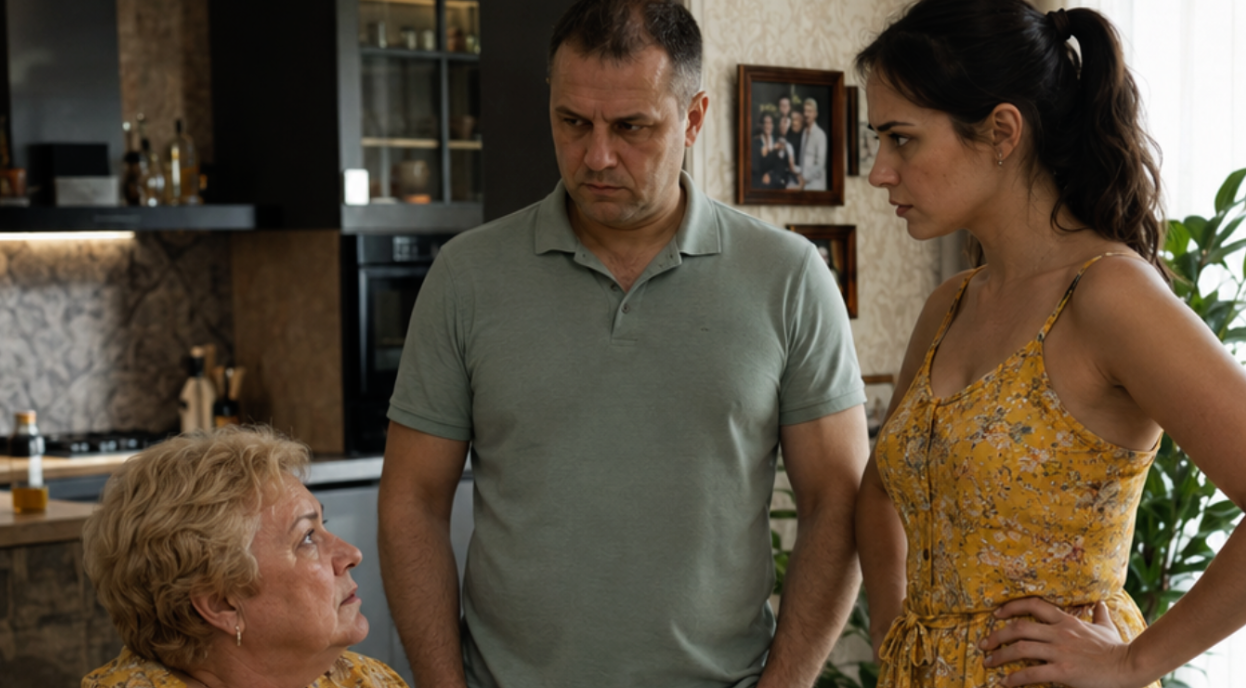
“If you don’t like it, go to your mother!” my mother-in-law snapped. So I went. And I took the house documents with me.
“Get out of here! I’m sick of you already — walking around, watching, sniffing everything out!” Zoya Ivanovna did not even turn around as she said it. She stood with her back to Vera, looking out the window, as if she were talking to the street and not to her daughter-in-law. “This is my son’s apartment, by the way. If we want, we’ll throw you out completely!”
Vera stopped in the middle of the hallway. In her hands was a bag of groceries. Not a single muscle moved on her face. She had already learned how to do that. In two years of this life, she had learned many things.
Her mother-in-law had moved in with them eight months earlier. At first it was “just for a couple of weeks” — supposedly because of renovations in her old Khrushchev-era apartment. Then the renovation ended, but Zoya Ivanovna did not leave. She simply stayed. Like a piece of furniture that had been brought in and forgotten.
The apartment was a two-room place in a new building on Oktyabrskaya Street. Vera paid the mortgage — every month, without missing a payment, from her salary as a manager at a travel agency. Her husband, Gleb, worked at an auto repair shop, but somehow his money always ran out before it was time to make the payments. “There was a problem,” “They delayed my bonus,” “I paid back a debt” — every time, a new story. Vera had long since stopped listening.
On Friday evening, Zoya Ivanovna brought guests over. Three of them — her friend Lyusya with her husband, and some man named Fedot, whom Vera had seen only once before. They settled in the kitchen, put bottles on the table, and turned the television up to full volume.
Vera came home at half past eight. On the table were piles of dirty dishes left from the last such evening, the ashtray was overflowing, and on the floor there was a dried stain from something that had been spilled.
“Gleb.” She looked into the room. Her husband was lying on the sofa, scrolling through his phone. “Did you see what’s going on in the kitchen?”
“Well, Mom came over with some people,” he shrugged. “What’s the big deal?”
“The big deal,” Vera repeated quietly. “Nothing.”
She turned around, went into the bathroom, and closed the door. She looked at herself in the mirror. Thirty-one years old, dark circles under her eyes, her hair tied up carelessly. It was peak season at the travel agency — she worked from nine until seven, sometimes until eight, and came home squeezed dry like a lemon. And at home, this was what awaited her.
From the kitchen came Zoya Ivanovna’s laughter — loud and rolling, as if she were performing onstage. “Oh, Lyudka, you’re hilarious!” Vera turned the water on louder.
Zoya Ivanovna was the kind of woman people called “cunning in her own way.” In public, she was the life of the party: laughing, treating everyone, hugging people, telling jokes. But that was in public. At home, she became a different person. She ordered everyone around, grumbled, moved things, and threw away anything she did not like. Once she threw out Vera’s new sneakers because they were “taking up space on the shelf.”
“I bought those sneakers for six thousand,” Vera had said then.
“So what? They were ugly,” her mother-in-law replied, then went off to watch her TV series.
Gleb had been present during that conversation. He had stayed silent.
Vera sat in the car outside the building for a long time that day. Just sat there. Thinking.
She began to notice a pattern — every time she tried to say something, to set some kind of boundary, Zoya Ivanovna immediately began crying. Just like that — tears on demand, red eyes, trembling lips. “I gave my whole life to my son, and now they’re throwing me out.” Gleb would immediately rush to comfort her and look at Vera reproachfully, as if to say, “See what you’ve done?”
It was a talent. A real one.
One April morning, Vera went to the MFC.
Not because something had happened. It was simply time. She had been thinking about it for a long time — since the previous summer, when Zoya Ivanovna had loudly declared in front of Lyusya, “This apartment belongs to Glebka, don’t forget that.” Vera had said nothing then. She had only remembered.
At the MFC, she stood in line for forty minutes. She obtained an extract from Rosreestr. She looked at the paper — everything was written there in black and white. Owner: Vera Alekseyevna Nikonova. Only her. Because the mortgage had been issued in her name, because the down payment — two hundred and thirty thousand — had come from her savings, because Gleb had said at the time, “Well, you can handle it anyway, your income is more stable.”
She took a photo of the extract on her phone and put the paper in her bag.
Then she went into the coffee shop across the street, bought a cappuccino, and called her mother.
“Mom, is the sofa in your guest room free?”
“Of course it’s free. Are you coming?”
“Maybe. Not right now — soon.”
Her mother did not ask unnecessary questions. She had always known when not to.
Everything was decided on Saturday.
Zoya Ivanovna had been in a bad mood since morning — apparently Lyusya had said something wrong on the phone, though exactly what was unclear. She walked around the apartment, sighing loudly, moving pots, and slamming cabinet doors. Vera sat at the kitchen table with coffee and work documents — she had to check bookings before Monday.
“You could at least clean up,” her mother-in-law threw out as she passed by.
Vera raised her eyes.
“I’ll clean this evening.”
“This evening! She’ll clean this evening!” Zoya Ivanovna turned around, and her voice already had that special tone — loud and forceful, as if she were not speaking at home but at the market. “Do you even understand how you live here? Dirt everywhere, a mess, no one to cook for Gleb…”
“Stop.” Vera closed the folder. “Zoya Ivanovna, let’s not do this.”
“Not do what?! Not tell the truth?!” The woman was already walking toward the table, her hands on her hips. “No one even understands what you’re doing here! You’re not a proper housewife, not a proper wife!”
“Mom, that’s enough.” Gleb appeared from the room — disheveled, in a T-shirt, with the expression of a man whose sleep had been interrupted.
“It is not enough!” Zoya Ivanovna raised her voice. “If you don’t like it, go to your mother!”
Vera was silent for one second. Then she nodded — very calmly, very slowly.
“All right.”
She stood up, took the folder with the documents — the very one containing the Rosreestr extract, the mortgage agreement, and all payment receipts for three years — and went into the bedroom. She opened the wardrobe and took out a bag she had packed in advance. Gleb watched her from the doorway.
“Vera, what are you doing? Where are you going?”
“To my mother,” she said simply.
“Are you serious? Just because of what she said?”
Vera zipped the bag closed. She took her phone, charger, and car keys. She placed the folder with the documents on top.
“I’m serious.”
Zoya Ivanovna stood in the hallway, silent for the first time that morning. Maybe she had not expected it. Maybe she had thought that Vera, as usual, would stay quiet, go into the bathroom, then come out and continue living as if nothing had happened.
But Vera opened the front door, stepped out, and closed it behind her — quietly, without slamming it.
In the elevator, she looked at the folder in her hands. The apartment documents. Three years of payments. Her apartment.
Her phone vibrated — Gleb was calling after only two minutes. She declined the call. Then he called again. She declined again. She put the phone in her pocket and went out to the parking lot.
The car started on the first try. A good sign.
Her mother lived on the other side of town — a forty-minute drive if there was no traffic. Vera drove down the wide avenue, and her mind was surprisingly quiet. No thoughts, no “what ifs,” no “maybe I was wrong.” Just the road, traffic lights, and the radio playing softly.
The phone rang three more times. Twice it was Gleb, once it was an unknown number. She did not answer.
Her mother opened the door before Vera even had time to ring the bell — apparently, she had been watching from the window.
“Come in. I’ve already put the tea on.”
She did not ask what had happened. She did not gasp or throw up her hands. She simply took the bag, put it in the corner, and the two of them sat in the kitchen — like in childhood, across from each other, mugs in their hands.
“For long?” her mother asked.
“I don’t know yet,” Vera answered honestly.
Her mother nodded and poured more tea.
Gleb came the next day, Sunday, around noon. He rang the doorbell — Vera saw him through the peephole. Standing there, his jacket unzipped, looking guilty. Classic.
She opened the door.
“Vera, let’s talk.” He stepped into the hallway and looked around, as if he had come not to his mother-in-law’s home but to negotiations. “Mom lost her temper. You know how she gets sometimes…”
“Gleb.” Vera crossed her arms over her chest. “Did you come to apologize or to explain?”
He hesitated.
“Well… both.”
“Then start with the first.”
He grimaced — only slightly, but she noticed. That expression — when he was asked for something specific, and that something was uncomfortable for him. He did not like specifics. Specifics required responsibility.
“I’m sorry,” he finally said. “I should have talked to her earlier. You’re right.”
“When you really talk to her, and when she moves back to her own apartment, call me. I’ll come back.”
Gleb opened his mouth.
“Vera, she can’t just…”
“She has her own place,” Vera interrupted calmly. “The renovation has been finished for a long time. Eight months ago.”
He left twenty minutes later — empty-handed. But in her mother’s kitchen, there was a reason for a short but precise comment:
“He’s a good boy. Shame he’s still his mother’s.”
On Monday, Vera went to work as usual — at nine, with coffee from the machine in the lobby. Her colleagues either noticed nothing or pretended not to. The workday flew by quickly — peak season, tours, clients, calls. By six in the evening, she had almost forgotten that her life had changed.
Almost.
On Wednesday, Zoya Ivanovna called. Vera looked at the phone screen and wondered whether to answer. She did.
“Vera,” her mother-in-law’s voice was unusually quiet. Almost human. “You’re an adult. You can’t just leave like that.”
“Yes, I can,” Vera replied.
“Maybe I said too much…”
“Zoya Ivanovna, let’s be honest. You have been living in my apartment for eight months. I pay the mortgage. You invite guests, don’t clean up after yourself, and throw away my things. This is not ‘saying too much.’ This is a system.”
A pause.
“What system?” her mother-in-law snorted, and there it was again — the old sharp, familiar tone breaking through. “The apartment is in your name only because Gleb had a damaged credit history. In human terms, it’s still his apartment.”
Vera almost laughed. In human terms.
“I understand your position,” she said evenly. “Goodbye.”
And she ended the call.
That evening, she took out the folder with the documents and carefully reread everything again. The mortgage agreement — borrower: Nikonova V. A. The EGRN extract — owner: Nikonova V. A. Receipts — payer: Nikonova V. A. Everything was clean. Everything was hers.
Then she opened the bank app and looked at the remaining debt. Four more years of payments. Fine. She had managed for the past three years — she would manage from now on too.
Her mother brought a plate of sliced cheese, set it beside her, and said nothing. Vera caught herself thinking that she had not felt this in a long time — silence without tension. Silence in which she did not have to wait for a door to slam or for someone to say something poisonous.
On Thursday, Gleb sent a message: “Mom agrees to move out. Let’s meet and talk.”
Vera read it twice. She did not like the word “agrees” — as if Zoya Ivanovna were doing them a favor, rather than fixing what she herself had caused. But those were details.
She replied: “All right. Tomorrow evening, the café on Kirova Street, at seven.”
Neutral territory. That mattered.
The café was ordinary — tables by the window, quiet music, the smell of coffee and fresh pastries. Gleb arrived early; he was already sitting when Vera came in. He looked tired — something dark had settled beneath his eyes, and his jacket was wrinkled.
“Hi,” he said.
“Hi.”
She sat across from him and placed her order with the waitress who came over. Gleb was silent, crumpling a paper napkin in his hands.
“She’ll leave this weekend,” he finally said. “I’ll help with her things.”
“Good.”
“Vera…” He raised his eyes to her. “Will you come back?”
She looked at him — at this person with whom she had lived for four years. He was not a bad person, in general. Just very convenient. Convenient for everyone except her.
“I’m thinking,” she said honestly.
“That’s not a yes.”
“That’s not a no.”
He nodded slowly. Accepted it. And that was something new — before, he would have started persuading her, pressing on her pity, or calling his mother for advice right from the table.
Coffee was brought. Cars passed outside the window, and at the neighboring table some company was laughing.
“I didn’t know it was so bad for you,” Gleb said quietly.
“You knew,” Vera objected without anger. “It was just more convenient not to notice.”
He did not argue. And that, too, was something new.
Vera took a sip of coffee and looked out the window. One thought was already turning in her head — not anxious, but almost practical: she needed to check whether there was anything in the apartment she did not know about. Something in her conversation with Zoya Ivanovna had caught her attention — that phrase about “in human terms, it’s his apartment.” Too confident to have been said casually.
Too confident.
On Friday evening, Vera drove to the apartment — not to go inside, just to look. She parked across the street and sat in the car for about ten minutes. The windows were lit. A shadow moved behind the curtain — Zoya Ivanovna was walking around the room.
Vera took out her phone and called a lawyer she knew — Pavel. They had studied together at university and sometimes spoke about work matters.
“Pasha, I have a question. If an apartment is registered to one owner, the mortgage is also in that person’s name, and the down payment was made by that same person, can anyone else claim a share?”
“During marriage?”
“During marriage. But the husband didn’t pay. At all.”
“Do you have proof? Receipts, bank statements?”
“Three years of receipts. Everything in my name.”
“Then in a division of property, you can very convincingly prove that the property was acquired with your personal funds. Especially if he didn’t contribute to the down payment either. What are you getting at?”
“Nothing yet,” Vera said. “I just want to understand where things stand.”
“I see,” he was clearly smiling. “Well, you understand everything correctly. Keep the documents.”
“They’re with me.”
Saturday began with a message from Gleb: “Come by at twelve. Mom is packing her things.”
Vera arrived at half past twelve. Gleb opened the door — he looked as if he had not slept all night. From the room came crashing sounds — something heavy was clearly being moved.
In the hallway stood a large checked duffel bag and two smaller bags. Vera looked at them silently.
“She packed the main things,” Gleb said quietly. “She’ll take the rest later.”
“When is later?”
“Vera…”
“I’m just asking.”
Zoya Ivanovna came out of the room with another bag — dark blue and stuffed to the limit. She saw Vera and stopped.
They looked at each other for three seconds. Then her mother-in-law snorted and looked away.
“So, you’ve shown up.”
“I have,” Vera confirmed calmly.
“Rejoice. You got what you wanted.”
Vera did not answer. She went into the kitchen and put the kettle on. She heard Gleb saying something quietly to his mother in the hallway, and heard her reply irritably, in short bursts.
The kitchen looked as if it had not been cleaned for a week. On the windowsill were dried rings left by glasses, on the table were crumbs, and on the stove were stains of unclear origin. Vera looked at it all and thought that in the evening she would take a cloth and put everything in order. Calmly, without anger. She would simply do it.
From the hallway came Zoya Ivanovna’s voice, louder now:
“I gave many years of my life to that child, by the way! And she stands here acting like the mistress of the house!”
“Mom, keep your voice down,” Gleb asked.
“I will not keep it down! Let her hear! She has the documents!” Her intonation became mocking. “So what — documents? I’m his mother!”
Vera came out of the kitchen and stood in the hallway doorway.
“Zoya Ivanovna, the documents mean exactly something,” she said evenly. “They mean that I make the decisions here. Not you.”
Her mother-in-law turned sharply.
“You…”
“For eight months, I kept silent,” Vera continued in the same tone. “You threw away my things. You invited guests into my apartment without asking. You smoked in the bathroom even though I asked you not to. You told me to go to my mother. I went. And I took the documents with me. Because they are mine.”
The hallway became quiet. Even Gleb was silent.
Zoya Ivanovna looked at her daughter-in-law — and something in that look changed. It did not soften, no. It was simply that the usual method was no longer working. There was no confused Vera who could be pushed further. There was someone else now — calm and very specific.
“Gleb,” her mother-in-law finally said, quieter now. “Call me a taxi.”
He took out his phone without a word.
The taxi arrived fifteen minutes later. Gleb carried out the duffel bag and the other bags and loaded them into the trunk. Zoya Ivanovna put on her coat in front of the mirror — slowly, carefully, as if she were not going home but making a public appearance.
Before leaving, she turned around. She looked at Vera for a long, studying moment.
“You think you’ve won,” she said.
“I think I’m tired,” Vera replied. “That’s different.”
The door closed. The lock clicked.
Gleb returned a few minutes later — apparently after helping carry the bags to the car. He came in, took off his shoes, hung up his jacket. Then he went into the kitchen and sat down at the table.
Vera poured two cups of tea. She set one in front of him and sat across from him.
They were silent for a long time. Outside the window, the city made noise — cars, someone’s voices in the courtyard, music somewhere far away.
“I didn’t know it would turn out like this,” Gleb finally said.
“With the apartment? Or in general?”
“In general.” He looked into his mug. “She always knew how to come in and fill everything with herself. I got used to it. I thought you would get used to it too.”
“I shouldn’t have had to get used to it,” Vera said without reproach. Just a statement of fact.
“I know.”
She looked at him. At this person — not bad, not cruel. Just someone who had lived too long in someone else’s shadow. First in his mother’s, and then allowing that shadow to cover everything around him.
“Gleb, I want you to understand one thing,” she said. “I didn’t leave because of your mother. I left because you stayed silent. Every time — you stayed silent. And I don’t know whether that can be fixed. But I want to find out.”
He raised his eyes.
“I want to find out too.”
It was probably the most honest conversation they had had in the last two years. No shouting, no tears, no third party behind the wall. Just two people at a kitchen table with tea growing cold.
That evening, Vera cleaned the kitchen. She scrubbed the stove, wiped the windowsill, and threw out the accumulated trash. She opened the window — fresh air flowed into the room.
Then she called her mother.
“Everything is fine,” she said. “She left.”
“How are you?”
Vera thought.
“Fine. Truly fine,” and that was honest. “Mom, thank you for not asking unnecessary questions.”
“You’re my smart girl,” her mother said simply. “You figured it out yourself.”
The folder with the documents lay on the shelf in the bedroom — next to the books, neat, with its spine facing outward. The mortgage agreement, the extract, the receipts. Four more years to pay. Fine.
Vera went to bed at half past ten — for the first time in many months without the feeling that tomorrow she would once again have to prepare for something unpleasant. Just tomorrow. Just a new day.
Outside the window, the city hummed. Somewhere on the other side of it, Zoya Ivanovna was putting her things into her own closets. Somewhere cars were driving, windows were glowing, and people were living their own stories.
And here, in the apartment on Oktyabrskaya Street, it was quiet. Good. Truly good.
And the documents were with Vera.
Three weeks passed.
Zoya Ivanovna did not call. Gleb went to see her once — on Wednesday after work — and returned quiet but calm. Vera did not ask for details. It was not her story.
She and Gleb now spoke differently — without background voices, without a third opinion on every matter. It felt unfamiliar and a little awkward, like learning all over again something you thought you had known for a long time.
One evening, Gleb washed the dishes. Without being asked, just like that. Vera noticed but said nothing. She only nodded. Sometimes silence is the best answer.
At the end of the month, the next mortgage bill arrived. Vera opened the bank app, entered the amount — and suddenly saw that Gleb had already paid half of it. An hour earlier.
She went out into the hallway. He was standing by the mirror, getting ready to go somewhere.
“I saw it,” she said.
“I should have done it long ago,” he replied simply.
They did not speak about it again.
Zoya Ivanovna called on Saturday morning — unexpectedly, without warning. Vera answered.
“I want to come and pick up some of my things,” her mother-in-law said. Dryly, without any preamble.
“All right,” Vera replied. “Sunday at three. Gleb will be home.”
A pause.
“Will you be there too?”
“I will.”
Zoya Ivanovna arrived exactly at three. She took a box of some belongings, a blanket, and an old vase. She walked through the apartment silently, did not give orders, did not move anything around. As she was leaving, she stopped in the hallway.
“The apartment is clean,” she said reluctantly.
“I try,” Vera said.
Nothing else was said. The door closed — quietly, without a slam.
That evening, Vera took out the folder with the documents. She did not reread them — she simply held them in her hands. Three years of payments. Her signature on every page. Her apartment.
Then she put the folder back on the shelf.
Outside the window, the city murmured. Everything went on in its own way.