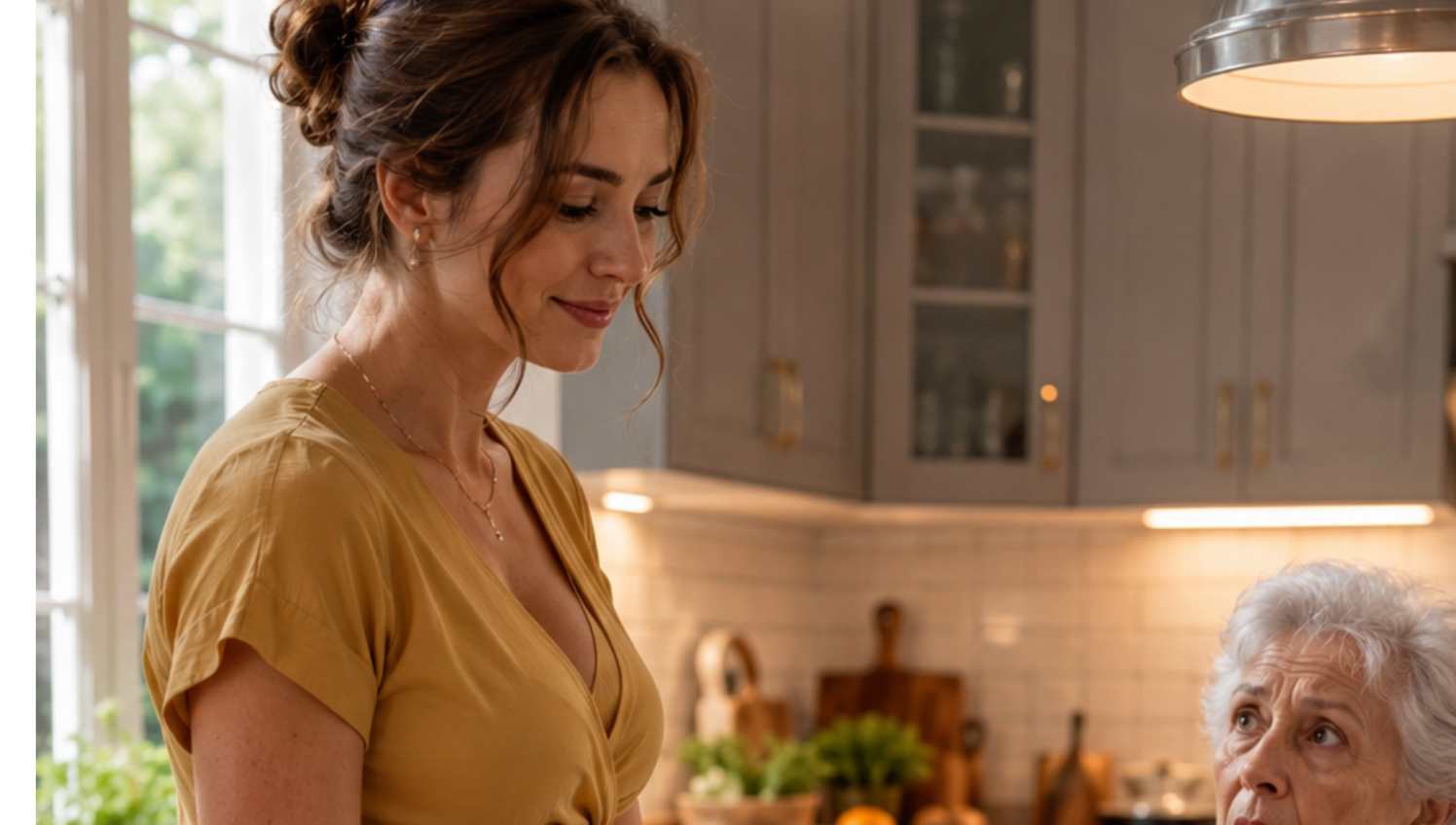
My Mother-in-Law Took Over My Kitchen for 10 Months: When I Was Five Months Pregnant, I Did Something She Never Expected
“Mom, don’t get too bold. Spinach is very healthy, and besides, no one invited you here in the first place.”
I said it evenly, without shouting, looking my mother-in-law straight in the eyes. Adelaida Yakovlevna froze with her fork in her hand. Andrey, who was standing by the refrigerator, never even closed the door. Even Tamara, my mother-in-law’s cousin, stopped rustling her napkin.
The kitchen went silent. So silent that I could hear the clock ticking in the other room.
But ten months had passed before that scene happened. Ten months during which I had gone from a polite daughter-in-law to a woman tired of counting other people’s spoons in her own soup. And honestly, it didn’t start with spinach. Spinach was only the finale. It started with a key.
Andrey and I got married in June.
The wedding was modest: twenty people, a small café by the river, white roses on the tables, no vulgar contests and no exhausted host with a microphone.
I was twenty-eight. He was thirty-one.
I worked as an accountant at a construction company, and he was an engineer at a factory. We lived in a rented two-room apartment on the outskirts of Rostov. The building was old, with an echoing entrance hall and an elevator that sometimes stopped between floors as if it were contemplating its own life.
But we were happy. The kind of simple happiness that does not need loud words. In the morning, I made coffee in a cezve, Andrey sliced bread, and in the evening we had dinner in the kitchen, talked about work, and laughed at the upstairs neighbors who, for some reason, moved furniture around at midnight. We didn’t have much money, but we had the feeling that we were a team.
Andrey’s family lived in the suburbs. His mother was Adelaida Yakovlevna, his father was Viktor Semyonovich, and his younger sister was Ksenia, twenty-three years old, unmarried and, as she herself put it, “actively searching, but without compromises.”
For the first few months, everything was proper. They came on weekends, called ahead, brought apples from the dacha, sat for an hour or an hour and a half, and left. I baked apple charlotte, poured tea, Adelaida Yakovlevna praised the curtains, and Ksenia twirled in front of the hallway mirror and complained that men in the city “weren’t what they used to be.”
Then, in September, my mother-in-law retired.
And it very quickly became clear that she had decided to spend her free time at our place.
The first warning bell rang at the end of September. It was a Tuesday. I came home from work at around six in the evening, opened the door, and immediately smelled fried potatoes. In the kitchen sat Adelaida Yakovlevna, Viktor Semyonovich, and Ksenia.
On the table was my large frying pan, a ladle lay in the sink, and in the refrigerator, less than a third was left of the five-liter pot of borscht I had cooked to last several days.
“Oh, Svetochka!” my mother-in-law exclaimed happily, as if I were the one visiting her. “We’re waiting for Andryusha. He said he’d be here by seven.”
I silently put my bag by the wall and looked at the pot.
“Adelaida Yakovlevna, what about the borscht?”
“Oh, it was delicious! Viktor Semyonovich had two bowls, Ksyusha had one, and I had a little too. You cook well, Svetik.”
A little. After their “little,” I had two portions left instead of six.
I changed clothes, waited for Andrey, and took him into the room.
“They came without calling, opened the apartment with their key, and ate almost all the borscht.”
He tiredly ran his hand through his hair.
“Svet, they’re my parents. Don’t be greedy. They’re not strangers.”
I remembered that “don’t be greedy” immediately. For some reason, words like that stick to memory better than kind ones.
I decided it was an accident. A bad day. A one-time thing.
It turned out to be a rehearsal.
By October, the visits had become constant.
Sometimes twice a week, sometimes three times. Sometimes only Adelaida Yakovlevna came, but more often she came with Ksenia. Viktor Semyonovich came less often and behaved more modestly. At least he didn’t open the refrigerator without asking and never commented on the food. But he didn’t stop his wife and daughter either.
Ksenia entered the apartment easily, as if she had lived there since childhood. She kicked off her shoes, went to the kitchen, opened the refrigerator, and stood in front of it with a thoughtful look, as if checking the assortment in a store.
“Do you have any normal cheese?” she asked. “Not this rubbery kind?”
“Normal” cheese cost almost twice as much as regular cheese, and that mattered to our budget. But Ksenia was not interested in our budget. In fact, very little interested her except herself.
Adelaida Yakovlevna acted more subtly. She didn’t ask directly. She assessed.
“The chicken is a little dry,” my mother-in-law would say, cutting herself a second piece. “I always baked it in foil for Andryusha.”
Or:
“The soup is a bit watery. Don’t be stingy with potatoes, they’re cheap.”
Or:
“You cook decently, Sveta, but without soul. Homemade food should have soul.”
As it turned out, “with soul” meant: from my groceries, during my free time, and without any invitation.
When they left, the refrigerator looked as if it had survived a raid.
The jar of sour cream was almost empty, the sausage had disappeared, the cutlets I had made for two days were gone in one evening, and only a lonely carrot in the bottom drawer reminded me that I had once had food.
I spoke to Andrey again.
“This is unpleasant for me,” I said. “Not because I feel sorry for the food, but because this is our home. They come in without asking, eat without asking, and then criticize!”
He again ran his hand through his hair.
“Svet, Mom is just used to a big family. She’s bored in retirement. Be patient a little, everything will settle down.”
Be patient. The second phrase I remembered.
By November, I had started hiding food.
At first, I was ashamed. Then I stopped caring.
I hid good cheese in a buckwheat container and put it on the top shelf. I hid meat for dinner in the freezer behind bags of vegetables. I moved candy to the wardrobe in the bedroom. Once, I even took a chocolate bar to work because I knew that if I left it at home, Ksenia would find it before I did.
Meanwhile, my mother-in-law reached a new level of shamelessness: she began coming with friends.
“Svetik, this is Nina Pavlovna, my close neighbor. We were nearby and decided to drop in.”
They lived forty minutes away. “Nearby” existed only in my mother-in-law’s head.
Nina Pavlovna would sit at my table, eat my cookies, drink my coffee, and say:
“You’re very lucky with your mother-in-law, Svetulya. Such an active woman, helping you.”
At moments like that, I only smiled. Not because I agreed. But because if I opened my mouth, I would say too much.
In December, it was Andrey’s birthday. I prepared for almost two weeks.
My husband and I kept separate budgets for personal expenses, but for holidays we usually pooled money together. This time, I bought most of the groceries myself: turkey, vegetables, eggs, cream, fruit, good tea, cheese, and fish for appetizers.
I made a menu, calculated everything, and set the table for six: Andrey and me, his parents, Ksenia, and my brother Pavel, who was supposed to come from Lipetsk.
Adelaida Yakovlevna arrived with two friends and her cousin Tamara.
Three extra people. Without warning.
“Andryushenka, you don’t mind, do you?” she sang from the doorway. “They want to congratulate you from the heart.”
The people “from the heart” came empty-handed, unless you counted Tamara’s cheap greeting card.
The evening passed like a bad dream.
A table meant for six had to feed nine people. The turkey was gone almost immediately. The salads disappeared in fifteen minutes. The cake was cut as if we were dividing rations. My brother, who had come from another city, got his piece only after Ksenia asked to have “a little” wrapped up to take home.
Pavel left late in the evening. In the hallway, while tying his scarf, he looked at me carefully and said quietly:
“Svet, they’re not eating your food. They’re eating you.”
That night, I couldn’t sleep for a long time.
Andrey lay beside me, content, full, convinced that the family evening had been a success.
And I stared at the ceiling and counted how many times in recent weeks I had opened an empty refrigerator. It came to eleven. I like precision. And when precision begins to humiliate you, it hurts especially badly.
In winter, I changed tactics. I stopped cooking in advance.
I made exactly enough for dinner and, at most, for the next day’s lunch. If my mother-in-law arrived, I spread my hands and said:
“Sorry, I wasn’t expecting guests.”
To this, Adelaida Yakovlevna once narrowed her eyes and replied:
“A good wife is always ready to receive her husband’s family. That’s how my mother taught me. And that’s how I raised my children.”
I stood by the stove with a spatula in my hand and felt anger slowly, calmly, and very coldly gathering inside me. Not an outburst. Not hysteria. Something far more dangerous.
In February, I found out I was pregnant.
Andrey was happy. He was even flustered with joy. He kissed me, said silly things, and promised that now everything would be different. Adelaida Yakovlevna was happy too — in her own way. She began coming even more often, now to “help.”
The help looked strange.
“You shouldn’t stand by the stove for too long,” she would say, sitting down at the table. “Let me finish these cutlets so they don’t get cold.”
And she would finish three out of four.
Or:
“You shouldn’t get upset. Go lie down. I’ll check everything myself.”
After which she opened the refrigerator, inspected what was inside, and concluded that “a pregnant woman should eat better,” while simultaneously eating cottage cheese, yogurt, and half of my baked apples.
At that time, Ksenia got a job as a sales assistant in a clothing store and started coming after her shift with the expression of a martyr.
“I’m hungry as a wolf,” she announced from the doorway, and in one evening she could destroy a frying pan of chicken pasta I had made for Andrey and me.
I tried to talk to my husband again. He saw everything. Heard everything. But each time he retreated into the same comfortable male helplessness.
“Well, Svet… well, Mom… well, Ksyukha is tired after work… Share.”
Share. The third word.
By the end of June, I was in my fifth month.
My belly was already visible, my jeans wouldn’t button, I got tired faster than usual, and more and more often I caught myself thinking that I was living like a wound-up kitchen servant: buy, cook, serve, clean, swallow the insult, go to bed.
And at some point, I understood a simple thing: talking would change nothing. For Andrey, this was normal. He had grown up in a family where his mother treated her son’s space as an extension of her own kitchen. He did not consider what was happening a catastrophe. For him, it was just “Mom came over.”
So I needed a method everyone would understand.
The idea came from my colleague Natalya. We were sitting at lunch, I was listlessly picking at buckwheat and telling her about the latest raid.
Natalya listened, stirred sugar into her tea, and smirked.
“You feed them too well.”
“What do you mean?”
“Literally. They’re not coming to see you. They’re coming because everything is ready for them. Remove the pleasure from the arrangement, and it will end on its own.”
At first, I didn’t even understand. Then I understood very well.
The doctor had indeed advised me to add more vegetables, greens, grains, fish, and less fried food to my diet. And suddenly I saw in this not only a recommendation, but a strategy.
On Saturday, June twentieth, Operation Spinach began.
In the morning, I went to the market and the health food store. I bought spinach, broccoli, cauliflower, arugula, lentils, chickpeas, quinoa, avocados, apples, and lemons. I came home tired, but with the feeling of a person who was finally doing something meaningful.
By lunchtime, the table held cream soup made from broccoli and spinach, quinoa with vegetables, arugula salad with apple and nuts, homemade hummus, and crispbread.
The table looked very beautiful. Almost festive. Everything was green, fresh, and elegant.
Andrey came into the kitchen, looked at all this splendor, and cautiously asked:
“Where’s the meat?”
“I’ll bake turkey for you in the evening,” I answered calmly. “Right now, this is healthier for me. The doctor said more greens and fiber.”
The word “doctor” worked on him flawlessly.
At two o’clock, Adelaida Yakovlevna arrived. Alone. She came into the kitchen and sat down at the table.
“What is this?”
“Lunch,” I said. “Broccoli is very healthy. Spinach contains iron, folic acid, and many other good things.”
My mother-in-law tasted the soup, made a face as if someone was trying to poison her, poked at the quinoa, and asked:
“Is there any normal food in the house?”
“This is normal food.”
“Sveta, I’m not a goat.”
“Neither am I. But I like it.”
She sat for about twenty minutes, drank tea without sugar — I had put away the sugar bowl, citing restrictions — and left noticeably earlier than usual.
I watched through the window as she walked to the bus stop, and for the first time in a long while, I felt not irritation, but relief.
The next round took place on Sunday.
This time all three of them came. Waiting for them on the table were roasted cauliflower with turmeric, lentil soup, salad with spinach and roasted pumpkin, and a sugar-free cottage cheese casserole.
“What is this, rabbit food?” Ksenia asked gloomily.
“It’s a Mediterranean-style diet,” I replied. “Very healthy.”
To my surprise, Viktor Semyonovich calmly ate the soup, thanked me, and said nothing else. Ksenia tried the cauliflower and pushed her plate away as if she had been personally insulted. My mother-in-law lasted longer, but her expression made it clear: she did not like the strategy.
“Andrey,” she finally said, “your wife has completely lost her mind. A man needs real food.”
“Mom, the doctor told Sveta to eat more greens,” he muttered.
“That’s for Sveta, not for us.”
“I’m not forcing anyone,” I answered gently. “But in my own home, I cook what I think is necessary.”
They left at four. Usually they stayed until evening.
For the next three weeks, I held my line.
Whenever my mother-in-law came, spinach always appeared on the table. In omelets, pies, soups, salads, side dishes. Ksenia stopped coming almost immediately.
“I’d rather buy shawarma after my shift,” she once tossed out in the hallway.
“That is a reasonable choice for an adult,” I replied politely.
Even Andrey began to understand what was happening. At first, he chuckled. Then he stopped. And then one evening, he opened the refrigerator, saw the containers of greens, fish, and roasted vegetables, and suddenly said:
“Listen… when they don’t come over, we actually spend less money.”
I put down the knife.
“You only noticed that now?”
He shrugged guiltily. It wasn’t redemption, but at least it resembled a thought.
On Saturday, July tenth, Adelaida Yakovlevna called Andrey and announced that she was coming over “to have a serious talk.”
From her voice, it was clear: what was coming was not a conversation, but a trial.
I prepared myself. Not morally — morally, I had been ready for a long time. I simply sliced the salad in advance, put a spinach and ricotta casserole in the oven, brewed herbal tea, and opened the window so the kitchen wouldn’t be stuffy.
My mother-in-law arrived with Tamara.
Apparently, Tamara was needed as a witness to the public disgrace.
They sat down. I put out the plates. Adelaida Yakovlevna did not touch the food.
“Sveta,” she began in the tone of a person about to announce a verdict, “we came to talk about what is going on here.”
“Go ahead.”
“What are you doing to my son? He’s lost weight.”
Andrey really had lost a little weight. But that was because he had started running in the mornings and stopped eating mayonnaise salads for dinner.
“He runs in the mornings,” I said. “That’s his decision.”
“Don’t change the subject. You’re feeding the family grass. This is not normal.”
“I cook food that is healthy for me during pregnancy. And by the way, it is quite expensive. Spinach, fish, nuts, avocado — this is not cheap food.”
“Don’t be clever,” she snapped. “A normal woman feeds her family properly.”
“A normal woman,” I said, “has the right to decide who comes into her home and when.”
The air in the kitchen seemed to tighten.
Tamara stared down at her plate.
Andrey came out of the room. He didn’t sit down. He simply stood by the wall.
“So you arranged all of this on purpose?” Adelaida Yakovlevna asked quietly.
“Yes,” I answered just as quietly. “On purpose.”
She even recoiled, as if I had hit her.
“Andrey, do you hear this? Your wife admits that she has been deliberately mocking us!”
I looked at my husband. He was silent.
And then my mother-in-law did what she always did at a critical moment: she went on the attack.
“I said from the beginning that she was greedy. Stingy. She begrudges everything. And she turns my son against his family. She’ll raise the child the same way.”
That was when something inside me finally clicked.
Not because of me. Because of the child.
I put my fork down on the table and said:
“Let’s count.”
“What else are we going to count?” she asked contemptuously.
“Over the past few months, you came to our place on average two or three times a week. Sometimes with Ksenia, sometimes with guests. One such visit cost us about fifteen hundred rubles in groceries. Sometimes more. That means twelve to eighteen thousand rubles a month went toward unplanned feeding. For a rented apartment and a family expecting a child, that is a very noticeable amount of money.”
Adelaida Yakovlevna turned pale.
“Are you billing me?”
“No. For the first time, I am calling things by their proper names. You came without invitation, opened the apartment with your key, ate what had not been bought for you, criticized my food, and still called me greedy. That is not help and not family closeness. That is shamelessness and arrogance.”
“How dare you!” she flared up.
“I dare because this is my home. And because I am tired of keeping silent.”
Tamara coughed as if by accident, but it was obvious she felt awkward.
“And one more thing,” I said. “Do not touch my child. Not with words, not even in your thoughts. Never.”
I stood up, went over to my mother-in-law, took her untouched plate, and carried it to the sink.
“Adelaida Yakovlevna, spinach really is very healthy. But if you don’t like it, the solution is simple: come only when you are invited.”
She slowly rose from the table. Tamara jumped up after her.
My mother-in-law turned to Andrey. Written all over her face was the firm conviction that now her son would finally put me in my place.
Andrey looked at the floor for several seconds. Then he lifted his eyes and said:
“Mom, Sveta is right.”
Only three words. But perhaps they were exactly the words I had been waiting for all those months.
Adelaida Yakovlevna looked at him as if he had said something obscene.
“So that’s how it is,” she said.
“That’s exactly how it is,” Andrey answered. And after a pause, he added, “And give back the key.”
She left silently. Tamara too. Only in the hallway did we hear hurried whispering and the clatter of heels.
When the door closed, I suddenly felt my legs trembling. I sat down on a stool and pressed my palm to my belly. The baby girl moved, as if she had heard everything too.
Andrey did not come over immediately. First, he stood in the middle of the kitchen. Then he sat down on his haunches beside me.
“I should have stopped this earlier.”
“Yes,” I said.
“I’m sorry.”
I looked at him. And for the first time in that entire long year, I saw not a confused son torn between his mother and his wife, but an adult man who was ashamed of his own weakness.
“Get the key back today,” I answered.
“I will.”
That evening, he went to his parents. He returned late, tired and silent. He placed the spare key on the nightstand and said:
“I told them everything. From now on, only by invitation. And in advance.”
“And?”
“Mom cried. Ksyusha said I was henpecked. Father was silent, and when I was leaving, he said, ‘It was long overdue.’”
For some reason, Viktor Semyonovich’s words touched me the most. From quiet people, every phrase weighs twice as much.
August and September passed peacefully.
Adelaida Yakovlevna did not come. Neither did Ksenia.
Andrey spent more time at home, bought groceries himself, and sometimes cooked simple things in the evenings: he baked fish, cooked buckwheat, and once even made syrniki, although they looked more like pancakes. But I ate them anyway and praised him.
In November, our daughter was born.
We named her Alisa.
My mother-in-law called that same day. Her voice was unusually quiet.
“Sveta… may I come see my granddaughter?”
I was lying in the hospital ward, looking at my daughter’s tiny wrinkled face, and suddenly realized that I was no longer as angry as before. The pain remained, the memory remained, but the anger itself was gone. Something more important had replaced it.
“You may,” I said. “On Sunday. At two.”
She came alone. Without Ksenia, without friends, without Tamara. In her hands, she held a bundle.
It was a baby blanket. Hand-knitted, uneven, in places too tight, in places too loose, but warm. I immediately understood that she had made it herself.
Adelaida Yakovlevna sat down at the table quietly, almost cautiously. I placed in front of her a plate of chicken and potatoes — a simple homemade lunch, without experiments. She looked at the food, then at me.
“Thank you, Sveta.”
Without the usual continuation. Without a “but.”
We ate in silence. Alisa was sleeping in the next room. Andrey sat beside me and held my hand under the table.
Two weeks later, Ksenia came over. For the first time in her life, she called the day before.
“Can I come by tomorrow? Not for long.”
She brought a rattle and a store-bought cake.
“I bought it, I didn’t bake it,” she clarified for some reason at the doorway.
“That’s noticeable,” I almost said, but I restrained myself and only smiled.
At the table, Ksenia ate one piece of pie, did not open the refrigerator, and even carried her cup to the sink herself. As she was leaving, she shifted awkwardly in the hallway and muttered, looking off to the side:
“Listen, Svet… back then… well… anyway, sorry.”
Awkward. Crooked. But sincere.
A year passed.
Alisa learned to walk along the sofa, laugh loudly for no reason, and say “ba” when she saw her grandmother.
Adelaida Yakovlevna came once a week, on Saturdays, always called ahead, and never again used a key, because she no longer had one.
She brought apples, sometimes pies, sometimes baby socks knitted just as unevenly as that first blanket.
One summer day, I was washing dishes and heard her sitting in the kitchen with Alisa on her lap, saying softly:
“Eat, little one. Your mother is strict, but she is right. Grandma used to be foolish.”
I froze for a second, then continued washing the plate.
On my windowsill stood a pot of spinach. Real, homegrown spinach. I had started growing it after that story — first as a joke, then I got used to it. The leaves reached toward the light, bright, firm, and calm.
Spinach really is healthy.
Sometimes even more than it seems.