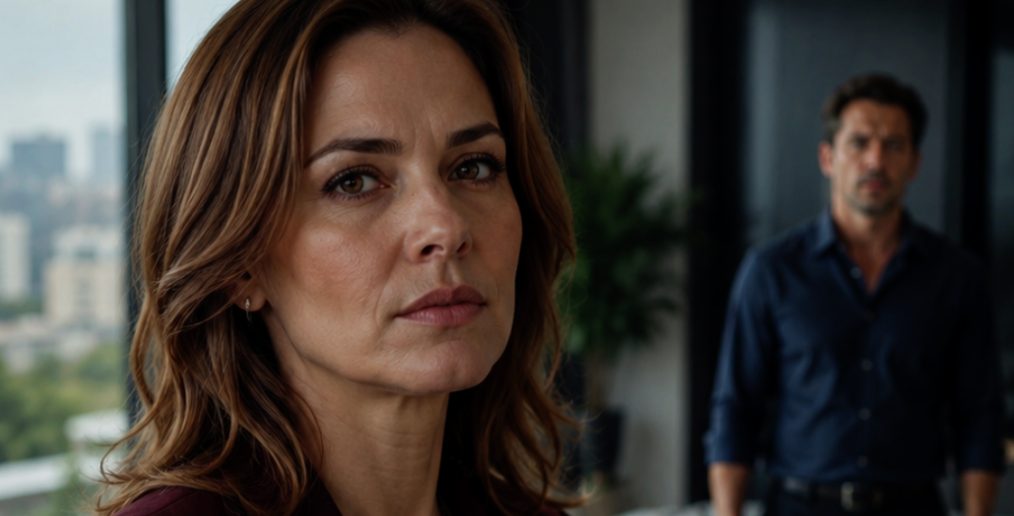
My former father-in-law announced in front of the guests: “Without my son, you’d still be washing floors.” I smiled and showed him my MBA diploma
“Mom, is Grandpa Grisha coming too?”
Zakhar asked this while tying his sneakers. His left shoelace was always coming undone — I had re-laced it about five times that week.
“He’s coming,” I said. “It’s your birthday, after all.”
He nodded and ran to the door. And I stood in the hallway, looking at my bag. Black, leather, with a firm structure. Inside were my planner, car keys, office pass. And a folder with documents I had picked up that morning from the framing shop.
Thirteen years. For thirteen years, Grigory Pavlovich had been explaining to me who I was. First as my father-in-law. Then as my former father-in-law. There was no difference at all.
Anton and I got married in 2013. I was twenty-nine, he was thirty-one. I worked as an economist in a public-sector organization. My salary was thirty-four thousand. Back then, Anton had just started working at his father’s construction company.
At the wedding, Grigory Pavlovich came up to me with a glass in his hand and said in front of everyone:
“Well, Albina, you got lucky. My son is pure gold. Hold on to him.”
I smiled. I thought he was just a caring father, worried about his son. Normal.
Six months later, we moved into an apartment Grigory Pavlovich had bought for Anton. A two-room place on Butyrskaya Street, with basic renovation. Anton was proud: “Dad helped.” I said nothing. What mattered more to me was that we were together.
But Grigory Pavlovich entered that apartment as if it were his own. Without calling. He opened the door with his own key — a key I had never given him. Anton had made a duplicate and given it to his father without asking me.
“This is my apartment,” Grigory Pavlovich said when I asked him to warn us before visiting. “I paid for it.”
The ring on his little finger gleamed when he raised his hand. Massive, gold, engraved. He had worn it for twenty years — I later learned it was a gift he had given himself when his company finally became profitable.
The first year, I endured it. I smiled. I cooked whenever he came over. He would not eat my borscht — “too bland.” The cutlets were “overfried.” The salad was “missing something.” I stopped cooking for his visits. I started ordering food instead.
“You can’t even feed a person,” he told Anton. In front of me. In my kitchen.
Anton said nothing. He always stayed silent when his father spoke.
In 2017, Zakhar was born. Nine hours in the maternity ward. Anton arrived three hours after I called him — he had been at a construction site, and his father would not let him leave. Grigory Pavlovich came the next day. He looked at his grandson and nodded.
“Well, at least it’s a boy. The heir.”
To me, he said:
“Now don’t even think about running back to work. Take care of the child.”
I went back to work eight months later. Grigory Pavlovich called Anton every week: “What kind of mother abandons her child? All she cares about is money.” He did not consider my thirty-four thousand real money.
During six years of marriage, I heard the same idea from Grigory Pavlovich again and again. In different words, but the meaning was always the same. Without Anton, I was nobody. An economist in some government office. No apartment, no car, no prospects. Anton was the one who had lifted me up. Anton was the one who had given me a life.
Twenty-three times. I did not count on purpose — I just realized one day that I remembered every single one. Every family dinner. Every New Year. Every birthday. “Hold on to my son.” “You got lucky.” “Without him, where would you be?”
And then Anton left me for Karina from the procurement department. He was thirty-seven. She was twenty-four.
I filed for divorce. Anton did not argue. The apartment was his — or rather, his father’s. Child support was set by the court: twenty-five percent of his salary. I took Zakhar, our things, and moved in with my mother in Lyubertsy.
Grigory Pavlovich called me once. A week after the divorce.
“Well, Albina. I told you — you couldn’t keep him. My Antoshka is a handsome man; women line up for him. And you — you go back to your thirty thousand. Someone has to wash the floors too.”
I hung up. My hands were not shaking. Inside, there was nothing. Just emptiness.
Six months after the divorce, I was sitting in my mother’s kitchen. Zakhar was asleep in the room. On the table lay a laptop, a calculator, and three printouts.
The cost of the MBA program at the Financial University was eight hundred thousand. Installments over two years — thirty-three thousand a month. My salary as an economist was thirty-eight thousand. Anton’s child support was irregular. He “forgot” two months out of three.
I calculated everything. If I went full-time, took on extra work — tax reporting consultations — and bought nothing for myself for two years, I could manage it. Barely, but I could. My mother said, “Are you out of your mind?” Then she was silent for a moment and added, “Fine. I’ll help with Zakhar.”
My first class was in September 2020. I came after work. Eight in the evening. There were fourteen people in the group, and I was the oldest. Some guy of about twenty-eight looked at me and asked, “Are you the instructor?”
Two years. Seven hundred and thirty days. On weekdays: work from nine to six, Zakhar from six to eight, textbooks from nine at night until one in the morning. On weekends: papers, case studies, group projects. My mother picked Zakhar up from school. I picked him up from sleep — I came home when he was already asleep.
There was one night in November 2021. Zakhar woke up and came into the kitchen. I was sitting over a financial model. My eyes burned from the screen.
“Mom, why aren’t you sleeping?”
“I’m studying, Zakhar.”
“Why?”
I looked at him. Five years old, dinosaur pajamas, hair sticking up.
“So no one ever feels sorry for us again,” I said.
He did not understand. He nodded and went back to bed. And I returned to my spreadsheets.
In June 2022, I received my diploma. With honors. My average grade was 4.8. Top of the group. The guy who had asked whether I was the instructor had dropped out by then.
Six months after graduation, I got an offer. Financial controller at a consulting company. My salary was four times higher than my old one. A year later — a promotion. Another year after that — the chair of the financial director. I was forty-one.
On my first day in the new position, I opened the client list. Construction company “GP-Stroy.” Founder: Vorontsov G.P.
Grigory Pavlovich. My former father-in-law.
I closed the file. I opened it again. Read it again. I closed it.
I thought about it all day. It was not gloating — no. Just a strange feeling. The man who had spent thirteen years telling me I was nobody was now paying my company for auditing and consulting. Paying for my signature on documents.
I told no one. Not my mother, not my friends. I simply worked. Grigory Pavlovich did not know. His accountant communicated with my employees. Not once in a year and a half did our paths cross through work.
But on Zakhar’s birthday — they cross every year.
We celebrated Zakhar’s birthday at a café called Oblako. Nine years old. A table for twelve people — my mother, Anton’s sister, three of Zakhar’s friends with their parents, Anton.
And Grigory Pavlovich. In a suit. With his ring. With a box tied with a ribbon.
He arrived before everyone else. Put the box on the table and sat at the head — even though no one had assigned seats.
“Zakhar, come to Grandpa!” he said, patting the chair beside him.
Zakhar ran over and hugged his grandfather. Grigory Pavlovich stroked his head and unwrapped the gift — a tablet, brand new, in shiny packaging.
“This is for you,” he said loudly, so everyone could hear. “From Grandpa. The best one, by the way. Sixty thousand.”
He named the price. In front of everyone. I stood by the entrance and felt something familiar tighten inside me. Familiar like Zakhar’s left shoelace — always coming undone, always needing to be tied again.
My gift was in a bag. A young engineer’s kit — a construction set, a soldering iron, and a robotics book. Zakhar had been asking for it for two months. Three thousand eight hundred rubles.
I placed the bag on the table.
“And this is from Mom,” Grigory Pavlovich said without even looking. “Something too, I suppose.”
“A construction set,” I said.
“A construction set,” he repeated and smirked. “Well, useful. Whose money paid for it, if it’s not a secret?”
The silence at the table was brief. Three seconds. The mother of one of Zakhar’s friends turned away. Anton’s sister buried herself in her phone. Anton looked down at his plate.
“My own,” I said.
“Well, well,” Grigory Pavlovich leaned back in his chair. The ring flashed on his little finger.
I sat down. Back straight. Hands on my knees. Fine. Familiar. Thirteen years will teach you.
Zakhar tore open the construction set and shouted, “Mom, there’s a real soldering iron in here!” I smiled at him. Grigory Pavlovich said nothing.
They brought the main course. Chicken, potatoes, salad. The usual set for a children’s party. Zakhar sat between me and his grandfather, eating potatoes with his hands. I corrected him every time; he forgot every time.
Grigory Pavlovich put chicken on his plate, looked at me, and started talking. Not to me — to the guests. To the mother of Zakhar’s friend, who was sitting across from him.
“You know, my Anton started from zero. I helped him, of course. Gave him an apartment, took him into the company. But he rose on his own. On his own! Now he’s deputy director at my firm.”
Anton poked at his salad with his fork. Deputy director at his father’s company. A position he had been given, not earned.
“And our Albina,” Grigory Pavlovich turned to me, “our Albina is modest. An economist. Or she was, at least. What she does now, I don’t know. Something.”
He laughed. The mother of Zakhar’s friend forced a smile. Awkward, strained.
I took a glass of water. Took a sip. Put it down.
“I work in financial consulting,” I said. Calmly. Without emphasis.
“Yes, yes,” Grigory Pavlovich waved his hand. “Shuffling papers. As for money — Anton brings in more in a month than you make in six.”
Anton raised his eyes. I looked at his father. Then at me. Said nothing. Again.
In six years of marriage and seven years after it, Anton had not contradicted his father once. Not once. Zero.
I counted that too. Not on purpose — I just noticed. Like those twenty-three times.
“Grigory Pavlovich,” I said. “Today is Zakhar’s birthday. Maybe we shouldn’t?”
“What did I say wrong?” he spread his hands. “I’m telling the truth. Are you offended or something? I don’t mean it badly. I think of you like family. Former family.”
He laughed again. Loudly. His ring struck the edge of the glass.
They cleared the main course. Then they brought the cake. Zakhar blew out the candles on the third try — puffing his cheeks so hard they turned red. Everyone applauded. I recorded it on my phone.
And then Grigory Pavlovich stood up. With a glass.
“I want to make a toast. To my grandson. Zakhar is Anton’s spitting image. The same eyes, the same character. Vorontsov blood.”
He looked at me.
“And to you, Albina, thank you. You gave birth — well done. But you understand, don’t you? Everything Zakhar has is from us. The apartment you lived in was ours. Anton’s education was mine. The money is ours. And you, well, you’re a good girl. You tried.”
The mother of Zakhar’s friend looked away. Anton’s sister quietly said, “Dad, enough.” Anton was silent.
I sat there and counted. My salary over six years of marriage — two million four hundred thousand. Food, clothes for Zakhar, utilities, my own expenses. The apartment — yes, his. But the life inside that apartment was mine. Laundry, cooking, cleaning, doctors, kindergarten, school. Seven years after the divorce — alone. Without help. Child support — every other time, if that.
I stayed silent. I had always stayed silent. Thirteen years.
They finished the cake. The children ran off to the play area. The adults remained at the table. The mother of Zakhar’s friend was getting ready to leave and apologizing. Anton’s sister went outside to smoke. Anton scrolled through his phone.
Grigory Pavlovich drank tea. Loudly, from the saucer. I remembered that habit from the very first family dinner.
“Albina,” he said, setting the saucer aside. “Don’t be offended. I’ve always treated you well. Always. But the truth is the truth.”
He turned to the mother of Zakhar’s friend, who was already putting on her coat.
“You, ma’am,” he said to her. “You understand, don’t you? Without a man, without support — where can a woman go? Our Albina, without my son, would still be washing floors in that government office of hers. I don’t mean it badly. It’s a fact.”
A fact.
He said the word as if stamping a document. Done. Approved. Not subject to appeal.
The mother of Zakhar’s friend muttered something polite and left. Anton’s sister returned, heard the end of the phrase, and shook her head.
Anton sat there. Silent. Looking at the table.
I felt my fingers cramp. Not from anger — from something else. From the silence inside me, which suddenly began to ring. Thirteen years of silence. Twenty-three times. Four of Zakhar’s birthdays at which Grigory Pavlovich had said the same thing. And Anton had stayed silent.
I stood up from the table. Calmly. Went into the hallway. Opened my black structured bag. Took out the folder. Came back.
I placed the folder on the table in front of Grigory Pavlovich. Opened it.
“Grigory Pavlovich,” I said. My voice was steady. My hands too. “For thirteen years, you have been saying that without your son, I would be washing floors.”
He looked at the folder. Then at me.
“This is an MBA diploma,” I said. “Financial University. With honors. I received it in 2022. Three years after the divorce.”
Silence. Anton’s sister leaned forward and looked at the document.
“I studied for two years in the evenings,” I continued. “After work, from nine until one in the morning. Eight hundred thousand rubles. Mine. Not yours. Not Anton’s. Mine.”
Grigory Pavlovich opened his mouth. I closed it.
“Now I am the financial director of a consulting company,” I said. “My salary for one month is more than Anton brings in over three. That is not bragging. It is a fact.”
I repeated his words. His intonation. He heard it.
“And now the most interesting part,” I put the diploma back into the folder. “Do you know the company Vector Finance? Your firm, GP-Stroy, is serviced by us. Auditing, financial consulting, tax support. Your accountant, Larisa Mikhailovna, sends documents to us every quarter. Contracts are signed by my deputy. The terms are approved by me.”
Grigory Pavlovich’s hand with the ring was resting on the table. It did not move.
“For a year and a half,” I said. “For a year and a half, you have been paying my company for work. My work. The work of a woman who, according to you, can only wash floors.”
Anton raised his head. He looked at me as if he were seeing me for the first time.
Anton’s sister quietly said, “Wow.”
Grigory Pavlovich was silent. The fingers with the ring finally twitched. He removed his hand from the table. Then he stood up. Heavily. Looked at Anton.
“Let’s go,” he said to his son.
“Dad,” Anton began.
“I said, let’s go.”
He left the café without saying goodbye. Anton stood up and looked at me. Opened his mouth as if he wanted to say something. He did not. He followed his father.
The door closed.
I stood by the table. The folder in my hands. Behind the glass, in the play area, Zakhar was hanging from a rope and laughing.
Anton’s sister came up to me.
“Are you serious? Financial director?”
“Serious.”
“And about Dad’s company?”
“That too.”
She shook her head. Smiled. And said:
“He won’t speak for three days. Then he’ll spend a week telling everyone how arrogant you are.”
“Let him,” I said.
Zakhar ran back from the play area, red-faced, holding an inflatable sword.
“Mom, did Grandpa already leave?”
“He left, Zakhar.”
“Was he offended?”
I crouched down beside him. Fixed his shoelace — the left one, of course.
“No,” I said. “He was just in a hurry.”
We drove home. I drove while Zakhar sat in the back seat, putting together the construction set from my gift. He talked nonstop — about the rope, about the cake, about Grandpa’s tablet.
“Mom, will you buy me a tablet too?”
“We’ll see.”
“Grandpa said you don’t have money.”
I looked in the rearview mirror. Zakhar did not lift his head; he was twisting a small part in his hands.
“Grandpa was wrong,” I said.
That evening, after Zakhar fell asleep, I sat in the kitchen. Drinking tea. My hands finally stopped feeling tense — only then did I notice I had been clenching them all evening.
My mother called.
“Anton’s sister wrote to me. Told me everything. What have you done?”
“I told the truth.”
“At a birthday party? In front of the child?”
“Zakhar was in the play area.”
“That doesn’t matter! It was his celebration! Couldn’t you find another place?”
My mother hung up. Then called back ten minutes later.
“Fine,” she said. “I wouldn’t have endured it either. But you could have done it later, one-on-one.”
“Thirteen years were one-on-one,” I replied.
My mother was silent.
“Financial director. Imagine that. I still can’t get used to it.”
Two months have passed. Grigory Pavlovich does not call. Anton passes messages through Zakhar: “Grandpa is offended.” Zakhar does not understand why. I do not explain.
GP-Stroy is still our client. The contract runs until the end of the year. Larisa Mikhailovna, his accountant, does not care who signs the documents. But now Grigory Pavlovich knows.
Anton wrote to me once. A short message: “Why did you do that?” I did not answer.
Anton’s sister was right — he tells everyone. That I am “an upstart.” That the MBA was “bought.” That I became a director “through connections.” People pass it on to me. I listen and do not correct them.
And at night, I sleep. Peacefully. For the first time in thirteen years, I no longer replay in my head what I should have said.
I answered.
Did I go too far that day in the café, at my son’s birthday? Or was I right not to stay silent this time?