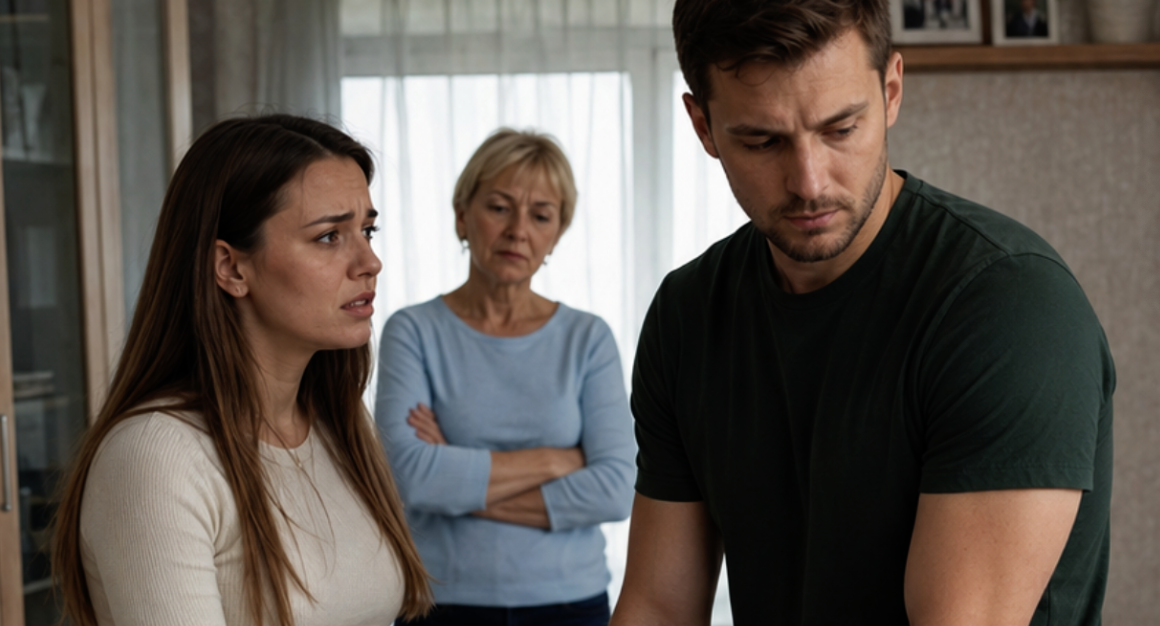
“You’re selfish! Normal daughters-in-law give their apartments to their mothers-in-law!” Lidia Stepanovna shouted while Vika packed her things.
A rented one-room apartment on the outskirts of Moscow. Sixteenth floor, radiators roaring like an airplane turbine, and the view from the window looked straight at the neighboring gray building, where people dried laundry on their balconies as if they were in a village. There was no trace of coziness here, but every evening Victoria repeated to herself, “It’s temporary. Just a little longer. Soon I’ll have my own apartment.”
She was stubborn by nature. She worked as a manager at a construction company, with no connections, no “relatives in city hall.” She simply worked hard. During the day — meetings, spreadsheets, phone calls. At night — online courses so her salary would grow. And finally, the bank approved her mortgage. It was her small victory. At twenty-eight, without her father’s connections or an apartment inherited from her mother.
“Anton,” she waved the printed approval in front of her husband’s face, “we did it. Fifteen million. The monthly payment is manageable. We can handle it.”
Anton was lying on the sofa in a T-shirt with a hole in the shoulder, lazily scrolling through his phone. He was thirty-one, a remote programmer, an eternal sleepyhead and an eternal “I’ll start a new life tomorrow” type. He had a talent: he always looked as if he was busy with something important, although most often there was a tank game flashing on his screen.
“Uh-huh,” he nodded absentmindedly. “Cool. Mom will be happy.”
“Mom?” Victoria narrowed her eyes. “Wait… what does your mother have to do with this?”
Anton put his phone aside, sighed, and sat up. He looked guilty, like a schoolboy who had forgotten his diary.
“Listen, I was thinking… Well, basically, it would be better to register the apartment in Mom’s name.”
Victoria laughed. At first, sincerely — she thought it was a joke. But Anton wasn’t smiling.
“Wait… say that again. In whose name?”
“Mom’s. It’s more profitable that way. She’s a pensioner, she gets tax benefits. And then, if… well, just in case…” He hesitated. “In short, it would be safer.”
Everything inside Victoria went cold.
“Right. So I take out the mortgage. I’ll work myself to exhaustion. I’ll pay for it. And your mother will become the owner. Convenient! Bravo!”
“You’re misunderstanding!” Anton fidgeted. “It’s temporary. Just to save on taxes. We’re family. What difference does it make whose name it’s in?”
“What difference does it make?” she almost shouted. “For you — none. For me — a fundamental one.”
She got up and went into the kitchen so she wouldn’t lose control. Their kitchen was only three steps from the sofa, but at least there was a door. The smell of yesterday’s buckwheat, a tiny table, two stools, peeling tiles. She sat down and stared into her cup of tea.
And then a voice came from behind the door. A woman’s voice.
“Vikochka, don’t get worked up.”
Her mother-in-law. Oh, yes. Of course. As if anything could happen without her. Lidia Stepanovna lived in the next building but appeared at their place more often than a Yandex Food courier. Sometimes she brought a bag of food, sometimes advice. Today she had clearly been sitting quietly in the room, waiting for the right moment.
Victoria bit her lip.
“You’re here?” she asked coldly.
“I was passing by,” her mother-in-law said, stepping into the kitchen with a forced smile. “I thought I’d drop in. You have such happy news — a mortgage. Well, Antosha is suggesting the right thing. I’m a pensioner, it’s easier for me. You young people are unstable. And an apartment means security.”
“Security for whom? For you?” Victoria set her cup down so sharply that tea spilled onto the table. “Excuse me, but this is my life, my money, my loan. Why should I gift the ownership rights to you?”
Lidia Stepanovna rolled her eyes and adjusted her glasses.
“Vikochka, you’re selfish. Everything is for you, you, you… Normal people think about the family. In our family, everything is shared.”
“Family?” Victoria smirked. “Funny. You and your son are a family? Then who am I — a tenant?”
Anton stepped in, raising his hands like a peacemaker.
“Girls, calm down. We’re just discussing it. There’s no need to argue.”
“I’m not a ‘girl,’ Anton,” Victoria said sharply. “I’m your wife. And I won’t let you make a fool out of me.”
“Vikochka,” her mother-in-law sighed theatrically, “why speak like that? I’m doing this for both of you. I’m thinking about the future.”
“And I’m thinking about the present,” Victoria jumped up. “And in my present, both of you are trying to deceive me.”
She paced around the room, her hands trembling. Anton stood up and tried to hug her, but she pushed him away.
“Don’t touch me. You don’t even understand what you’ve done. You sold me for a tax benefit.”
“Don’t dramatize!” he snapped. “You always make everything complicated.”
“Of course!” Victoria smirked. “Because if I don’t make things complicated, tomorrow you’ll throw me out onto the street. After all, the apartment will belong to Mom.”
A heavy silence hung in the air. Only the clock ticked on the wall. Her mother-in-law sat down on the sofa, folded her hands on her knees, and said quietly but venomously:
“Well, if it’s so hard for you to trust your husband and his mother, maybe you don’t need a family at all.”
And that was the last straw. Victoria grabbed the keys from the table and slammed the door so hard that old whitewash crumbled from the wall.
The stairwell smelled of neighbors’ cutlets and bleach. She ran down the stairs, feeling everything inside her tighten into a knot. Tears choked her, but anger held her up. Outside, cars roared, windows glowed, life went on. Only her life had suddenly cracked like glass under a heel.
And Victoria understood: there was no way back.
Victoria rented a room for one night in a nearby district. An old hostel with yellow walls and squeaky beds, but at least there was no mother-in-law and no poisonous remarks. She lay on the narrow bed and thought, “So that’s my whole family life. Three years, and it all ended because of an apartment.”
Her phone rang every ten minutes. First Anton. Then Anton’s mother. Then Anton again. She didn’t answer the messages, but she read them.
“Vik, don’t be stupid. It’s just a piece of paper. What difference does it make to you?”
“Come home, the neighbors are already whispering.”
“Are you doing this on purpose to shame us?”
“Shame us” — Victoria even laughed. As if she was responsible for keeping up the reputation of the whole family. She was twenty-eight, not someone with forty years of married life behind her, and they were already trying to drive her into a cage where “Mommy” decided everything.
By morning, she had made up her mind: she would go home, pack her things, and leave for good.
Lidia Stepanovna opened the door. She was wearing a flowered robe and curlers in her hair, as if she had been waiting.
“Oh, our dear guest. Decided to come back?” Her voice was sweet, but her eyes were cold.
“I came for my things,” Victoria said calmly.
“Of course, for your things…” her mother-in-law drawled. “Why didn’t you take them right away?”
“Lidia Stepanovna,” Victoria walked into the room without looking at her, “let’s skip the theatrics.”
Anton was sitting on the sofa, his head lowered. Like a schoolboy after being called to the principal.
“Vik, you understand…” he began.
“I understand,” she interrupted. “I understand that you’re not a husband, but an attachment to your mother.”
He jumped up, his hands trembling.
“Don’t go too far! I only wanted what was best!”
“Best for whom? For her?” Victoria nodded toward her mother-in-law. “And what am I, an empty space?”
Lidia Stepanovna, pleased that she had been drawn into the conversation, made herself comfortable.
“Vikochka, think for yourself. Life is long. What if you two separate, and the apartment stays with you? That would be unfair.”
“Oh, so that’s what this is!” Victoria laughed bitterly. “So you’re already planning your son’s divorce in advance?”
“I’m a realist,” her mother-in-law replied calmly. “And you’re too naive.”
At that moment, Victoria felt not only hurt for the first time, but rage. Not the kind that fades after half an hour. Cold rage, like steel.
“You know what?” She opened the wardrobe and started pulling her clothes into a bag. “I’m not naive. I’m the mistress of my own life.”
Anton rushed over and grabbed her by the arm.
“Wait, don’t act in the heat of the moment. We can still solve this.”
“Solve it?” Victoria pulled her arm free. “You already solved everything. Without me.”
And then, like in a cheap TV drama, the scene turned ugly. The bag wouldn’t close, shirts flew onto the floor. Anton tried to shove them back in, and she yanked them away.
“Are you leaving?” his voice cracked. “You won’t last a single day without me!”
“We’ll see,” Victoria said coldly.
“Vikochka,” her mother-in-law interfered, “listen to a mother.”
“I’m not your daughter,” Victoria snapped.
Then Lidia Stepanovna abruptly stood up and came right up to her.
“Then know this: if you leave, don’t come back.”
“I promise,” Victoria zipped up the bag and went to the door.
Anton rushed after her.
“Vik, you understand… Everything was fine between us. It’s just an apartment… just paperwork…”
“Paperwork?” Victoria stopped at the door. “This isn’t paperwork. This is respect. And neither of you has any for me.”
She stepped out into the stairwell. A heavy bag in her hands, emptiness in her chest. But for the first time in a long while, she felt as if she was breathing on her own, without someone else’s instructions.
That night, Victoria sat in her new temporary housing — a tiny studio she had rented on Avito. The room smelled of paint and dust, and the view from the window was of garages. But it was her choice.
Her phone rang again. Anton’s name was on the screen. She didn’t answer. Then a message arrived:
“If you leave, I won’t pay the mortgage. Deal with it yourself.”
She looked at the screen and smirked. “That’s it. This is the real me now. No illusions.”
But her heart still ached. After all, only yesterday she had believed they had a future.
For three weeks, Victoria lived in the small studio where everything creaked and smelled of someone else’s life. But it was her territory: no mother-in-law’s curlers in the kitchen and no Anton complaining about his “stressful job.”
She went to the bank. Sitting opposite a consultant in a strict suit and feeling her hands tremble, she asked:
“If my husband refuses to pay, can I take out the mortgage only in my name?”
The man adjusted his glasses.
“If your income allows it, of course. But then the property will belong exclusively to you.”
That phrase sounded like music. Hers. The apartment would be hers. Without “mommies” and “profitable schemes.”
A couple of days later, Anton called.
“Vik, listen. I thought everything over. Let’s go back to the conversation. Mom agrees to include you as one of the owners. But on the condition that she remains the main owner.”
“Seriously?” Victoria even laughed. “So you two conspired, and now you’re generously offering me a share?”
“Well, what’s wrong with that? It’s a compromise!” Irritation was audible in his voice.
“No, Anton. It’s a handout.”
“You’re selfish,” he snapped. “You have no family. You only think about yourself.”
“That’s right,” Victoria replied calmly. “I really don’t have a family anymore. Because family means respect, not being bought for a tax benefit.”
He shouted something else, but she pressed “end call.”
The final scene happened unexpectedly. That evening, someone knocked on the studio door. Victoria opened it — her mother-in-law stood on the threshold. She was wearing a coat, holding a bag, her face hard.
“Victoria,” she began without taking off her shoes, “you’re doing everything wrong. A woman must hold on to her family. And you’re shaming my son.”
“Your son is shaming himself,” Victoria replied. “I’m no longer his wife.”
“How dare you!” her mother-in-law stepped closer. “Do you want us to be left with nothing?”
“‘Us’?” Victoria smirked. “That’s your problem, not mine.”
And then Lidia Stepanovna threw the bag onto the table. Inside were Victoria’s old things: a sweater, a couple of books, a mug.
“Take everything. And forget the way back to our family.”
“With pleasure.” Victoria picked up the mug and put it on the shelf. “You know, unlike you, I will have my own home.”
Her mother-in-law flared up but said nothing. She left, slamming the door so hard that plaster crumbled.
Three months later, Victoria received the keys to her apartment. A small two-room flat in a new building, white walls, the smell of fresh paint. She walked in, barefoot, crossed the floor, and smiled.
No husband, no mother-in-law, no endless “advice.” Only her and her own space.
At that moment she understood: sometimes it is better to be alone than to live in a family where you are not respected.
And for the first time in a long time, she said out loud:
“I am the mistress of my own life.”