“You’re a man, Vadik. Don’t disgrace yourself in front of the relatives,” my mother-in-law scolded into the phone so loudly that I heard every word. The phone was lying on the kitchen table, next to the mortgage bill.
The Golden Display Case
I had just opened my banking app. I looked at the remaining balance after the transfer and immediately understood: if I reached into my own wallet again for someone else’s celebration, we wouldn’t be counting the days until payday — we’d be counting pasta.
“Mom, I understand,” Vadim muttered, walking around the kitchen in his socks.
“We’ll see.”
Then he ended the call, sat down, and did not even bother easing into it.
“Add some money for the gift.”
Just like that. Straight away.
I looked up.
“How much?”
He coughed and looked away.
“Well… a decent amount. Mom liked a bracelet. It’s a milestone birthday, after all. We can’t just show up with a card.”
I smoothed the yellow bill with my palm. The paper crackled.
“No.”
He did not understand.
“What do you mean?”
“I mean exactly that. I won’t give you money.”
The refrigerator hummed. Outside, someone was dragging a sled across the yard with no snow, its runners scraping against the asphalt. Vadim looked at me as if I had not refused him, but had dropped something expensive.
“Svet, don’t start.”
“I’m not starting. I’m closing this shop.”
He gave a short laugh, without joy.
“Funny. Last year you yourself said Mom needed decent earrings. And it was fine.”
I remembered. Of course I remembered. His mother had spent the entire evening turning her head under the lamp so the stones would sparkle. And she kept telling everyone:
“My Vadik is generous. He doesn’t spare anything for his mother.”
And the receipt for those earrings had stayed in my wallet for a week, tucked between chewing gum and the grocery list. Then I tore it up and threw it away. So I would not feel disgusted with myself.
“Last year I was stupid,” I said.
“This year I won’t be.”
He leaned forward.
“What is wrong with you? It’s one holiday.”
“Your mother has ‘one holiday’ every year. A birthday, an anniversary, or just because she happened to like something.”
Pasta Until Payday
All evening he slammed cabinet doors, rattled cups, walked from the kitchen to the room and back again. A theater of offense.
I stood at the stove, chopping onions for the sauté, thinking about only one thing: if I gave in now, my money would once again end up in his mother’s envelope, and she would once again brag to her friends about her generous son.
“Why are you being so stubborn?” he asked.
“My mother asked just once.”
“She didn’t ask. She got used to it.”
“Oh, of course. Everyone is bad, and you’re the only good one.”
I brushed onion skins off the cutting board and turned on the water.
“Vadim, I’ve been carrying the mortgage for the third year now. You know that.”
“Not alone. Together.”
“Together means both people carry it. Not when I pay, and you receive the gratitude.”
He stood up so abruptly that the chair scraped across the linoleum.
“You want to humiliate me?”
“No. I just don’t want to cover for you anymore.”
He went into the room and turned the television louder than necessary. Cheerful voices poured out of it. I washed spoons and remembered how many times I had put money into an envelope myself, whispered, “Let’s say it’s from both of us,” smiled at his mother, and pretended that this was how things were supposed to be.
Peace in the family. Beautiful words.
Only for some reason, they were paid for from my pocket.
Half an hour later, he came back and said in a different tone:
“Well, do you want me to write you an IOU?”
I even turned around.
“What?”
“An IOU. That I’ll pay you back.”
“I don’t need an IOU from my husband for a gift to his mother.”
He hesitated, then pushed his phone toward me and placed it in front of me.
“Transfer it. I’ll withdraw cash tomorrow.”
The transfer screen was glowing. The amount had already been entered. All I had to do was place my finger on it.
That was when something inside me truly clicked.
I took the phone, looked at the numbers, and pressed cancel.
“No.”
He stared at the screen as if I had broken something important.
“Svet, you’re making a mountain out of a molehill…”
“No. I simply don’t want to eat plain pasta without butter afterward while your mother shows the bracelet to Aunt Galya.”
He turned away and snapped in irritation:
“You’re impossible.”
And for some reason, I felt lighter.
The next day he tried again.
“Let’s at least split it.”
“No.”
That evening, once more.
“I would pay you back after my bonus.”
“You don’t have one.”
The next day, our daughter came by for a jar of jam. She stood in the kitchen, twisted the lid, and asked:
“Mom, does Grandma really tell everyone that Dad supports the family?”
I raised my head.
“Where did you get that?”
“She told the neighbor right in front of me. Said Sveta was lucky with her husband.”
My daughter snorted, took a container of cutlets, and said at the door:
“Just don’t bail him out again. I’m tired of watching you be the only adult in your family.”
After her words, I stood by the sink for a long time. I washed an empty sour cream jar, even though there was nothing to wash. The water rushed. On the windowsill, green onions in a glass gave off their sharp smell.
And suddenly it became very clear to me: if even the children could see it, then I was no longer preserving peace. I was simply tired of propping up someone else’s cardboard façade.
A Discount Card
On the day of the anniversary, I got ready in silence. I put on a dark dress, small stud earrings, and wiped my boots with a napkin. The kitchen smelled of strong tea and men’s deodorant.
“Well, are you satisfied?” Vadim asked, looking into the mirror.
“Not yet.”
He was waiting for me to back down. I could see it. Even while buttoning his shirt, he kept glancing in my direction. As if I would suddenly take out my card and say, fine, just don’t sulk.
I did not take it out.
We stopped at a supermarket to buy a cake. I went to the refrigerated section, and he lingered by the checkout. Then he caught up with me, already holding a thin white envelope.
I caught a glimpse of the card. White cardboard, gold letters saying “Congratulations,” pale flowers along the edge. The kind people grab on the way out.
He paid for it separately. He took out crumpled bills, then dug in his pocket for coins. Behind him, a woman with a mesh bag of oranges was already shifting impatiently.
And that was when it truly hit me: our beautiful fairy tale was over. Not for my mother-in-law. For me.
The restaurant was hot and noisy. It smelled of baked chicken and heavily perfumed artificial roses. Nina Pavlovna sat at the head of the table in a blue dress with shiny trim. Marina, thin and tight-lipped, fussed beside her.
“Well, you finally came,” my mother-in-law said.
“We thought you were busy with your own affairs again.”
Her gaze immediately slid to her son’s hands. There was no jewelry store bag. Only a cake and a flat little envelope.
Marina noticed it too.
“Seriously?” she whispered.
I sat closer to the edge of the table. They placed a salad with chicken and prunes in front of me. My fork clinked against the plate.
While everyone was getting seated, Nina Pavlovna managed to tell the woman on her left twice:
“My Vadik never comes without a gift. He knows how to honor his mother.”
I heard it and did not even turn my head. I looked at the napkin beside my plate. White, starched. One corner had already curled up.
My mother-in-law accepted gifts slowly. A dinner set from her niece. A scarf from the neighbor. A coffee machine from Marina and her husband. When the word “Italy” was mentioned, Nina Pavlovna even lifted her chin.
Then it was our turn.
“Well, Vadik, show me what you’ve brought to make your mother happy.”
He coughed. He handed her the card and the cake.
“Mom, this is from the heart.”
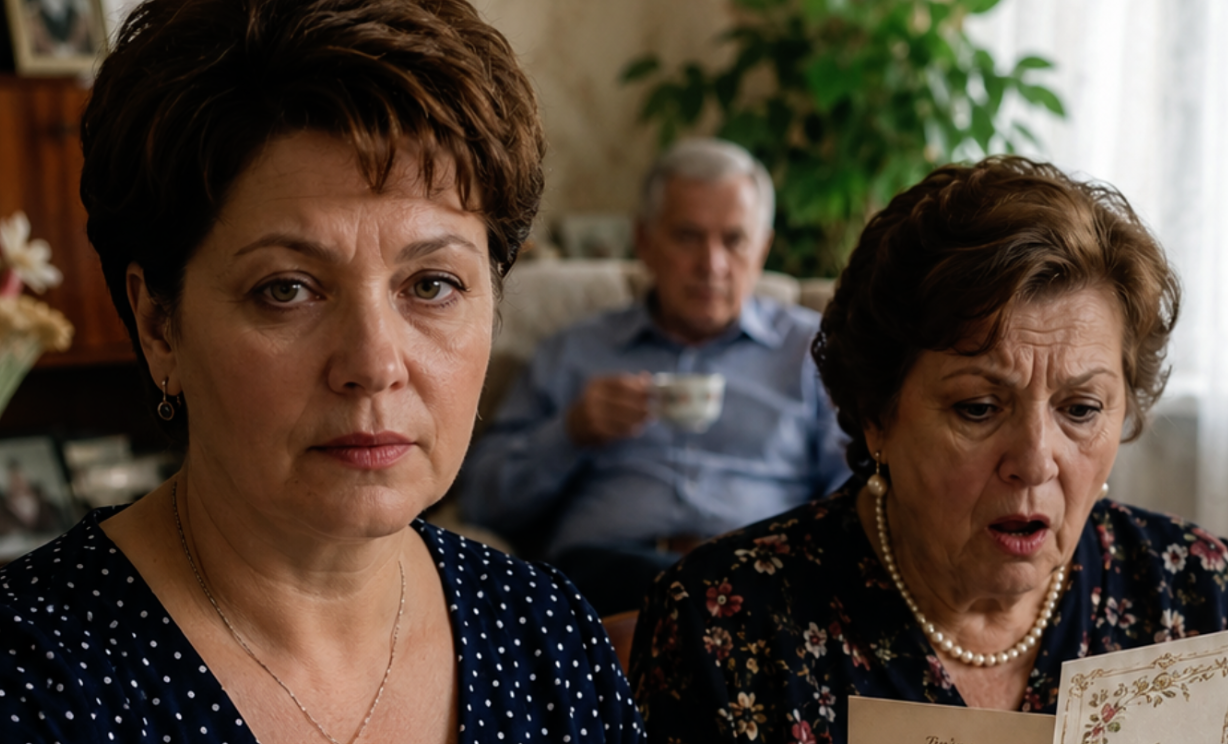
My mother-in-law took the card with two fingers, opened it, and froze. Inside, in his crooked handwriting, it said: “Mom, wishing you health and many long years.”
And that was all.
“Is this everything?” she asked.
The Checkout Card Showed Who Was Really Carrying the Family
A waiter dropped a spoon onto a tray. The sound was sharp.
Vadim turned red and immediately twisted his head toward me.
“Well… you see what times are like. Sveta didn’t get her bonus.”
The Bill on the Table
I put down my fork.
“My bonus went here,” I said, and took the folded bill out of my bag.
“Toward early mortgage repayment.”
I unfolded it right on the tablecloth and pushed it toward my mother-in-law. The yellow strip lay beside her glass.
“And Vadim chose the gift with his own salary.”
At first, no one understood. Then Marina froze with her glass in her hand. Aunt Lusya blinked and, for some reason, adjusted her napkin.
My mother-in-law slowly looked at the bill, then at her son.
“What is this supposed to mean?”
“This is my apartment payment,” I said.
“And my money, which will no longer be used for generosity.”
“Sveta, what are you getting at?” Vadim hissed.
“That it’s enough.”
Marina snorted.
“Well, isn’t that something. For so many years everything suited you, and now suddenly you’ve grown a spine.”
I turned to her.
“Yes. For so many years I pretended your Vadim could do more than he actually could. Enough.”
My mother-in-law squeezed the card so tightly that the cardboard crunched.
“You mean to say my son couldn’t buy his mother a gift?”
“I mean to say, Nina Pavlovna, that your son gave exactly what he earned himself.”
Silence.
My mother-in-law shifted her gaze to the bill, as if something obscene had been written on it. Then she pushed it away with her fingernail.
“You did this on purpose, didn’t you? In front of everyone?”
“No. What I did on purpose was before. When I kept quiet and paid the difference.”
Then Aunt Lusya coughed into her fist and said loudly, almost angrily:
“Well, she’s right. He gave what he could.”
Everyone turned toward her.
“What are you all staring at me for?” she grumbled.
“Better that than showing off.”
Marina pressed her lips together.
“You could have sorted this out at home.”
“I could have,” I said.
“Only at home, for some reason, I was always the only one sorting things out. And he was the one being thanked.”
Vadim sat there red, all the way to his ears.
“We’ll talk at home,” he muttered.
“At home you usually slam cabinet doors,” I replied.
“Here, everyone heard it the first time.”
My mother-in-law went pale under her blush.
“How are you not ashamed to do this at a celebration?”
“And was I supposed to feel no shame for silently paying for this picture for years?”
After that, everything went crooked. The toasts sounded wooden. Marina spilled water on the tablecloth. Nina Pavlovna spoke only to the people seated on her right. I even found it funny.
For so many years they had protected one legend, and it fell apart because of a fifty-ruble piece of cardboard and one payment bill.
Before we left, my mother-in-law finally said, without looking at me:
“I never expected this from you.”
“Neither did I,” I answered.
The Table Stopped Wobbling
We drove home in silence. The windshield wipers scraped across the glass. At the entrance, Vadim finally could not hold back.
“You made me look like a pauper in front of everyone.”
I pulled the keys out of my bag.
“No. I stopped paying extra for your pretty image.”
“You could have done it like a decent person.”
“Like a decent person, I asked you for years to be responsible for your own gifts.”
On the second floor, it smelled of fried potatoes. A child was crying at the neighbors’. At home, I immediately took off my shoes and put on the kettle. It began to hum at once, in a homely way.
Vadim stood in the kitchen doorway.
“So what now?”
“Now it’s simple. You buy gifts for your mother yourself. Trips too. And you make impressions with your own money.”
“And family?”
I poured tea leaves into the teapot.
“Family is when one adult isn’t turned into a wallet for everyone.”
He was silent for a while. Then he waved his hand and went into the room. He did not even turn on the television.
In the morning, my mother-in-law called. I looked at the screen and did not answer. A minute later, a message came from Marina: “You could have kept quiet.”
I smirked and put the phone away. Absolutely not.
Then Vadim came into the kitchen, gloomy and rumpled, sat at the table, and said:
“Mom didn’t sleep all night.”
I placed a mug in front of him.
“And did I sleep peacefully all these years?”
He said nothing. He ran his finger along the oilcloth and stood up. That was the whole conversation.
At lunchtime, I went to the store for bread and tea. By the checkout, there was a spinning rack of cards. Exactly the same ones. White, with gold lettering, on sale.
I picked one up, turned it in my hands, and put it back.
At home, I wiped the table, set out the sugar bowl, and arranged the bills into a neat stack. In the top drawer, that very card was still lying there. Vadim had absentmindedly stuffed it into the glove compartment, and then, for some reason, brought it home.
I took it out, tore it in half, and slipped the pieces under the leg of the kitchen table that had been wobbling for a long time.
The table immediately stopped wobbling.
Would you be able to stop paying for someone else’s generosity if it meant the family fairy tales started falling apart? Or would you transfer the money again, just so nobody at the table would frown?
If something in this story stung, don’t pass by in silence. Things like this need to be said out loud, otherwise they take root in a family as the norm.