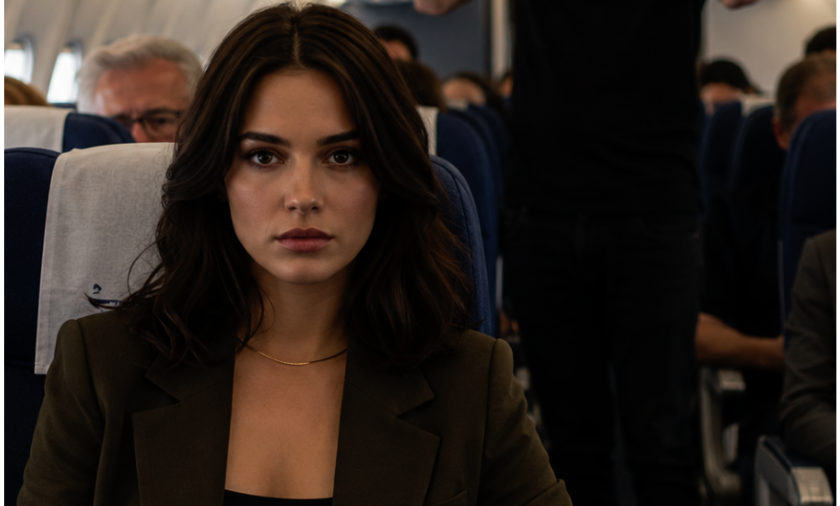
“This is my seat,” the guy in white sneakers with red soles said, jabbing his finger toward the window seat.
I looked up from my phone. Business class. Moscow–Sochi flight, departure at 7:40 p.m. Seat 2A — by the window, away from the aisle. I always book that exact seat.
“Young man, what seat is listed on your boarding pass?”
He did not even look at his ticket. He waved a hand with a massive gold bracelet as if he were swatting away a fly.
“What difference does it make? I paid for business class. I want the window.”
He was about twenty-six. Maybe twenty-seven. A T-shirt with a huge logo across the chest, the smell of perfume that could be noticed three rows away. A short haircut styled with gel. And a look — from top to bottom, as if he were appraising an item on sale.
I silently showed him my boarding pass. 2A. Black on white.
His eyes slid over my linen blazer. Over my simple gray trousers. Over my face without makeup. Over my short hair, openly streaked with gray. He paused at my hands — no rings, no bracelets. Only a watch. Plain-looking, without any brand name.
And he smirked.
“Listen, auntie. Are you even sure you belong here? Maybe you mixed up the cabin?”
For twenty-two years I have been building a business. I started with one kitchen in an industrial zone in Podolsk — four people, one refrigerator, pots from home. Now I have two hundred and eighty employees, three production workshops, and contracts with the largest airline in the country. I fly in this seat fifty times a year. And in all those years, I still have not learned how to wear price tags on myself. I do not want to. I see no point.
“I’m sure,” I said. “Please sit in your own seat.”
He snorted. He sat down in 2B — across the aisle from me. He crossed one leg over the other and pulled out a phone in a gold case.
But he did not calm down. I understood that even then.
I took out my laptop and opened my work email. A new contract for the next quarter — one hundred and forty-six pages. Three airports, eleven routes, in-flight meals for every flight. My company, AviaTechLine, has been supplying this airline for nine years. Every meal tray, every packaged napkin, every portion of coffee in a thermos — my people, my workshop, my recipes.
I immersed myself in the numbers. Clause thirty-two — hot-meal logistics, loading standards for the aircraft. Familiar work. I like reading my own documents — seeing how twenty-two years turn into specific clauses, subclauses, and tables.
The guy stayed silent for about seven minutes. Then he could not hold back.
“Hey,” he leaned across the aisle. “How come you’re in business class without a ring, without earrings? Got a husband? Or are you flying on your last pennies?”
I did not answer. I turned the page.
“Can’t hear me? Or are you deaf already?” He laughed at his own joke. Loudly, across the whole cabin.
There were twelve seats in business class. Seven were occupied. A man in a gray suit one row away lowered his newspaper and looked at the guy over his glasses. A woman with a daughter of about eight in the third row turned around, then quickly looked away.
“Ignoring me?” he chuckled. “Fine.”
He stood up. Opened the overhead compartment above me — confidently, proprietarily, as if it were his apartment. He took my suitcase with both hands, pulled it out, and shoved it into the far end of the compartment, into the corner, pressing it down with his jacket. Then, into the space he had freed exactly above my seat, he placed his own suitcase — black, with gold zippers, with the tag of some Italian brand.
“My suitcase was standing here,” I said.
“And now it isn’t. Mine is more expensive. Yours will be fine in the corner.”
I closed my laptop. Stood up. Opened the compartment. Took out his suitcase with the gold zippers and carefully placed it in the aisle. Put mine back in its place. Closed the compartment. All silently. Without hurrying. Calmly.
His ears turned red. That was what I noticed — his ears, not his face. The tips of his ears turned scarlet.
“What do you think you’re doing? Are you out of your mind?”
“I am returning my things. Your suitcase belongs in your compartment. Above your seat,” I said, gesturing with my hand.
“Do you know who I am?”
The whole cabin heard it. The man with the newspaper placed it on his knees. An elderly woman two rows away shook her head.
“No,” I said. “And I see no reason to find out.”
“My father is Arkady Vakhitov. The Golden Shashlik chain. Twenty-three restaurants in Moscow and the region. Heard of it?”
He said it as if he were naming the password to a safe. Or the password to adult life, where people let him in because of his surname.
I had heard of that chain. We had once considered them as a subcontractor for one regional route. Our food technologist inspected their kitchen and wrote a fourteen-page report. We rejected them — they did not meet sanitary standards.
“I have,” I nodded. “Please sit down. The plane will begin taxiing soon.”
“No, wait. You heard of it, but you didn’t understand. I’m Danil Vakhitov. My father is a gold client of this airline. Gold! And who are you? Some auntie in a linen jacket? Flying economy, you broke loser.”
Broke loser. He said it calmly, as a statement of fact. As if it were a medical term.
I did not answer. I took out my laptop and opened it again. My hands were steady. For now — steady.
He did not let up. He pressed the flight-attendant call button.
Angela appeared half a minute later. I have known her for six years — she has worked this route since the airline’s first day. Short, dark hair in a tight bun, always with an even voice. She recognized me as soon as I entered the cabin. She nodded and smiled. As always.
“Galina Renatovna, good evening,” she addressed me first. “Is everything all right?”
Danil opened his mouth. Closed it. Opened it again.
“Wait. You call her by name and patronymic? Seriously? Her?” He jabbed a finger in my direction. “Why?”
Angela turned to him. The smile remained, but her eyes changed — colder, more attentive.
“How may I help you?”
“Move her,” he said as an order. “Anywhere. Economy. She doesn’t belong here. Look at her — she looks like… well…” He snapped his fingers, searching for the word. “Like a cleaning lady. I don’t want to sit next to a broke loser. I have gold status in your loyalty program. Gold!”
Silence. That kind of silence when there are twelve seats, seven passengers, and everyone simultaneously pretends not to hear. The man with the newspaper folded it in half. The woman with the daughter covered the girl’s ears with her palms. The elderly woman two rows away looked at Danil the way people look at a cockroach on a white tablecloth.
Something shifted inside me. Not hurt. Anger. Quiet, thick anger that had not accumulated in one day or one year. For twenty-two years I had been building my business, and people like this guy decide who is worth what by the price tag on a T-shirt.
“Young man,” Angela spoke evenly, as if following protocol. “Galina Renatovna is our regular passenger. Her seat has been paid for. I have no right, and I will not move anyone. Please return to your seat and fasten your seat belt. We are preparing for departure.”
“Regular passenger?” He burst out laughing. “Saved up miles by skipping lunches?”
Angela did not smile. She waited.
“Please fasten your seat belt.”
He fastened it. But immediately turned to me.
“Fine, auntie. Sit there. But my suitcase will stand where I want it. I paid for that.”
“Your suitcase belongs above your seat,” I repeated.
“And I want it above yours. What are you going to do to me?”
Angela left. I saw her stop by the partition between business and economy, take out a radio, and quietly say something. Then she returned to the front of the cabin, but remained standing there — she did not leave.
Danil waited until she turned away.
She turned away for one second — to adjust the window shade in the first row.
He stood up. Yanked the compartment open. Grabbed my suitcase with both hands and threw it down.
Not moved it. Threw it.
The suitcase fell onto the aisle floor, hit the corner, the lock clicked, and the lid opened slightly. A folder of documents rolled out, and sheets scattered like a fan — white pages with tables and stamps. Three sheets flew under the seat of the man with the newspaper. One landed at the feet of the woman with the child.
Angela turned around. Her face changed — for the first time in six years, I saw her turn pale.
I looked at my papers on the floor. Documents I was carrying to be signed at the Sochi office. One hundred and forty-six pages that my lawyers had spent two months preparing. Approvals, signatures, appendices. On the cover of the folder was my company’s logo. AviaTechLine. The very same logo printed on every food tray on this aircraft. The logo this boy would see in two hours of flight when they brought him dinner.
My fingers turned icy. I noticed it when I bent down to collect the pages. Cold, as if I had plunged them into a bucket of water.
The man in the gray suit silently stood up and helped me pick up the folder. He collected three sheets from under his seat, carefully stacked them, and handed them to me. He nodded. Sat back down.
The woman with the daughter picked up the sheet from under her feet and passed it across the aisle. The girl looked at Danil with round eyes.
Angela was already beside me. She crouched down and helped close the suitcase.
“Galina Renatovna,” she said quietly, only to me. “I’ll report this now. This is already a legal offense.”
“Wait, Angela.”
I placed the suitcase in the aisle. Straightened up. The folder was in my hands. The logo was facing Danil directly, but of course, he was not looking at the folder. He was looking at me. With that same smirk — condescending, lazy, habitual.
Twenty-two years. Two hundred and eighty people who come to the workshop every morning at five-thirty, put on gloves, caps, and aprons. They prepare food for passengers on these flights. They cut, boil, and portion everything into trays. Forty-six thousand portions a month. Each one according to my recipes, my standards. I have been doing this for nine years, and not once — not a single complaint from sanitary control.
And this boy with Daddy’s gold chain throws my documents onto the floor and calls me a broke loser.
“Danil,” I said. Quietly. The whole cabin heard. In business class, there is no need to raise your voice. “Do you know what you just threw onto the floor?”
He shrugged.
“The documents of the company that feeds you on every flight of this airline. Every meal tray they will bring you in two hours — that is my workshop, my people. The logo on this folder — do you see it?” I turned the folder toward him. “It is the same one that will be on your dinner. On every napkin. On every cup.”
He blinked. For the first time during the whole conversation, something in his face faltered. Not remorse — confusion. Like a person who had misjudged the situation and had not yet understood how badly.
“I do not wear price tags on myself,” I continued. “I do not wear gold bracelets. I do not name my father’s surname when I want a window seat. I do not need to — I have my own name. Angela knows it. Half the crew knows it. And the airline has known it for nine years.”
Silence.
“And do you know what I see when I look at you? Twenty-three restaurants belonging to your father. Not yours — his. Sneakers worth one hundred and twenty thousand that you did not earn. A gold loyalty card you did not pay for. And manners worth exactly zero rubles.”
The man with the newspaper coughed. Quietly, but I understood — he was on my side. The elderly woman two rows away nodded.
“You have just damaged another passenger’s belongings on board an aircraft. You insulted a passenger in front of witnesses — seven people heard the word ‘broke loser.’ You twice failed to comply with a flight attendant’s instruction — you were asked to fasten your belt and sit down, yet you stood up and threw a suitcase. Those are three grounds for removal from the flight under Article 107 of the Air Code.”
His eyelid twitched. The left one.
“You’re bluffing,” he said. His voice had grown thinner. The bossy bass had gone somewhere.
“Angela,” I said without turning around. “Please report it.”
“Already done,” Angela replied. “Oleg Borisovich has been informed.”
The cockpit door opened. Oleg Borisovich came out — I had been flying with him for four years. Tall, gray-haired, with broad shoulders and a heavy, calm face. He looked around the cabin. The suitcase in the aisle. The scattered papers I had not yet collected. Me, holding the folder. Danil, pale, with a twitching eyelid.
“Galina Renatovna,” he said. “Good evening. I have been informed of the situation. On behalf of the crew, I apologize. We should have intervened earlier.”
Then he turned to Danil. Not immediately — first he was silent for a second, and that second was longer than any words.
“Young man. I am Oleg Borisovich Gerasimov, senior pilot, with twenty-two years of flight experience. Under Article 107 of the Air Code of the Russian Federation, I have decided to remove you from this flight for violating rules of conduct on board, damaging a passenger’s property, and failing to comply with a flight attendant’s instructions. Transport police will arrive shortly. Please collect your belongings.”
Danil turned white. Like a sheet of paper.
“You can’t. My father…”
“Your father is not flying here,” Oleg Borisovich said. “Your belongings, please.”
“I’ll make a call! I’ll have all of you—”
“Make your call,” Oleg Borisovich nodded. “After you leave the aircraft.”
Danil looked at Angela — she stood straight, hands behind her back. At the man with the newspaper — he was looking out the window. At me — I held the folder with the logo and said nothing. At the eight-year-old girl, who was watching him from behind her mother’s hand.
He swallowed. And picked up his suitcase with the gold zippers.
They escorted him out nine minutes later. Two transport police officers — silently, without handcuffs, but without ceremony. One carried his suitcase. Danil walked ahead, hunched over. At the boarding stairs he turned around and looked at the business-class window. I do not know whether he saw me. I was not looking. I was rereading clause thirty-two.
Angela brought me coffee. No sugar, with a drop of cream — she remembered. She placed it on my tray table and lingered for a moment.
“Galina Renatovna, again, I’m sorry. We should have acted sooner.”
“Everything is all right, Angela. You did everything correctly.”
She nodded and went to prepare the cabin for takeoff. I took a sip of coffee. Hot, strong. My hands were no longer icy.
The man in the gray suit one row away said quietly:
“You handled yourself well.”
I nodded. Not because I needed praise. Simply because one stranger had said it to another, and that turned out to be enough.
The plane began to move. Outside the window, the airport lights drifted by. I closed the folder and opened my laptop. One hundred and forty-six pages were waiting. Three airports, eleven routes. Work that no one would do for me.
But inside, beneath that calmness, beneath the coffee and work email, there was a question. Sharp as a splinter.
What helped me was not patience. And not calmness. What helped me was my name. My name. My nine years with this airline. My logo on the folder. The flight attendant who knows how I take my coffee.
But what if another woman had been sitting in my place? The same kind of woman, in the same linen blazer, with the same gray hair. But without AviaTechLine. Without “Galina Renatovna” from the crew. Just a passenger who had bought a ticket with her own money.
Would he have thrown her suitcase? Of course. Would he have called her a broke loser? Yes. Would they have called the police? Would they have removed him from the flight?
Or would they have said, “Sort it out yourselves, we do not interfere in disputes between passengers”?
I did not know the answer. And that was the most unpleasant part.
Three days later, the airline’s press office wrote to me. One of the passengers had filmed a video on their phone. A short one, about forty seconds — from the moment he threw the suitcase to Oleg Borisovich’s words about removing him from the flight. The video ended up in a Telegram channel with two hundred thousand subscribers. The headline: “Rich kid throws woman’s suitcase in business class — removed from flight.”
In one day — four thousand reposts.
I read the first fifty comments.
Half wrote: “Good! A boor deserves to be treated like a boor. Well done, woman! It’s long past time to teach people like that a lesson!”
The other half wrote: “And if she had been an ordinary passenger, would they have removed him too? Or only because she is a contractor for the airline? That isn’t justice. That’s privilege. The same kind of privilege as his — just from the other side of the counter.”
I closed Telegram.
Arkady Vakhitov, Danil’s father, called the airline. Twice. He demanded that the decision be reversed, threatened court, the press, and some connections. Danil was placed on a blacklist — one year without the right to buy tickets. Vakhitov senior wrote a newspaper column about “airline arbitrariness.” My surname was not mentioned in the column, but there were hints about “dubious contractors who use connections for personal purposes.”
They offered me the chance to comment. I refused.
My lawyers checked everything: three witnesses were ready to confirm the insult. There was video. The suitcase lock was damaged — an expert inspection had been done. If I wanted, I could file a counterclaim. For property damage and insult to honor and dignity.
I have not filed yet. I do not know whether I will.
And the question has not gone anywhere. It sits inside me, and I think about it every time I pack my suitcase before a flight.
He threw my things, called me a broke loser, refused to obey the flight attendant’s instruction — they would have removed him from the flight even without me. Article 107. Everything according to the law.
Or would they not have? Honestly — if Angela had not known me by name, if there had been no logo on the folder, if I had not said the words about nine years and two hundred and eighty employees — would they have reacted the same way?
I sleep normally. The documents were signed. The new quarter has begun. Work continues.
But sometimes I think: did I do the right thing back then — or did I use my position to put that boy in his place?
What would you have done? Kept silent — or named yourself too?