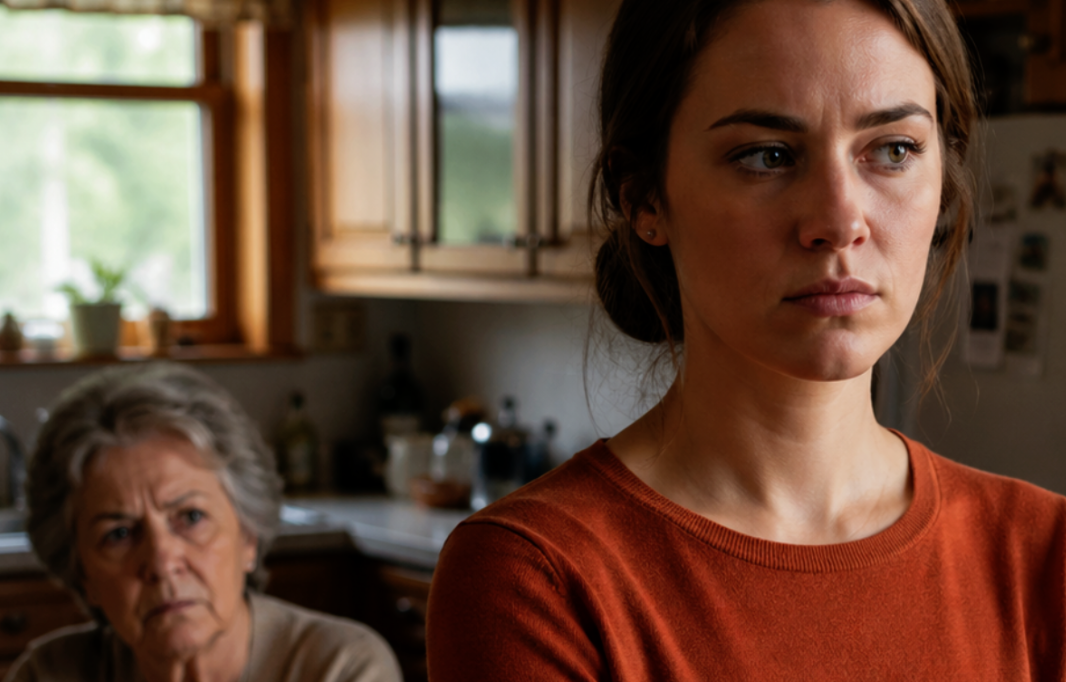
— Roma, just look at how early the radishes are this year, so plump and juicy, — Anastasia Mikhailovna loudly heaved her shopping trolley bag onto the kitchen table, a lonely bunch of wilted greens sticking out of it. — Forty rubles a bunch, by the way. And someone has to earn those forty rubles while others chop them into salad without a shred of conscience.
Zhanna, standing by the sink, did not even turn around. She was methodically scrubbing the frying pan after the morning’s eggs. The April sun shamelessly lit up every speck of dirt on the linoleum, and Zhanna knew: here it comes. The air did not smell of spring, but of an approaching scandal, thickly mixed with her mother-in-law’s enthusiasm.
“Mom, why are you starting again?” Roma said, not looking up from his phone as he reached for a mug. “Zhanna is looking. Times are tough right now. Companies are bursting like soap bubbles.”
“People look for treasure, Romochka. Work is something you do,” Anastasia Mikhailovna sighed theatrically and began taking a carton of kefir and a pack of the cheapest cookies out of her bag. “At her age, I was juggling three jobs when your father decided he was a free artist and needed to find himself on the sofa. But our dear Zhannochka, as I see it, has found herself as a decorative element of the interior. On your neck, by the way.”
Zhanna wiped her hands on a towel and turned around. She was fifty-five. A wonderful age: you already know everything, but you have not forgotten everything yet. In the mirror, a rather attractive woman looked back at her, still retaining traces of her former grace despite two months of forced idleness.
“Anastasia Mikhailovna,” Zhanna said calmly, “in these two months I’ve had six interviews. At one place they said I was ‘overqualified.’ At another, they said they needed a ‘young and creative team,’ meaning people willing to work for food and praise.”
“Oh, of course,” her mother-in-law pursed her lips, making herself look like a dried apricot. “A bad dancer always blames the team. Zhannochka, since you’re sitting at home anyway, you could at least wash the floors more often. Roma came home, and there was sand in the hallway. As if this isn’t an apartment, but a beach in Anapa. And now you’re paying for the apartment alone, Romochka? And the electricity too? The rates went up again in April.”
Roma looked guiltily at his wife. He was not a bad man, but he was soft, like yesterday’s loaf of bread. Twenty-five years of marriage had taught Zhanna that in arguments with his mother, her husband took the position of an ostrich: head in the sand, and everything else exposed to attack.
“I’m paying, Mom,” Roma muttered. “What else can I do?”
“Exactly,” Anastasia Mikhailovna seized on his weakness. “You’re carrying everything alone. And what about sending money to Yulechka in Moscow? A dorm is a dorm, but the girl needs clothes and food from the cafeteria. She’s probably living on porridge alone over there. And her mother is resting here like a lady of leisure.”
Zhanna silently took a pot of soup from the refrigerator. The soup was made from chicken backs — the economy version introduced into the menu three weeks earlier.
“Sit down and have lunch,” she said curtly.
“I don’t eat that,” her mother-in-law said, peering into the pot with disgust. “That chicken is nothing but cholesterol. Zhanna, you’d be better off doing something useful. There was a notice hanging at the vegetable shop around the corner: they need a packer. Honest work. Almost in the fresh air.”
“I worked for thirty years as a senior economist,” Zhanna said without even raising her voice. “I’ll go sort rotten potatoes only if we have absolutely nothing left to eat. For now, as far as I can see, Roma’s salary is enough for the internet and for your visits.”
“Did you hear that?” Anastasia Mikhailovna clutched dramatically at her heart, somewhere near her glass-bead brooch. “My visits bother her! Roma, do you hear how she talks to your mother? She lives off your money and dares to reproach me!”
Roma sighed heavily and pushed his plate away.
“Zhan, honestly, Mom means well. Maybe you really should find some temporary side job? Yesterday I saw the electricity bill — the numbers looked like a phone number. You’re home all day: you turn on the kettle, the TV murmurs in the background. It all adds up, Zhan.”
Silence hung in the kitchen. All that could be heard was the lazy drip of water from the tap — the gasket should have been replaced back in March. Zhanna looked at her husband as if she were seeing him for the first time. Or, on the contrary, as if she were seeing him too clearly, right down to the hidden seams of his conscience.
“So the TV murmurs?” she asked quietly. “And I turn on the kettle too often?”
“Well, I just meant…” Roma fussed, trying to catch her eye. “It’s just that right now every kopeck counts. We need to send money to Yulia for her exams. Her jacket tore…”
“I see,” Zhanna straightened her back. “A good jacket is important. And television is a luxury.”
She left the kitchen, leaving her mother-in-law triumphantly chewing stale cookies.
All evening, Zhanna did things that seemed strange to Roma. She did not watch her series. She did not scroll through the news feed. She went through the wardrobe.
“What are you up to?” Roma asked, peeking into the bedroom. “Cleaning?”
“Inventory,” Zhanna replied, neatly folding her sweaters into a suitcase. “Roma, I’ve been thinking. April is a month of renewal. You’re right, I spend too much of your precious resource. The air in this apartment probably costs money too, doesn’t it? After all, I breathe it twenty-four hours a day while you slave away at the factory.”
“Zhan, come on. Stop it. Mom went too far, and I lost my temper. Stay. I’m not kicking you out.”
“You’re not kicking me out,” Zhanna zipped up the first suitcase. “You’re just counting my cups of tea. And I’m a woman who is no longer young, proud, and, as it turns out, ‘overqualified’ to listen to lectures about electricity rates from a man whose shirts I ironed for twenty-five years.”
“And where are you going? To Yulka’s dorm?” Roma chuckled nervously.
“Romochka, for me it’s like in that movie: ‘Life begins at forty.’ And at fifty-five, it continues in my own apartment on the embankment. The tenants just moved out the day before yesterday. I hadn’t even had time to post the ad yet. Good thing I didn’t. I’ll live there myself.”
“Are you serious?” Roma sat down on the bed. “What about me? What about dinner? The ironing? Mom won’t come here every day.”
“Your mother has the energy of a nuclear reactor. She’ll manage. Besides, now no one will be wasting your electricity for nothing. Savings, Roma. Pure profit.”
Zhanna left in the morning while Roma was at work. She did not make a scene. She did not break dishes. She simply called a taxi and loaded two suitcases into it. She placed the apartment keys on the hallway cabinet, next to the gas bill.
Her one-room apartment greeted her with the smell of emptiness and dust, but to Zhanna, that smell seemed like the aroma of freedom. The apartment was simple, but it had a good view of the river. There was no mother-in-law here with her “advice,” no Roma with his eternal “there’s no money.”
The first thing Zhanna did was turn on all the lights in the hallway. Just because. So it would shine. Then she put on the kettle — the biggest one, two liters. And she drank a cup of coffee while watching the ice drift on the river.
On the third day, Yulia called from Moscow.
“Mom, Dad called. He said you went into ‘autonomous navigation.’ He’s been eating dumplings for two days straight. Says the fridge is empty.”
“Yulechka, Dad is a grown boy. He knows how to use the stove. I checked. How are your studies?”
“Fine. But Dad is kind of twitchy. He asked whether I knew where his blue socks were. Can you imagine? The man is fifty-eight, and he can’t find his socks.”
“They’re in the bottom drawer of the dresser, under his own T-shirts. But don’t tell him. Let it be a quest. It develops fine motor skills and attentiveness.”
A week later, Roma began calling. At first, he tried to sound stern.
“Zhanna, this isn’t serious. You’re an adult woman. The cat is lonely. He walks around the corners and yowls. And, uh… how do you start the washing machine on quick mode? I pressed something, and now it’s draining water and squealing like it’s being slaughtered.”
“The manual is in the top kitchen drawer, Roma. Between the pancake recipes and the vacuum cleaner warranty. The cat is yowling because he needs to be fed twice a day, not whenever you remember.”
“I do feed him! But he wants your fish. Anastasia Mikhailovna came by and brought some kind of pumpkin porridge. Said it was healthy. The cat looked at it like it was an enemy of the people and went into the closet.”
Zhanna smirked. She imagined her mother-in-law with the porridge and Roma trying to cope with German appliances.
“Call if anything happens,” Roma added more quietly. “It’s just that the apartment feels kind of… hollow. And dust comes from somewhere, even though I’m almost never home.”
On the tenth day, Anastasia Mikhailovna called Zhanna. Her voice had lost its former grandeur.
“Zhanna, how long are you going to keep acting up? Romka has lost weight. He looks worn out. Yesterday I came over, and he hadn’t ironed his shirt. He went out just like that, all crumpled. The neighbors see these things! They’ll say his wife abandoned him and his mother failed to look after him.”
“You should tell him about electricity rates, Anastasia Mikhailovna. Ironing burns so many kilowatts! An iron is a powerful, ruinous device. Let him get used to natural wrinkling. It’s fashionable now.”
“Oh, you’re always being sarcastic… I only wanted what was best. For the budget to be in order. And now Romka is angry. He snapped at me yesterday. Told me to take my radishes and go back to the dacha.”
Zhanna hung up and went to the bathroom. She put on a face mask — something she had never had time for at home. Either Roma would barge into the shower, or her mother-in-law would start with her “that’s harmful, all chemicals.”
On the twelfth day, Zhanna was offered a job. Not at a vegetable shop, but at a large construction holding company. A former colleague called: “Listen, our chief accountant is retiring, and we’re looking for someone old-school to keep everything in order. What do you think?”
Zhanna went to the interview in a new suit bought with the money from renting out the apartment. She felt as if an old, tight shell had been removed from her.
That same evening, the doorbell rang. Roma was standing on her threshold. In his hands, he held a huge bouquet of mimosa — it was April, after all — and a supermarket bag. A loaf of bread stuck out of the bag and… a bottle of good kefir.
“Forgive me, Zhan,” Roma looked unusually embarrassed. “I’m an idiot. I did the math… Basically, without you I spend one and a half times more money. On convenience foods, ready-made meals, dry cleaning, because I spilled coffee on my suit and didn’t know how to clean it. Turns out your ‘neck’ was the foundation of our home.”
Zhanna leaned against the doorframe, arms crossed over her chest.
“And what about the kettle, Roma? What about the TV?”
“Let it run around the clock if it wants! I changed the bulbs to LED. They don’t use much. I told Mom that if she mentions your ‘earnings’ one more time, I’ll block her from coming in. Zhan, come home. The cat is genuinely depressed. And so am I.”
Zhanna looked at her husband and understood: justice is a pleasant thing, but drinking tea alone from a two-liter kettle was still rather boring.
“All right,” she said. “But on one condition.”
“Anything!” Roma brightened.
“From now on, you vacuum and take out the trash. Always. And I’ll pay for the electricity myself, from my new salary. So I never hear a single reproach again.”
Roma beamed like a polished kettle. He rushed to hug his wife, almost crushing the mimosa.
Zhanna returned home on Sunday. The apartment greeted her with the strange smell of burnt rice and slight disorder, but it was her disorder. She went into the kitchen, where Anastasia Mikhailovna was already trying to impose her order, rearranging the spice jars.
“Well, the prodigal daughter has returned,” her mother-in-law grumbled, but Zhanna noticed a shadow of relief in her eyes. “Romka has completely slipped out of hand. He won’t even listen to me about saving money anymore.”
“And he’s right not to,” Zhanna gently took the jar of salt from her and put it back in its place. “By the way, Anastasia Mikhailovna, I’ve started working again. The salary is good, so we’ve decided to buy Yulia a vacation trip. To Sochi.”
Her mother-in-law opened her mouth to say something about “we never lived richly, so there’s no need to start,” but she met her daughter-in-law’s calm, confident gaze.
“Well… Sochi is good,” she unexpectedly agreed meekly. “The air is from the sea there. Good for the lungs.”
Zhanna smiled and put on the kettle. Life was returning to its familiar track, but now it was a track she was laying herself. Roma was diligently buzzing the vacuum cleaner in the hallway, the cat was purring contentedly by his bowl of fish, and the April sun outside the window promised that all the most interesting things were still ahead.