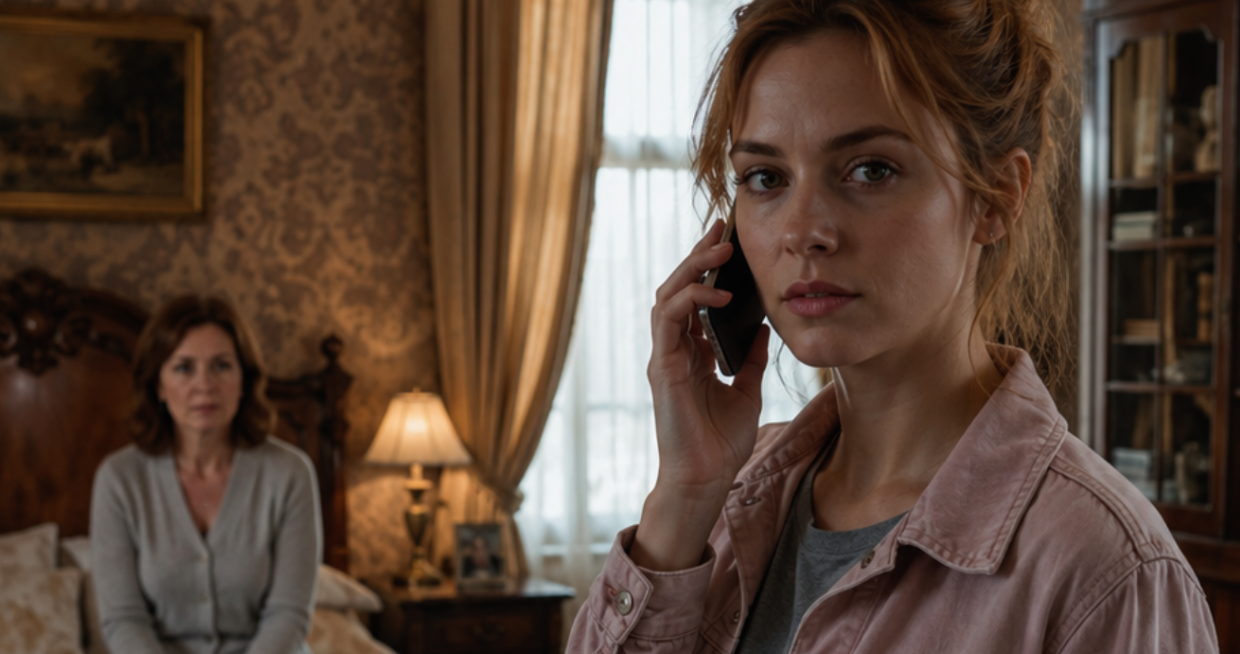
Instead of making a scene, I called the police and reported a break-in. Let my husband explain to his relatives why they’re in handcuffs.
“This isn’t your apartment anymore, Yana. We’ll stay here for a while, so don’t make a circus out of it,” Angela hissed, sitting on my bed in my robe and flicking ash into a saucer from my wedding china set.
I stopped in the bedroom doorway and did not even take off my wet raincoat right away. October in Saint Petersburg had been pouring rain into my face all day. The taxi had barely crawled from the station, my suitcase had dragged heavily at my arm, and at home, instead of silence and a hot shower, I was greeted by someone else’s feet on my bedspread. Tolik, sprawled in the armchair by the window, was drinking something amber-colored from my glass. Dark dirty footprints stained the parquet. Cigarette smoke drifted from the bathroom, even though I had asked Kirill ten times not to smoke even in the kitchen, let alone in the bathroom. In the hallway, Angela’s patent-leather bag lay on the bench, and beside it were her boots, my house slippers, and a stranger’s men’s backpack, unzipped like a mouth after a bad fight.
I did not scream. Not because I had nothing to say. Quite the opposite. It is just that at some point, when you see that your life is no longer being politely asked to make room, but is simply being shoved aside with someone’s elbow, everything inside becomes too quiet for a scandal.
“Where is Kirill?” was all I managed to breathe out.
Angela smirked and crossed one leg over the other, as if this were not my home, but some cheap rental apartment where she had come “for a week.”
“He went to the store. For water. We’ll crash here for a bit. Don’t make that face like you don’t like it.”
Tolik snorted without looking up from his glass.
“Seriously. We’re family.”
And in that very second, I finally understood that a scandal would only play into their hands. Angela was exactly the kind of woman who bloomed when people shouted around her. Later she would tell everyone that “Kirill’s wife is crazy,” that “we only asked to stay for a couple of days,” that “she almost attacked us.” Tolik would add a couple of filthy details. Kirill would hesitate again and start dragging out his favorite line: “Why do you have to react like that right away? We could have talked calmly.” And in that thick family mess, I would be the hysterical one.
I slowly put my suitcase against the wall.
“I see,” I said.
Angela even seemed disappointed.
“And that’s it?”
“For now, that’s it.”
I walked out of the bedroom, closed the door from the outside, and turned the key. Then, just as calmly, I locked the guest room, where their jackets and bags were lying. Tolik did not jump up immediately. Only when the lock clicked.
“Hey!” he barked. “What the hell are you doing?”
I was already walking toward the front door. As I moved, I took out my phone, opened my call list, and dialed 112.
“Illegal entry into an apartment,” I said evenly when the operator answered. “Saint Petersburg, such-and-such street, such-and-such building. Strangers are inside the premises without my consent. Property has been damaged. There is suspicion of attempted theft.”
Behind the bedroom door, silence hung for a moment. Then Angela’s screech rang out:
“Have you completely lost your mind?!”
From the stairwell came the smell of dampness, wet metal, and someone’s dinner with fried onions. In my Stalin-era building, there had always been heavy staircases, high ceilings, thick doors, and that special old-house echo in which another person’s scream sounds especially ugly. I leaned my back against the wall, and only then did I feel how badly my fingers were trembling.
It was not only the apartment that was under threat now. Not only my things, the parquet, the china set, my clothes, my documents. What was under threat was the last thing about this marriage that still looked decent from the outside: the illusion that Kirill was simply soft. That he was harmless. That he just found it difficult to say no.
No. Soft people do not bring an entire camp into your home while you are away on a business trip and give their sister the keys to your bedroom. Soft people are simply afraid of conflict. Kirill had long been using fear to cover up other people’s shamelessness.
The patrol arrived quickly. The October rain tapped against the stairwell window. A door slammed downstairs, and someone came heavily up the stairs. I looked at my phone and remembered how it had even come to this.
When Kirill and I got married, I thought his main flaw was his desire to be liked by everyone. He was one of those men who would always move a chair for someone in company, pour tea, help carry bags, and spend far too long justifying a person who had long since climbed onto his neck. After rude, self-confident men, that softness had even seemed rare at first. Back then, I worked a lot, already handled serious civil cases, and was used to keeping my face steady, not falling apart under pressure. Kirill felt almost like rest beside me. Domestic, smiling, someone who could hang lights beautifully and spend ages choosing a font for a logo, as if that were what peaceful life was made of.
The problem was not only him. The problem always entered our apartment in the form of his relatives.
Angela was eight years older than Kirill, but behaved as though she were the younger one — fragile and endlessly offended by fate. Something was always happening to her. Either her rental apartment “suddenly” became too expensive. Or work “temporarily wasn’t going well.” Or another man let her down. Or her health acted up precisely when it was time to pay back money. And for some reason, all of her eternal helplessness always landed on my husband’s shoulders.
“Well, she’s my sister,” Kirill would whisper when, for the third time in a year, I found Angela in our kitchen with the flattened-out look of a martyr and yet another story about her difficult life.
“She is a grown woman,” I reminded him.
“I understand. But if I don’t help her, who will?”
That question was a trap. If I answered, “I don’t know,” he would fall into suffering silence. If I said, “Let her solve it herself,” I automatically became heartless. And Angela had a talent for turning other people’s boundaries into scenes of cruelty.
Tolik appeared in her life in the spring. Rude, loud, smelling of cheap cologne and cigarettes, with the habit of putting his feet on furniture even when the hosts were watching. He talked about some “projects,” “startups,” “proper money moves,” but in reality he was either unemployed or “temporarily helping acquaintances.” On the very first evening, when Kirill brought them to our place “just for dinner,” Tolik wiped his hands on my linen towel and, after looking around at the ceilings, whistled approvingly.
“You’ve set yourselves up nicely. You could live here.”
Even then, I felt uneasy. Not scared yet. Just uneasy, the way you feel when a stranger evaluates your walls too freely.
Then the small oddities began. Angela started asking more often when I was leaving on business trips. Once, as if casually, Kirill asked whether I had a second set of keys, “just in case something happened.” I refused. He took offense.
“You don’t trust me?”
“I trust you,” I said. “But not everyone you want to please.”
He sulked then, went into the room, and spoke to me for two days in that quiet voice people use to punish without making a scandal. And, as usual, at some point I went to make peace myself. Because I was tired. Because work burned me out. Because at home I wanted at least silence, not another conversation about his ingratitude toward his family.
The first real blow happened a week before that trip to Moscow.
I came home earlier than usual, opened the closet in the hallway, and saw that one of my bags was not where it belonged. An expensive one, a gift I had bought for myself after winning a difficult case. Dark cherry-colored, one I almost never wore. Inside, it smelled of Angela’s sweet perfume. I held the bag in my hands and understood: this was no longer carelessness. Not “oh, I accidentally took a bag.” This was trying on someone else’s life. Testing boundaries for taste.
“Kirill,” I called then.
He came out of the room with his laptop.
“What?”
“Did Angela touch my things?”
The pause was short, but it was enough for me.
“She just looked at it. Are you really upset over that?”
“Upset?” I repeated.
“Yana, don’t start. She didn’t steal it.”
After that, for the first time, I did not think about a quarrel. I thought about a legal proceeding. About the fact that one day I would have to do with my own marriage what I did every day in court: remove illusions and leave only facts.
And then something happened that I was not prepared for.
Returning from Moscow a day early, I saw not just Angela in my bedroom. I saw how quickly people stop pretending when they are sure you will not appear for another twenty-four hours. Cigarette butts lay in the ashtray in the kitchen. Her tights were drying on the radiator in the bathroom. My work tablet lay face down on the table. And the most disgusting thing was the feeling of someone else’s confidence hanging in the air. They were no longer asking to stay with us. They were already living there.
When the police arrived, Angela started screaming first.
“This lunatic locked us in!” she yelled as Lieutenant Sokolov and the second officer came up to the floor. “We’re relatives! We had an agreement!”
I stood by the wall, my wet raincoat already chilling my shoulders, and spoke calmly. Not because I was above the scandal. It is just that in my profession, tone sometimes matters more than facts. And I already had enough facts.
“The apartment is registered in my name. In the owner’s absence, unauthorized people were moved into it without the owner’s consent. There are signs of property damage. There was access to a private room. I insist that everything be recorded.”
Lieutenant Sokolov was young, with the tired face of a man who had seen too much domestic nonsense during one shift. At first, he looked at me with cautious politeness. Then he shifted his gaze to Tolik, who had started throwing his weight around about this being a “family matter,” to Angela in my robe, to the ashtray, to the dirty parquet, and somehow immediately became more focused.
“Do you have the apartment documents?”
“On my phone and in a folder in the study. The study is locked.”
“Key?”
“I have it.”
Kirill appeared at the worst possible moment. Apparently, he had seen the police car pull up and rushed upstairs. He flew onto the landing with a bag of water, wet, confused, wearing the same expression that used to make me pity him. Now it only made me tired.
“Yana, what are you doing?” he breathed out. “This is Angela!”
“I can see that.”
“We could have just talked.”
“With whom?” I asked calmly. “With people who are making themselves at home in my bedroom?”
Angela immediately jumped in.
“There! I told you she’s crazy! We’re only here for a couple of weeks while we launch the startup!”
The lieutenant raised his eyebrows.
“You’re launching a startup from someone else’s apartment?”
Tolik stepped forward.
“Listen, boss, no need for that. We’re here through family.”
“Step back,” Sokolov said dryly.
And that was when Kirill truly got frightened for the first time. Not for me. For himself. For the fact that his usual scheme — “but they’re family” — had not worked on a man in uniform who did not care who was whose sister.
“Yana, withdraw the report,” he whispered in a completely different voice. “Let’s not take this that far.”
I looked at him and saw our entire marriage very clearly: how I had always been the one who did not take things that far. I had not taken things that far with Angela. Not with the keys. Not when he allowed people to get into my belongings. Not when he retreated from my “no” not because he understood, but because he hoped to push harder later. I had always stopped somewhere short, so that at home there would still be something that resembled peace.
“No,” I said.
Angela and Tolik were led into the hallway. Angela immediately switched to a new performance.
“He is my brother!” she shrieked. “I have the right! We’re not supposed to be on the street!”
“You have the right to rent a hotel,” Sokolov said through his teeth. “Or not break into someone else’s home.”
While they argued, Valentin Petrovich came out of the neighboring apartment. Our retired officer from the third floor, dry, straight-backed, in a knitted vest, with the face of a man who sees everything and forgets nothing. He looked over the landing, paused his gaze on me, and said quietly:
“Yanochka, one minute.”
Then he disappeared into his apartment and returned with a small flash drive.
“There are recordings from the hallway camera on it. I installed it after that incident with the couriers. I think it may be useful to you.”
“What recordings?” Sokolov immediately became alert.
Valentin Petrovich nodded toward Angela.
“The day before yesterday, this lady and her gentleman carried bags to the elevator three times. Then they brought them back. I even wondered why they were moving so nervously. And yesterday she walked through here wearing your fur coat. I didn’t interfere. I thought, who knows, maybe it’s family business. But now I see I was right to save it.”
Angela turned pale. Tolik swore under his breath.
“Now that is more interesting,” Sokolov said quietly.
The flash drive was checked in my study. The recording showed Angela leaving the apartment with my dark bag, then with a package, then returning while looking around. Tolik was dragging a box with small electronics toward the elevator. All of that was enough for their “family stay” to turn into a very different conversation.
Kirill stood by the wall, white as plaster under the ceiling.
“I didn’t know,” he breathed out.
I did not even turn around.
“Of course.”
I felt the point of almost-defeat when I saw the handcuffs click shut on Angela. Not because I felt sorry for her. Simply because in that moment everything stopped being domestic filth and became a reality that could no longer be played back. A night at the station. Explanations. A report. Kirill between his mother, his sister, and me. And for one second, a very feminine, very tired thought flashed inside me: maybe I really had gone too far. Maybe I should have just thrown them out quietly. Changed the locks and forgotten it. Family, after all. A husband. Relatives.
That thought lasted a few seconds. Exactly until Sokolov showed me, in a bag among their belongings, my cosmetic pouch and my jewelry case.
“Is this also part of ‘crashing for a while’?” he asked dryly.
And everything fell into place.
The turning point turned out to be almost ordinary.
While the patrol was filling out the paperwork, I called a lock replacement service. Then I called a cargo taxi. Then I opened Kirill’s closet and took out a suitcase. Into it, quickly and almost without looking, went his sweaters, jeans, chargers, a box with a tablet, his eternally lost socks, two notebooks with logos, and a stack of T-shirts I had bought him myself because he always chose shapeless things. That was the strangest part: packing another person’s things calmly. Without throwing them. Without drama. Simply the way you close a case.
When Angela and Tolik were taken away, Kirill tried once more to play helpless. Quietly this time. Without “you don’t understand.” Just powerlessly.
“Yana, she’s my family.”
“And what am I?” I asked.
He fell silent. And in that silence, he answered more honestly than in all our conversations over the past years.
“I didn’t think they would do that.”
“You never think,” I said. “And I always clean up the mess.”
He looked at the suitcase by the door.
“Are you kicking me out?”
“No. I am evicting the person who gave strangers access to my apartment.”
Yes, perhaps this is the moment that will divide readers. Someone will say I went too far. That I turned family chaos into a criminal matter. That I could have been softer. Quieter. Talked it through. But I know too well how “talks” end when one side has lived for years with a sense of impunity. Softer for whom? For Angela, who tried on my things? For Tolik, who had already set his sights on the electronics? For my husband, who would once again have let everything slide? Or for me, who would have remained for another year in an apartment where I did not feel safe?
The cargo taxi arrived forty minutes later. By then, the locksmith had changed the locks, Sokolov had left with the detainees, and Kirill had managed several times to sit down on the edge of the sofa, stand up, walk around the room, and start again:
“Let’s at least discuss it tomorrow.”
“No.”
“You’re not leaving me any chance.”
“I left you too many for too long.”
He stood in the middle of the hallway with that suitcase and looked not angry, not offended, not even broken. Just stripped of his familiar environment. The very environment where someone had always made decisions for him and justified him at the same time.
When the door closed behind him, the apartment became unusually empty. Not triumphant. Not frightening. Just empty. The old house hummed through its radiators. The rain was still falling outside. On the hallway floor, wet marks from other people’s shoes still glistened. In the bathroom, it smelled of cigarettes and mint air freshener, which Angela had apparently used to cover the smell. The crumpled bedspread lay on the bed. In the kitchen stood the glass Tolik had not finished.
I gathered the dishes, opened the windows, turned on the extractor fan, and made myself coffee. It was already past midnight. The city beyond the glass shone with wet yellow lights. Somewhere in the distance, a tram rang so thinly that it was almost funny. I sat down at the kitchen table with the hot mug in my hands and, for the first time in a long while, heard my own apartment without other people’s voices.
Silence can be heavy too.
But this silence was mine.