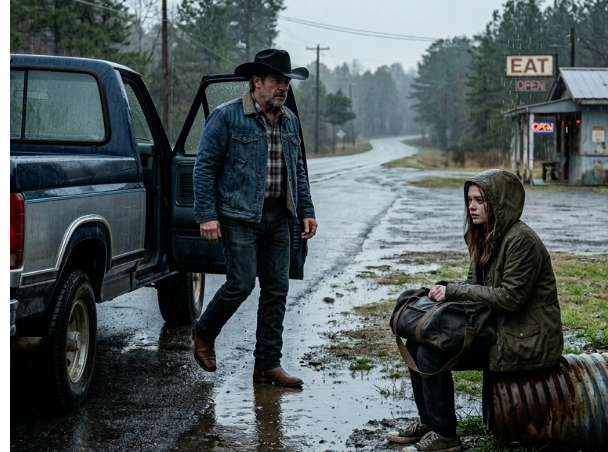
The sky over Montana did not merely cloud over; it collapsed. By late afternoon, the horizon had dissolved into a bruised purple, and the rain began—not as a gentle spring shower, but as a violent, sideways assault that turned the narrow county roads into rivers of slick, treacherous mud.
Wade Bennett gripped the steering wheel of his weathered truck, his knuckles white against the plastic. He was a man defined by the topography of his life: a single father, a widower, and a soul that had sought the silence of the timber-framed house his father had built decades ago. To Wade, the silence was a shield. It protected him from the echoes of his late wife’s laughter and the sharp edges of a world that had taken too much from him too soon.
He was focused on the road, eager to reach the warmth of his hearth before the storm peaked, when he saw her.
At the edge of a road that seemed to lead nowhere sat a rusted bench—a remnant of a bus route that had been defunct for three years. Shrouded in the gray veil of the downpour was a figure so still it looked like a statue carved from grief.
Wade’s instinct was to keep driving. In these mountains, a man learned early that survival often meant minding one’s own business. But as a jagged bolt of lightning fractured the sky, he saw the glint of brass and the familiar, rigid posture of a soldier. She was young, soaked to the bone, and staring into a middle distance that Wade recognized all too well—the gaze of someone who had seen the end of the world and was still trying to find their way back.
He pulled over. The truck’s engine rumbled, a low growl against the screaming wind. When he stepped out, the rain hit him like gravel. The woman didn’t flinch. She sat with a massive military backpack cradled in her lap, her hood pulled low.
“There ain’t no bus here, Ma’am,” Wade called out, his voice competing with the thunder. “Hasn’t been one for three years.”
She blinked, the truth of his words settling on her face not with panic, but with a weary, hollow defeat.
“I’m not a creep,” Wade added, softening his tone. “I’ve got a warm truck and coffee that’s probably burnt. But you’re coming with me.”
It wasn’t a request; it was an anchor thrown to a drowning person. She hesitated, her hands tightening around the backpack with a protective ferocity that hinted at a hidden weight. Finally, she stood. Her boots squelched in the mire, and as she climbed into the passenger seat, the smell of wet wool and exhaustion filled the cabin.
The Bennett household was a sanctuary of woodsmoke and mismatched flannel. When they arrived, Wade’s ten-year-old son, Jesse, was already home, his muddy sneakers discarded by the door like shed skins.
The woman, who introduced herself as Claire Monroe, was a study in trauma. She moved through the house with the hyper-vigilance of a scout in enemy territory. Wade offered her the guest room—his father’s old den—and watched as she set her backpack down on the bed with the kind of reverence one might accord a holy relic.
“You don’t have to talk,” Wade told her as he handed her a steaming mug of coffee. “In this house, silence is a respected guest.”
Claire looked at him, her green eyes shimmering for a fraction of a second with something that looked like relief. “You didn’t have to stop,” she whispered.
“I know,” Wade replied. “But I wanted to.”
That night, the house held three souls under its roof, each carrying a different kind of ghost. Wade lay awake, thinking of his wife, Aaron, and the brightness she had taken with her. He wondered what Claire was hiding in that heavy pack—and why she looked like she was waiting for a war that had already ended.
The next morning, the secret was revealed not with a bang, but with a soft, rhythmic hum. Wade walked past Claire’s room and saw the door slightly ajar. Inside, Claire was kneeling on the floor, her hands trembling as she reached into the oversized backpack.
From the depths of the canvas, she lifted a tiny, fragile girl—no more than four years old. The child wore a knit cap and had a thin medical tube taped to her chest, connected to a portable oxygen concentrator nestled in the pack. This was Sophie.
Wade stood frozen in the hallway. He realized then that Claire hadn’t been carrying gear; she had been carrying her entire world.
The Reality of Claire’s Journey:
The Condition: Sophie had cerebral palsy and required constant oxygen therapy.
The Struggle: Claire had been traveling through shelters and bus stations, often turned away because Sophie’s medical equipment was deemed a “liability.”
The Strength: Claire’s hyper-vigilance wasn’t just for herself; it was a mother’s shield against a world that viewed her daughter as a burden.
“She’s beautiful,” Wade said softly, stepping into the room.
Claire flinched, her instinct to hide her daughter kicking in. But Wade didn’t look at Sophie with pity or shock. He looked at her the way he looked at the sunrise—with a quiet, grounded appreciation for life in all its forms.
“She doesn’t look broken,” Wade said, crouching beside them.
“She’s not,” Claire snapped, her voice thick with years of defensive fire. “She’s just… fragile. But she’s strong. Stronger than me.”
The integration of Claire and Sophie into the Bennett home was facilitated by the simplest of ambassadors: a ten-year-old boy. Jesse didn’t see a medical condition; he saw a “princess” in a magic hat.
Within days, the kitchen table became a workshop of hope. Jesse, fascinated by Claire’s ability to fold intricate shapes out of paper, begged her to teach him origami.
“In Japan,” Claire explained, her fingers creasing a square of graph paper, “they say if you fold a thousand cranes, your wish comes true.”
“What’s your wish?” Jesse asked.
Claire looked at Sophie, who was sitting in the sunlight, watching the paper birds with wide, glistening eyes. “I stopped making wishes a long time ago, Jesse.”
“Then I’ll make them for you,” the boy declared.
Soon, the house was draped in strings of colorful cranes. They hung from the mantle, the banisters, and above Sophie’s bed. Each bird represented a silent prayer for stability—a currency that Claire had lacked since her husband, Ben, had been killed in an ambush during their deployment in Syria.
Peace, however, is often a fragile thing in the face of bureaucracy. A week into Claire’s stay, a sharp, official knock echoed through the house.
A man named Grant Lewis stood on the porch, a clipboard in hand and the cold, detached aura of a government official. Someone in town—perhaps a well-meaning neighbor or a suspicious passerby—had reported a “disabled child in an unregulated facility.”
Claire’s transformation was instantaneous. The soft woman who folded paper birds vanished, replaced by the battle-hardened medic who had survived shrapnel and grief.
“You have no right to see her without a warrant,” Claire said, her voice a low, dangerous growl. “She is safe. She is loved. And you are trespassing.”
Though she drove the man away, the encounter left her shattered. She began to pack her things, the old “fight or flight” response screaming in her veins. She couldn’t let Wade lose his home or his reputation because of her.
“I’m a burden, Wade,” she sobbed as he found her in the mudroom. “I’m a transient. They’ll take her from me if they think I’m unstable.”
Wade took her hands in his. “You’re not a transient, Claire. You live here. If they want to take her, they have to go through me. And I’m a very stubborn man.”
Just as the dust from the caseworker’s visit began to settle, another miracle—or perhaps a ghost—arrived.
It was a Sunday morning, and the house smelled of cinnamon muffins. A man in an Army green jacket, his face etched with the scars of a long and difficult journey, appeared on the porch.
“Luke?” Claire whispered, her knees buckling.
It was Luke Monroe, Claire’s half-brother. For six years, she had believed he was dead—Missing in Action during a classified mission. But Luke had survived a traumatic brain injury and a year in a foreign medical facility, eventually regaining enough of his memory to track Claire through VA records.
The reunion was not a cinematic explosion of joy; it was a quiet, tear-streaked recognition of survival. Luke brought with him the final piece of Claire’s identity. He didn’t just bring back her brother; he brought back her history.
The Impact of Luke’s Return:
Validation: Claire was no longer an isolated survivor; she had a witness to her life.
Support: Luke’s presence provided an extra layer of protection against the authorities.
Healing: Seeing her brother bond with Sophie, his niece, allowed Claire to finally mourn her husband, Ben, with a sense of peace rather than pure agony.
By late spring, the Montana landscape had finally yielded to the warmth. The fields were dotted with wildflowers, and the “Sophie Day” party—a celebration Jesse had organized to make up for her missed birthday—was in full swing.
Wade sat on a crate, strumming a guitar. He wasn’t a good player, but the music was honest. Claire watched him, realizing that the house was no longer just a shelter. It was an address for her heart.
That night, she sat at the kitchen table and wrote a letter. It was a letter she had intended to be a “goodbye,” a way to explain her departure if the fear ever became too much. But as she looked at the paper cranes swaying in the hallway and heard the rhythmic breathing of her daughter and her found family, she realized she didn’t need a goodbye.
She tore the letter into pieces.
“I’ve always been waiting for the next storm,” she told Wade later that night on the porch. “Every good thing in my life ended too soon.”
“Me too,” Wade said, reaching for her hand. “But maybe we can stop preparing for the worst and start preparing for the best.”
Claire leaned her head on his shoulder. The storm that had brought her to the bus stop had been a violent, terrifying thing. But it had also been the wind that blew her home. Sometimes, the simplest choice—to pull over, to offer a ride, to say “You’re coming with me”—is the only thing standing between a tragedy and a miracle. In the heart of Montana, Wade Bennett and Claire Monroe stopped being survivors and started being a family.