Zariah West, at forty-two, carried the history of twenty years in the United States Air Force within the very marrow of her bones. While the public imagination often sanitizes military service into a montage of fluttering flags and crisp salutes, the reality for Zariah was far more visceral and unforgiving. Her service was written in the language of chronic pain—a persistent, gnawing ache in her lower back that, in cold weather, mimicked the sensation of pulverized glass grinding between her vertebrae.
The source of this agony was a crash outside Kandahar, an event she rarely discussed. She didn’t speak of the acrid scent of jet fuel and scorched titanium, nor the way the Afghan sand seemed to permeate her very soul. Most importantly, she never mentioned the Silver Star.
The medal, the nation’s third-highest award for valor in combat, resided in a modest velvet box in her dresser. It was a paperweight for memories she preferred not to leave scattered. She lived a life of “quiet competence,” a civilian existence where she sought not the spotlight, but the simple, painless navigation of the physical world. The journey began with a telephone call from a nurse in Florida. Mr. Harlan, the grandfather of Zariah’s ex-husband, Malcolm, was nearing the end of his life. Despite the divorce, a bond of genuine affection remained between the old man and the veteran. Mr. Harlan had always recognized the steel in Zariah’s character, treating her with a warmth that the rest of the Westbrook family often struggled to emulate.
When a man who once carved you extra turkey and validated your life’s work asks for your presence on his deathbed, you do not consult a calendar; you book a flight. Zariah, mindful of her doctor’s strict warnings regarding spinal compression, purchased a first-class ticket. It was not a gesture of vanity or a desire for luxury. For Zariah, seat 2A was a medical necessity—a sanctuary of legroom and lumbar support that would allow her to arrive in Florida capable of standing by Mr. Harlan’s side. The tranquility of her journey was shattered at the boarding gate by the appearance of Amelia Westbrook. Amelia, Malcolm’s sister-in-law, was a woman whose personality was defined by “little cuts.” She was the type of person who viewed every social interaction as a ladder to be climbed or a rival to be humbled. Now a lead flight attendant, Amelia stood at the aircraft door, her uniform as sharp and cold as her disposition.
When Amelia saw Zariah’s boarding pass for 2A, a flicker of something dark—perhaps envy, perhaps a long-simmering resentment—crossed her face. She immediately manufactured a “operational adjustment,” claiming a higher-tier loyalty passenger required the seat. This was a transparent fabrication. In the aviation industry, confirmed first-class seats are rarely reassigned for standby passengers without significant compensation.
Amelia’s true intent revealed itself when she informed Zariah that she would be moved to 31B—a middle seat in the very last row of the aircraft. “I guess a soldier should be fine with a middle row seat, right?” Amelia added, her voice dripping with a saccharine malice. It was a calculated attempt to remind Zariah of her “place” through the lens of Amelia’s own petty hierarchies.
Zariah, trained in the discipline of the Air Force and weary of the performative outrage that defines modern discourse, chose the path of silence. She understood that some people bait you into an emotional explosion so they can later label you as “difficult” or “unstable.” She accepted the boarding pass for 31B and began the long, painful walk to the back of the plane. The transition from the spaciousness of first class to the claustrophobic confines of row 31 was more than a change in geography; it was a physical assault on Zariah’s health. Wedged between a teenager with blaring headphones and a businessman whose elbows seemed designed for territorial expansion, Zariah felt her spine begin to protest. Each breath was a negotiation with the pain.
She sat in the cramped seat, a Silver Star recipient hidden in the shadows of the economy cabin, while the woman who had orchestrated this humiliation preened at the front of the aircraft. It was a stark tableau of how easily merit and sacrifice can be discarded when they collide with the ego of those who hold a modicum of temporary authority. The cabin rhythm—the clicking of seatbelts and the stowing of luggage—was suddenly interrupted by a shift in the atmosphere. The cockpit door opened, and the Captain emerged, looking uncharacteristically pale. Following him was a figure who seemed to belong to a different world entirely: General Daryl Flynn.
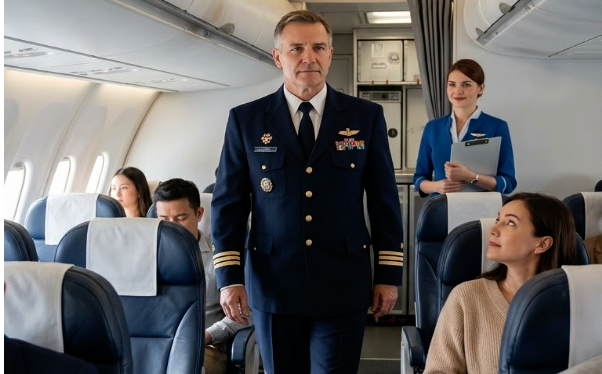
In his full service dress uniform, with four silver stars gleaming on each shoulder, General Flynn was the embodiment of the authority that Zariah had once served under. The cabin fell into a hush that only a four-star general can command. He didn’t wave or seek attention; he moved with a singular, lethal purpose toward the back of the aircraft.
He stopped at row 31.
“Ma’am,” he said, his voice a low, controlled resonance that commanded the attention of every passenger within earshot. He identified himself and then turned to address the entire cabin. He did not speak of seat assignments; he spoke of the Silver Star. He explained that the woman sitting in the cramped middle seat had risked her life for the country and that such valor was not decorative—it was foundational.
In a move that redefined the concept of “rank has its privileges,” the General turned his gaze toward the Captain. He didn’t ask; he ordered. “Vacate seat 1C,” he commanded, referring to his own seat. “I’ll take hers.”
The silence that followed was thick with the weight of a public moral reckoning. As Zariah stood to follow the General back to the front of the plane, the passengers who had previously ignored her now watched with a mixture of awe and shame. They were witnessing a rare occurrence in the modern world: the swift, surgical application of justice. As they passed the galley, Zariah saw Amelia. The flight attendant’s face had drained of color, her clipboard trembling in her hand. She looked like a thief caught in the middle of a heist by a high court judge. General Flynn did not stop to lecture her. He didn’t need to. As he passed, he delivered a single, quiet sentence that effectively dismantled her career and her ego: “We don’t let heroes fly in the back.”
The General took Zariah’s place in row 31, a symbolic act of humility that underscored his words. Zariah, now seated in the leather-bound comfort of 1C, felt the support under her back—a physical mercy that had been returned to her by the only man on the plane who outranked the pettiness of the situation. By the time the flight landed in Florida, the incident had already transcended the cabin. In the age of digital immediacy, a passenger had filmed the encounter, and the video was racing across social media platforms. Zariah’s name, her service record, and her Silver Star were now public property.
However, Zariah’s focus remained on Mr. Harlan. When she reached the reunion house, she found the old man in his final hours. He had seen the video on a nurse’s phone. “You always did have a way of making fools regret their choices,” he whispered, a final, raspy chuckle escaping him.
Their final conversation was not about the flight or the General. It was about the continuity of family and the importance of not allowing the world to “shrink” you. Mr. Harlan’s death shortly thereafter was a quiet conclusion to a life lived with integrity, leaving Zariah with a final lesson: dignity is the part of you that stays standing even when someone tries to move you. The aftermath of the flight was a masterclass in systemic correction. The airline, facing a PR nightmare of monumental proportions, was forced to move beyond the usual scripted apologies. Zariah, encouraged by her friend Renee, a former military officer turned HR director, refused to let the incident be buried.
She participated in a call with the airline’s CEO, Dana Hill. It was here that the story shifted from an individual act of bravery to a broader policy change. Zariah insisted that the issue wasn’t just about her status as a veteran, but about the fundamental right of a passenger to the seat they had purchased, especially when medical needs were involved.
This led to the implementation of the “West Rule”—a series of internal policies that mandated documentation for any seat reassignment and forbade the use of loyalty tiers as a weapon for personal bias. General Flynn, true to his character, provided a statement supporting these changes, ensuring that the momentum for reform didn’t dissipate. Amelia Westbrook’s fall was as public as Zariah’s rise. She was terminated from her position, her career in aviation effectively over. However, the story offers a rare glimpse into the possibility of genuine penance. Months later, Zariah learned that Amelia had begun volunteering at a veterans’ nonprofit, performing the “invisible” work she had once mocked.
When Zariah eventually encountered Amelia at an airport—Amelia now working a humble ground operations job—no words were needed. A simple, respectful nod from the former flight attendant signaled that she had finally begun the difficult work of “earning back her humanity.” The legacy of Zariah West is not found in the viral video or the policy memos that bear her name. It is found in her return to a life of quiet service and personal boundary-setting. She continued to teach self-defense to women, not just to teach them how to fight, but how to “take up space.”
Zariah’s story serves as a bookish, detailed reminder that justice often requires a witness with the courage to speak. It reminds us that while power can be used to humiliate, it can also be used to restore. Most importantly, it teaches us that dignity is not a seat assignment. It is an internal state of grace—a commitment to holding the line, quietly and steadily, until the rest of the world catches up.
As Zariah herself noted in her journal, reflecting on the Silver Star and the seat in first class: “You don’t need to shout to change a room. Sometimes you just need to refuse to disappear.”