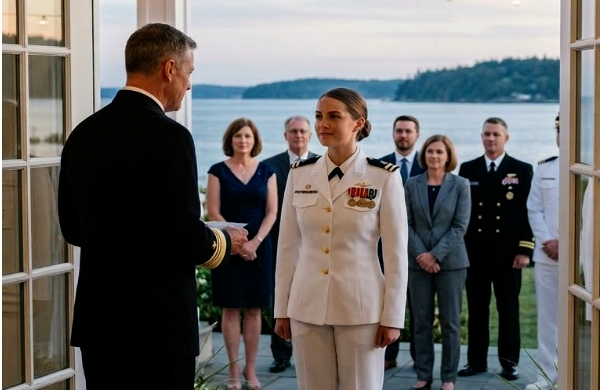
The home of Admiral Robert Thorne in Charleston was less a residence and more a hallowed cathedral dedicated to the preservation of a singular ego. Every mahogany surface was polished to a mirror sheen, reflecting the countless plaques, commendations, and ceremonial sabers that lined the walls. To my father, a man who viewed his four stars not as a rank but as a constellation of divine right, the world was divided into two categories: those who projected power and those who were merely the background noise of history.
On that humid South Carolina evening, the background noise was particularly loud. The air on the waterfront patio was thick with the scent of salt spray and expensive champagne. High-ranking officers and their perfectly coiffed spouses mingled with the practiced ease of the military elite, their laughter a rhythmic percussion against the lapping of the bay. At the center of this orbit stood my stepsister, Jessica, and my father, whose chest was puffed out with the kind of pride he usually reserved for fleet maneuvers. Jessica was the daughter my father had always wanted because she understood the theater of command. She knew how to recount a story about navigating a destroyer through a squall with just the right amount of dramatic pauses and humble-bragging. To hear her tell it, she had personally wrestled 10,000 tons of steel against the fury of Poseidon himself. My father drank it in, his eyes glowing. He didn’t just love Jessica; he loved the version of himself he saw reflected in her visible, loud heroism.
He tapped a crystal flute with a silver spoon, and the party fell into a respectful, conditioned silence. “To my daughter, Jessica,” he boomed, his voice a practiced instrument of authority. “The youngest Commander in the fleet. A true warfighter who sees the challenge and meets it head-on. She represents the very best of our traditions—merit, honor, and the unassailable integrity of the chain of command.”
As the crowd erupted in applause, I stood in the shadows of the French doors, feeling the weight of the file in my hand. I was wearing my own service dress whites, the uniform crisp, the three silver bars of a Commander pinned to my shoulders. But in this house, I had always been the “spook”—the intelligence officer who shuffled papers in windowless rooms. To my father, my career was “pencil-pushing stuff.” He couldn’t comprehend a world where power wasn’t announced with the thunder of a jet engine but was exercised in the absolute silence of a secure facility. The “reckoning” had actually begun two weeks prior, not with a confrontation, but with a signal. As an intelligence officer, my job is to find the anomaly in a sea of data. While on a brief leave, I had overheard my father on a secure line in his study. He wasn’t discussing strategy; he was discussing “favors.” He was slick, persuasive, and utterly unapologetic as he leaned on a subordinate, Captain Phillips, to “smooth the path” for Jessica’s promotion board.
It was a blatant confession of nepotism—a heresy against the very meritocracy he preached. But the deeper sting was his dismissal of my own recent Joint Service Commendation. He had called it “nice office work,” unaware that the “office work” in question involved a forty-eight-hour vigil in a Sensitive Compartmented Information Facility (SCIF), where I had identified a threat matrix against a carrier strike group and redirected a fleet with less than thirty minutes to spare.
To my father, Jessica’s “theatrical” command was the only reality. But the system he claimed to revere is built on rules, not feelings. And rules have a paper trail. I didn’t act out of a daughter’s spite; I acted out of an officer’s obligation. I logged into the military’s administrative portal and filed a formal, clinical inquiry into procedural irregularities. I wasn’t looking for a family fight; I was looking for the “smoking gun”—the structural weakness in his narrative.
I found it buried in an appendix of Jessica’s promotion packet: a waiver for a mandatory sea-duty qualification. It had been signed by Captain Phillips at my father’s request. This single sheet of paper turned Jessica from a prodigy into a product of a compromised system. When I stepped onto that patio, the silence didn’t just fall; it shattered. The first to notice were the junior officers, their eyes widening as they processed the rank on my shoulders—the same rank my father had just toasted as a “historic” achievement for Jessica.
My father’s glass slipped from his fingers, the crystal exploding on the flagstones like a gunshot. The rage that contorted his face was something I had seen directed at subordinates, but never at me. “Who in the hell,” he roared, his voice shaking with a fury that demanded total obedience, “approved this rank?!”
I stopped directly in front of him. I didn’t raise my voice; I didn’t have to. In the world of intelligence, the loudest person in the room is usually the one with the least information. “You did, sir,” I said, my tone as even as a briefing. “When you signed off on my last performance evaluation. My promotion came through three months ago. You just didn’t notice.”
I opened the file. The paper was cool and solid against my palm. “But that’s not why I’m here. This is a copy of Jessica’s promotion packet. Specifically, the waiver for her surface warfare qualification. Signed by Captain Phillips. At your request.”
The murmur that went through the crowd was the sound of a legend collapsing. These were professionals; they knew exactly what that signature meant. It was the “handshake” of corruption. I looked at Jessica, whose radiant smile had dissolved into a mask of horror. “An officer’s rank is earned, not gifted,” I said, my voice absolute. “This celebration is premature.” The fallout was not a single explosion, but a slow, systemic collapse. In the months that followed, the Inspector General’s office didn’t just look at Jessica’s promotion; they looked at the “node” that was Admiral Robert Thorne.
I was called for an interview with Lieutenant Colonel Hayes, a woman who measured truth with the cold tools of the JAG office. “We’re not interested in your feelings,” she had told me. “We’re interested in facts.”
I gave her the facts. I described the network of favors, the “quiet understandings” between men who believed they were the institution. I explained how my father viewed the rules as a decoration for others but a suggestion for himself. But as the investigation deepened, something even more disturbing emerged. My father wasn’t the architect of this system; he was a link in a chain.
The rot went higher. It reached back to his own mentor, a retired senior officer who had spent decades selling access and “accelerating” careers for the right people. This was a culture of shortcuts, where the “Old Boys’ Club” acted as a shadow promotion board. My father had been a loyal foot soldier in this network, trading his integrity for the “respect” of men he wanted to impress.
The Final Choice
The climax of the drama didn’t happen on a waterfront patio, but in a sterile visitor center at Fort Meade. My father sat in a plastic chair, stripped of his uniform, wearing a suit that suddenly seemed too large for him. He looked like a man who had finally realized he wasn’t the tallest thing in the room.
“I signed waivers,” he admitted, his voice a low gravel. “Too many. I told myself it was harmless. That I was just speeding up what would happen anyway.” He looked at me, and for the first time in my life, I saw shame. “Then you walked onto my patio with a file. And I realized I’d been calling it leadership when it was just… bending.”
The ultimate test came when his mentor—the “legend” who had started him on this path—tried to pull him back into the fold. The task force, led by a civilian Director named Sloan, used my father as a “sting.” They watched as the mentor offered my father an “envelope”—a way back, a way to silence the inquiry and protect the “pipeline.”
“Robert,” the mentor had said, “you were always loyal. You just got embarrassed by the wrong person. Your daughter… She’s a problem. But problems can be moved.”
At that moment, my father had a choice between the image he had spent a lifetime building and the truth I had forced him to see. He pushed the envelope back. “No,” he said. “I’m done bending. If the system collapses because we stop lying, then let it collapse.” A year later, the museum house in Charleston was quiet. Meredith, my stepmother, had left when the “image” cracked. Jessica had been transferred to a different command, her promotion nullified, forced to rebuild her career from the ground up—this time, the right way.
My father stayed retired, but the silence between us had changed. It wasn’t the heavy, judgmental silence of my childhood; it was the quiet of a shared understanding. One evening, he gave me a small navy-blue box. Inside was a worn, silver coin. On one side was an old Naval crest; on the other, the words Hold Fast.
“My father gave this to me when I pinned on my first command,” he said. “He told me it meant integrity. I forgot. You didn’t.”
I didn’t give him a dramatic embrace. I didn’t offer a tearful forgiveness. I simply nodded and closed the box. I had earned my rank, and I had earned my peace. My worth was no longer a matter of his opinion; it was demonstrated in the quality of my analysis and the clarity of my leadership.
Real leadership is not found in the thunder of the toast or the brilliance of the four stars. It is found in the quiet decision to hold the line, even when the person on the other side is the one who gave you your name.