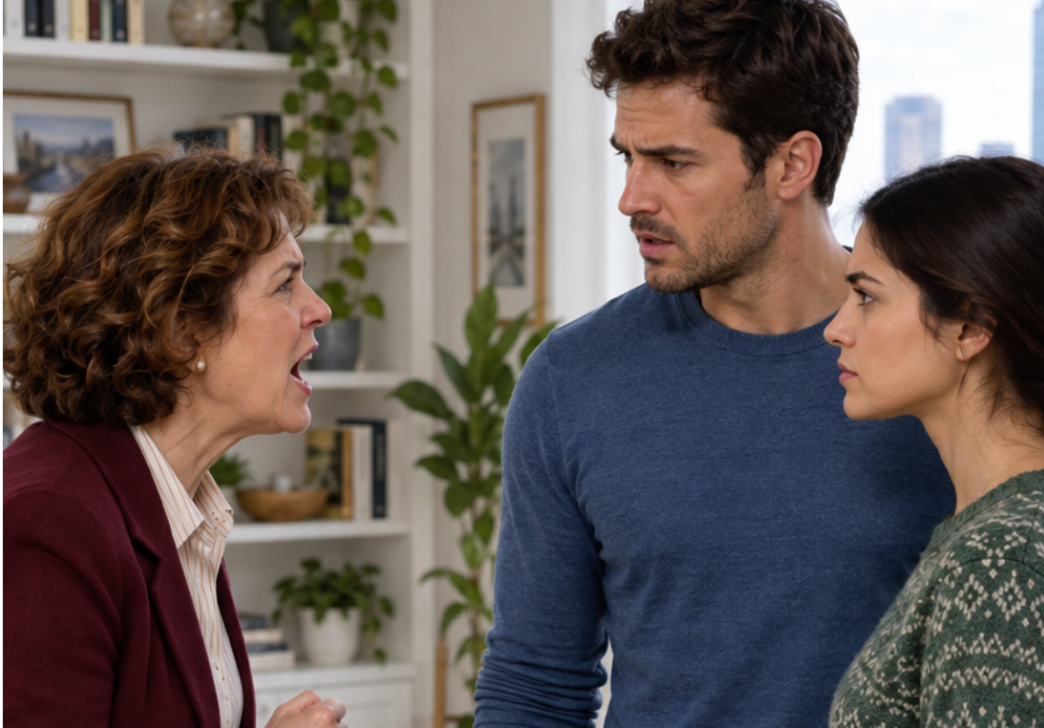
She came all the way from her dump and now she’s trying to better herself! Riding on someone else’s coattails, living in someone else’s flat! You think I don’t know what you’re planning?!
Tamara Petrovna’s voice burst through the closed kitchen door—loud, shrill, like a rusty door hinge. I was sitting in the room Denis and I shared, gazing out the window at the gray September rooftops. The linden trees in the yard stood quietly, not a single branch moving. Somewhere below, the gate slammed shut.
She was on the phone with her friend—the same Lyudochka she’d been inseparable from for nearly twenty years. I wasn’t trying to eavesdrop, but in these old Stalin-era buildings, for all the myths about their thick walls, the sound carries so well that you can make out every word.
“Can you imagine? She’s just sitting here, sorting through her archives, acting all smart. And she just landed here with everything ready for her!”
I turned the page in my book. Didn’t read a single word.
We had been living here for almost a year—since last October. Denis had convinced his mother to register me as a resident: without city registration, I couldn’t get a permanent position at the state archive where I worked. After two weeks of negotiations, pursed lips, and silent dinners, Tamara Petrovna finally agreed. She agreed—and ever since, she never let me forget it.
At dinner, in passing: “Well, it’s easy for you, you’re registered now…” When guests were over, with a smile: “Our little provincial has settled in nicely…” And sometimes it was just a look—a long, appraising stare, like at a flea market when you regret paying too much for something.
I endured it. Not because I had nowhere to go—I had my friend Olya, who would let me stay anytime. I put up with it because I loved Denis. Or at least, I thought I did. Now, honestly, I wasn’t so sure.
Denis was always late at work. His auto repair shop was on the other side of the city, the shifts were long, and he’d come home exhausted, smelling of engine oil and carrying a faint whiff of guilt—as if he could already sense that something was off at home. He was good at sensing things, but never knew what to do about them.
“Denis, are you listening to me?” Tamara Petrovna had clearly switched from her call with her friend to calling her son, because her tone changed: it became sweeter, almost tender. “Son, I’m telling you—this isn’t right. I’ll put up with it, of course, I always do, but this is just too much…”
I got up. Picked up my phone from the table, set it back down. Walked over to the window.
In the yard, the old poplar was reluctantly dropping its first leaves, one by one. September had been warm, but something in the air had already shifted, changed. It was that feeling when summer hasn’t left, but you know for certain it isn’t coming back.
“Put me on speaker, son, let her hear this!”
And that’s when something inside me just stopped.
My mother-in-law’s voice erupted at full strength—not muffled by walls anymore, but loud and deliberate, echoing down the hallway:
“That beggar only ensnared you for registration! Tomorrow, we’re filing in court and kicking her out—she’s going nowhere!”
I stood by the window, looking at the poplar tree.
A beggar. So that’s what I was: a beggar.
I grew up in a small district center, four hours from this city. Mom worked as a teacher, Dad—in local administration. We weren’t poor, but there was never anything extra. I got into university for history, found a job, then met Denis—completely by chance, at a mutual friend’s birthday. He was funny, a little awkward, and the way he looked at me made me want to smile. And I did.
I never asked for his apartment. In fact, I never asked for anything.
I could hear the muffled sounds coming from the kitchen—Tamara Petrovna was talking much quieter now, still complaining to Denis about something out of habit. Then the fridge door slammed. Then everything went quiet.
I walked into the hallway, took a large bag—the one I originally brought when I first arrived here—out of the closet. I started packing: documents, my laptop, a change of clothes, and the folder with papers I always kept separate and never showed to anyone.
Tamara Petrovna emerged from the kitchen holding a cup of tea, stopping to look at me.
“Where are you headed?” she asked.
“To a friend’s,” I replied calmly.
“Well, don’t let the door hit you on the way out,” she shrugged and pretended not to care. But I noticed her fingers gripping the teacup a little tighter.
I zipped up my bag, put on my jacket, and left.
Olya lived in a new neighborhood, in a small one-room apartment on the fifth floor with no elevator. She greeted me without any fuss—just opened the door, looked at my bag, and said, “The kettle’s already boiling.”
We sat in the kitchen, and I stared at her geraniums on the windowsill—three pots, all blooming, even though it was already September. I told my story briefly, without tears. Olya just listened, never interrupting.
“Are you going to do anything about it?” she finally asked.
“We’ll see,” I answered.
My phone stayed silent for almost an hour. Then a message from Denis came in: “Alyona, you shouldn’t have done that. Mom’s just upset, you know how she gets. Don’t pay attention to her, just come home.”
I read his message twice.
Don’t pay attention. His favorite phrase. He used it for everything—my hurt feelings, my tears, my attempts at a real conversation. Denis wasn’t a bad person. He just got used to ignoring things. Mom yells—ignore it. Wife leaves—ask her to come back. Everything will sort itself out.
But not everything sorts itself out.
I replied with a short message: “Denis, I need to be alone. Please don’t call tonight.”
I put my phone down and asked Olya to pour me some more tea.
The next morning, Tamara Petrovna called an acquaintance—some lawyer named Boris Semyonovich, who had once helped her arrange an inheritance after her father died. He was a meticulous, thorough man, the type who read documents slowly and aloud.
She arrived with a firm intention: to file a lawsuit, have her daughter-in-law removed from the register by court order, and put an end to this once and for all. She brought a folder with apartment documents, her ownership certificate, and an extract from the house register.
Boris Semyonovich put on his glasses and began reading.
Tamara Petrovna sat across from him, speaking confidently and in detail, explaining how this young woman arrived from the provinces, seduced her son, registered herself in the apartment and was now living there as if it were her own home. The lawyer nodded, flipping through the documents.
Then he fell silent.
“Tamara Petrovna,” he said carefully, “I need to clarify something. Are you aware of your son’s financial situation?”
She frowned.
“What situation? He earns a decent living at the auto shop…”
“I’m not talking about his salary.” Boris Semyonovich took off his glasses and looked at her over the papers. “Six months ago, Denis took out a loan secured by real estate. He used the house his grandfather left him as collateral. It’s a sizable amount.”
Tamara Petrovna’s mouth fell open.
“What house? What loan?”
“You didn’t know?” The lawyer paused for effect. “Interesting. And do you know who is currently servicing that debt?”
Tamara Petrovna looked at the lawyer as if he had just started speaking in a foreign language.
“What do you mean, who is servicing it? Denis, who else would it be…”
Boris Semyonovich sighed—softly, almost inaudibly, but she caught it. It was the kind of sigh people make when they have to explain something obvious to someone who refuses to hear it.
“No, Tamara Petrovna. Not Denis. For the last four months, the loan payments have been made by your daughter-in-law. Alyona Sergeevna Voronova. Every month, on time. From her own funds.”
The office was quiet. Outside, the street buzzed— a tram rattled past, a door slammed somewhere, a seagull shrieked overhead. Life went on, oblivious to what was happening in the small office with a heavy oak desk and the smell of old paper, where an older woman’s familiar look of confidence was slowly slipping from her face.
“That can’t be,” Tamara Petrovna finally said. “Where would she get the money? She’s an archivist, she gets paid next to nothing…”
“She had savings. From before the marriage.” The lawyer opened another folder. “And that’s not all I have to tell you.”
He gave her a moment. A professional habit—pausing before revealing something that would change the conversation.
“A month ago, Alyona Sergeevna bought the debt from the bank. Completely. She transferred the rights to herself. It’s a legal procedure, all aboveboard. She is now your son’s creditor. Not the bank—her.”
Tamara Petrovna didn’t understand at first. Then she did—and she wished she hadn’t.
“So…”
“So if you try to evict her through the court and she moves out,” Boris Semyonovich spoke in an even, detached tone, “she has the right to demand full repayment from Denis. Immediately. As a legal creditor.”
“And if he can’t pay?”
“He doesn’t have that kind of money. So enforcement would be taken against his assets. The only liquid asset in his name…” The lawyer glanced at the papers again, though he seemed to know them by heart, “is his share of your apartment.”
“What share?! He signed over the deed ages ago!”
“He did sign over the deed. But three months ago, Denis filed a lawsuit to have that transaction declared invalid. Under duress, lack of proper understanding at the time—he’s got a good lawyer, by the way. Not me.”
Tamara Petrovna sat up straight, but something in her posture had changed—as if someone had quietly pulled the support from inside her.
“Who found him a lawyer?” she asked quietly, though she already knew the answer.
Boris Semyonovich said nothing. The answer was obvious.
I didn’t find out about this conversation immediately.
I was sitting in the reading room of the archive, sorting through documents from 1948—yellowed, fragile, smelling faintly of something indefinably old. The kind of work many considered boring, but it calmed me. Everything here made sense: dates, signatures, official seals. No double meanings, no shrieking on speakerphone.
Denis texted me around noon: “Alyon, Mom wants to talk. Can you come by tonight?”
I didn’t reply right away. I slipped my phone into my pocket and spent another hour working on documents. Then I stepped outside into the September air, which smelled of damp leaves and that hint of rain you sense before it actually starts, even though it hadn’t begun yet but was obviously coming.
I called Olya.
“Well, what do you think?” she asked after listening to me.
“I think she went to see a lawyer.”
“And now what?”
“Nothing,” I said, and it was almost true. “Let’s see what she does next.”
Tamara Petrovna called herself. In the evening, around eight. I was at Olya’s, having soup and watching some TV series that I lost interest in after about ten minutes.
“Alyona,” she said, and her voice was… different. Not soft—she never spoke softly. But the steely superiority that had been in every word from her for the past year was gone. “I wanted to… Anyway, I’m planning to make pancakes on Sunday. Will you come?”
I paused for a moment.
“Tamara Petrovna, I have to work on Sunday. We have fund inventory.”
“Ah… Okay. Well, alright.”
Short beeps from the phone.
Olya looked at me over her plate.
“Pancakes,” I said.
“Seriously?”
“Yeah.”
We sat in silence. Outside, the rain finally started—quiet, autumn rain, with no rush.
“So what are you going to do?” Olya asked.
I thought. Really thought—not about Tamara Petrovna and her pancakes, not about the square meters or the lawsuits, which already didn’t matter. I thought about Denis.
That was the real problem.
Not the mother-in-law. She was just the scenery—loud and dramatic but still just a backdrop. Behind it all stood Denis, who had taken out a loan six months ago without telling me. Who put his grandfather’s house up as collateral—just like that, without thinking, because he urgently needed money for a new tool for the shop, and he made the decision on his own without consulting me. And when the payments started piling up, he didn’t come to me—he just stopped sleeping well and went to even greater lengths to avoid any serious conversation.
I found out by accident. There was a bank notification in the mail he hadn’t managed to delete. And I didn’t cause a scene. I just decided that it would be smarter to handle it a different way.
This wasn’t a sacrifice. It was calculated—cold and precise, like an archive inventory. I wasn’t protecting my own registration. I was protecting both of us from the fallout of his mistake. But he still had no idea about what I actually did. He thought the bank had simply rescheduled the payments.
And now, that was the thing that needed to be dealt with.
“I don’t know,” I answered Olya honestly. “I honestly don’t know yet.”
She nodded and poured me more tea. Outside, the rain was getting heavier, drumming steadily and persistently on the ledge. Somewhere in this city, Tamara Petrovna was sitting in the kitchen of her old Stalin-era apartment, probably staring out the window. And Denis was driving home from work, tired, smelling of oil, with no idea that just a few hours ago, the world around him had quietly and irreversibly changed.
And there I was at Olya’s, drinking tea and realizing that sometimes the hardest part isn’t winning. The hardest part is deciding what to do with your victory.
Denis showed up at Olya’s on Friday evening—no warning, just buzzed at the intercom and said, “Alyon, could you come out, please?”
I went downstairs.
He stood by the entrance in his work jacket, hands buried deep in his pockets, gazing somewhere off into the distance—toward the wet asphalt, the streetlamp, the parked cars. Anywhere but at me. The rain had already stopped, but the air was thick and damp, and the leaves scattered on the pavement were dark and soggy patches.
“You knew about the loan,” he said. Not a question—just stated it.
“Yes.”
He fell silent. He rubbed the back of his head—a gesture I knew all too well; he did it whenever words just wouldn’t come.
“Why didn’t you tell me?”
“And what would you have done, Denis?”
He didn’t answer. And that was an answer in itself.
We stood there, side by side, not saying a word. Somewhere behind the buildings a tram rumbled past—faint, barely audible. The streetlamp above us flickered, then calmed itself.
“Mom called,” he finally said. “Told me about the lawyer. About everything.”
“I know. She called me too.”
“About the pancakes?”
“About the pancakes.”
He suddenly almost smiled—a crooked, weary grin, but still a grin.
“She’s good at that. When things get rough, she invites us over for pancakes.”
I looked at him and couldn’t help but think he wasn’t angry or cruel—just weak. Weak the way people are when someone else has always made their decisions for them. First his mother, then life itself, then his mother again. It wasn’t that he didn’t want to take responsibility; it was simply that no one had ever taught him how.
“Denis,” I said calmly, “what I need from you isn’t silence or apologies.”
He looked up at me.
“I need you to make a decision—just once—on your own. Without your mom, without me, without anyone’s hints. Just you.”
He stared at me for a long time. Then he nodded, slowly, as if the motion cost him real effort.
“Give me some time,” he asked.
“You have time,” I said, and went back inside the building.
Sunday turned out grey, no sun, but dry. I went out for a walk alone—just because—wandering through the streets I’d grown to love over the past year. Past the old buildings with their plasterwork, past a park with damp benches, past a little bakery on the corner that always smelled so good in the mornings you never wanted to go anywhere else.
I didn’t choose this city for a residency permit. I chose it because it had an archive with collections no one had bothered to sort through for twenty years. Because there was work here I knew how to do well. Because, strangely, I felt I belonged—in these courtyards, in this air, surrounded by the heavy pre- and postwar architecture, which seems made to keep its secrets for ages.
Tamara Petrovna thought I came here for the square footage. Really, I came here for the life I wanted to build. The square meters were just a tool—temporary, utilitarian, like a desk or a library card.
My phone buzzed in my pocket.
An unfamiliar number.
I stopped by the iron fence of the park and answered.
“Alyona Sergeyevna?” The voice was dry, businesslike, and mature. “This is Boris Semyonovich. Attorney. We haven’t met, but I’m handling a case that concerns you. It’s important I speak with you. If you’re available, could we talk today, at whatever time works for you?”
I hesitated for a moment.
“Who asked you to call me?”
A brief pause.
“At Tamara Petrovna’s request.”
We met at a small café near his office—his suggestion, and I agreed. Boris Semyonovich turned out to be a short, neat man around sixty-five, with the habit of folding his hands on the table and looking at you just over the tops of his glasses.
He spoke directly and to the point—no introductions, no unnecessary words. I appreciated that.
According to him, Tamara Petrovna had come to see him again—not with a lawsuit this time, but with another question: was there a way to resolve the situation so that everyone would keep what they had?
“Does she want peace?” I asked directly.
“She wants certainty,” the lawyer corrected me. “That’s a bit different. Tamara Petrovna is someone who needs to understand what’s happening with her apartment, her son, and her life. In the past few days, that certainty has disappeared. For her, that’s unbearable.”
I looked out the window. A man walked down the street carrying a large umbrella, though it wasn’t raining.
“What exactly is she proposing?”
“She’s willing to sign a notarized agreement that she won’t initiate any litigation over your registration. In return, she wants assurance that you won’t use Denis’s debt as a form of leverage against the family.”
I sat in silence.
“Boris Semyonovich, I never intended to use that debt as leverage.”
He looked at me over his glasses.
“That’s what I thought,” he said quietly. “But she needs to hear it from you personally.”
I met with Tamara Petrovna in that same Stalin-era apartment—the one at the center of all this. I came Wednesday evening. Denis was home—sitting in his room, and I could hear him moving around but he didn’t come out.
Tamara Petrovna opened the door and stepped aside to let me in. Without a word. That was already something.
There was a kettle on the kitchen table, two cups, and a little vase with cookies. She had clearly prepared.
We sat across from each other. She was upright, well-dressed, her hair neatly styled—everything as usual. But her gaze was different. Not looking down at me as she used to, but just straight at me, wearily.
“I want to ask you something,” she said without any preamble. “Why did you do it? Why? You could have just… left. When you learned about the loan. You could have walked away and let him deal with it himself.”
I thought about how to answer. To be honest—that’s what I decided.
“Because he’s my husband,” I said. “For now, he’s still mine.”
She caught that “for now.” Squinted slightly, but said nothing.
“I didn’t come to this city for your apartment, Tamara Petrovna. I just needed a place to stay until I got on my feet. I was planning to rent my own place in a year, two at most. That was my plan even before the wedding.”
“Why didn’t you tell me that?”
“You never asked. You already knew everything about me.”
She looked away. Picked up her cup, then set it back down.
“I was unfair to you,” she finally said, and it seemed those words cost her more than anything else she’d said these past few days.
I didn’t say “everything’s fine”—because it wouldn’t be true. I didn’t say “I understand”—because pretending to accept rudeness isn’t part of my plan. I just nodded.
“What now?” she asked.
“Now—we’ll see,” I replied. “It doesn’t depend on you or me.”
Finally, Denis came out of the room. He stopped in the kitchen doorway, looking at both of us. His face showed the look of someone who’d been mustering their courage for a long time and finally did it.
“I made an appointment with a family therapist,” he said. “By myself, to start. They told me it’s… normal. That people do this.”
Tamara Petrovna opened her mouth and closed it again. Apparently, this took her by surprise.
Me too. But it was a good kind of surprise.
I looked at him—at this man who always seemed apologetic, and who had just done something on his own, without anyone’s suggestion—and I felt something inside me loosen, just a little.
Not everything. Far from it.
But something.
Outside, September was ending. The leaves on the poplar in the yard had almost all fallen—only a few stubborn yellow ones remained. Those are always the ones that last the longest.
I picked up my cup and took a sip of tea.
We’ll see, I thought. Let’s just see.
Three months passed
I rented an apartment—a small one, on the fourth floor of an old building, ten minutes’ walk from the archive. Two rooms, high ceilings, a window overlooking a quiet courtyard with a lone rowan tree. The landlady, an elderly woman named Nina Alexandrovna, was quiet and hard to offend. We got along just fine.
I moved out of the Stalin-era apartment in November. No fights, no tears—just packed my things, called a taxi, and left. Denis helped carry the boxes. We stood by the entrance, and he asked, “Is this the end?” I answered honestly, “I don’t know.”
He kept going to therapy. Once a week, every Wednesday. One day he told me he was saying out loud what he was afraid of for the first time in his life. I didn’t ask for details—it was his, private, and I respected that.
I didn’t ask for the money back. I quietly redid the terms through the same lawyer—no pressure, no drama. Just put the documents in order, the way an archivist organizes a collection: methodically, without too much emotion.
Tamara Petrovna didn’t call with pancakes anymore. But on Archivist’s Day, she sent a brief message: “Happy holiday.” No signature, as if the number itself had texted me. I replied, “Thank you.” We both pretended that was enough.
Maybe it is.
Work at the archive carried on as usual. In December, I was offered the position of senior custodian—unexpected, but earned, as the director said. I accepted.
Olya called that same evening, and we celebrated in a little cafe around the corner—just the two of us, quietly, with a glass of wine and pastries that turned out to be too sweet, but it didn’t spoil the night.
The city outside carried on with its ordinary life. December covered the rooftops in a smooth gray light, streetlights reflected in puddles, and somewhere far away, a tram hummed.
I was walking home, taking my time with my hands tucked in my pockets. I thought about how, just a year ago, I arrived here with only one suitcase and a lot of uncertainty. Now I have my own apartment, a job I love, and a sense of clarity—not loud or triumphant, but quiet and steady, like a neatly organized archive.
Currently in the spotlight