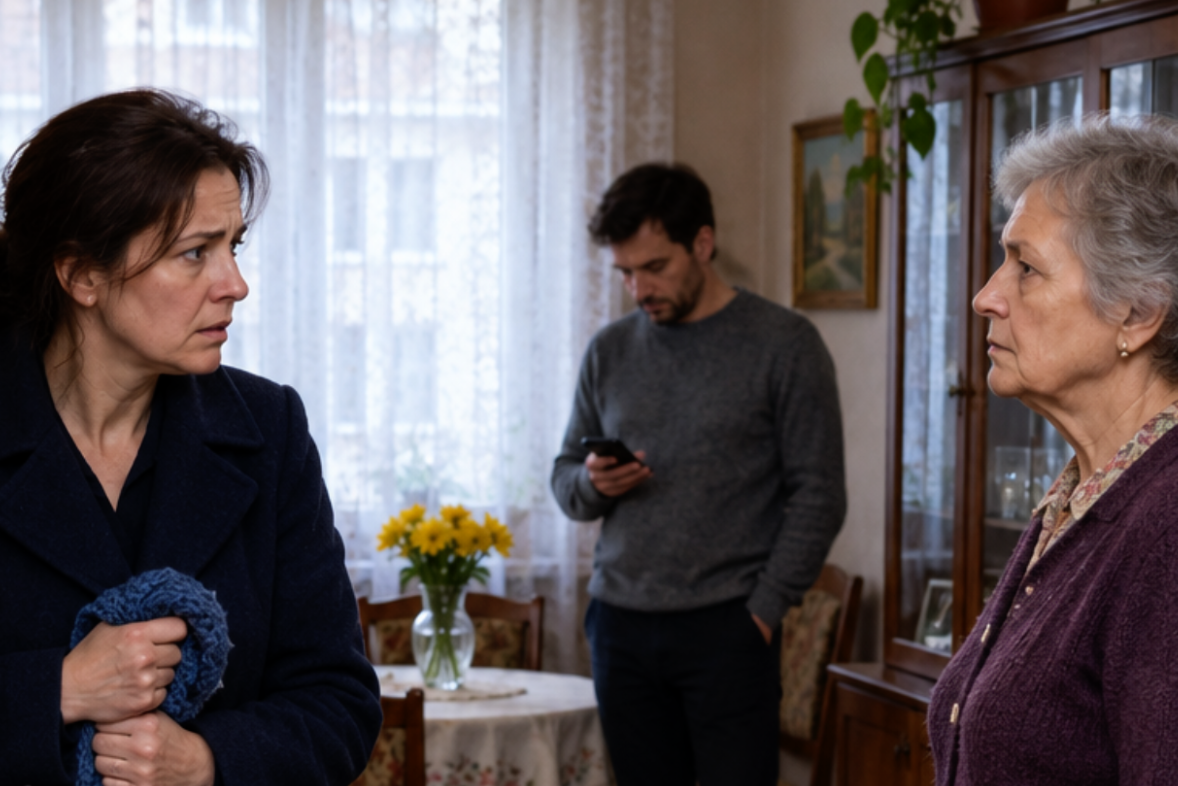
“Your things are already in the hallway,” said my mother-in-law. She still didn’t know who the woman she decided to evict was calling.
“Take your coat, and your bag too. And don’t look at me like that—you won’t be spending the night here tonight.”
Vera paused on the threshold of her own apartment, not even having time to take her key out of the lock. Two black bags sat on the doormat, one with the sleeve of her house sweater poking out, and nearby lay her mother’s shawl—the one Vera had never put away, even though her mother had been gone for three years. Her mother-in-law held her pillow, clutching it against her stomach as casually as if she were about to bring laundry to the wash. Behind her, near the kitchen, stood her husband, silently rubbing a crack on his phone case with his thumb. Vera looked first at the bags, then at him, and realized: he’d seen it all.
“Andrey,” she called. “What’s going on?”
“Just stay calm,” he said immediately, not looking up. “Mom started feeling unwell after your conversation. We just need a little time apart right now.”
Lyudmila Pavlovna tossed the pillow onto the bags and adjusted the collar of her knitted sweater. Her expression was that of someone who had already made an unpleasant but entirely necessary decision and was now just waiting for everyone else to stop getting in the way.
“Go stay with your aunt,” she said. “You spend every other day there anyway. We’ll live here for a while like civilized people, without your rules.”
Vera slowly removed her key, closed the door behind her, and set her work bag on the table. Then she pulled out her phone.
“Hello, Tamara? Can you come over right now? Yes, to my place. And please bring the folder… No, it’s nothing about my health.”
“Now you’re going to gather relatives too?” her mother-in-law smirked. “Go ahead. Maybe someone will finally explain to you that family matters more than your precious square meters.”
Vera didn’t reply. She bent down, picked up her mother’s shawl from the floor, and gently folded it into her arms.
Just three weeks ago, the loudest sound in this apartment was the old refrigerator, humming through the night as soon as the kitchen lights went out. Vera kept meaning to replace it, but there was always something more pressing: winter tires, dental treatments, a new tool for Andrey. The apartment had come to her from her mother, long before she got married—an ordinary three-room flat in a nine-story building, with a narrow hallway, a cool bedroom, and a large linden tree outside the window. In the kitchen, her mother’s round table remained, covered with a clear tablecloth; Vera had replaced nearly all the furniture but couldn’t bring herself to throw out that table. On Saturdays, a bowl with dough would sit on it, and clean cups would dry by the window.
She met Andrey in a workshop where she brought a wobbly chair. He spent a long time examining the old joint, explained why the wood had cracked, and offered to fix three more chairs from the same set so she wouldn’t struggle to match the color later. Vera liked how gently he treated things: he never threw them, jerked them, or hurried to brush aside someone’s question. After her mother’s death, she noticed such carefulness all the more acutely. A year later, Andrey moved in with her, and half a year after that, they got married.
At first, he worked a lot, coming home with sawdust stuck to his sweater and carrying groceries in a huge bag that always seemed to split near the elevator. Then the workshop closed down, and Andrei started taking on orders himself—at first steadily, then more and more rarely. He would say he didn’t want to do things half-heartedly, that people didn’t appreciate handmade work, and that a good craftsman needs time to find the right customer. Vera worked as a senior accountant at a small transport company and earned enough to cover their living expenses, so she didn’t pressure him. She believed her husband was just going through a tough time, and tough times in a family are something you face together.
They set aside the room with the balcony for his work: added a table, lamp, sample shelves, and even bought a small vacuum for the sawdust. But it never really became a true workshop—Andrei spent more time drawing, looking at pictures of furniture, and watching videos than actually working with his hands. Still, Vera learned to knock before entering and to speak more softly on the phone when he was thinking about an order. Sometimes, when leaving in the morning, she’d leave a note: “Soup’s in the fridge, the bread is fresh.” And in return, in the evenings, she’d hear: “Totally forgot to eat, got caught up in things.”
Andrei told Vera about his mother coming to stay on Wednesday, after she had already gone to bed.
“Mom’s having some trouble with her house,” he said from the darkness. “The wiring is old, they had to open up a wall in one room. She just needs to stay with us for a bit.”
Vera turned toward him, propped herself sleepily on her elbow, and asked how serious the issue was. Andrei didn’t answer immediately, then explained that an electrician had come by, quoted a huge price, and now they needed to find someone else. His mom could have stayed with a neighbor, but at her age, that wasn’t convenient, and Andrei’s brother, Slava, also needed to come to the city for a job interview. “Two weeks, three at the most,” her husband added, kissing Vera on the shoulder. She agreed, just asking to be told in advance what day she should expect them.
They arrived the very next morning.
Lyudmila Pavlovna came in first—strong, short, wearing a new maroon coat Vera hadn’t seen before. Slava followed with two suitcases, a travel bag, and a big cardboard box wrapped in tape. When Vera remarked that it seemed like a lot for a two-week stay, her mother-in-law replied that she wasn’t about to wear the same thing every day, and that men needed a stockpile of clothes, too. Slava, a thirty-four-year-old man with soft hands and a habit of smiling before anyone asked a question, immediately asked for the Wi-Fi password. Andrei stood nearby, carefully untangling the handles of a bag filled with homemade preserves.
In the first few days, Vera tried her best to be a good hostess. She cleared a shelf in the bathroom, bought her mother-in-law’s favorite cottage cheese, changed the bedding on the living room sofa, and gave Slava the fold-out chair from Andrey’s room. Lyudmila Pavlovna made thick soups, wiped down the stove after every use, and frequently remarked how everything was arranged much more conveniently at her own place. Vera half-listened—her work quarter was ending, drivers called constantly, some lost invoices, others needed documents urgently redone. By evening, all she wanted was dinner and about twenty minutes of quiet.
But the silence didn’t last long. The TV in the living room was on from seven in the morning, Slava talked on speakerphone, and Lyudmila Pavlovna liked to discuss household matters right when Vera came home from work. One day, she met her daughter-in-law at the door holding a wet rag and announced that she’d thrown out the old wooden spatula because it had ‘turned black and was embarrassing to show people.’ Vera asked which bin she could fish it out of, making her mother-in-law raise surprised eyebrows. The spatula had belonged to Vera’s mom; explaining that was somehow harder than just silently heading to the trash chute.
Another evening, Vera found a box of her books on the balcony. On the now-empty shelf in the bedroom stood her mother-in-law’s creams, brushes, and the little illuminated mirror Slava had brought in that same cardboard box. Lyudmila Pavlovna explained that it was too dark to put on makeup in the living room, and Vera left earlier than everyone anyway. She then added it might be a good idea to clear out the closet—surely a working woman had things she hadn’t worn in ages. Andrey, sitting on the bed, said, ‘Mom just wanted to make things more comfortable.’
‘For whom?’ Vera asked.
He winced.
‘Why do you always have to go there?’ he said.
On the tenth day, Lyudmila Pavlovna suggested swapping rooms. As it turned out, it was hard for her to sleep on the sofa, Slava stayed up late watching TV, and Vera and Andrey had a comfortable bed in the bedroom. Vera was peeling potatoes at that moment, thin skins dangling from her knife into the sink. She looked up at her husband and asked why they couldn’t move the fold-out chair to the living room so that his brother could sleep elsewhere. Andrey replied that his workspace was already cramped, and his mom really wasn’t sleeping well.
‘You have a room where you hardly do anything,’ Vera said quietly. ‘I’m not leaving my bedroom just so your brother can conveniently watch TV until two in the morning.’
Her mother-in-law set her cup down on the table with a bang.
‘You’ve got the most respectful way of talking about your husband. You can really hear the respect,’ she said.
Vera turned off the water, wiped her hands, and suggested they finally talk about when they’d be leaving. Lyudmila Pavlovna looked away towards the window, Slava suddenly remembered a call and stepped into the hallway, while Andrey asked his wife not to start a loud conversation—though no one had even raised their voice. That night, for the first time, Vera realized the three of them seemed to have an agreement she hadn’t been told about. She waited for her husband to come to the bedroom and asked the question again.
“The electrician still isn’t available,” Andrey replied as he took off his watch. “You understand, you can’t just flip a switch and move in over there.”
“Give me his number. We’ve got a good specialist at work—I could compare what they’re suggesting.”
“Mom can handle it herself.”
“I just want to help.”
“Vera, there’s no need to control everything.”
After that, Vera lay awake for a long time, listening to the voices behind the wall. Her mother-in-law was quietly telling something to her younger son, who laughed, and the clinking of teaspoons sounded from the kitchen. Andrey was sleeping peacefully beside her. In recent months, he had gotten used to falling asleep before she did, even though he woke much later, and suddenly Vera had a sharp and unpleasant realization: even her exhaustion had become a private inconvenience in this house, something she was expected to endure in silence. In the morning, she discovered the lunch she’d prepared for work had been eaten by Slava, who left the empty container in the sink.
The next day, Aunt Tamara called Vera over. She and her mom were sisters but completely different—her mom was always giving in, sighing, and then falling ill, while Tamara had a way of asking questions that could make someone embarrassed about their own answer. Tamara had managed a warehouse for many years, raised her son alone, and hadn’t thought of a firm voice as a flaw in a woman for some time. Right now, she was sorting through old family documents and asked Vera to pick up her folder: the apartment contract, her mom’s papers, and several receipts that Tamara had kept since the renovation. Vera said she’d come by on the weekend, and, almost without realizing it, started venting about her house guests.
Tamara listened and then asked,
“Are you sure there’s really a renovation going on at her house?”
Vera actually felt hurt.
“Aunt Tamara, why would anyone make up something like that?”
“I don’t know. That’s why I’m asking if you know for sure.”
The answer came on Saturday when Vera called her mother-in-law’s neighbor. Vera had known Nina Alexeyevna for years: they bumped into each other at family celebrations, exchanged seedling photos, and had even once gone together to pick out a new phone for Lyudmila Pavlovna. Vera had planned to ask about the electrician, but started off gently—asking about the weather and whether the house felt too cold without anyone living there. The neighbor sounded surprised: why would the house be empty? There were tenants living there now— a young couple with a child. Vera had to sit down on a stool.
“What tenants?”
“Lyuda rented the house out,” Nina Alexeyevna explained. “She arranged it last month. She said you were taking them in, that you’ve got plenty of space.”
From the kitchen came the smell of frying onions, her mother-in-law was humming along to the TV, Andrey was looking for something in the closet. Vera stared at the fridge door, at the magnet from a trip she and her husband had put off for two years because of money. Nina Alexeyevna kept talking—she said the tenants were nice, the man works at the station, and the wiring had already been checked back in spring, before they moved in. Vera thanked her and ended the call without properly saying goodbye. Then she got up and went to the living room.
“Did you rent out your house?”
Lyudmila Pavlovna froze with a towel in her hands. Andrey stopped rummaging in the closet but didn’t turn around.
“Yes, I rented it out,” her mother-in-law said after a short pause. “Why?”
“Because you said you came for two weeks because of repairs.”
“Well, some repairs are needed. There’s always something that needs fixing.”
Vera glanced at her husband.
“Did you know?”
He closed the cupboard door with extreme care.
“I was going to explain.”
It turned out the house had been rented out for six months. Lyudmila Pavlovna wanted to spend some time in the city, go to the doctors, help her younger son settle in, and, along the way, see how the older one was “eating and living here in general.” Andrey knew about this from the beginning, but was afraid Vera would refuse if he told her the whole timeframe upfront. They decided to come first, believing that everything would somehow work itself out later. As Vera listened, she noticed odd little things: her mother-in-law folding a towel perfectly into quarters, Andrey hiding his hands in his pockets, Slava going completely quiet behind his own door.
“So you made the decision for me, who I’d be living with for six months,” she said. “And you spent all that time telling me it was just for repairs.”
“You talk as if you’ve been robbed right now,” Lyudmila Pavlovna retorted. “I’m your husband’s mother, not a stranger off the street.”
“That’s exactly why I trusted you.”
For a moment, the room fell silent. Vera heard water rustling in the radiator, then Andrey exhaled, clearly exhausted, as if he had been enduring something unbearable throughout the conversation. He said nothing terrible had happened yet, there was enough food, the apartment was big, and his mother had always carried them through life alone, so she had every right to depend on her sons now. Vera asked why helping his mother had to mean lying to his wife. She got no answer.
That evening, she set a deadline: two weeks either to move back home or find another place to live. If the house couldn’t be freed yet, they could use the rental money to rent an apartment—Vera even offered to help with ads and moving things. Lyudmila Pavlovna burst into tears, Slava called the situation humiliating, Andrey stepped out to smoke, though at home with Vera he’d never smoked before—not even on the balcony. That night, he slept on the very edge of the bed. In the morning, he didn’t say goodbye.
The next few days were filled with heavy, suffocating silence. Vera would come back from work and hear conversations cut off as soon as she arrived, only to start up again when she went to the bathroom. Her mother-in-law cooked for three but stopped setting a plate for Vera, even though Vera was still buying all the groceries. Slava deliberately took his jacket off the shared rack, as if he was already being thrown out into the snow. Andrey answered everything in monosyllables, and Vera found herself lingering by the building entrance, fiddling with her keys in her pocket, not wanting to go back inside.
On Wednesday, Vera received a notification about a missed car payment. The car was registered to her; they’d taken out the loan back when Andrey worked at the workshop, agreeing that Vera would cover the apartment and groceries while her husband would pay the car loan from their joint reserve if his income fell short. She transferred money for that reserve into a separate account they both used for family expenses. Vera opened the app and saw that almost the entire sum had gone in two transfers. The recipient was Vyacheslav.
Andrey came back from the store half an hour later and immediately knew, just by looking at her face, what this talk would be about. He dropped the grocery bag by the door, still in his shoes, and admitted he had meant to tell her everything, but just couldn’t find the right time. Slava needed money to get into a small business—a friend was offering equipment for a coffee stand. In a month, he promised, the investment would return even more. Vera asked where the equipment was. Andrey glanced toward the living room.
“Nowhere yet. There’s a delay.”
“How much?”
He told her the amount. When Vera heard it, she suddenly remembered how just a month ago she’d skipped a check-up at a private clinic, deciding to build up their family savings first.
“You took our last savings and gave them to your brother. Without even asking?”
“I thought I’d return it before you even noticed.”
“What about the payment?”
“I figured we’d make it in time.”
This time Vera didn’t argue. She asked Slava to leave, set her phone on the table, and demanded an explanation for where the money went. At first, he spoke quickly, flashing his usual smile, but then fell silent and admitted there was no coffee stand yet, and some of the money paid off an old debt. Andrey sank down on a chair like his legs suddenly ached. Lyudmila Pavlovna, who’d been silently standing in the kitchen, spoke up right away: Slava shouldn’t be cornered now—he’s going through a tough time as it is.
“And what about me?” Vera asked.
No one replied. For the first time in days, her hands started to tremble, and she hid them under the table so her husband wouldn’t see. She felt ashamed at how badly she wanted to cry in front of these people—even though there were much better reasons to be ashamed. She stood up, left for the bedroom, and closed the door. A minute later Andrey knocked, but Vera asked him to give her some space.
The next day, she closed access to their reserve account, paid the car bill herself, and set up a meeting with a lawyer she knew. She wasn’t ready to think about divorce yet—the decision just wouldn’t fit in her mind—but she needed to get clear on their obligations and what Andrey might have promised without telling her. The lawyer calmly explained what documents to gather, and advised her not to make any big financial choices during a fight. Vera took careful notes, feeling strange: at work she’d spent years checking other people’s accounts, but at home she’d just taken it on faith instead of even asking questions. That evening, she told her husband not to use her car anymore and to leave the keys on the table.
“So now we’re counting every nail?” he asked.
“We’ll start with the money you gave to Slava.”
On Friday, Vera came home earlier than usual and overheard a conversation in the kitchen. Lyudmila Pavlovna was speaking in a low but steady voice: if Andrey gave in now, he’d lose his say in the family forever; his wife would realize she could kick out his relatives and use it against him for life. Andrey replied that Vera wasn’t kicking anyone out, just suggesting they rent somewhere else. His mother-in-law didn’t miss a beat: “With what money, when Slava needs help right now?” Vera stood in the hallway, an apple bag in hand, waiting to hear what her husband would say next.
“I just can’t force her,” he finally said.
That was what finished her off. Not “we tricked her,” not “this is her home,” not “mom, stop it.” He regretted only that he couldn’t force her.
Vera walked into the kitchen, set the bag down on the table, and said that they had to make a decision about the apartment by Sunday. Lyudmila Pavlovna turned pale, clutched her chest, and collapsed into a chair. Andrey rushed to get some water, Slava demanded that they stop immediately. Vera suggested calling an ambulance, but her mother-in-law abruptly refused: she needed peace, not a hospital. Then she asked her sons to take Vera out of the kitchen. Vera left on her own and spent the evening in the bedroom with her laptop open, not reading a single work email.
In the morning she needed to run to the office for a bit — to check documents before an inspection. Andrey asked when she’d be back, and Vera answered, “By four.” He nodded without looking at her, and Lyudmila Pavlovna, standing by the window, suddenly gave her a deep, searching look. Vera would remember that look later, when she returned home to see her things packed in bags.
—
Tamara arrived forty minutes later, in an old jacket, with a folder under her arm and hands red from the cold. She took off her boots, saw the bags, and immediately stopped unzipping her coat. Vera was standing by the kitchen window; the kettle had boiled twice already and cooled down, and she still hadn’t poured herself any tea. Lyudmila Pavlovna sat at the head of the table, Andrey next to her, Slava leaned against the doorframe. They all looked like they were bracing for a confrontation that had already drained them.
“Who packed the things?” Tamara asked.
“I did,” replied her mother-in-law. “Because sometimes a person needs to be shown what it feels like to be driven out of their own home.”
Tamara looked at Andrey.
“Did you help?”
He stayed silent.
“I didn’t think mom was serious. I wanted Vera to understand…”
“Understand what?”
Andrey ran his hand over his face, unable to finish. Vera looked at him and suddenly remembered so clearly that day in the workshop: his hands carefully holding an old chair, his warm voice, promising to fix the hardware so nothing would get damaged. She wanted to ask what happened to that man, but she knew it was useless. This was the same Andrey. She just hadn’t seen what he did before, when it was her who needed protecting.
Lyudmila Pavlovna pushed her teacup away.
“Tamara, you’re a grown woman. Please explain to her—it’s not right in marriage to always say ‘mine.’ My apartment, my money. Andrey lives here too, he’s a man, he should have the right to decide.”
“And where are his things?” Tamara asked.
Her mother-in-law didn’t understand.
“What does that have to do with…”
“You decided the spouses should live separately. Why are only Vera’s things in the bags?”
Slava shifted his weight from one foot to the other. Andrey lowered his head even more, while Vera, for the first time all day, felt solid ground beneath her feet. Up until then, everything had seemed uncertain – maybe she really was too harsh, too attached to her routines, too used to living alone to know how to be a wife. But to her aunt’s question, she had no answer. The bedroom was being cleared out for Lyudmila Pavlovna, Andrey’s comfort was preserved, Slava was given time, but Vera was left with bags by the door.
“I want you to go pack your things now,” she told her mother-in-law. “Carefully. Just your things.”
Lyudmila Pavlovna leaned back in her chair.
“Andrey, will you allow this?”
He looked up at Vera.
“You understand it’s already evening outside. Mom has high blood pressure, Slava doesn’t have any money. Can’t we at least wait until Monday?”
Vera glanced at the clock. It was ten to five.
“You have money from renting out your house. There are hotels, there are apartments. For three weeks, you’ve lived here, and today you decided that I’m the one who should leave with my bags. Why did you assume I’d find a place to spend the night, and you wouldn’t?”
Her mother-in-law suddenly stood up, the chair screeching against the floor. She started speaking loudly, stumbling over her words: how much she had given to her sons, working double shifts, not buying herself winter boots when they needed jackets, dreaming of finally living peacefully in her old age. Vera listened and, for the first time, didn’t try to mentally argue with every word. She believed Lyudmila Pavlovna had worked hard and made sacrifices. But the bags in the hallway hadn’t disappeared because of it.
“I never did this to you,” Vera said quietly after her mother-in-law stopped to catch her breath. “I never forced you to raise kids alone. I let you stay because I was told you were in trouble. And now you’ve emptied my closet, taken my money through Andrey, and you’re standing here explaining why I should leave.”
“I didn’t take any money!” Lyudmila Pavlovna snapped.
“Did you know Slava took it?”
Her mother-in-law turned away.
“He needed help.”
Then Slava spoke up. He said he hadn’t asked for such a scene, and that he could leave right now if needed, but he wouldn’t be able to pay the money back immediately. Vera asked him to name a deadline and to write down how much he had taken and how much he planned to return each month. He tried to smirk, but with Tamara standing nearby and Andrey staying silent, his usual carefreeness didn’t come through. Slava sat at the table, took the paper Vera handed him, and stared at the blank page for a long time before writing the first line.
While he was writing, her mother-in-law went to the bedroom and called for her elder son. The door stayed ajar, and Vera heard whispering, the rustle of bags, then clearly: “Are you with us or not?” Andrey came back a few minutes later, lingered in the kitchen doorway, and asked if he could speak to Vera alone. Tamara picked up her cup and left for the living room, Slava following her out. For the first time in days, the couple was alone.
“I messed everything up,” Andrey said.
Vera waited for him to continue.
“I didn’t know how to say no to everyone. Mom puts pressure on me, Slava interferes, you’re angry… I just wanted it all to somehow work out on its own.”
“But you managed to refuse me,” Vera replied. “When I asked you to tell the truth. When I asked for my money back. When I stood in the hallway next to my things.”
He sat down across from her, reached for her hand but stopped before touching it. His face looked gray, exhausted, and Vera noticed just how much he had aged in a single evening. In the past, seeing this expression, she would have tried to soften things: made some tea, suggested they talk tomorrow, admitted maybe she’d overreacted too. Now she just stared at his fingers near her cup. She felt sorry for her husband, but convincing herself to trust him again was no longer possible.
“Can I stay?” he asked.
“Not tonight.”
He didn’t nod immediately.
“Is that all?”
Vera felt her eyes start to sting.
“I don’t know what happens next. But I’m not going to live like this anymore.”
It took about two hours to get everything packed. Lyudmila Pavlovna came out of her room several times, hoping to start a new conversation, but Tamara always broke in with something simple: do you need another bag, has everyone found their chargers, where should I put the medicine? Slava ordered a taxi and made a call about a short-term apartment; Andrey carried the suitcases out to the stairway landing. Before leaving, her mother-in-law lingered by the side table and remarked that Vera would regret living in an empty house. Vera quietly held out her hand for the spare keys.
When the door closed, the refrigerator hummed so loudly that both women jumped. Tamara picked up a bag from the floor, untied the tight knot, and started taking out clothes, smoothing every sweater with her hand. Vera sat down next to her, right on the floor. From the second bag, a photo frame of her mother fell out — the glass cracked diagonally, just along the edge of her mom’s face. Vera picked up the frame and burst into tears so suddenly she didn’t even have time to turn away.
Tamara didn’t say a word. She just sat beside her, wrapped her in an embrace and held her for a long time, until the kitchen kettle clicked off again.
—
The next day, Andrey messaged that he wanted to come back and fix everything. Then he called, suggesting he get a steady job, sell off unneeded tools, and talk things over with his brother. Vera listened as she sat at her mother’s table, realizing that just a month earlier, she would’ve given so much to hear these words. Now, they came too late to change anything right away. She replied she was willing to discuss debts and belongings, and would decide about their marriage later.
A week later, Lyudmila Pavlovna moved back home. It turned out she could reach an agreement with her tenants: they had already been looking for a place closer to work and agreed to leave when she returned the unused rent. Slava stayed in the city, rented a room, and got a job as a warehouse picker — the same job he used to call a temporary option only for the unlucky. The first transfer from him arrived in a month, a small amount with a dry note: “Toward the debt.” Vera entered the sum in her spreadsheet and didn’t reply.
Andrey found a job too, working at a furniture workshop on the other side of the city. They met at a café to settle the money they’d spent and to pick up the remaining things. He looked different—his hair was cut short, he wore a plain work jacket, and there were none of his usual long speeches about clients or inspiration. Vera noticed the change and was genuinely happy for him, even if that happiness no longer had anything to do with their life together. When her husband asked if there was still a chance for them, she answered honestly:
“I don’t want to sit at home waiting for someone, worrying that he’s made another decision behind my back.”
They filed for divorce closer to spring. No scandals, no loud accusations in the hallway, no attempts to get gifts back; the hardest part had happened earlier, beside those two black trash bags. For a long time after, Vera would wake to sounds in the stairwell and listen, wondering if a key was turning in the lock—but the lock had long since been changed. Sometimes, she wanted to call Andrey just to ask if he’d eaten. She would pick up her phone, look at the screen, put it down, and then go reheat her own dinner.
Vera didn’t rush to redo the room with the balcony. First, she took out the empty boxes, scrubbed the windowsill, hung up clean curtains, and then brought in her old sewing machine that she’d kept on a closet shelf for years. She used to love sewing, but there had always been more important things to do. Her first project was a simple linen tablecloth for the round kitchen table. The edge turned out uneven, and Vera had to rip out the stitches twice, grumbling to herself. But suddenly, she burst out laughing—for the first time in a long while, loudly and without worrying about the closed door.
On Saturday, Tamara came by, brought a pie, and asked if it was too quiet being alone. Vera poured tea, while outside the linden tree’s bare branches swayed. On the table lay the new tablecloth, a bit short on one side. The room smelled of warm pastry, clean laundry, and the damp earth from a newly repotted plant. Her mother’s shawl was draped over the back of a chair. Vera ran her hand along it and shook her head:
“I’m doing alright for now. Turns out, I’m really tired of always having to adjust myself.”
That evening, Andrey messaged to say his mother still blamed Vera for everything. He didn’t apologize for his mother or suggest meeting up—he just told her, as if sharing heavy news. Vera looked at the message, then at the half-finished pillowcase sitting by her sewing machine. For a few seconds, she wondered what to reply. Finally, she typed: ‘I’m not going to argue with her anymore,’ and went back to work.
After all of this, was there really any way to save the marriage—or had her husband already made his choice back when he silently watched her things being packed away in those bags?