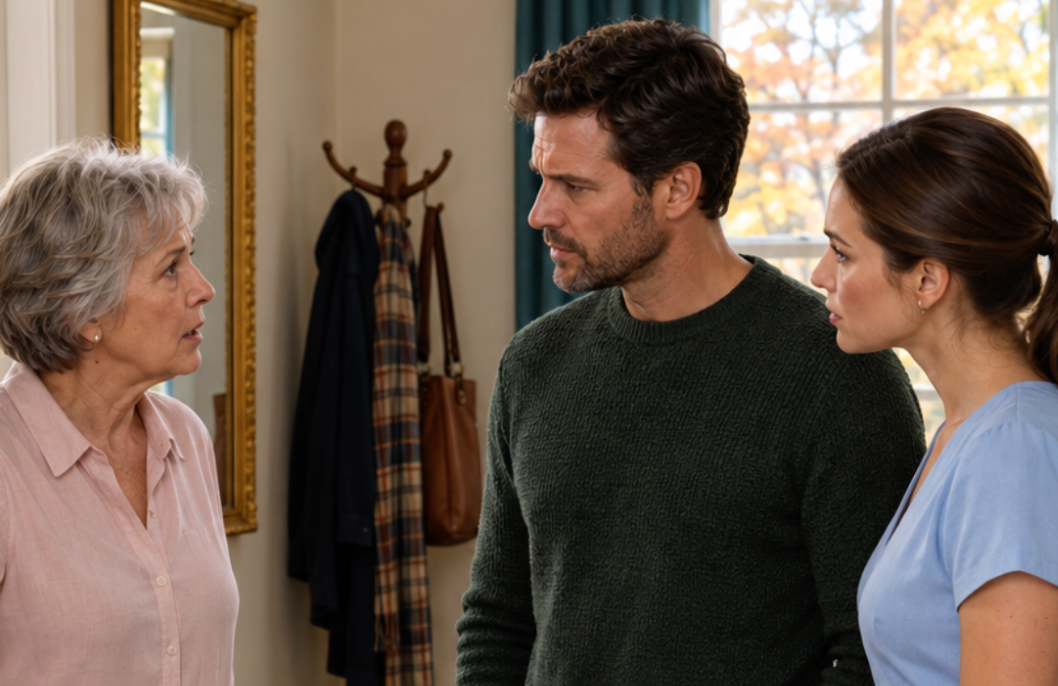
“Sit down and be quiet! This is none of your business!”
And that’s how it went. Without even looking at his wife. Maksim stood by the window, gazing out into the courtyard—somewhere out there, beneath the gray September drizzle, pigeons were darting across the wet pavement—and he spoke to her back. As if Sonya wasn’t even a person. As if she was just some object, shoved in the corner.
She sat at the kitchen table with a cup of coffee, waiting for her husband to finally turn around. He never did.
It all began three days ago, when Zinaida Petrovna—Maksim’s mother, a woman whose voice was made for commanding, not asking—called her son and told him, “We need to settle the dacha issue once and for all.” Sonya hadn’t heard the conversation, she just saw Maksim nodding into the phone, quietly agreeing, almost childlike. “Yes, Mom. Yes, of course. I’ll talk to her.”
And talk to her he did. This is how he talked.
The dacha had belonged to both of them since their first year of marriage. It wasn’t a gift—Sonya had inherited it from her aunt, who moved to live with her daughter in another city and officially transferred the plot to her niece. Six hundred square meters, a two-story house—old, but sturdy—with a veranda and apple trees. Every summer, Sonya would spend two or three months there, painting something, nailing something, once even replacing the floorboards in the small bedroom herself—she found the planks and asked the neighbor for help. Maksim would only come on weekends, sunbathe on a camp bed, and eat whatever she’d cooked in the summer kitchen.
And now—apparently, the dacha was to be given to his mom.
“Give it away?” Sonya still didn’t get what he meant. “But…she’s not Maksim’s mother. The dacha is mine.”
“We’ll put it in her name. Mom wants to live there from spring till fall, it’s better for her health. And you’re young, you’ll be fine without a dacha.”
“Maksim, it’s my property.”
“Sonya.” He finally turned to her, his face a mix of tired and condescending—the look of someone who made up their mind long ago and is now explaining to a child. “With your kind of salary, you don’t really get a say. Mom suggested a sensible solution. She needs fresh air, peace. And the dacha is just sitting empty.”
“It’s not empty. I’m there every summer.”
“So what? Mom is more important.”
And there it was—the key word. Mom. Mom is more important. Mom decided, Mom said, Mom wants. Maksim was forty-one, worked for a trading company, wore a nice watch, and always managed to look like a serious man in public. Yet at home, he turned into someone else. A boy who called his mom first whenever something went wrong. Who reported everything. Who asked for permission.
Sonya worked as an administrator at a private clinic—her salary was lower than Maksim’s, that was true. But they’d paid off their mortgage three years ago, and she had contributed the majority of those last payments because Maksim had lost his job at the time and spent six months searching for a new one. He never brought that up.
The next day, Zinaida Petrovna arrived.
Sonya had just gotten home from work—her feet ached and her mind was spinning with her to-do list for the rest of the week. She opened the door to their apartment and immediately caught the scent. Her mother-in-law wore some heavy, cloying perfume that always lingered on the curtains long after she left. So, she was already here.
They sat together in the kitchen—Maxim and Zinaida Petrovna. Zinaida Petrovna had a cup of tea in front of her; Maxim had a plate of food that his mother had brought in containers. Sonya hung up her coat, walked in, and greeted them.
“Oh, you’re here,” Zinaida Petrovna said flatly, as though noting the presence of a chair. “Maxim, explain to her what we’ve decided.”
Maxim stood up and straightened his shirt.
“Sonya, Mom looked over the documents today. We thought it’d be best to go with a deed of gift. Quick and without any unnecessary fuss.”
Sonya stopped by the doorway. She looked at him. Then at Zinaida Petrovna—who sat with a straight back, wearing the look of someone who had come to collect what was rightfully theirs.
“A deed of gift. From me. To your mother.”
“To my mother, yes.”
“Maxim,” Sonya said evenly. “The dacha is registered in my name. It’s my property. I’m not signing any deed of gift.”
Zinaida Petrovna set her cup down. Slowly, and with emphasis—so firmly that the porcelain clinked against the table.
“Listen, girl. My son feeds you, clothes you, and puts a roof over your head. With your salary, you have no rights. Not to the dacha, not even to an opinion. Understand?”
“I understand,” Sonya replied.
Clearly, her mother-in-law had expected something else—tears, excuses, or at least a trembling voice. But Sonya just stood there, looking straight ahead—calm, almost curious. Much like watching a force of nature you’ve studied enough to no longer fear.
Maxim said something—something about Sonya needing to think it over, and that this was “in the interest of the family”—and then nodded to his mother. Zinaida Petrovna stood up, walked to the door to the other room, and deliberately closed it right in Sonya’s face, as if savoring the moment.
Behind the door, they talked about something in low voices. Sonya could catch a few words—”notary,” “this week,” “she’ll agree.”
Sonya went out into the hall, put her coat back on, the same one she had just taken off, and grabbed her bag.
Outside, it smelled like autumn—wet leaves, earth, the first chill. Sonya walked down the sidewalk, unhurried. The pigeons flew away. The sky above the buildings was low and gray—the kind that makes you want to think slowly and carefully.
She was thinking.
The dacha was registered in her name. That was a fact. You couldn’t reassign a deed of gift without her signature. That was a fact, too. So they were going to pressure her. They would find a way—through Maxim, through arguments, through silence and coldness at home, through whatever tactics people use when they’re used to getting their way by wearing others down.
Sonya turned into a small park, where it always smelled of fallen leaves in the autumn and there was always someone out walking their dog. She sat down on a bench. Took out her phone.
She had found the number a month ago—completely by chance, in conversation with her colleague Irina, who had divided up property with her ex-husband two years ago and come out of it with both an apartment and her dignity intact. A lawyer. A woman named Svetlana Andreyevna. Specializes in family and property law.
Sonya typed out a message: “Hello. I need some advice. I’d like to know how to protect my property from forced transfer. Would tomorrow morning work for you?”
Sent it off. Put my phone away. I looked at the trees—leaves were just starting to turn yellow around the edges, but still clung to the branches. September was only just beginning.
The reply came seven minutes later.
“Yes, that works. I’ll be expecting you at ten.”
Svetlana Andreevna turned out to be a petite woman in her fifties, with a short haircut and glasses on a chain, which she never wore on her nose but always held in her hands. Her office was small and cozy—stacks of folders, a couple of pots of geraniums on the windowsill, a diploma, and several certificates for something legal hanging on the wall. All of this made it feel less like a government office and more like a place where people are truly listened to.
Sonya explained the situation quickly, without unnecessary words. She had brought all the documents with her—proof of ownership, a registry extract, and the inheritance papers from her aunt.
Svetlana Andreevna flipped through them unhurriedly.
“No one can force you to sign a deed of gift,” she finally said. “That’s illegal. No court would find the deed valid if you report being pressured. Legally, you’re protected.”
“Legally,” Sonya repeated.
“You understood correctly.” The lawyer tilted her head slightly. “If your husband tries to get a division of property in the event of a divorce, the country house you inherited can’t be divided. It’s your personal property, not shared marital assets.”
Sonya nodded. She had more or less expected this, but it was one thing to guess and another to hear it from someone actually looking at the documents.
“So the only way I could lose it is if I sign something myself?”
“Or if it’s sold using forged documents, which in your case would be technically very difficult.” Svetlana Andreevna took off her glasses and put them back on the chain. “But I want to ask you something. Are you trying to protect yourself right now—or are you already thinking about what comes next?”
Sonya was silent.
“I’m thinking about what comes next.”
She left the legal office at half past eleven. It was a bit warmer outside—the September sun had broken through the clouds and lit up the wet rooftops and yellow trees along the sidewalk. Sonya walked instead of taking a taxi. She needed to think, and it was easier to think while walking.
At home that night, Maxim didn’t go to bed until one—he sat in the living room, scrolling through his phone. When Sonya passed by, he looked up.
“We’re going to the notary tomorrow,” he said. “Mom already arranged it. Three o’clock.”
“I’m working until six,” Sonya replied and closed the bedroom door.
He came in a minute later.
“Sonya, you don’t understand how important this is for Mom. Her blood pressure, her heart—she needs peace and nature. The country house is the only thing that can help her. Do you want her to get sick?”
Sonya was already lying down, staring at the ceiling.
“Maxim, I’m not going to any notary. And I’m not signing anything.”
“Why are you so selfish?” His voice took on that childish resentment she’d learned to recognize over their seven years together. “Mom’s not well, and all you care about is the house.”
“I’m thinking about my own property. That’s not the same thing.”
He left. For a while he walked around the apartment, moving things around in the kitchen — deliberately making noise so she’d know he was upset. Then he called his mom — Sonya could hear his voice through the wall, soft and complaining: ‘She doesn’t want to, Mom. I don’t know. I tried.’
Sonya closed her eyes.
She thought about how, seven years ago when they first got married, Maksim seemed so different — calm, reliable, a bit reserved, but that never scared her. From the very start, Zinaida Petrovna treated her daughter-in-law like a temporary and unwelcome addition, someone you tolerate until you can figure out how to get rid of them. Sonya thought she’d get used to it. She never did. Year after year, her mother-in-law crept further into every part of their life together: constant advice, demands, showing up every weekend, pushing her opinions about housekeeping, about Sonya’s clothes, about how much Sonya earned.
‘With a salary like yours, you shouldn’t have a say.’
How does that sort of confidence even start, she wondered? This idea that money equals rights. That whoever makes more automatically gets to decide for everyone else. Maksim really believed that. Or maybe he just convinced himself, because it was easier that way.
The next day, around lunchtime, Sonya went to the government service center.
There, she grabbed a number and waited twenty minutes for her turn, then submitted her request. Not for divorce — at least, not yet. She just requested an expanded extract from the property registry for the summer cottage, with notes on any encumbrances and a record of ownership transfers. Just a formality, but an important one. Svetlana Andreevna had advised her to have all the documents on hand.
As she left the service center, she came face to face with Zinaida Petrovna.
Her mother-in-law stood at the entrance — wearing a light beige coat, a purse hanging on her arm, explaining something to another woman next to her while jabbing at a phone with her finger. She saw Sonya — and stopped mid-sentence.
‘What are you doing here?’ her mother-in-law asked.
‘I have some business,’ Sonya replied, and kept walking.
‘Wait.’ Zinaida Petrovna caught up with her in two steps. ‘Were you doing paperwork? What paperwork? Does Maksim know?’
Sonya stopped. She looked at her — steady, calm.
‘Zinaida Petrovna. I want to say this to you just once.’ She spoke quietly, her voice even. ‘The cottage is mine. It was mine before and it will stay mine. You can try to pressure Maksim as much as you like. It won’t change anything.’
Her mother-in-law opened her mouth, but Sonya was already heading to her car.
That evening Maksim came home earlier than usual. He looked on edge — his mom had called, told him all about the run-in at the service center and, judging by his mood, must have thrown in a bunch of details that never happened.
‘Did you go take care of something without me?’ he asked the moment he walked in.
‘I requested a statement for my own property. That’s my right.’
‘Sonya, you…’ He pinched the bridge of his nose. ‘Do you realize you’re doing this on purpose? Just to humiliate my mom?’
‘I’m protecting my own property, Maksim. This isn’t about your mom.’
‘It’s always about mom!’ he suddenly yelled, and in that outburst was so much pent-up, childlike emotion that Sonya almost felt sorry for him. Almost. ‘She’s spent her whole life for me, and you…’
‘And I’ve been here for seven years,’ Sonya interrupted quietly. ‘Seven years by your side. But I guess that doesn’t count.’
He fell silent.
She walked into the kitchen and set the kettle to boil. Outside, it was getting dark, and the streetlights along the courtyard were flickering on one by one. The leaves on the poplars rustled as the evening wind began to pick up.
Sonya could hear Max walk into the living room and pick up his phone again. Once more, it was his mother calling. Once again, that quiet, complaining voice drifted through the wall.
She took a small notebook from the drawer—the one she used for lists: groceries, chores, phone calls. She opened to a blank page, wrote down the date at the top, and underneath it, just a single word.
Divorce?
She added a question mark, closed the notebook, and slipped it into her bag.
For now, it was just a question. But deep down, she already knew the answer.
Two weeks went by.
During those two weeks, Zinaida Petrovna visited three times. Each time, she arrived without calling first, as if she was just in the neighborhood by chance. She brought containers of food for Max, settled herself in the kitchen, drank tea, and spoke loudly enough so Sonya could hear from the other room. She talked about how daughters-in-law could be ungrateful. How a good wife thinks about her family instead of some papers. And how the dacha would end up being her mother’s anyway—sooner or later.
Max would just listen, nod, and remain silent.
Sonya kept quiet too. In fact, she’d grown quieter—not out of resentment, but something more like a new understanding. Words hadn’t solved anything here in a long time. Now it was all about paperwork, signatures, numbers in an account.
In mid-September, she scheduled a second appointment with Svetlana Andreyevna.
This conversation was different. It was much more specific.
“I want to understand the steps involved in getting a divorce,” Sonya said. “What’s divided, what isn’t, and how long does it all take?”
Svetlana Andreyevna listened carefully without interrupting. When Sonya finished, the lawyer paused for a second, then asked:
“Do you have shared savings?”
“We have a joint account. We both transferred money there. There’s about eight hundred thousand in it.”
“Does he know what you’re planning?”
“No.”
“Alright,” Svetlana Andreyevna said, opening a folder. “Let’s start from the beginning, then.”
Sonya left the consultation just after one. She paused on the steps to let the cold but still-living autumn sun warm her face. She called work to say she’d be late, then crossed the street to a small café with wooden tables and the scent of cardamom lingering in the air. She ordered a coffee and sat there for almost an hour.
She thought about how decisions are made. Not the kinds declared out loud with dramatic pauses—but the real ones. The ones that grow slowly and quietly, like something underground, until one day they just surface—fully formed and solid, with no going back.
And this was exactly that kind of decision.
Once home, the first thing she did was open her laptop and transfer the amount she’d been saving for the past three years—secretly, just in case—from her personal card to a separate account Max didn’t know about. Two hundred and forty thousand. Not anyone else’s money—her own, slowly set aside, just in case. And now, the time for ‘just in case’ had come.
Next, she called Irina—the very coworker who had given her the lawyer’s number.
“Ira, do you know anyone renting out a one-bedroom? Something affordable?”
Irina wasn’t surprised at all. She just asked:
“Is it for good?”
“I don’t know yet. But probably yes.”
“Give me a day, I’ll ask around.”
The next evening, Maksim came home and announced right from the doorway that his mother had ‘set up an appointment with the notary for Friday.’ He added that this time, it would be better for Sonya ‘not to be stubborn.’
Sonya was sitting at the table with her laptop. She looked up.
“Maksim, I need to tell you something.”
Something in her voice made him pause. He walked into the kitchen and sat across from her—carefully, as if he sensed that this wasn’t going to be the conversation he’d prepared for.
“I’ve filed for divorce,” Sonya said. “The paperwork is already with the court. The first hearing is in a month.”
Maksim stared at her. He stayed silent.
“You…” He hesitated. “You’re joking.”
“No.”
“Because of the dacha? Is this about that?” His voice was full of surprise, almost childlike. “Sonya, it’s just a dacha. My mom asked…”
“It’s not about the dacha,” she cut him off. “It’s about everything.”
He didn’t understand. She could see it on his face—he truly didn’t get it. Seven years together, and he never really noticed what was happening. Or maybe he saw and just chose to ignore it—because his mother always knew best.
Maksim got up and paced around the kitchen.
“I’ll call Mom.”
“Go ahead,” Sonya replied.
She closed her laptop, stood up, and grabbed her jacket. As he was dialing, she walked to the hallway, put on her shoes, and opened the front door. Maksim, already holding the phone to his ear, shouted from the kitchen:
“Where are you going?”
“For a walk,” she answered, and closed the door behind her.
Outside, it was cool and quiet. September was nearly over—leaves covered the sidewalk in a thick layer, yellow and orange, softly rustling underfoot. Sonya walked without any destination, just moving—past familiar houses, past the little park, past the bakery where the smell of fresh bread drifted through the open door.
Irina called.
“I found one. Small one-bedroom, second floor, the landlady rents to decent folks. She wants to know—when can you come see it?”
“Tomorrow morning, if possible.”
“I’ll arrange it.”
The apartment turned out to be small and bright, with a window overlooking a courtyard where an old birch tree grew. The landlady, an elderly woman named Vera Nikolaevna, said right away that she looks at papers carefully, but trusts people at first sight. She looked at Sonya and said, “You can move in as soon as this Saturday.”
That Saturday, Sonya moved in.
She brought only a few things—personal items, documents, a few kitchen things she’d bought herself. Maksim was at his mother’s house at the time. He had left the night before, after a long phone call with Zinaida Petrovna, from which Sonya only caught a few phrases: “It’s her own fault,” “I warned you from the very beginning,” “It’s fine, we’ll sort it out.”
Let them sort it out.
The new apartment smelled unfamiliar—a bit like paint, a bit like something floral from the landlady’s detergent. But the window was good, and the birch tree outside stood golden, the last golden birch of autumn before the leaves would fall.
Sonya put the kettle on. She took a notebook out of her bag and opened it to the page where, two weeks ago, she’d written a word followed by a question mark.
She grabbed a pen and crossed out the question mark.
She put a period instead.
Outside the window, the leaves fell quietly. The birch let go of its leaves slowly, almost ceremoniously, as if it knew this was how it should be. That this wasn’t the end—just the next step.
Sonya made herself some coffee, sat by the window, and for the first time in weeks, didn’t think about Maksim, or Zinaida Petrovna, or notaries and deeds.
She was thinking about how she’d repaint the porch at the dacha in the spring. Maybe with white paint. Or maybe in light green.
She’d have to make up her mind.
The divorce was finalized after three months.
Everything went quietly—no courtroom scandals, no plates thrown, no dramatic scenes. Maxim attended the hearing with a lawyer who, it seemed, was found by Zinaida Petrovna. The lawyer tried to bring up the dacha. Svetlana Andreevna laid out before the judge an extract from the registry, the inheritance certificate, and two paragraphs from the civil code. That matter closed itself.
They split their joint account equally. The dacha stayed with Sonya.
Word was, Zinaida Petrovna was furious. Sonya didn’t see it—she and Zinaida never crossed paths again. Only once, already in February, she ran into Maxim at an ATM in a shopping center. He’d lost weight, looked tired. He glanced at her, nodded. She nodded back. They went their separate ways.
And that was it.
In the spring, Sonya finally visited the dacha for the first time in a long while. She opened up the house, aired out the rooms, walked through the garden. The apple trees were starting to bloom—white flowers on gnarled old branches, and the scent was so strong and pure that she just wanted to stand there and breathe.
She painted the porch light green. Did it herself, over two days, with a paintbrush and an old radio on the windowsill. It turned out well.
Irina came over during the May holidays—she brought wine and cheese, and the two of them sat on the porch until dark, chatting about nothing in particular. Work, the neighbor’s dog that barked at them from the road, ideas for where to go in the summer.
Sonya looked at the garden, at the evening sky above the apple trees, at the first stars appearing one by one—and she felt something very simple. Not happiness in that loud, storybook way. Just peace. Her own life. Her own space. Her own decisions.
The notebook with a dot instead of a question mark was at home on the shelf.
The new pages were blank.
Spotlight right now