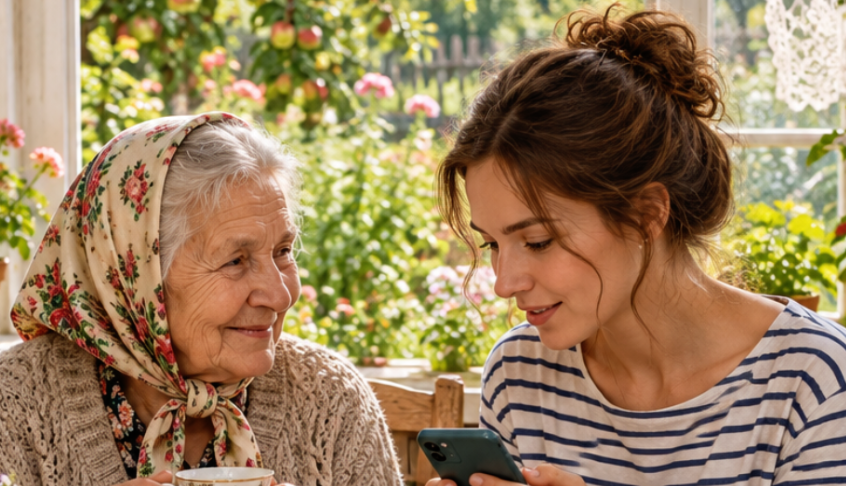
When her mother-in-law announced that the dacha had been signed over to the grandchildren, Rita just nodded and picked up her phone. She chose not to argue. But what she later found in the documents changed everything.
Zinaida Pavlovna was slicing cucumbers so thin you could almost see through them. The knife hit the cutting board rhythmically, steady as a metronome. Rita stood in the doorway of the veranda, watching her hands—the brown spots near the knuckles, the wedding band pressed so deeply into her finger that the skin around it had turned pale.
“The dacha is registered to the grandchildren,” her mother-in-law said without looking up.
Rita nodded. Then she took out her phone and opened the notes app, just to keep her hands busy. Her fingers slid across the screen while she stared at the blank page.
Cucumber slices landed on the plate in perfect, even circles. Zinaida Pavlovna worked in silence, and through that stillness Rita could hear a fly buzzing behind the wall, the old Biryuza fridge creaking, and, somewhere far off at the neighbors’, a dog barking.
“To both of them?” she asked.
“To both,” her mother-in-law confirmed. “Equally. I went to the notary on Thursday.”
Thursday. Rita remembered Thursday. She had taken Kostik to the dentist and picked up Zhenya from music class. Her mother-in-law said she was going to visit a friend in Pushkino. A friend.
The knife stopped. Zinaida Pavlovna looked up and met her daughter-in-law’s eyes with that gaze Rita had learned to decipher in twelve years. It said: I did what I had to do. There’s nothing to discuss.
“Thank you,” Rita said.
And she walked out onto the porch.
The dacha, set on six sotkas in Malakhovka, was one Rita remembered differently. When she and Gleb had first come here, the fence was green, the apple trees were trimmed, and delicate floral curtains hung on the veranda. Thirteen years ago. She was pregnant with Kostik and terrified of mosquitoes—she had read somewhere that bites could harm the baby.
Gleb had laughed, smeared repellent on her shoulders, and said his mother grew up here, that the land had been in the family since ’68, and someday their own kids would run around here.
Kids did run. Kostik was twelve, Zhenya was nine. The fence was sagging now, the apple trees grown wild, and the curtains had been taken down when the fabric rotted and tore in the wind. But the dacha still stood. And it smelled the same: warm sun-baked wood, dill fresh from the garden, something tangy coming from the cellar.
Rita sat down on the step. The board under her was rough and warm from the sun, the paint peeling away. She ran her palm over it and felt a tiny splinter—so small it was like an eyelash. She didn’t pull it out. She just sat there, thinking.
Registered to the grandchildren. Equally. Without a word to her, without a word to Gleb. The notary on Thursday.
Her phone vibrated in her pocket. Gleb.
“How are you holding up?”
“It’s fine. Mom’s slicing cucumbers.”
“Ah. Okay. I’ll be there by seven.”
“Alright.”
She put her phone away and looked at the apple tree by the gate. The lower branch had broken off last autumn, and Gleb had promised to saw off what remained. The jagged stump stuck out like a gnawed bone. That promise was still hanging there, just like all his other promises: to fix the roof, to lay the path, to talk to his mother about the money.
They never talked about money. Not once. It was an unspoken rule that everyone followed. Zinaida Pavlovna made the decisions, Gleb nodded in agreement, and Rita stayed silent. For twelve years.
In the evening, after the kids had fallen asleep upstairs and the house had grown quiet, Rita opened her laptop. She didn’t plan to look up anything in particular. She just wanted to check a recipe for charlotte cake, since the apples this year were small and sour and needed to be used up somehow.
But instead of the recipe, she typed into the search bar: ‘deed of gift for real estate for underage children.’
The pages loaded slowly—the summer house internet just barely worked. Rita read, resting her cheek on her fist, and felt a chill creeping up the back of her neck. Not from fear—from understanding.
Deed of gift for a minor. Only a legal representative can accept it. That means a parent. That means Gleb. Or her.
But Zinaida Pavlovna had said: it’s already been done. On Thursday.
Who signed it?
Rita closed the laptop and pressed her palms to the lid, as if it might open by itself. Outside, the apple trees rustled. The wind was picking up, and the old window frame rattled in its grooves.
She knew who had signed.
Rita woke up at six in the morning. Zinaida Pavlovna was already in the kitchen: warming milk for Zhenya, who wouldn’t eat her porridge without it, and slicing bread with the same knife, the same steady movement.
‘Zinaida Pavlovna.’
‘Hmm?’
‘Who signed the deed of gift for the children?’
The knife didn’t stop. The slice of bread landed on the plate.
‘Gleb signed it. Who else? He’s their father.’
‘When?’
‘I told you. On Thursday.’
Rita stood by the doorframe, her fingers finding a long crack in the wood, running from floor to shoulder. She traced it with her fingernail, like a map.
‘He didn’t tell me.’
‘Why would he need to? The dacha is mine. The grandchildren are mine. I made the decision, he agreed.’
The milk hissed, bubbling over onto the stove. Zinaida Pavlovna rushed to the burner, pulled the saucepan off. A white stripe ran down the enamel, filling the air with a burnt smell.
‘Hold this,’ she said, handing Rita the saucepan.
Rita took it. The handle was hot, so she switched her grip with a towel. Her mother-in-law wiped the stove with a rag, leaning low, and Rita could see her slender neck, the protruding vertebrae, and the large mole behind her ear, as big as a cherry.
‘Zinaida Pavlovna. I am also a legal representative of the children. You can’t complete a deed of gift without my signature.’
The rag stopped moving.
There were five seconds of silence, enough for Rita to count the cracks in the ceiling. Four. One new, running from the corner to the lamp.
‘What are you trying to say?’ Her mother-in-law’s voice sounded different now. Not harsh, just cautious. Like someone stepping onto ice, unsure if it would hold.
‘I’m saying that maybe you didn’t do everything correctly.’
‘The notary knows their job.’
‘The notary should have required the consent of both parents. Or at least a notarized consent from the second parent.’
‘Gleb signed.’
‘But I didn’t.’
Zinaida Pavlovna straightened up. She was only five foot two, but at that moment she seemed taller. Her shoulders squared, chin lifted. Rita recognized the gesture. Defense mode.
‘Rita. Are you against this?’
‘I’m not against the dacha going to the kids. I’m against the fact that no one asked me.’
The word ‘Ritka’ stung. Her mother-in-law only called her that when she wanted to make her feel small. To diminish her. Put her in her place.
“I’ve looked after this dacha for thirty years,” said Zinaida Pavlovna. “I fixed the roof, put up the fence, planted potatoes when your husband was still in school. And I get to decide who gets it.”
“You decide. But you still have to do it legally. And legally, my signature is needed.”
Gleb arrived by lunchtime, dusty, in a wrinkled shirt, carrying a bag from Pyaterochka. Inside: a watermelon, a loaf of bread, a pack of dumplings.
“What happened?” he asked from the doorway, noticing his mother sitting on the veranda with a face like she’d just heard the world was ending, while Rita was cleaning the floors in the other room and didn’t come out to greet him.
“Nothing,” answered Zinaida Pavlovna.
“Rit?”
Rita wrung out the rag. The dirty, brown water from the old floorboards dripped into the bucket.
“Let’s talk.”
They walked out to the gate. Kostik and Zhenya were by the neighbor’s fence, building something out of planks, their voices floating over in snippets: “bring it here,” “no, it’s crooked,” “move over.”
“Your mother signed the dacha over as a gift. To the kids.”
“I know. She told me.”
“And you signed it.”
“Yeah. So what?”
“Without me.”
Gleb winced—not out of anger, but confusion. He always frowned this way when he didn’t see a problem where Rita did. His forehead would wrinkle like an accordion, right eye squinting slightly.
“Rit, it’s mom’s dacha. She wants to leave it to her grandchildren. That’s normal.”
“It’s normal. But the notary should have required my consent.”
“Maybe mom mixed something up.”
“Maybe. Or maybe the notary is a friend.”
Gleb fell silent. The watermelon in the bag banged against his knee, so he shifted the bag to his other hand.
“So, you’re going to make a scene?”
“I’m going to get to the bottom of this.”
“Get to the bottom of what? The dacha’s for the kids. You don’t need this dacha.”
“I need them not to leave me out.”
Gleb looked at her. And in his gaze, Rita saw the same thing she had for twelve years: his unwillingness. Unwillingness to start an argument, unwillingness to make a choice, unwillingness to stand between his mother and his wife. He was a good husband when it came to things that didn’t require taking a side.
“Alright,” he said. “Figure it out.”
And he headed back to the house.
That evening, after everyone had gone to bed, Rita called her friend Lena. She stepped outside, sat on the bench by the old well. The well hadn’t worked in ages, its cover was rotten, and Gleb had nailed it shut so the kids wouldn’t go near it.
“Lena, you’re a lawyer, right?”
“Well, almost. Assistant notary. Former assistant, actually.”
“Former works. Listen up.”
She told her the whole story. Lena listened in silence, and Rita could hear her pouring water and the glass clinking on the table through the phone.
“Okay, here’s how it is,” Lena said. “A gift to a minor. The legal representative accepts the gift. If it’s from the grandmother, either parent can accept it. Officially, the other parent’s consent isn’t always required. Depends on the notary.”
“So, it’s all legal?”
“Theoretically… no, wait. There’s a nuance. If one parent accepts the gift from their own mother, that’s a conflict of interest. Grandma gives, son accepts for the kids. Some notaries require the other parent to accept, or at least their consent.”
“And if they didn’t ask for it?”
“Depends on the situation. But it can be challenged.”
Rita pressed her phone tighter to her ear. The night was warm, filled with the scent of earth and freshly cut grass from the neighbor’s yard. Somewhere far away, a commuter train clattered by.
“I’m not trying to challenge it, Lena. I just want to understand why this was done in secret.”
“Are you sure it was secret?”
“Nobody asked me. I was only told about it after the fact.”
“That’s not the same as hiding it.”
Rita paused in thought. Lena was right. But the feeling remained. Something wasn’t right, and it went deeper than just legal technicalities.
The next day, Rita went into the city. She said she was going to the dentist. Her mother-in-law nodded, Gleb didn’t ask anything. The kids stayed with their grandmother, and Zhenya waved from the window, her nose pressed against the glass.
On the train, Rita pulled out her phone and found the property record in Rosreestr. The plot in Malakhovka, six sotkas, cadastral number. She keyed in the digits from the screen, double-checking them against the old certificate she’d photographed last autumn when helping her mother-in-law sift through documents.
And that’s when she froze.
The plot wasn’t registered to Zinaida Pavlovna.
It was registered to Gleb. Since 2019.
Rita double-checked. Verified the number. Refreshed the page. The train’s signal was spotty, data was loading in fits and starts, but the numbers stayed the same.
The plot had been transferred to Gleb six years ago. Zinaida Pavlovna couldn’t have gifted something to her grandchildren that didn’t belong to her anymore.
That meant the deed wasn’t signed by a son on his mother’s behalf. It was signed by the real owner. Gleb. Without his wife’s consent.
She stepped off at the platform and stood still until the train left. The platform emptied. The scent of diesel and hot rails hung in the air. The sun was in her eyes, and Rita covered them with her hand—not to block the light, but just to hide her face.
Not because she was crying.
Because she was smiling. Nervously, awkwardly, just one corner of her mouth. Like someone who finally found the word for something that’s haunted them for years.
Six years. The plot was transferred six years ago. She hadn’t known. Gleb hadn’t told her. Zinaida Pavlovna never mentioned it. And when her mother-in-law said, ‘The dacha is registered for the grandchildren,’ what she actually meant was not ‘I gave it to them,’ but ‘Gleb and I decided.’ Without Rita. As always.
She called Lena.
“Lena. The plot isn’t hers. It’s been Gleb’s since 2019.”
“Wow.”
“So, Gleb was the one gifting it. As the owner. To the kids.”
“Wait. Were you already married in 2019?”
“Yes.”
“A free-of-charge transfer from mother to son is a gift. Not joint property. If the mother gave it to Gleb, it’s his personal asset.”
“Wait. So, the dacha I’ve spent twelve years repairing, painting, weeding…”
“Legally, it’s his. If it was a gift from his mother.”
“So, what is he gifting the kids now?”
“His own personal property. And here, your permission… legally, it’s not required. Because it’s not jointly acquired.”
Rita sat down on the bench. The bench was hot, made of metal, and the heat came right through her skirt. She didn’t stand up.
“Lena. I don’t want that dacha.”
“I know.”
“I just want to understand why nobody told me six years ago.”
“Did you ask?”
“No.”
“There’s your answer.”
Rita never made it to the city. She took the next train back. The carriage was empty, except for an old man dozing by the window, his fishing rod propped up, and his backpack sliding down onto the floor.
Her mind was elsewhere. Not on the summer house, not on the paperwork, not on notaries. On something entirely different.
For twelve years, she lived in a family where decisions were made without her. Not out of malice, just because that’s how things were done. Zinaida Pavlovna made the calls, Gleb would go along, and Rita would hear about it after. They paid for her mother-in-law’s apartment renovations from their own budget, because, “She only has one mom.” They changed cars because, “Gleb’s commute is too long.” Every summer they spent their vacation here at the dacha, because, “the kids need fresh air.”
Every time, Rita nodded. Not because she agreed, but because she couldn’t see where she might put her disagreement.
Now she could.
She got off at the station and started walking. It was twenty minutes through the woods from the platform to the dacha, then past the pond, then a right turn at the transformer box. She knew this path by heart—every stone, every pothole, every tree with its bark scraped off.
Fishermen sat by the pond. One turned around and nodded. Rita nodded back. Mosquitoes buzzed right by her ear, and she brushed them away with a familiar gesture.
The house smelled like pancakes. Zinaida Pavlovna was at the stove, flipping them expertly with a single flick of her wrist, no spatula needed. Zhenya sat at the table, her face covered in sour cream. Kostik was reading something on his phone, his brow furrowed just like his father’s.
“Mom, you’re quick,” he said without looking up.
“Quick,” Rita confirmed.
She walked out onto the veranda. Gleb was sitting in a wicker chair, scrolling through the news. The chair creaked with every movement—the same creak Rita had heard for thirteen years.
“Gleb.”
“Mm.”
“The plot was transferred to you in 2019.”
He didn’t look up. But his finger paused on the screen.
“Mom asked. Just to make things simpler.”
“To make things simpler.”
“Yeah. So we wouldn’t have to mess around with inheritance later.”
“And you didn’t tell me.”
“Why would I? It was Mom’s summer house. Was Mom’s, now it’s mine. Next, it’ll be the kids’. What does it matter whose name’s on the paper?”
“The difference is, I’ve spent twelve years painting fences, planting tomatoes, cleaning floors here—and I’m always the last to find out, if I ever find out at all.”
Gleb finally looked at her. In his eyes was that expression she hated more than anything: condescending patience. Like an adult explaining the obvious to a child.
“Rita, come on. It’s for the kids.”
She stood in the doorway, the setting sun at her back, her shadow stretched across the veranda floor—long, narrow, like a crack.
“For the kids,” she repeated. “Every time—it’s for the kids. Or for your mom. Or for work. Not once has it been: for us. Or even: let’s talk about it.”
“We’re talking about it now.”
“No. Right now you’re explaining why I’m wrong.”
They fell silent. From the kitchen came Zhenya’s voice: “Grandma, one more with jam!” Zinaida Pavlovna replied with something, the stove hissed, and the house filled with the smell of browned butter.
Rita sat across from her husband. The chair creaked as Gleb leaned forward.
“Do you want them to not give the dacha as a gift?” he asked quietly.
“I want to be asked.”
“Fine. I’m asking. Do you agree that the dacha should be for the kids?”
“That’s not the point anymore.”
“Then what is?”
She looked at the apple tree outside the window. A broken branch jutted into the twilight, and on it sat a bird—a small, gray shape, lost in the shadows.
“It’s the fact that you transferred the plot to yourself six years ago and didn’t tell me. Not because you forgot, but because you didn’t think it was necessary.”
“Mom asked me to.”
“I heard her.”
“So what do you want?”
She didn’t know what she wanted. No, she knew. But she couldn’t put it into words Gleb would actually hear. He only understood specifics: yes or no, agree or not, sign or refuse.
But she wanted something else. She wanted someone to call her on Thursday and say, “Rita, Mom wants to put the summer house in the children’s name. What do you think?” And she would reply, “That’s a good idea. Let’s do it.” And that would be it. There wouldn’t be this conversation, this knot in her stomach, this feeling that she was just furniture in someone else’s house.
“I want you to call me next time before the notary, not after.”
Gleb nodded. Slowly, like someone who agreed not because he understood, but because he was tired of arguing.
“Alright.”
That night, Rita didn’t sleep. She lay on her back, listening to Gleb breathing, the house creaking, and the wind brushing the apple tree outside the window.
She thought about 2019. About how that year they changed their car because the old one broke down, and Zinaida Pavlovna picked the new one because “Gleb doesn’t know much about cars, but I’ve been driving all my life.” About how that year she wanted to take the kids to the seaside, but instead, they spent another summer at the dacha because “Why spend money when we have a summer place?”
And about how that same year, Gleb quietly, without a sound, transferred the plot to himself.
What else didn’t she know?
Rita turned onto her side. The pillow smelled of dust and the old pillowcase that Zinaida Pavlovna washed by hand, saying, “The machine ruins the fabric.” Gleb lay on his back, mouth slightly open, left hand dangling off the bed.
She could get up, go to the kitchen, pour herself some water. She could check her phone, reread articles about joint property. She could text Lena.
But she didn’t.
Because it wasn’t about the property. It wasn’t about the summer place. It wasn’t about those six hundred square meters in Malakhovka.
It was about how Zinaida Pavlovna sliced cucumbers while at the same time deciding the future of Rita’s children. And Gleb would sign. And all Rita could do was nod.
In the morning, she packed. Not everything. Just her things and the kids’. Two backpacks, a bag with shoes, Zhenya’s stuffed bunny, Kostik’s charger.
“Where are you going?” Zinaida Pavlovna stood in the kitchen doorway, towel in hand.
“To the city. The kids have a dentist appointment on Monday.”
“But it’s only Saturday, the appointment is Monday.”
“We need to get ready.”
“There’s nothing to get ready for here, everything’s already here.”
Rita zipped her backpack.
“Zinaida Pavlovna. Thank you for the pancakes.”
Her mother-in-law looked at her for a long moment. The towel twisted tightly in her hands.
“Rita. Is this about the summer house?”
“No.”
“Then what is it about?”
“I need to think.”
Zhenya ran out of the bedroom barefoot, in her nightgown with a sleepy face.
“Mom, are we leaving? But Grandma promised pie!”
“Grandma will bake it next time.”
“But when?”
“Soon.”
Rita took her daughter’s hand. Zhenya’s fingers were warm and sticky from sleep, and she squeezed them tighter than she should have.
On the train, Kostik fell asleep right away, leaning against the window. Zhenya munched on the cookies Zinaida Pavlovna had slipped into the bag at the door, silently, not looking at Rita.
The train car gently rocked from side to side. Outside, rows of identical summer house fences flashed by like the teeth of a comb. Then came a stretch of thick, dark forest, and after that, more fences—but these were different now: tall, new ones made of metal sheeting.
Rita pulled out her phone and opened her notes app. There was still an empty line—the very one she had looked at two days ago, right after her mother-in-law announced the property gift.
She started typing.
“What I want.”
She put a period. Thought for a moment. Then wrote underneath.
“For people to ask me. Not just present me with a done deal. Not make decisions for me. Not explain why I’m wrong every time I ask a question.”
Zhenya peered at the phone screen.
“Mom, are you making a list?”
“Yes.”
“Of what to buy?”
“Something like that.”
She put the phone away and looked out the window. The train was passing by a pond—the one where fishermen used to sit. The fishermen were gone now. Only ducks, four of them, swam close to shore, leaving little triangle trails in the ripples.
At home, it was empty and quiet. The apartment smelled of stale air and dust on the windowsill. Rita opened the windows. The city noise burst in immediately—cars, voices, music from the café downstairs.
She unpacked the backpacks, started the washing machine, poured herself some tea. Then she sat down at the kitchen table and called Gleb.
“Rita, Mom is upset.”
“I know.”
“You shouldn’t have left.”
“Maybe.”
“Come back.”
“No.”
“Why?”
“Because I need to be somewhere people don’t try to explain me away.”
He was silent. Rita could hear the old wicker chair creaking through the phone—it was thirteen years old.
“I don’t understand you,” Gleb said.
“I know,” Rita replied. “That’s exactly the problem.”
She didn’t return, not Sunday or Monday. The kids went to the dentist, then to the park, then ate ice cream by the fountain. Zhenya dropped her cone on the sidewalk and didn’t cry; instead, she stared at the stain with a serious look, as if she saw a sign in it.
On Tuesday, Zinaida Pavlovna called.
“Ritka.”
“Yes, Zinaida Pavlovna.”
“I made borscht. Come over.”
Rita smiled. Her mother-in-law never apologized with words. Borscht was her way of saying sorry, pie meant forgiveness, and pancakes were love. Everything went through food, her hands, the stove.
“Thank you. But we’re still in the city for now.”
“For long?”
“I don’t know.”
“The tomatoes are ripening. There’s no one to pick them.”
“Gleb will pick them.”
“Gleb squashes them. His hands are like shovels.”
Rita laughed softly, briefly. Her mother-in-law made a little noise, too, on the other end.
“Come over,” Zinaida Pavlovna said. And her voice was different than usual: without armor, without the commanding tone. It was just an old woman asking her daughter-in-law to visit.
“I’ll come,” Rita said. “But first, we need to talk. The three of us.”
“About what?”
“About how we move forward.”
“What’s wrong, exactly?”
“Zinaida Pavlovna, you know what’s wrong.”
There was a long pause. Something clinked on the line—probably a spoon tapping against a saucer.
“Alright,” her mother-in-law said. “We’ll talk.”
On Wednesday, Rita went alone. No kids this time. Gleb was at work, and she asked him to come in the evening.
Zinaida Pavlovna met her at the porch. She was holding a towel, wearing the same colorful kerchief with gray strands peeking out. Her eyes squinted from the sun, and there seemed to be more wrinkles by her eyes these days—or maybe that was just how Rita saw it.
“Come in. I’ve put the kettle on.”
They sat out on the veranda. The tea was strong and dark, served in glasses with metal holders. Zinaida Pavlovna had always drunk her tea this way, and the holders once belonged to her mother-in-law, engraved with ’60 years’—a factory gift for an anniversary.
Rita wrapped both hands around her glass. It was hot, but just bearable.
“Zinaida Pavlovna. I don’t need the dacha.”
“I know.”
“I don’t need any paperwork, notaries, or cadastral numbers.”
“So what do you need?”
“I need you and Gleb to stop making decisions behind my back. Not just about the dacha—about everything.”
Her mother-in-law took a sip of tea, set down her glass, and looked out the window at the apple tree with its broken branch.
“I wasn’t deciding things behind your back. I was making decisions for my grandchildren.”
“You made decisions with Gleb. Without me.”
“Gleb’s their father.”
“And I’m their mother.”
Zinaida Pavlovna turned toward her. For the first time, Rita noticed something new in her face—not hurt, not anger, not that usual defensiveness. It was confusion. Just a small crack, but visible all the same.
“My whole life I made decisions on my own,” her mother-in-law said quietly. “My husband died when Gleb was seven. I did everything by myself—the dacha, the apartment, work, raising my child. I got used to being in charge. If I didn’t decide, nothing got done.”
“I understand.”
“No. You don’t. You’ve never been alone.”
That stung. But it was honest. Rita didn’t argue.
They sat in silence for about ten minutes. The tea cooled. A fly buzzed against the glass, stubbornly, monotonously, not noticing that the window was open right nearby.
“I’ll call the notary,” Zinaida Pavlovna said. “I’ll check if everything is in order. If your signature is needed, I’ll let you sign.”
“It’s not about the signature.”
“Then what’s it about?”
Rita set her glass on the table. It left a wet ring on the oilcloth.
“Next time before making any decisions about the kids, call me. Not Gleb, me.”
Zinaida Pavlovna looked at her for a long time. Then she nodded. Just once, short and firm, like putting a period at the end of a sentence.
“Alright.”
That “alright” cost her dearly. Rita could see it in the way her mother-in-law pressed her lips together, and how her fingers tightened around the edge of the towel.
Gleb arrived at seven, just as he’d promised. He came in, saw them sitting on the veranda—two women, two glasses, silence.
“So, did you make up?” he asked hopefully.
“Sit down,” Rita said.
He sat down. The armchair creaked.
“Gleb. When your mother suggests anything about the kids, the money, anything at all, you don’t just nod along. You call me, and we decide together. Both of us.”
“Rit…”
“I’m not finished. When you sign anything at the notary’s, you tell me before, not after. Whenever you change something in the property papers, you tell me. Always.”
“It’s Mom’s dacha.”
“It was Mom’s dacha. For six years it’s been yours. And for six years you kept it from me.”
He opened his mouth. Closed it. Looked at his mother. Zinaida Pavlovna was staring out the window and didn’t say a word.
“Alright,” Gleb said.
“Not ‘alright.’ Say that you understand.”
He rubbed the bridge of his nose. A childhood habit Rita recognized: he did it before a test, before talking to his boss, any time he wanted to avoid a tough decision.
“I understand. I’ll tell you.”
“Ask me.”
“Ask you.”
That evening, the three of them had dinner together. Zinaida Pavlovna reheated the borscht—the very one she had prepared as a peace offering. The borscht was thick and dark, with pieces of beetroot floating in it, and carried that unmistakable country aroma: dill, garlic, and something indescribable that you could never recreate in a city apartment.
They ate in silence. Spoons clinked against plates. Outside, dusk was falling, the apple tree became just a silhouette, and the broken branch—the same one as before—vanished into the darkness.
“The borscht is good,” Rita said.
“The beets turned out well,” replied Zinaida Pavlovna.
That was their truce. No signatures, no notaries, no official papers. Just borscht and beets. Spoon against plate.
Gleb finished eating, got up, and took his plate to the sink. He washed it himself. For the first time that Rita could remember, he washed his plate himself instead of leaving it on the table.
It was a small thing. But Rita noticed.
The next morning, she stepped out into the yard. The sun was just rising, dew sparkled on the grass, and spiderwebs between the garden beds caught the light like tiny traps.
On the porch stood Zinaida Pavlovna’s worn rubber boots, caked with soil. Next to them were Gleb’s sneakers, size forty-four, with an untied lace. And her own blue slippers, with a torn strap.
Three pairs of shoes on the porch.
Rita went down the steps. The same board with a splinter creaked under her foot. She walked to the apple tree and looked at the broken branch.
Then she went back into the house, found a handsaw in the shed, and cut off the remaining branch. It fell to the ground softly, almost silently. The wood at the cut was pale and alive.
She carried the branch to the fence and laid it down carefully.
Zinaida Pavlovna came out of the house.
“What are you doing?”
“I sawed it off. It needed to be done for a long time.”
Her mother-in-law looked at the apple tree. At the smooth, bright cut. At Rita.
“A long time,” she agreed.
And she went to put the kettle on.