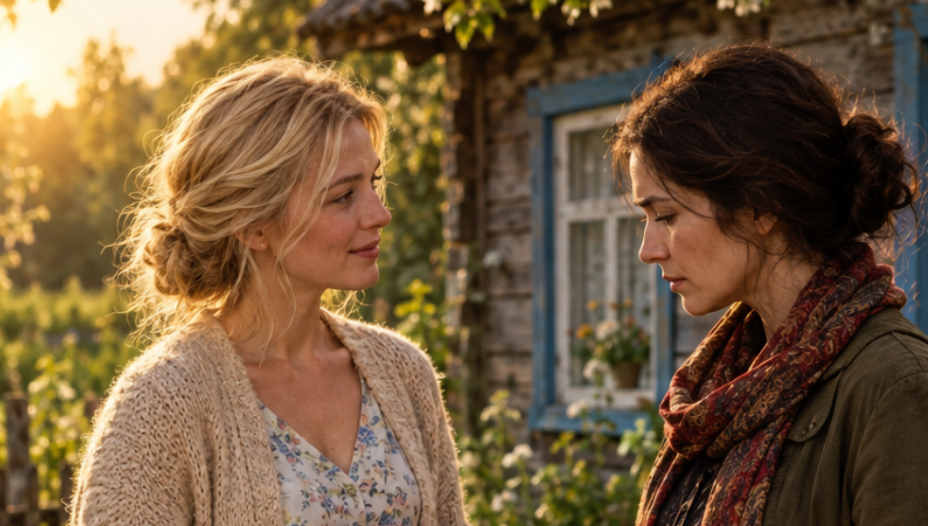
After the funeral of her mother-in-law, Tamara’s sister-in-law showed up at the dacha, keys and work crew in tow. She was certain the property was now hers. But Tamara quietly reached into her bag and pulled out an envelope she’d been keeping for four years.
Tamara stood by the gate, counting apple trees. Seven, as always. Two Antonovkas, three White Nalyv, and two others whose names she still hadn’t learned after twelve years. Her mother-in-law used to call them “my tart ones” and made preserves from them that made your mouth pucker.
The gate creaked. No one had oiled the hinges since last August, so the sound was long and mournful. Tamara pushed it open with her shoulder and stepped inside.
The place looked as if the owner had just stepped out for a minute. A watering can sat by the porch. An upside-down bucket, where Zinaida Pavlovna used to sit while weeding. Work gloves on the railing, faded beyond recognition.
But the owner hadn’t left for a minute. The owner had left forever. Forty days ago.
Tamara’s husband, Gleb, didn’t come. He claimed he couldn’t get off from work, but she knew: he didn’t want to. He didn’t want to see his sister. He didn’t want to divide things. He didn’t want to remember how his mother lay in the hospital asking for raspberries from the dacha—and how he didn’t make it in time.
“Sort it out yourself, Tom, okay? You’re better at these things than me.”
He said this while staring at his phone, his finger sliding across the screen. Tamara nodded, even though he wasn’t looking.
She was used to handling things alone. After twelve years of marriage, it had practically become her second job. Her first was as an accountant. The second: problem-solver.
The dacha came to Zinaida Pavlovna from her own mother. A wooden house, six sotkas of land, a well with a crane that hadn’t worked in ages, but no one removed it because “it’s a memory.” The village was Ryabinki, forty minutes by suburban train from the city.
Tamara came here every summer. First with Gleb, then alone with the kids, then again with Gleb when he felt guilty about something and tried to make up for it with a weekend together.
Zinaida Pavlovna would meet them at the platform. Tiny, just over five feet tall, in her sunflower-print hat and carrying a net bag with cucumbers. She always brought cucumbers. Even in winter, buying them at the market and saying, “These are from the garden, just harvested late.”
Tamara smiled. Her lips trembled and she pressed her palm to her face.
Enough.
She walked up the porch steps and took out a key. Her mother-in-law had given it to her four years ago, on the evening when they sat alone on this porch, drinking tea from a thermos.
“Tamara, let me tell you something. Don’t interrupt.”
“Alright, Zinaida Pavlovna.”
“I wrote my will. It’s for you.”
Tamara set the thermos down on the step. The metal clinked against the wood.
“For me? What about Gleb? And Rita?”
Rita. Zinaida Pavlovna’s eldest daughter. Gleb’s sister. Tamara’s sister-in-law. The woman who called their mother every other week and came to the dacha twice in the last six years—both times just to pick up jars of preserves for some charity sale.
“Gleb won’t look after it. You know that. He’s kind, but he’s not handy. And Rita… Rita’s gotten her share.”
Zinaida Pavlovna fell silent. She sipped her tea and looked at the apple trees.
“Rita sold my apartment when I moved here. She took her share. I’m not upset about it, but this summer house, it’s mine. And I want it to stay with the person who actually comes here.”
Tamara remembered the feeling of her fingers tightening around a warm glass. The scent of freshly cut grass filled the air, mixed with a trace of smokiness from a neighbor’s bonfire.
“Zinaida Pavlovna, that’s not right. Gleb will be upset. And Rita…”
“Rita’s already upset. Fifteen years ago. She’s never stopped since.”
Her mother-in-law reached into the pocket of her robe and pulled out an envelope. Thick, white, sealed with a blue notary stamp.
“Keep this safe. Don’t show it to anyone while I’m alive. After that, it’s up to you.”
For four years, the envelope lay in the bottom drawer of the dresser, tucked under a stack of bed linens. Tamara always knew it was there. Gleb didn’t know. Neither did Rita.
Sometimes, while changing the sheets, Tamara’s fingers would brush the edge of the envelope and she’d wonder: Had her mother-in-law changed her mind? Maybe she wrote a new one? Maybe it was just an old woman’s joke who wished someone would come here for more than just the jam?
But Zinaida Pavlovna wasn’t joking. She was one of those women who say little, do things quietly, and make up their minds for life.
The door opened with difficulty, swollen from dampness. Tamara leaned her shoulder into it, and the hinges creaked like a garden gate.
Inside, it smelled of old wood, dry earth, and something sweet. Jam. Three jars sat on the kitchen shelf. The lids were rusted around the edges, but the labels were neat, written in her mother-in-law’s handwriting: “Antonovka, Aug. 2024,” “Gooseberry, July 2024,” “Tangy, Sept. 2024.”
Tamara ran her finger over one of the labels. The letters were round, pressed with a steady hand. The pen was blue, nothing special.
She sat on the stool by the window and looked out into the garden. The apple trees were in bloom. It was May, the very beginning. White petals covered the branches, and a few had already landed on the grass like scraps of paper.
Her phone rang in her pocket. The screen lit up: Rita.
“Hello.”
“Tamara, hi. Are you at the summer house?”
“Yes.”
“Good. I’m on my way too. I’ll be there in an hour.”
Rita’s voice was calm. Businesslike. No “How are you?” or “How was the drive?”, not even a pause for politeness.
“Why are you coming?”
“We need to talk. About the property.”
Tamara looked at the jars of jam. At the label marked “Tangy.”
“Alright. I’ll be waiting.”
She put her phone on the table and sat there for a long time, listening to the clock ticking on the wall. It was a cuckoo clock, but the cuckoo broke about ten years ago. Zinaida Pavlovna never fixed it. She’d said, “Let her stay quiet. She’s done enough cuckooing.”
Rita arrived not in an hour, but in forty minutes. She drove up in a silver crossover, got out, and slammed the door so hard that sparrows scattered from the fence.
She was half a head taller than Tamara. About one meter seventy-two, skinny, with a short haircut dyed dark chestnut. Her eyebrows were thin, drawn higher than her real ones. Her lips were pressed tight. Her jacket was red, bright as a warning signal.
A man got out of the car after her. Tamara didn’t know him. About fifty, wearing a work jacket, with a bag slung over his shoulder.
“This is Valery,” Rita said, without a greeting. “He’s here to change the locks.”
Tamara stood on the porch and looked at Rita. At Valery. At the tool bag.
“What locks?”
“On the house. I’m installing new ones. The summer house belongs to Mom, and I want everything to be in order here.”
Valery shifted uncomfortably from foot to foot. He was clearly uneasy. Tamara noticed by the way he avoided eye contact and fiddled with the zipper on his bag.
“Rita, wait. Let’s talk first.”
“There’s nothing to talk about. Mom is gone. The dacha goes to her children—me and Gleb. You have no claim here.”
She pronounced the word “claim” as if she were scraping something gross off her shoe.
They went inside the house. Valery stayed out on the porch, lit a cigarette, and sat down on Zinaida Pavlovna’s overturned bucket. Tamara saw him and turned away.
In the kitchen, Rita looked around. She opened a cupboard, peeked in, and shut it. She touched the curtain. She ran her finger along the countertop.
“It’s dirty in here.”
“It’s clean. I came early this morning and wiped everything down.”
“Of course. You’ve always run things here. Mom let you.”
Rita’s tone was unique. Not angry, not loud—more like someone convinced they’re right and just stating a decision out loud.
“I came here because I loved coming here. And Zinaida Pavlovna asked me to help with the garden beds, the house, and…”
“…with the jam?” Rita nodded at the shelf. “I see. Three jars. Very touching. But the dacha isn’t about jam. It’s property. And property goes to the heirs, by law. To the children.”
Tamara felt something cold move up her arms, from her wrists to her elbows. She crossed her arms over her chest.
“Rita, are you sure you know what Mom decided?”
“And what else could she have decided? There’s no will. I checked with the notary.”
“Which notary?”
“Mom’s notary. Semyonov, on Pushkinskaya.”
Tamara stayed silent. The clock ticked. The cuckoo clock was silent too.
Zinaida Pavlovna didn’t make her will with Semyonov. She went to another notary, in the next district. Kozlova, Irina Andreevna. Office on the third floor, windows overlooking the courtyard. Tamara knew this because she took her mother-in-law there herself. She waited in the hallway, sitting on a hard chair, flipping through a ‘Gardening’ magazine on the windowsill.
Zinaida Pavlovna came out twenty minutes later. Her face was calm. Her purse clutched at her side.
“Let’s go, Tamarochka. We’ll buy ice cream on the way home.”
And so they got ice cream. Classic vanilla in a wafer cup. They sat on a bench at the bus stop, and her mother-in-law reminisced about how, in her childhood, ice cream was sold from carts and only cost seven kopecks.
Back then, Tamara didn’t ask for details. She didn’t want to. It felt like asking would be rushing things. And there was no need to rush.
“Rita, sit down.”
“I’ll stand.”
“Sit down, please.”
Something in Tamara’s voice had changed. Rita picked up on it. She didn’t sit, but she froze, like someone who feels a draft where they least expect it.
Tamara opened her bag. Just a regular brown bag, the handle worn. She took out an envelope. White, sturdy, sealed with a blue stamp.
“What’s that?”
“A will.”
Rita didn’t reach for it. She just stared at the envelope, like it was a stranger’s letter delivered to the wrong mailbox.
“Whose will?”
“Mom’s. Your mom’s.”
“Mom didn’t leave a will.”
“She did. It was made at Notary Kozlova’s. Four years ago.”
Tamara set the envelope on the table, right next to the jar labeled ‘Kislenkie’.
Rita didn’t sit down. She stepped up to the table, looked at the envelope, then at Tamara, then back at the envelope.
“Show me.”
“Take it.”
Rita’s fingers touched the paper. Her nails were short, coated with clear polish, and one—on her index finger—was broken.
She pulled out the sheet, unfolded it, and began reading silently. Tamara watched her eyes move left to right, line by line.
The kitchen smelled of dry wood and the rust from can lids.
“This is a fake.”
“No, it’s not.”
“Mom couldn’t have done this. She would have told me.”
“She decided not to tell you.”
“Why?”
“Because you wouldn’t have let her have any peace afterwards.”
Rita lifted her head. Her eyes were dry. Her face looked pale, except for a patch of blush on her left cheek—bright, almost like a burn.
“You have no right to say that.”
“I’m telling you what she said to me.”
Silence hung there for maybe a minute, maybe more. Outside, someone walked down the road, the gravel crunching underfoot. On the porch, Valery coughed.
Rita placed the sheet back into the envelope, neatly, lining up the edges.
“You set all of this up.”
“Rita.”
“You kept coming here, making jam, taking Mom to the doctor—all for the summer house. For those six hundred meters.”
“Six hundred meters, Rita? You think I spent twelve years weeding garden beds for that small stretch of land?”
Tamara didn’t raise her voice. She spoke quietly, each word dropping like a stone to the bottom.
“I came because your mom was lonely. Because Gleb couldn’t come, and you didn’t want to. Because she needed someone when the well got clogged, when the roof leaked, when her blood pressure spiked in the night and she called—not you, but me.”
“She could have called me.”
“She could have. But she didn’t.”
Rita stood by the table, and Tamara saw her clench her jaw. A muscle flickered beneath her cheekbone.
There were two chairs in the room. Tamara sat on one. The other stood by the wall with a crocheted doily on it. Zinaida Pavlovna put these doilies everywhere—on chairs, nightstands, even the TV she never used.
Rita finally sat—but not on a chair. She perched on the windowsill, which was wide, made of planks, and chipped with peeling paint.
“I don’t believe she could do this.”
“Read it again. It’s all clear. The summer plot and the house. To me.”
“What about Gleb?”
“Gleb gets the garage in the city. That’s in the will, too.”
“And me?”
“She left you Mom’s brooch. The one with turquoise. It’s in the jewelry box in the bedroom.”
Rita exhaled. The sound was strange—not quite a sigh, not quite a laugh. Something in between.
“A brooch. For me. A brooch.”
“The one you loved as a kid. She said you wore it to school parties.”
Rita turned to the window. Apple trees were blooming outside. White petals on the branches, white petals on the grass. A bee buzzed nearby, insistent, like an alarm clock.
Valery peeked in through the door.
“So, should I change the locks or not?”
“No,” said Tamara.
“Yes,” said Rita.
They looked at each other. Valery scratched the back of his head.
“I’ll wait on the porch. You two work it out.”
He left and the door closed softly, no slam. Polite guy, Tamara thought.
“I’m going to contest this.”
“That’s your right.”
“Mom wasn’t herself. These past years, her blood pressure, her memory…”
“Rita, you last visited her two New Years ago. You brought a cake and left after three hours. You don’t know what her memory was like.”
“And you do, I suppose.”
“I know she kept track of how many cucumbers she picked from each garden bed in August. She wrote it all down in a notebook. I can show you.”
Tamara stood up, opened a drawer in the buffet, and pulled out a notebook. It was a regular, checkered school notebook. On the cover, written in her mother-in-law’s handwriting: “Garden, 2024.”
Inside, page after page, neat handwriting detailed the dates, names, and amounts. “August 12: Cucumbers, Masha, 14 pcs. Cucumbers, Zozulya, 9 pcs. Tomatoes, Bull’s Heart, 3 pcs. (big ones)”.
Rita didn’t take the notebook, but she looked at it. Tamara noticed something shift in Rita’s expression. Not softness, just something changed. As if someone flipped an image inside her—her old look was still there, but it didn’t match anymore.
They sat in silence for a long time. Tamara poured water from a bottle into a glass and placed it in front of Rita. Rita didn’t touch it.
“Why do you want this dacha?”
The question sounded tired, not hostile. It was as if Rita finally asked what she’d been wanting to from the very beginning.
“It’s not about wanting. I… I spent every summer here. I know where the roof leaks, where the apple tree roots have lifted up the path, where Zinaida Pavlovna buried a jar of coins ‘for a rainy day.’”
“She buried a jar?”
“By the shed. Under the currant bush.”
“Which currant bush?”
“The red one. The one on the left.”
Rita closed her eyes. And suddenly Tamara realized—she was crying. Not openly, without tears, but her face changed. Her eyebrows lifted, and a wrinkle appeared between them that hadn’t been there before.
“I didn’t come because I was ashamed.”
Tamara didn’t answer. She waited.
“I was ashamed that I didn’t want to come here. That I felt bored here. That while Mom talked about cucumbers, I’d be thinking about work, the mortgage, about my husband—never mind. I was ashamed for being a bad daughter. And the more ashamed I was, the less I visited. Because coming meant looking at all this. And I didn’t want to look.”
A bee flew in through the open window, circled above the table, then flew back out.
Tamara understood that feeling. Not exactly the same, but close. When shame turns into a wall, and the wall becomes distance, and the distance becomes a habit. Then you say, ‘I can’t come,’ but really, you can’t look someone in the eye.
She didn’t say that out loud. She didn’t have to.
“Rita, I don’t want to fight with you.”
“Then what do you want?”
“I want to keep the dacha. So the kids can come. So the apple trees don’t dry out. So there’s someone living here.”
“And making jam.”
“And making jam, yes.”
Rita opened her eyes and looked at the jars on the shelf. At the ones labeled ‘A little tart.’
“Did Mom teach you how to make it?”
“She did. By her recipe, with lemon zest. She’d say, if there’s no zest, it’s just a compote, not real jam.”
Rita snorted. Quick and through her nose. Not laughter exactly, but close.
“She told me the same thing. When I was ten.”
Valery peeked in again.
“Should I go?”
“Go ahead,” Rita said. “No need for the locks.”
He nodded, clearly relieved, grabbed his bag, and headed to the car. Tamara heard the crunch of gravel, the engine starting, and the car turning and driving away.
It became quiet. Only the clock ticked and the bees buzzed in the garden.
“I won’t contest it.”
Tamara glanced at Rita. Rita was sitting on the windowsill, hugging her knees, looking smaller than she actually was. As if her stature had shrunk along with her voice.
“But I want one thing.”
“What is it?”
“To come here. Sometimes. Not as if it’s mine. Just as a guest.”
Tamara nodded. Her throat tightened, and she turned to face the window so Rita wouldn’t see her.
“Come whenever you want.”
“And bring your daughter. She’s eight, and she’s never been here. Mom invited her, but I…”
She didn’t finish. She didn’t need to.
They drank tea from Tamara’s thermos. Sitting on the porch steps—the same ones where, four years ago, Zinaida Pavlovna had handed over the envelope.
The tea was ordinary black from a teabag. Her mother-in-law wouldn’t have approved. She brewed loose-leaf in a porcelain teapot with a chipped spout, always covering it with a towel.
“Will you show me where the jar of coins is?”
“I will.”
“And will you let me read the notebook with the cucumbers?”
“I will.”
Rita held her glass with both hands. Her nails were coated in clear polish, chipped on her index finger. The steam from the tea drifted up and disappeared.
“Did she really keep records?”
“Every day. From April to October.”
“That’s just like her.”
“Yes.”
They fell silent. The apple trees were in bloom. Petals drifted down onto the grass slowly, one by one, as if the trees were letting go one at a time. And each petal landed separate from the others.
Before leaving, Rita walked into the bedroom. Tamara stood in the doorway, watching as her sister-in-law opened the jewelry box on the dresser. Wooden, with a burned-in design on the lid: two birds.
Inside was a brooch. Silver, tarnished at the edges, with a turquoise-colored stone, small—no bigger than a pinky nail.
Rita picked it up. She turned it over in her fingers.
“I wore this on my school apron for the third grade performance. Mom scolded me—said I’d lose it. But I didn’t.”
“She remembered that.”
“Really?”
“When she gave me the will, she said: ‘Give the brooch to Rita. She won’t lose it.’”
Rita clenched the brooch in her fist. Her knuckles turned white.
“I should go.”
“Alright.”
“Thank you for the tea.”
“You’re welcome.”
She left without looking back. Her red jacket flashed by the gate. The car started. Gravel crunched. And then it was quiet.
Tamara returned to the porch. The sun was already low, and the shadows from the apple trees stretched across the entire yard. The watering can by the porch glistened. The gloves on the railing sat exactly where they always did.
She pulled out her phone and dialed Gleb.
“Tom, so what happened there?”
“Rita came over.”
“And?”
“Everything’s fine. We’re not changing the locks.”
“What locks?”
“Doesn’t matter. Gleb, bring the kids tomorrow. The apple trees are blossoming here.”
He was quiet for a moment. She could hear a TV in the background behind him.
“Alright. I’ll bring them.”
“And bring a shovel.”
“Why a shovel?”
“There’s something to dig up under the currants.”
“What’s to dig up?”
“You’ll see when you get here.”
She put down her phone. Looked out at the garden.
Seven apple trees. Two Antonovka, three White Transparent, and two ‘tart’ ones. All blooming. All alive.
On the kitchen table lay an envelope. White, with a blue seal. Next to it was a jar of jam with a label written in bold, rounded handwriting.
Tamara walked inside, put the envelope back in her bag. Took the ‘Tart Ones’ jar, opened it. She tasted a spoonful.
Her cheeks puckered.
Everything was just right.