“Just don’t let them in without me,” Andrey said in the hallway as he zipped up his jacket. “Call me and I’ll come over. I want to show them everything myself.”
I nodded without even asking why he needed to take time off work for two water meters in the bathroom. At half past ten, the doorbell rang. I opened it because there were two men on the landing, both wearing blue vests and carrying a tablet, while my broth was boiling over on the stove.
“Management company, routine meter inspection,” the older man said—a heavyset fellow of about fifty with a neat mustache. “We won’t take long.”
I led them to the bathroom. The younger guy crouched by the meters, shone a flashlight, and snapped some photos. Meanwhile, the older one stepped out to the hallway and peeked into the big room. I figured he was looking for an outlet or a pipe. But when I took the pot off the stove and came back, he was standing in the middle of our bedroom, snapping photos of the corners with his phone.
“There aren’t any meters in here,” I said.
“We’re checking the radiators,” he replied without turning around. “Nice plastic windows. Is the balcony enclosed?”
“Why do you need to check the balcony?”
He looked at me as if I’d asked something silly and headed to the third room—the small one that faces the courtyard, where I keep my sewing table. The younger man had already left the bathroom and was measuring the hallway with a laser tape. The red dot slid along the wallpaper, across the mirror, and onto my bag on the nightstand.
“Alright,” I said, grabbing my keychain from the hook, not even sure why. “You’ve checked the meters. That’s it. Goodbye.”
“Ma’am, we still need to file a report…”
“Put the report in my mailbox. Out you go.”
The older one hesitated, then said something brief to the younger guy, and they left—unhurried, as if I’d just given them a lunch break, not kicked them out. On the way out, the mustached man turned back:
“Nice, bright apartment. The small room, just like we thought, faces the courtyard.”
I locked the door with both locks. I stood there for a while. The broth in the kitchen was getting cold, but I just stared at the entryway, where two gray footprints from their outdoor shoes still marked the rug. They never did put on the shoe covers.
This apartment is mine. A three-room place on the seventh floor, which I bought at thirty-one, two years before the wedding. My parents paid half, after they sold their house in Tver and moved to a one-bedroom place closer to me. The other half I paid off over seven years with my mortgage, and made the final payment already married, with my own bonus, which I still have the receipt for. Andrey moved in with just two gym bags and a box of tools. I joked back then that my dowry was worth more.
We lived together for twelve years. Not bad, all things considered. Andrey worked as a truck service technician, while I did the bookkeeping for three small companies from home, so I was almost always around. We didn’t end up having kids, and we stopped talking about it a long time ago. But we did have Nina Pavlovna, my mother-in-law, who lived just two bus stops away and talked about my apartment as if she’d picked it out with me.
“Ira dear, there’s no point keeping the small room as a nursery if it didn’t work out,” she once said over tea. “Let Andryusha make it his garage. A man needs his own space.”
Back then, I stayed silent. Honestly, I’ve been silent a lot over the years. I gave her our spare keys when we went away to the sea for two weeks so she could water the plants, and I never took them back. It felt awkward to ask. She would bring us cabbage pies, call in the mornings to ask what I made for my son’s dinner. I always saw it as the caring gestures of an older, lonely woman. Andrey’s father passed away long ago, his younger sister Oksana lives in Kazan and only calls their mother on holidays. Who else was there for her to care for?
That day, the first thing I did was call the building management company. The dispatcher, a tired-sounding young woman, spent a long time clicking away at her keyboard.
“There are no scheduled inspections for your building. And actually, checking the water meters is your responsibility, we don’t do apartment visits. If someone did come, you should call the police.”
I set the phone down on the windowsill. Then picked it up again and dialed Andrey.
“The repairmen were here. The ones you mentioned.”
The line went quiet. I could hear the hum of a compressor somewhere behind him.
“You let them in? I specifically asked you not to.”
“They showed up at half past ten. Andrey, the management company never sent anyone. Who even told you there’d be an inspection?”
“There was a notice. On the first floor.” He coughed. “Did you kick them out?”
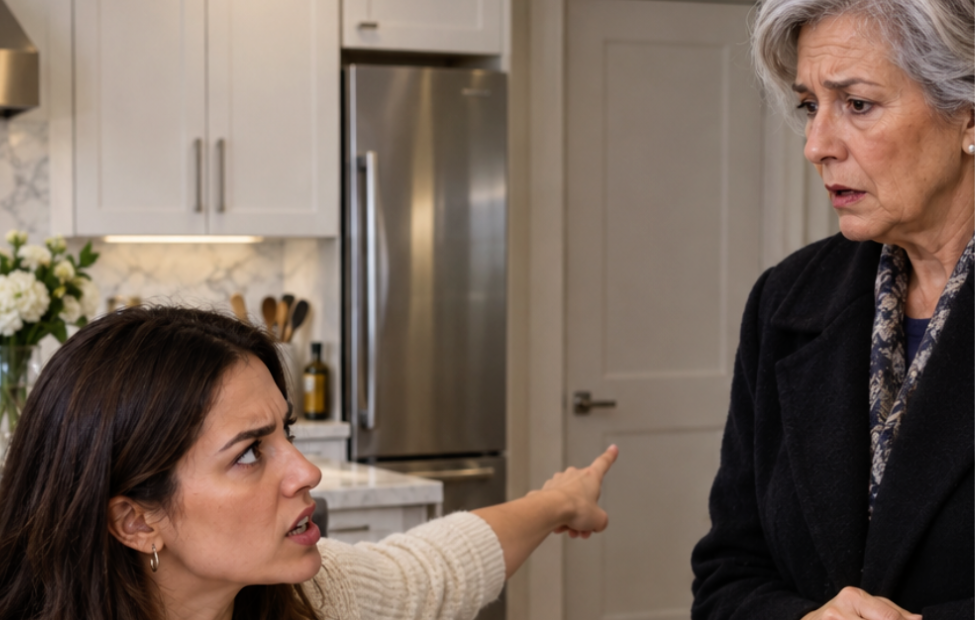
“I did. They were taking pictures of the bedroom.”
“Good. That’s the right thing to do. I’ll come by and we’ll sort this out. Don’t touch anything.”
There actually wasn’t any notice on the first floor. I went down to check: the bulletin board just had ads for stretch ceilings and a slip about a tenants’ meeting. Our concierge, Timofey Ilyich, a former military man who knew everyone in the building by name and by their cars, was sitting at the desk.
“Two guys in blue vests?” he repeated. “Yep, they came through. Told me they were going to forty-two, to your place. I figured if the owner’s expecting them, she’s expecting them.”
“Why did you think I was expecting them?”
He shrugged and scratched his eyebrow.
“Well, they told me your last name. And the floor. Strangers don’t usually know that kind of detail.”
That evening, Andrey came home earlier than usual. He walked through the apartment, stood for a while in the small room where the marks from the tape measure were still visible on the laminate, like someone had drawn a line through the dust with their fingernail. I told him everything: about the vests, the balcony, the phrase at the door.
“Scouts,” he said confidently. “That’s how they operate now. They check what’s in the apartment, where the safe is, when the owners leave. You did the right thing kicking them out.”
“Then why didn’t you want me letting them in without you? Did you know something?”
“Ira, how could I have known? It’s just safer to have a man in the apartment, that’s all.” He opened the fridge and stared inside for a long time. “No need to call the police, nothing was taken. You’ll only waste your time.”
I believed him. Almost. The theory about them being scouts sounded realistic—people had written about it in the building’s group chat, and last year the woman from the fifth floor got her laptop stolen after some fake ‘gas workers’ visited. I ordered a new lock cylinder and decided that was the end of it.
But in the morning, Andrey asked where our apartment documents were.
He asked casually while buttering his bread. Like, since thieves are making the rounds, we should put all the important stuff in one spot, or better yet, take it to his mom’s—she’s got a safe from his late father.
“They’re in the closet, in the shoebox as always,” I said. “And I’m not taking them to your mom’s.”
“Why not?”
— Because those are my documents, Andrey.
He shrugged, but set the knife down too abruptly, making it clatter noisily against the plate.
Nina Pavlovna called that same day, closer to lunchtime. Her voice was cheerful, like someone who already had a few lines prepared.
— Irochka, Andrei told me about the scammers. How awful. You know, I really think you shouldn’t be living in that apartment at all. Seventh floor, the elevator is always breaking down, and you’re alone there all day. You should sell it, buy something simpler and closer to me. It would be safer for me, and you’d end up with some money left over.
— What money, Nina Pavlovna?
— Well, what do you mean what money? The difference in price. A three-room apartment in your area is twelve million now, I checked. And you could get a two-room near me for seven. That’s five million left in your pocket, Ira. Who would say no to that?
— You checked?
She hesitated for just a second.
— Everyone knows! They put up flyers, after all.
After the call, I sat for a long time staring at someone else’s invoices, not seeing a single number on them. Twelve million. My mother-in-law had never once cared about real estate prices in her life—she even paid her utility bills with Andrey’s help through an app. But now, she rattled off a price without a second thought.
I started to think that someone got into her head—her friends at the park bench, TV dramas, maybe the neighbor who’s a realtor. It was just like her: get fired up about someone else’s idea and drag it into our family, the same way she brought cabbage pies. At that moment, I was actually more annoyed at her than at Andrey.
On Friday, Andrey suggested we go to my parents’ country house. It was his idea this time—I didn’t have to beg him, although I usually do. I was happy about it and even baked some cottage cheese pancakes for my mom. But halfway there, he remembered he’d forgotten his phone charger, so we turned back. The apartment door was locked with only one lock, not both. I always lock both. Always.
— You were the last one out, I said.
— I must have forgotten. Ira, please don’t start.
The hallway smelled like someone else’s perfume. Sweet, with a hint of lily of the valley. I don’t use scents like that—they give me a headache. Andrey said it must have drifted in from the stairwell, where the neighbor from the eighth floor always wears perfume. I didn’t argue, but I remembered.
At the country house, I was distracted all evening. Mom noticed, of course.
— What’s wrong? You seem out of sorts.
— Oh, it’s nothing. Just work stuff.
I couldn’t tell her. My mom always said Andrey was reliable. Dad, on the other hand, never said much, except that time he commented, if a man hasn’t hung a single shelf in his wife’s house in twelve years, he’s either very busy or living there like a guest. Back then, I was offended on my husband’s behalf.
The next week, I got a bank app notification. Well, not me exactly, but our shared family account—the one we both use for utilities and groceries. Andrey had transferred forty thousand out. The note said: ‘G. V. for a house call.’
— Who’s that? I asked him that night, showing him the screen.
— Gennady Viktorovich. From work. He helped me diagnose the car, I owe him. — Andrey didn’t even look up from the TV. — Are you checking up on my transfers now?
— It’s a shared account. I put in half.
— There you go. Half yours, half mine. I spent my half.
But half of his contribution had been missing from our account for ages. I pulled up a six-month statement and did the math. Since spring, Andrey had been transferring about three times less than before, and I had just been adding enough to cover everything without looking. Over those six months, I realized I was covering almost all the groceries, utilities, and gas for his car myself. I had no idea where his salary was going.
I did what I do best: I opened a spreadsheet. It’s easier for an accountant to think in columns. On the left, I listed everything odd: the repairmen who knew my last name. The phrase “as we discussed.” Twelve million mentioned by Nina Pavlovna. Documents that needed to go to her safe. One lock instead of two. The lily of the valley in the hallway. Forty thousand to G.V. for a call-out. His money that had stopped coming home.
On the right, I tried to write out explanations. It almost made sense, if you really wanted it to. Accomplices, mom got paranoid, he forgot to lock up, the neighbor put on perfume, a car debt, paycheck delays. But none of these explanations really fit together; you could only believe each one separately.
The next day, I ordered an extract from the registry for my apartment. Through the government portal, in twenty minutes. I’m still the owner, no encumbrances, no liens. I exhaled so loudly I startled myself. No one could sell or mortgage my place without me. So whatever they were up to, for now it was just talk.
But that same evening, I submitted a request that no registry actions could happen without me present. My friend Sveta, who studied with me and now works at a legal office, told me to do that over the phone, without even hearing the whole story.
“Ira, it’s free and takes five minutes. No power of attorney will work unless you show up in person. And change your lock—not just the cylinder, really change it, and don’t give any keys out.”
“Sveta, what if I’m just overthinking? What if it really is just thieves?”
“Then you’ll have a new lock and peace of mind. And if it isn’t just thieves, then it’s all the more important.”
I changed the lock on Wednesday while Andrey was on shift. That evening, he spent a long time fiddling with his key at the door, then called me. I opened up and handed him a new set of keys, just one.
“What’s this?”
“After those repairmen. You said it yourself—could be accomplices.”
“What about mom?”
“Why would mom need it?”
He looked at me for a few seconds, and for the first time, I saw not annoyance but confusion on his face. Like someone whose plan had just gone off track, a plan no one was supposed to know about.
“Because she waters the plants when we’re away.”
“I’m not going anywhere anymore,” I said. “I’ll water them myself.”
On Friday, Nina Pavlovna showed up unannounced. She brought a bag of apples and the face of a wronged queen.
“Andryusha said you changed the locks. And didn’t give one to me. Do you think I’m a thief or something?”
“No, Nina Pavlovna. It’s just that this is my apartment.”
“Yours!” She put the bag on the chair so hard an apple rolled out and hit the baseboard. “My son’s lived here twelve years, but the apartment is still all yours. What is he, a tenant? He’s a man of the house, he should make the decisions. Meanwhile, you sit at your computer all day and see nothing.”
“What don’t I see?”
She pressed her lips together and glanced at her son. Andrey stood by the window, looking out at the courtyard as if there was a football match happening out there.
“It’s alright,” she finally said. “We’ll talk later. When you’ve calmed down.”
She left, and I picked up the apple, holding it in my hand for a long time. I wanted Andrey to say something—anything. That Mom was wrong. That he was on my side. He just had dinner and went to bed, only telling me that I was being paranoid and should really take something to calm down.
I probably would have started taking something to calm down. I would’ve begun doubting myself, apologizing, maybe even given my mother-in-law back her key. I was really close to it. Twelve years had taught me that peace in the family was supposed to matter more than my own discomfort. If it wasn’t for Timofey Ilyich.
On Monday, I went down for the mail and paused at the front desk. The concierge was flipping through his journal and suddenly asked,
“Irina Sergeyevna, those two haven’t come to see you again? The repairmen?”
“No. Why?”
“It just seemed to me that I’d seen one of them before. The one with the mustache. But I couldn’t remember where.” He tapped his temple with a finger. “It’s not a computer in here anymore.”
Then I remembered the photo. When the mustached man was standing in the bedroom, I had absentmindedly taken his picture on my phone to show Andrey later. The shot was blurry, but you could see his face. I found it and handed my phone to Timofey Ilyich.
He put on his glasses, pushed the phone away, then closer again.
“That’s him. Exactly. He came by about three weeks ago—maybe a little more—with your husband’s mother. Nina Pavlovna brought him, and I was surprised because she never brings men around when you’re home. She said he was a window specialist, that you were away, and she was just showing him around as family. So I let them in. She has keys, after all.”
Three weeks ago. That was when Andrey and I had gone to visit my parents for two days, his idea too.
“Did they stay long?”
“About an hour. Maybe more. And they took pictures—I definitely remember that. He was clicking away on the stairs, taking shots of the view from the landing.”
I thanked him and walked up to the seventh floor on foot, because I couldn’t stand to be in the elevator. I stopped on every landing, trying to figure out what I was feeling. Hurt? Anger? But mostly, I just felt ashamed. That for twelve years, I’d kept giving them the keys and called it trust.
At home, I typed “Gennady Viktorovich urgent apartment buyout” into the search bar. I’m not sure why I added “urgent buyout.” Maybe because that phrase had been building in the left column of my spreadsheet for a while, and I just hadn’t let myself say it out loud.
The third link. An agency called “Key Question,” offering to buy apartments in three days, helping people in debt, and specializing in family real estate. On the “Our Specialists” page was my mustached repairman, smiling. Gennady Viktorovich Somov, assessor, twenty years’ experience.
I called the number from the website. My voice was so calm, even I was surprised.
“Hello. I’m calling about the property on Zarechnaya, apartment forty-two. I need to check what stage the deal is at.”
– Just a moment. – The woman on the other end clicked her mouse a few times. – Yes, I see it now. The preliminary agreement is signed, the deposit has been paid, one hundred and fifty thousand. We’re waiting for the owner to show up at the notary. Andrey Nikolaevich said his wife agrees, she’s just sick right now and we need to wait a little. Are you calling on his behalf?
– I am the owner, – I replied. – Irina Sergeevna Belova. I never gave any consent.
There was a sudden silence on the line. Then the woman said she would transfer me to her manager, and she did.
The agency manager, a man with a raspy voice, was not a villain but rather a very cautious person. Apparently, he had seen plenty of people like Andrey before. He explained exactly what I was beginning to understand. Andrey approached them back in April. He said he had debts from loans, that debt collectors were calling his work, and that his wife had wanted to sell the apartment for a long time but was too shy to do it herself. The agency was willing to buy the three-room flat for nine million, urgently, no haggling. Andrey received a deposit of one hundred and fifty thousand in cash ‘to cover the most urgent debts.’ An appraiser inspected the apartment twice: the first time with the client’s mother, the second time, as arranged, with the client himself so they could take good photos for the report.
– He was supposed to be at home, – said the manager. – Your husband. Apparently, our team arrived a bit early. Sorry it turned out this way. I can return your copy of the contract, if you’d like. We’ll recover the deposit from him according to the law—it’s all stated in the paperwork.
– Yes, I want it, – I said. – Please send it to my email.
The contract arrived ten minutes later. Andrey’s signature, his passport details, the address of my apartment, and a phrase: ‘The Seller guarantees the owner’s consent will be obtained by June 30.’ And on the last page, in the ‘contact person’ field: Belova Nina Pavlovna, his mother. And her phone number.
The forty thousand ‘G.V. for a visit’ paid for the second inspection. The scent of lily-of-the-valley in the hallway was from her perfume—the one Oksana gives her every March 8th. I just had never stood so close to my mother-in-law before to notice. Only one lock instead of two. The dacha that Andrey was so eager to go to. Documents that had to be taken to his mother’s safe. Twelve million—’I checked.’ Suddenly, every detail fit together so neatly, there was no room left for ‘maybe I’m being paranoid.’
I forwarded the contract to Sveta with just one word: ‘Here.’ She called me a minute later.
– He can’t sell a thing without you, you know that. The apartment is pre-marital property, your restriction is registered with Rosreestr. But now he’ll have to return the deposit. And, Ira, do you get what he was trying to do to you? He wasn’t trying to trick you—he was trying to wear you down. Getting his mom ready to move, talking about the seventh floor, making you feel ‘paranoid.’ They were hoping you’d cave and agree just to be left alone.
I understood. I understood it very well. The five million ‘difference’ from his mother’s calculations was actually Andrey’s debts, and that two-room flat near Nina Pavlovna would probably have ended up in anyone’s name but mine.
I decided not to ask him directly how much he owed. I tried to find out through a friend at the bank one of my companies worked with, but that led nowhere, so I dropped it. But in the bottom drawer of his nightstand, which I hadn’t looked in for years, there was a stack of letters. Microloans, from four different organizations. The latest demand was for one million nine hundred thousand, including interest. Under the letters was a brochure for an agency called ‘Key Question,’ with a pen circling the amount ‘9,000,000.’
On Saturday, Nina Pavlovna called me herself.
“Irochka, I’ll come by tomorrow with Andrey. And we’re bringing someone else too, for business. You’re a reasonable woman. Let’s talk calmly, without stress, like family.”
“Come by,” I said. “At twelve.”
On Sunday morning, I baked a pie. Not for them. I just needed something to keep my hands busy, and working with dough was the best distraction. I printed out the contract, an extract from the real estate registry, a notification about my statement to Rosreestr, a photo of the mustached man, and a screenshot from the website. I put everything in a regular clear folder and left it on the kitchen table, text side down.
They arrived as a group of three. Nina Pavlovna wore a burgundy coat, Andrey brought flowers—which he hadn’t given me since our fifth anniversary, I think. And there was Gennady Viktorovich, without his vest, dressed in a suit, clutching a leather folder under his arm.
When he saw me, the appraiser slowed his pace a bit. Apparently, he’d been warned this was going to be a straightforward conversation.
“Irina, let me introduce you,” Nina Pavlovna began as she walked straight into the kitchen like it was her own. “This is Gennady, he’ll help us with the move. He’s someone we trust.”
“We’ve met before,” I said. “He was the one taking pictures of the radiators in my bedroom. Please, have a seat.”
Andrey cleared his throat and set the flowers on the windowsill. Nina Pavlovna took the seat at the head of the table—my seat—and folded her hands.
“Well, it’s good you’ve already met. Here’s the situation: Andrey’s going through a tough time, as you know. Work, his boss—lots of pressure. We’ve thought it over. We’re selling the apartment. There’s a good offer, and it’ll go quickly. We’ll buy a two-bedroom near me—I’ve already found one. It’ll be put in my name, for peace of mind, just in case. You’ll keep living as you have. And Andrey will use the rest of the money for his business.”
“What business?” I asked.
“That’s a man’s business,” she shot back. “Not your concern.”
I flipped the folder over and placed the first document in front of her. It was the extract from the real estate registry.
“I’m the sole owner. Since 2011. This is for you, Nina Pavlovna, to clear things up once and for all.”
Then I set the second document in front of Andrey.
“This is a notification from Rosreestr. As of the 12th, no transactions with my apartment can happen without me there in person. No power of attorney or anything else.”
Andrey didn’t take the document. He looked at it like it was a bill at a restaurant where he wasn’t the one ordering.
The third sheet I set in front of Gennady Viktorovich.
“This is your preliminary contract with my husband. Deposit of 150,000. ‘The seller guarantees the owner’s consent.’ I’ve already informed your agency that there won’t be any consent. Your boss knows, so it was a waste coming here on the weekend.”
The appraiser silently took the paper, scanned it, shoved it back into my pile, and got up.
“Andrey Nikolaevich,” he said while buttoning up his jacket, “we told you, we don’t work without the owner present. Someone will contact you about the deposit. All the best, Irina Sergeevna.”
The door closed behind him quietly, almost politely. In the kitchen, the hum of the refrigerator suddenly became noticeable.
“What kind of circus is this?” Nina Pavlovna said. Her voice was hoarse, and she cleared her throat. “Were you spying on your husband? Were you snooping through his things?”
“I was walking around my own apartment. The same apartment you brought an appraiser to three weeks ago when I wasn’t home. Timofey Ilyich remembers you quite well. And your Gennady too.”
She opened her mouth, then closed it. She turned to her son.
“Andryusha, tell her.”
Andrey rubbed his face with both hands. Then, for the first time during all this, he looked me straight in the eyes.
“Ira, I have debts. Almost two million. I wanted to pay them off quickly so you wouldn’t find out. Mom said you’d agree anyway if we presented it right. Honestly, what do you need a three-room apartment for by yourself?”
“And whose idea was it to put the two-room place in someone else’s name, your mom’s too?”
He stayed silent. But the answer was written all over his face.
“You told me not to let repairmen in when you weren’t home,” I said. “But you weren’t afraid of thieves, Andrey. You were afraid they’d say too much in front of me. And they did: ‘just like we said before.’”
Suddenly, Nina Pavlovna stood up, grabbed her purse, and slung her coat over her arm.
“I’m not going to be a part of this,” she said to no one in particular. “I meant well. I’m a mother.”
“You’re the contact person listed on the contract,” I reminded her. “Your phone number is there, Nina Pavlovna. If the agency files a lawsuit to recover the deposit, you’ll be the first they call.”
She froze in the kitchen doorway. Her coat started to slip from her arm and she caught it at the last moment.
That evening, I packed Andrey’s things. Two suitcases and a box of tools he hadn’t opened in twelve years. He sat on the edge of the bed, watching as I folded his shirts.
“Are you kicking me out because of the money?”
“No. I’m kicking you out because you tried to sell my home and move me in with your mother. This isn’t about the money, Andrey. The money—you’ll deal with that on your own now.”
“I have nowhere to go.”
“Go to your mom,” I said. “She has a two-bedroom. The one she wanted all along.”
He left that same evening. He put his key on the hallway table, next to my purse, right where that red laser pointer dot had wandered just a week before.
The divorce took three months. There wasn’t much to divide: Sveta brought court statements, the twelve-year-old sale contract, and my receipt for the last mortgage payment I’d made with my bonus. Andrey didn’t argue. The agency reclaimed the deposit from him through the court in installments, plus a penalty. Nina Pavlovna, as my neighbor later told me, sold her dacha near Konakovo to pay off at least part of his debts. The same dacha where every summer she’d complain that I was weeding the strawberries wrong.
She called once, in November. She asked if I wanted to ‘make peace for Andryusha’s sake.’ I told her that for twelve years, I fed her son, and hung up. She never called again.
For New Year’s, I gave Timofey Ilyich a good thermos because he kept complaining that his tea would get cold during shifts. He was embarrassed and told me he hadn’t done anything special—it’s just that he still remembers faces well.
In the spring, I finally sorted out the small room—the one with windows facing the courtyard that the appraiser really liked. I took out Andrey’s old exercise machine that had become a drying rack for laundry, painted the walls light green, and brought in the big desk I’d dreamed of since college. Now I manage five companies at that desk, not just three, and each morning the first thing I do is open the window. There’s a birch tree growing in the courtyard, and you can only see it from this room.
Yesterday, someone rang the doorbell. I looked through the peephole and asked who it was. It turned out to be the real technicians I had called myself to check the meters. I let them in, showed them to the bathroom, and then stood in the hallway drinking coffee while they worked. Nobody peeked into my bedroom. Nobody measured my life with a tape measure.
Sometimes the truth stands right on your doorstep—you just have to be brave enough to open the door and look it in the face.