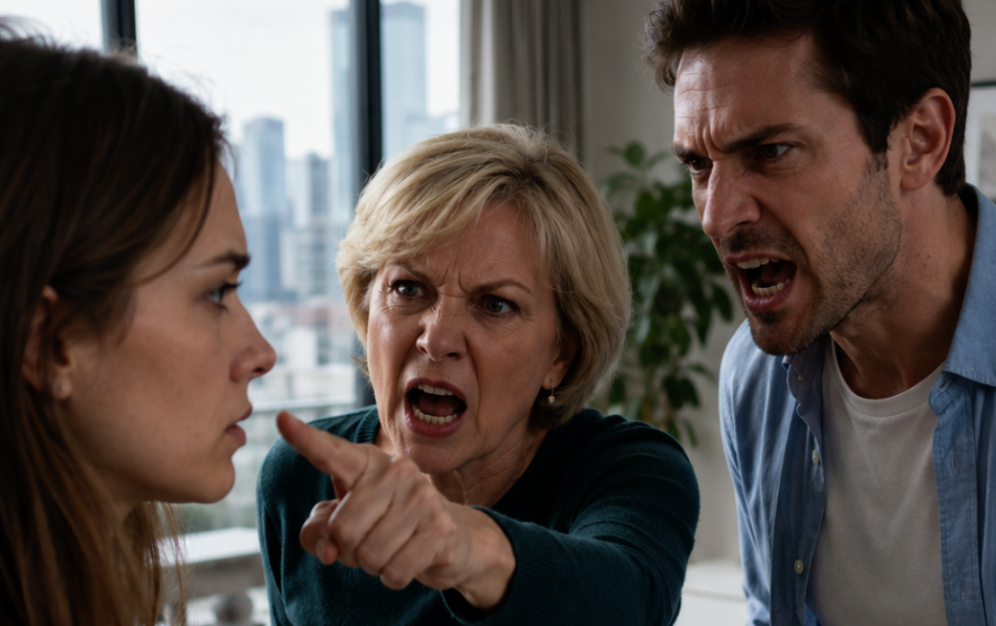
“Get out of my life,” Andrey said quietly, almost calmly. And that calmness was the most frightening thing of all. “Pack your things and leave. The easy way. While I’m still asking.”
Katya stood in the middle of the living room and looked at her husband.
Ten years.
For ten years she had looked at that face — and suddenly she saw it for what it truly was, as if someone had switched on the light in a dark room.
“Are you serious?” she asked.
Her voice came out even, without a tremor. She was surprised herself.
Andrey did not answer. He stood by the window, scrolling through something on his phone, pretending the conversation was already over. Tall, wearing an expensive sweater, carrying himself with that certainty in every movement — the certainty that Katya had once mistaken for reliability.
Now she understood. It had never been reliability.
It was arrogance.
She went into the kitchen and poured herself some water. Not because she was thirsty. She simply needed to go somewhere, to do something with her hands. A magnet from Prague hung on the refrigerator — they had brought it back from their honeymoon. Katya took it down, turned it between her fingers, and placed it in the desk drawer. In the same drawer where old batteries and a roll of tape were kept.
Just like that.
It had all begun by accident — as most unpleasant discoveries do.
Six months earlier, Katya had been looking for a recipe on her husband’s tablet. He used to download cooking collections there, she had laughed to herself at the time, and then she stumbled upon a chat in a messenger app.
She did not read it.
She closed it immediately.
But she had managed to see a few things: the name “Olya” and a sum of money. A large sum. With the note: for Mishka’s teeth.
Mishka.
So there was a Mishka.
That night, Katya put the tablet back on the charger, returned to the bedroom, and lay down. Andrey was sleeping beside her, breathing evenly. She stared at the ceiling until four in the morning and thought:
Did I know this?
No.
Did I feel it?
Yes.
Always.
Then came a week during which she smiled at dinner, served food onto plates, asked him how things were at work, listened to his answers — while in her mind she was assembling the puzzle.
Transfers she had glimpsed in their shared statement.
“Household expenses.”
“Materials.”
“For services.”
He had always explained them away — repairs, clients, contractors. She had nodded. She had believed him.
Was she a fool?
Maybe.
But more likely she was simply a person who had not wanted to know the truth before she was ready to do something about it.
Then Katya began to act.
She worked at a small law firm. She specialized in family law, which now seemed to her like a cruel irony of fate, and she knew how to think methodically. She requested details for the card she had access to. She asked her colleague Sasha, casually, to explain what a scheme for hiding assets during a divorce might look like.
Sasha explained it with pleasure. He loved conversations like that.
Within three months, she had gathered enough.
The transfers had been made regularly — every month, sometimes more often. To the same name, to the same card. The amounts varied: from twenty thousand to one hundred and fifty thousand.
Over three years — more than two million.
Their shared money.
Money Katya also earned.
Olya had a son. Mishka was three years old. Katya found her social media page — private, but some things still leaked through. A fair-haired little boy with his father’s ears.
She looked at the photo for five minutes.
She did not cry.
Andrey did not know that she knew.
And that was her greatest advantage.
When he told her that morning — get out, the easy way — Katya understood: something had changed. He had made some decision. He was in a hurry. That meant he was nervous.
She returned to the living room.
“Andrey,” she said, sitting down on the sofa. “Sit down.”
He raised his eyes.
“I have nothing to talk to you about.”
“Sit down,” she repeated. “Please.”
Something in her tone stopped him. He sat in the armchair across from her. Crossed his arms.
“I’m not leaving,” Katya said. “And not because I have nowhere to go. Because I do not intend to hand over to you what belongs to both of us. Do you understand what I’m talking about?”
“This is my apartment.”
“Half of it is mine. We bought it during the marriage.”
He smirked — briefly, almost imperceptibly. That smirk meant: You can’t do anything to me.
He had always thought that.
About everyone.
“Katya, don’t start. I’m tired of this marriage. You’re tired too. Let’s separate normally.”
“Normally,” she repeated thoughtfully. “That’s an interesting word. Tell me, Andrey: transferring two million from the family budget to another woman — is that normal?”
Silence.
The first real silence of the entire morning.
His face did not change — almost. Only his fingers tightened slightly on the armrest.
“I don’t know what you’re talking about.”
“Yes, you do,” she said. “Olya. Mishka. Three years old. Do you want me to list the amounts by month?”
At that exact moment, the front door slammed.
Her mother-in-law, Nina Vasilyevna, always entered without ringing. She had a key, which Andrey had given her about eight years earlier “just in case.”
“Just in case” happened about three times a week.
“Andryusha!” she called from the hallway. “I brought you…”
She entered the living room and stopped. She looked at her son, then at her daughter-in-law, then back at her son.
“What is going on here?”
“Nothing, Mom,” Andrey said. “Please leave.”
“What do you mean, leave? I can see something is…”
“Nina Vasilyevna,” Katya said calmly. “We’re talking. It’s an important conversation.”
Her mother-in-law pursed her lips. Nina Vasilyevna was a short, sturdy woman with a perm and the gaze of an investigator. She had never liked Katya — too independent, too quiet, too much of her own mind.
A daughter-in-law was supposed to be different: loud, simple, understandable.
Easier to control.
“Are you starting again?” she asked Katya, with that familiar squint Katya knew by heart. “Andryusha told me that you…”
“Mom!” Andrey stood up. “I said enough.”
But Nina Vasilyevna was already walking toward the sofa, already taking off her jacket, already settling in — for the long haul, like the owner of the place.
“I’m not going anywhere,” she announced. “This is my son’s home. I have the right to know what is happening.”
Katya looked at her. Then at Andrey.
And suddenly she understood something important.
They both thought she was alone.
They both thought she had nothing except this apartment and ten years thrown into someone else’s pocket.
They were wrong.
“Fine,” Katya said and stood up. “Since we’re all here… Nina Vasilyevna, did you know about Olya?”
Her mother-in-law blinked.
“What Olya?”
“The one your son has been paying for three years from our joint account. She has a child by Andrey. A boy. Mishka.”
The living room became very quiet.
Only the refrigerator hummed in the kitchen — steady, indifferent, as if it had nothing to do with human catastrophes.
Nina Vasilyevna slowly turned to her son.
“Andryusha?”
He was silent.
And in that moment, Katya understood: her mother-in-law had known. Not everything. But something — she had known. It was in the way she looked. Not with surprise. With assessment — trying to determine exactly how much the daughter-in-law knew.
Katya picked up her bag from the chair.
“I’m going to the office,” she said. “I have a meeting with a lawyer. You can talk in the meantime.”
“Stop,” Andrey snapped.
“You leave the easy way,” she said, already at the door. “Or the court will find out everything about those transfers. The choice is yours.”
Katya’s lawyer was named Roman Evgenievich — a lean man of about fifty, with a habit of drumming his fingers on the table when he was thinking. He listened to her silently, without interrupting.
Then he drummed his fingers.
Then he said:
“Two million over three years from the joint budget — that’s good. Very good for us.”
“I’m glad someone is pleased,” Katya replied.
He did not smile. He simply opened a folder and began writing.
Katya looked out the window. Down below, the city was noisy — cars, people, someone’s dog pulling at its leash. Life went on as if nothing had happened, and for some reason that irritated her most of all.
She filed the claim a week later.
Andrey learned about it from his lawyer — whom, apparently, he had hired in advance. So he had been preparing. So there had been a plan.
Katya thought about that on the way home and felt something strange. Not offense, no. Something resembling respect for her own intuition.
She had felt everything correctly.
She had simply spent too long convincing herself she was mistaken.
That evening Andrey came home late. They barely spoke. He slept in the study; she slept in the bedroom. The apartment began to resemble an office where two employees in a quarrel were forced to share space.
And then Olya appeared.
It happened on Wednesday, around noon.
Katya left a café after a meeting with Roman Evgenievich and saw her near the entrance — a young woman with a stroller. Twenty-eight, no older. Fair hair, jeans, sneakers. Nothing remarkable.
Except for her gaze — direct, without a shadow of awkwardness, as if Katya were the one out of place here, not her.
“Ekaterina?” the woman asked.
Katya stopped.
“Yes.”
“I’m Olya. I think you know who I am.”
A pause.
In the stroller, a fair-haired boy was moving around — that same Mishka with his father’s ears. Katya looked at him for one second and turned away.
“I know,” she said.
“Then I’ll be direct.” Olya shifted her shoulder slightly — a confident, almost careless gesture. “Andrey told me you filed for divorce and intend to divide the property. I want you to understand: he has a child. Mishka will be taken into account in any division.”
Katya slowly exhaled.
“You came to explain this to me?”
“I came to reach an agreement. Like decent people. Before anything ugly starts.”
Ugly.
Katya mentally noted the word.
So, to her, court was ugly.
Not three years of secret transfers. Not another woman’s child being raised on family money.
Court was ugly.
“Olya,” Katya said evenly. “I have nothing to agree on with you. If you have questions for Andrey, talk to him. If you want to get something through the court, hire a lawyer.”
“I already have,” Olya said, and something firm appeared in her voice. “And my lawyer says the chances are good. Andrey supported us for three years. That can be proven. Which means the relationship can be recognized as an actual family relationship.”
Katya looked at her carefully.
So that was it.
Not just a mistress with a child.
A woman with a plan.
“Good luck,” Katya said, and walked toward her car.
“You’ll regret not making an agreement!” came from behind her.
Not a shout.
Almost calm.
Which was worse than shouting.
That evening, Nina Vasilyevna called.
“Katya,” she began in a tone suggesting that she was already doing her a favor by dialing her number. “Do you understand what you are doing to the family?”
“What family, Nina Vasilyevna?”
“Andrey is a father. He has a child. Little Mishenka. Do you want the boy to grow up with nothing?”
Katya closed her eyes for three seconds.
“Little Mishenka grew up on my money for three years,” she said. “I think I’ve done enough to give him a start in life.”
“You’re selfish!” her mother-in-law’s voice rose. “You always were! Andryusha suffered with you. You’re cold, you’re closed off, you didn’t want children…”
“Didn’t want children?” Katya almost laughed. “Nina Vasilyevna. Andrey and I underwent treatment for five years. I went through four IVF protocols. Did you know that?”
Silence.
“He didn’t tell you,” Katya understood. “Of course. Why tell the truth when it’s more convenient to make me guilty?”
Her mother-in-law did not hang up. She simply fell silent for a long time — and in that silence there was something alive, almost human.
Maybe she really had not known.
Maybe Andrey knew how to lie equally well to everyone.
“I didn’t know about the IVF,” Nina Vasilyevna said at last. Quietly.
“I understand,” Katya replied. “Good night.”
The first hearing took place at the end of the month.
Olya arrived with a lawyer and with Mishka — though she left the boy with some woman in the corridor, the very fact of the child’s presence was clearly meant as a gesture.
Andrey sat with a stone face. His lawyer — young and talkative — immediately began speaking about “voluntary financial assistance” that “does not constitute marital property.”
Roman Evgenievich listened, drummed his fingers, and waited for his turn.
When it came, he spoke for twenty minutes. Calmly, with figures, with dates. The regularity of the transfers. The sums that did not correspond to any “household expenses.” The absence of the second spouse’s consent.
Katya looked at Andrey.
He looked at the table.
Olya looked at Katya. With curiosity, almost appraisingly. As if only now she was truly seeing her and trying to understand: Who was this woman who did not scream, did not cry, did not make a scene?
Katya held her gaze.
Calmly.
I am the one who gathered every document, she thought. I am the one who waited and prepared. I am the one you both underestimated.
The judge postponed the hearing for three weeks.
On the way home, Katya stopped at a small flower shop — for no reason at all. She bought one tulip. Orange. At home, she placed it in a glass of water.
Andrey came home late and went into the kitchen. He saw the tulip.
“What is this?”
“A flower,” Katya said.
He looked at her with an expression she could not decipher. Not anger. Something else. Perhaps, for the first time in a very long time — confusion.
“Katya…” he began.
“Don’t,” she said. Without malice. Simply tired. “Please don’t.”
She took the glass with the tulip and went into the bedroom. Closed the door. Behind the wall, it was quiet — Andrey was standing in the kitchen. She could sense it with some sixth sense.
Standing there, not knowing what to do.
That was a new feeling.
Not her confusion.
His.
And Katya understood that something irreversible had changed right then. Not when she found the messages. Not when she filed the claim. But here — in the quiet apartment, with the orange tulip in a glass — when she stopped being afraid of him.
The three weeks before the next hearing dragged on strangely, as if time had thickened.
Andrey was almost never home. He came late, left early, left empty mugs in the kitchen and the smell of someone else’s tobacco — he had not smoked for seven years, which meant he was nervous.
Katya washed the mugs silently and thought:
So this is what the end looks like.
Not a scandal, not broken dishes.
Just someone else’s mugs in someone else’s kitchen.
Olya, meanwhile, did not stay quiet.
She wrote Katya a message — long, sometimes pitiful, sometimes threatening, with a photo of Mishka at the end. Katya read it and showed it to Roman Evgenievich. He took a screenshot and said, “Excellent.”
Then Olya wrote again — shorter, angrier.
Then she called from an unknown number and said that Katya was “destroying a child’s life.”
“You and Andrey are destroying the child,” Katya replied. “Not me.”
And she hung up.
When Roman Evgenievich found out about the calls, he shook his head with the expression of a man whose clients were doing his work for him.
A week before the hearing, Nina Vasilyevna called.
Katya almost did not answer. But something stopped her — perhaps fatigue, perhaps curiosity.
“Katya,” her mother-in-law said. Her voice was different. Without the usual pressure. “I want to talk. Not on the phone. Can you come?”
It was so unexpected that Katya agreed.
Nina Vasilyevna lived in an old district, in a Khrushchev-era apartment building on the fifth floor with no elevator. Katya climbed the stairs and thought that in ten years she had been there perhaps twenty times at most.
Her mother-in-law had always come to them — with pies, with advice, with complaints.
The door opened immediately — which meant she had been waiting at the peephole.
The apartment smelled of old furniture and valerian. There was tea on the table, two cups. Nina Vasilyevna looked smaller than usual — without her coat, without her bag, just an elderly woman in a house robe.
“Sit down,” she said.
Katya sat.
They were silent for two minutes. Nina Vasilyevna looked into her cup.
“I knew about Olya,” she said at last. “Not from the very beginning. About a year and a half ago, Andrey told me. Asked me to keep quiet.”
Katya did not answer. She simply waited.
“I thought it would resolve itself,” her mother-in-law continued. “I thought he would come to his senses. Men sometimes do foolish things…” She stopped. “I understand how that sounds.”
“It sounds exactly the way it sounds,” Katya said quietly.
Nina Vasilyevna nodded — unexpectedly meekly.
“I am guilty before you. I didn’t protect you. I pushed you away when I should have pushed him away.”
Katya looked at her.
In ten years — their first honest conversation.
Why was it always like this? Why did it take a catastrophe for people to become human?
“I didn’t know about the IVF,” Nina Vasilyevna repeated what she had said on the phone. “He said you didn’t want children. That your career was more important.”
“Four protocols,” Katya said. “Four times. The last one was three years ago. I didn’t get out of bed for a week. Andrey was… busy during those days.”
Nina Vasilyevna closed her eyes.
Sunlight shone through the window. Somewhere below, children were shouting in the courtyard. Katya suddenly felt a strange lightness — not joy, not forgiveness. Simply a release from something heavy that she had carried for too long.
“I’ll testify,” Nina Vasilyevna said. “If necessary. About what I knew. About the fact that he asked me to keep silent.”
Katya looked at her carefully.
“Why would you do that?”
“Because I’m ashamed,” her mother-in-law answered simply.
The second hearing began unexpectedly.
Olya appeared again — this time without Mishka, but with a new lawyer, an older and very loud man. From the doorway he began speaking about “established stable relations” and “moral damages.”
Andrey sat to the side, staring at one spot. He had lost weight over these weeks; dark circles had appeared beneath his eyes.
Katya looked at him and thought:
Once, she had loved this man.
Truly, without reservations.
That had existed, hadn’t it?
It had.
Roman Evgenievich waited for a pause and presented Nina Vasilyevna’s testimony — written and certified.
The room became very quiet.
Olya’s lawyer stopped mid-sentence. Andrey slowly turned his head and looked at Katya — for the first time during the entire hearing.
There was something in his gaze she had not expected.
Not anger.
Not calculation.
Something like exhaustion.
The same kind as hers.
We are both tired, she thought.
Only in different ways.
The judge examined the documents. Then again. Then announced a recess.
In the corridor, Olya approached Katya.
“You did that on purpose,” she said. Quietly, almost without intonation.
“Did what exactly?”
“Your mother-in-law. That was a blow below the belt.”
Katya looked at her calmly.
“Olya. You came to another woman’s husband. You lived on someone else’s money for three years. You came up to me at a café and explained how I should behave. Then you called from unknown numbers.”
She tilted her head slightly.
“Tell me again about blows below the belt.”
Olya opened her mouth.
Closed it.
For the first time in all this time, Katya saw in her not a threat and not a rival. Just a young woman who, in her own way, had also ended up trapped. A different trap, from the other side — but still a trap.
That did not make her right.
But it made her a little more understandable.
“Take care of your son,” Katya said. “Andrey is obligated to pay child support. That is legal and right. The rest is not my story.”
And she walked past her.
The court decision arrived a month later.
The apartment was to be divided in half — with Katya having the right to buy out the share or sell. The two million in transfers were recognized by the court as joint funds used without the spouse’s consent — Andrey was ordered to pay compensation. Not the entire amount, but a significant portion.
Olya was denied recognition of an actual family relationship. Child support would be a separate claim, and that was no longer Katya’s story.
Roman Evgenievich called her himself — something he rarely did.
“Congratulations,” he said. “A good result.”
“Thank you,” Katya replied.
She stood by the window of her — now officially her — half of the apartment. On the windowsill stood the glass with the dried orange tulip. She still had not thrown it away. She did not know why.
Maybe because it reminded her:
There had been a moment when she stopped being afraid.
And that moment was worth remembering.
Andrey came to collect his things on Saturday.
Katya left during that time — walked along the embankment, stopped by a bookstore, bought two novels and a notebook. When she returned, the apartment was empty in the places where his wardrobe, his armchair, and his shelves of business books — which he had never read — used to stand.
Strangely, it became brighter.
On the kitchen table lay an envelope. She opened it. Inside were keys. And a note, three words:
Forgive me. If you can.
Katya stood still for a while. Then she put the note back. She hung the keys on the hook by the door — not because she was waiting for him, but because she did not yet know where else to put them.
Then she put the kettle on. Took out one of her new books. Opened it at random and read the first line her eyes fell on — something about the sea, and about how every road sooner or later leads you to where you are meant to be.
Maybe so.
She poured tea. Sat by the window. Beyond the glass, the city lived its own life — loud, indifferent, endless.
And for the first time in a long while, that indifference did not hurt.
It felt freeing.
Just life.
Just a new page.
Katya took a sip and began to read.
A year later, she rented out one room to a young postgraduate student named Vera, quiet and always wearing headphones. They rarely crossed paths, but sometimes in the mornings they drank coffee in the kitchen and talked about nothing: the weather, books, the fact that lilacs had finally been planted in the neighboring courtyard.
It was good — that unobtrusive presence of another life nearby.
She saw Andrey twice — at the notary and at the bank. Both times they spoke only about business. He looked different: quieter, smaller. As if someone had let out the air that had once taken up too much space inside him.
Katya did not gloat. She simply looked at him and thought that perhaps now he would have to sort himself out too — and that was harder than any court case.
Nina Vasilyevna called in March to wish her a happy birthday. Katya had not expected the call. They did not speak for long. At the end, her mother-in-law said, “Stay strong,” and it did not sound like a formal phrase. It sounded like something real.
Katya answered, “You too.”
She did not call again.
But even that was honest in its own way.
Work changed. Katya took several difficult cases herself, without partners. It turned out she was capable of more than she had thought. Or perhaps before, she had simply never given herself enough space to find out.
She threw away the orange tulip in November, while doing a thorough cleaning and finally reaching the windowsill. She stood there for a second. Then she threw it away calmly, without ritual.
The memory of that moment had not gone anywhere.
It simply no longer needed a reminder.
One evening, Katya was walking home past the flower shop and stopped again. She bought three tulips — no longer one, and no longer orange, but pink, simply because she liked them.
She placed them on the table.
Vera, passing by, said, “Oh, beautiful.”
“Yes,” Katya agreed.
And it was true.