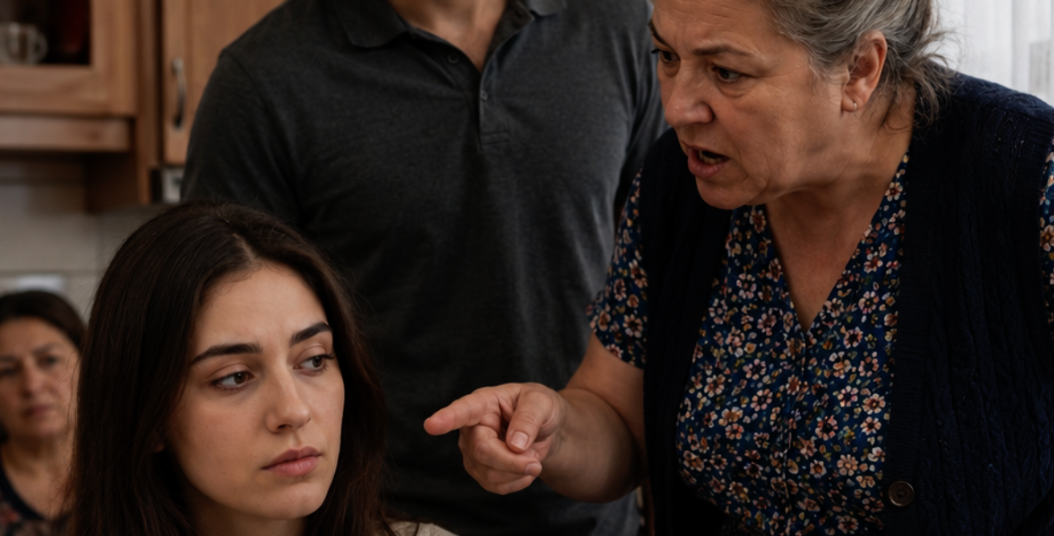
The autumn rain tapped against the apartment windows, creating the special kind of coziness Svetlana loved so much. The evening had been peaceful — Kirill was browsing the news on his tablet, while his wife was preparing dinner. This two-room apartment was the only thing Svetlana had left from her parents. After her father and mother passed away, the property had been inherited by their daughter, becoming a safe refuge for the young family.
The doorbell interrupted the evening idyll. Svetlana wiped her hands on a towel and went to open the door, already guessing who might show up unannounced at such an hour.
“Tamara Ivanovna, welcome,” the daughter-in-law said restrainedly, letting her mother-in-law into the hallway.
Tamara Ivanovna took off her raincoat, cast a critical glance around the apartment, and walked into the living room without even properly saying hello. The woman always carried herself as if the whole world was supposed to revolve around her. At fifty-eight, she still had an authoritarian character and the habit of controlling the lives of everyone around her.
“Kirill, we need to talk,” his mother declared, settling into an armchair. “A serious talk.”
Svetlana’s husband put down his tablet. His eyes darted toward his wife, then back to his mother. From her son’s face, Tamara Ivanovna understood that this conversation would not be easy.
“Mom, what happened?” Kirill asked cautiously.
“What happened is that I can’t keep carrying this burden alone anymore!” his mother-in-law’s voice grew sharper. “Three years ago, I took out a loan for a house in the Moscow region. I thought the children would help me pay it off. But what do we have now? I’m paying alone, giving my last kopecks to the bank!”
Svetlana froze with a plate in her hands. What house? What loan? Her husband had never told her the details of his mother’s financial affairs.
“Mom, but we talked about this,” Kirill began. “You decided to buy that house yourself. We didn’t ask you to…”
“Didn’t ask?!” Tamara Ivanovna jumped up from her seat. “And who did I buy it for? The neighbors? I thought the grandchildren would spend summers there, that the family would have its own little place in nature!”
The daughter-in-law set the plate on the table a little louder than necessary. Tamara Ivanovna did not have any grandchildren yet, but she regularly hinted at the subject, as if Svetlana were obligated to give birth on demand.
“How much exactly is the debt?” Svetlana asked, trying to remain calm.
“Two million eight hundred thousand rubles,” Tamara Ivanovna answered bluntly. “The monthly payment is seventy thousand. My pension only covers a third of it.”
Kirill turned pale. Svetlana lowered herself onto a chair, trying to grasp the scale of the problem. Such money was simply unimaginable for their family.
“Tamara Ivanovna, why don’t you sell the house?” the daughter-in-law suggested. “If the payments are so heavy…”
Her mother-in-law turned to Svetlana with an expression as if she had suggested burning all the family photographs.
“Sell the house? My dream? What I built for future generations?” Every word sounded like an accusation. “No, my dear. The house stays in the family.”
“Then what solution do you see?” Svetlana crossed her arms over her chest.
Tamara Ivanovna slowly swept her gaze around the room, lingering on the expensive electronics, the quality furniture, the paintings on the walls.
“The solution is simple. Since you are my son’s wife, you will pay off the debt for the house. Sell the apartment.”
Silence hung in the air, heavy and tense. Svetlana blinked several times, unable to believe what she had heard. Kirill froze, looking from his mother to his wife.
“Excuse me, what?” Svetlana’s voice sounded quieter than usual.
“You understood me perfectly,” Tamara Ivanovna leaned back in the armchair with a satisfied look. “You sell this apartment, pay off the loan, and we all move into the house together. There’s enough space there for everyone.”
“Mom…” Kirill started, but his mother cut him off with a gesture.
“Kirill, you are a grown man. It’s time to think about the family, not only your own comfort. Svetlana got this apartment for free, from her parents. It’s time to use that inheritance for the benefit of everyone.”
Svetlana’s cheeks flushed with outrage. Got it for free? As if her parents had given her the apartment as a birthday present, and not left her their only property after their deaths.
“Tamara Ivanovna, this is my apartment. My inheritance. And I have no intention of selling it to anyone.”
“Oh, is that so?” Her mother-in-law rose from the armchair, her face twisted with anger. “So you don’t care about the family’s problems? What, am I supposed to live on the street when the bank takes the house?”
“Mom, calm down,” Kirill intervened. “Let’s discuss this calmly…”
“What is there to discuss?” Tamara Ivanovna waved her hands. “Your wife should understand: when you get married, you accept not only your husband, but also his family with all its problems!”
Svetlana stood up from the table, her fists clenching on their own. How could someone be so shameless? To demand that another person sell her apartment to pay off debts she had created herself?
“I married Kirill, not the bank you owe money to,” the daughter-in-law replied sharply.
“You little…” Tamara Ivanovna took a step forward, but Kirill stood up and placed himself between the women.
“Mom, enough. Svetlana is right. You can’t demand that she sell her parents’ inheritance.”
His mother turned to him with a look as if he had betrayed every family value.
“So that’s how it is! Your wife is more important to you than your mother! I raised you alone after your father left. I worked two jobs so you could study and dress decently. And now, when I need help, you turn your back on me!”
“Mom, that’s not true…”
“It is exactly true!” Tamara Ivanovna grabbed her handbag. “Since you’re both so principled, deal with it yourselves. But when the bank takes the house and I’m left without a roof over my head, remember — this was your choice!”
His mother-in-law headed for the exit and slammed the door so hard that the glass in the sideboard trembled. Svetlana sank onto the sofa, trying to collect her thoughts. Kirill stood in the middle of the room, confused, staring at the closed door.
“Does she seriously think I’m going to sell my apartment because of her debts?” Svetlana asked quietly.
Her husband sat down beside her and rubbed his forehead with his palm.
“Mom has always been… determined. When she gets something into her head, it’s hard to convince her otherwise.”
“Determined?” Svetlana turned to Kirill. “She is demanding that I sell my inheritance! The only thing I have left from my parents!”
“I understand that it sounds strange…”
“Strange?” his wife’s voice grew louder. “It sounds insane! Why should I pay off a loan your mother took without our involvement?”
Kirill sighed, avoiding direct eye contact.
“Svetlana, Mom isn’t getting any younger. If the bank really takes the house, where will she live? You can’t rent an apartment on a pension…”
“Wait,” the daughter-in-law frowned. “Are you supporting her idea?”
“I’m not supporting it. I’m just trying to understand the situation from all sides.”
“What other sides are there? Your mother got herself into debt without consulting us. Now she demands that we pay for it. Where is the logic?”
Kirill stood up and paced the room.
“The house really is good. A big plot of land, the forest nearby. If you think about it practically…”
Svetlana slowly turned her head toward her husband.
“Are you serious? Do you really think I should sell the apartment?”
“You don’t have to. But maybe it’s worth considering the option? The house is bigger than the apartment. The air is cleaner. If we ever have children…”
“If we have children,” Svetlana stood up, “they will live here. In my apartment. Which I will not sell to anyone.”
“Svetlana, be reasonable…”
“Reasonable?” his wife’s eyes flashed. “It would have been reasonable for your mother to think about the consequences before taking out such a huge loan!”
Her husband stopped and turned to her.
“Mom counted on our support. In a family, people help each other.”
“In a family, people consult each other before making decisions that affect everyone,” Svetlana cut him off.
A serious conflict was brewing. Kirill understood that, but he did not want to back down. Over the past few months, his mother had regularly complained about the heavy payments, asked for advice, hinted at needing help. Gradually, her son had gotten used to the idea that the problem had to be solved by the whole family.
“Listen,” Kirill sat down opposite his wife, “let’s think soberly. If we sell the apartment, we’ll close the loan and get our own house. Isn’t that a decent prospect?”
Svetlana looked at her husband as if she were seeing him for the first time.
“A decent prospect? For whom? I work in the city center. Am I supposed to commute from the Moscow region every day? And the utility bills for the house? Property taxes? Repairs if something breaks?”
“Those are all solvable issues…”
“Solvable with my money from the sale of my apartment!”
Kirill fell silent. His wife’s arguments were reasonable, but his mother’s tears and reproaches would not leave his mind either. Tamara Ivanovna knew how to get to her son, playing on his guilt and sense of family duty.
“All right,” her husband finally said. “Suppose you don’t want to sell the apartment. Then how do we solve the problem with the loan?”
“What problem?” Svetlana crossed her arms. “This is your mother’s problem. Let her sell the house and rent a place she can afford.”
“Mom will never agree to sell the house.”
“Then let her declare bankruptcy. There are legal ways to deal with debt problems.”
Kirill shook his head.
“You don’t understand. Mom dreamed of this house for years. She planned for children and grandchildren to gather there…”
“Dreaming and taking out a loan you can’t pay are two different things.”
The conversation reached a dead end. Her husband was clearly leaning toward his mother’s point of view, while Svetlana categorically refused to sell her parents’ inheritance. A compromise seemed impossible.
“You know what,” Svetlana rose from the sofa, “I’m tired of this conversation. I have an important presentation at work tomorrow. I need to prepare.”
She went to the computer, turned it on, and opened her work files. The conversation was over, at least for today.
Kirill remained sitting in the living room, thinking about what had happened. His mother was right that family should support each other. But Svetlana was not to blame for his mother’s debts either. How could he find a solution that would satisfy everyone?
His phone vibrated. A message from Tamara Ivanovna: “Think about my words. Time is running out. The next payment is in two weeks.”
Kirill reread the message several times. His mother was not going to back down. That meant the conversations with his wife would continue. But how could he convince Svetlana that selling the apartment was the only way out?
The following days passed in a tense atmosphere. Svetlana left for work early and returned late, avoiding serious conversations. Kirill tried cautiously to bring up his mother’s problems, but his wife cut off every attempt at discussion.
“I’ve already expressed my opinion,” Svetlana replied. “Nothing has changed.”
But Kirill felt the growing pressure. Tamara Ivanovna called every day, talking about threats from the bank, about possibly losing the house. His mother skillfully played on his filial feelings, reminding him of the years of loneliness after his father left, the difficulties of raising him without a man’s support.
“I devoted my whole life to you,” Tamara Ivanovna said. “And now, when I need help, you choose your wife’s side.”
Gradually, a thought began to form in Kirill’s mind: maybe his mother really was right? Maybe support and mutual help mattered more in a family than principles? An apartment was just real estate, while a house was the future, a place for children and grandchildren.
By the end of the week, Kirill decided to have a serious conversation with his wife. He needed to find arguments that would convince Svetlana to change her decision.
On Sunday morning, he woke up with a firm intention to resolve the family conflict. Svetlana was making breakfast, carefully avoiding his gaze. Kirill gathered his courage and began the conversation.
“Svetlana, we can’t go on like this. We need to find a compromise.”
His wife did not answer, continuing to stir the eggs in the frying pan. The silence stretched on and became unbearable.
“Listen, I’ve been thinking about the situation all week,” Kirill continued. “Maybe we should consider Mom’s proposal not as a demand, but as an opportunity?”
“An opportunity for what?” Svetlana finally responded without turning around.
“An opportunity to change our life for the better. The house really is good. A large plot, clean air…”
“Kirill, we’ve already discussed this.”
“We discussed it, but not fully. Think about the future. About the children we may have someday.”
Svetlana sharply turned toward her husband.
“What children? We weren’t even planning them in the next few years!”
“But we are planning them someday, aren’t we? And isn’t a country house better for raising children than a city apartment?”
His wife turned off the stove and placed the frying pan on the table.
“Kirill, are you seriously trying to convince me to sell the only inheritance from my parents for the sake of nonexistent children and your mother’s debts?”
“I’m trying to find a solution that works for everyone.”
“There is a solution. Your mother sells the house and rents a place within her means.”
Her husband shook his head.
“Mom will never agree to that. The house is a symbol of achievement for her, the dream of her whole life.”
“Then let her deal with her dreams on her own.”
The conversation reached another dead end. Kirill felt his irritation rising. Why was his wife so stubborn? Why couldn’t she meet the family halfway?
The doorbell interrupted the argument. Svetlana looked at the clock in surprise — half past nine in the morning, early for visitors. Kirill went to open the door, already guessing who might come at such an hour.
“Mom?” her son said in surprise, opening the door. “You didn’t warn us…”
“Why should I warn you?” Tamara Ivanovna walked into the apartment without even taking off her shoes. “I came to see my daughter-in-law. To have a serious talk.”
His mother-in-law headed into the kitchen, where she found Svetlana eating breakfast. Tamara Ivanovna’s face expressed unshakable determination.
“Svetlana, stop playing principled,” the mother-in-law declared without preamble. “Since you are my son’s wife, you will pay off the debt for the house. Sell the apartment.”
The daughter-in-law slowly set her cup on the table, raised her head, and said clearly:
“This apartment is mine, and I will be the one to decide what happens to it.”
Tamara Ivanovna flared up, her cheeks reddening with indignation.
“Oh, is that so?!” the mother-in-law shouted. “You live at my expense! My son supports you, and you still turn up your nose!”
Svetlana slowly stood up from the table. At my expense? Supports me? Her husband worked as a mid-level manager and earned a decent salary, but not enough to fully provide for the family. Svetlana worked as a designer at a large agency and earned no less than her husband.
“Tamara Ivanovna,” the daughter-in-law replied in an even voice, “first of all, no one supports me. I work and earn my own money. Second, the apartment belongs to me by inheritance. Third, your debts are your problems.”
“My problems?” her mother-in-law waved her hands. “I bought the house for the family! For future grandchildren! And what about you? You only think about yourself?”
“I think about common sense. You took out a loan without consulting anyone. Now you demand that others pay it off.”
Kirill stood in the doorway, awkwardly shifting from one foot to the other. Her husband was clearly waiting for his wife to give in under his mother’s pressure, to make concessions for the sake of family peace.
“Kirill!” Tamara Ivanovna turned to her son. “Are you going to allow your wife to speak to me like that? Where is your man’s word?”
Her son sighed and cast a pleading look at Svetlana.
“Maybe it really is worth thinking about?” Kirill suggested cautiously. “The house is good, the plot is big…”
“Kirill,” Svetlana interrupted her husband, “whose side are you on?”
“I’m trying to find a compromise…”
“What compromise?” his wife’s voice grew firmer. “Your mother is demanding that I sell my apartment. Where is the compromise here?”
Tamara Ivanovna smiled triumphantly, seeing her son hesitate.
“You see? Even your husband understands that I’m right. Family is more important than your whims.”
Svetlana looked at Kirill, then at her mother-in-law. Something cold and decisive flashed in the daughter-in-law’s eyes.
“Fine,” Svetlana said calmly. “Then let’s settle this once and for all.”
His wife went into the bedroom, opened the wardrobe, and began packing her husband’s things into a travel bag. Kirill and Tamara Ivanovna exchanged bewildered looks.
“Svetlana, what are you doing?” her husband asked, entering the bedroom.
“Packing your things,” his wife answered calmly, continuing to fold shirts. “If you want to live in that house, go there.”
“Have you lost your mind?”
“On the contrary, for the first time in a long while, I’m thinking clearly.”
Svetlana zipped the bag closed and took her husband’s keys from the bedside table.
“These are the keys to my apartment,” she said, putting the keyring into her purse. “You won’t need them anymore.”
Kirill stared in confusion at what was happening.
“Svetlana, you can’t throw me out! This is our home!”
“This is my home. My inheritance. And I have the right to decide who lives here.”
His wife picked up the bag with her husband’s things and headed for the exit. Tamara Ivanovna stood in the hallway with her mouth open.
“Here is your son,” Svetlana said, handing the bag to her mother-in-law. “Take him. You can pay off the dream house together.”
“You have no right!” Tamara Ivanovna screamed. “You are destroying the family!”
“You destroyed the family when you decided you could dispose of someone else’s property.”
Svetlana opened the front door and placed the bag on the landing.
“Kirill, choose. Either you stay here and forget about your mother’s debts, or you go to your mother and help her pay them off.”
Her husband stood in the middle of the hallway, his gaze darting between his wife and his mother. Tamara Ivanovna grabbed her son by the sleeve.
“Kirill, are you really going to let this woman treat us like this? Have you forgotten who gave birth to you and raised you?”
“Mom, wait…”
“I will not wait!” his mother-in-law dragged her son toward the exit. “If we are not valued here, we will leave with dignity!”
Kirill cast one last glance at his wife, hoping to see at least a shadow of doubt in her eyes. But Svetlana stood firm, holding the door open.
“Svetlana, think again…”
“I have already thought everything through. Goodbye, Kirill.”
The door closed with a quiet click. Svetlana leaned against the doorframe and exhaled. The silence in the apartment seemed deafening after weeks of arguments and scandals.
Several hours later, the phone rang. Kirill tried calling, but Svetlana did not answer. Then messages came — first pleading, then accusatory. His wife deleted the conversation without reading it to the end.
The next day, Svetlana took a day off and went to see a lawyer. A divorce through the registry office would not work — there was jointly acquired property, even if not much. She would have to file in court.
“Grounds for divorce?” the lawyer clarified.
“Irreconcilable disagreements over the family budget and interference by relatives in family life.”
The lawyer nodded, making notes.
“Jointly acquired property?”
“A car registered in my husband’s name, furniture, appliances. The apartment is mine, inherited.”
“Children?”
“No.”
“Then the case should go quickly. Two or three months at most.”
Svetlana signed the documents and paid the state fee. The decision had been made; there was no way back.
Kirill tried to contact her several more times and even came to the building. But the intercom went unanswered, and the former husband no longer had keys. Gradually, his attempts to restore contact stopped.
A month later, Svetlana learned from mutual acquaintances that Kirill had moved in with his mother in the ill-fated house. Tamara Ivanovna had made her son a co-borrower on the loan, and now the bank obligations rested on both of them. Mother and son paid for the mother’s dream together.
The divorce was finalized three months later. The court divided the jointly acquired property equally: Kirill received the car and half the value of the furniture and appliances. The apartment remained fully Svetlana’s as premarital property.
Her ex-husband tried to challenge the decision, citing investments in the apartment’s renovation. But there was no documentary proof of major expenses — the renovation had been done by Svetlana’s parents, and minor improvements were not considered significant investments.
One winter evening, exactly six months after that memorable scandal, Svetlana sat in her apartment with a cup of coffee and looked out the window. Snow slowly swirled in the light of the streetlamps. The silence no longer felt oppressive — now it was the silence of peace and freedom.
Her phone vibrated. A message from an unknown number: “Svetlana, this is Kirill. Mom is in the hospital. Heart attack. The doctors say it was stress from the debts. Maybe we could meet? Talk?”
The woman read the message twice, then deleted it. Tamara Ivanovna had chosen her own path when she took out an unbearable loan. Kirill had chosen to support his mother instead of his wife. Everyone got what they deserved.
Svetlana put the phone aside and returned to reading her book. Outside the window, the snow continued to fall, covering the city with a white blanket. The apartment was warm and cozy. Her parents’ inheritance remained with her, just as it should have from the very beginning.
A week later, Svetlana learned that her ex-husband had sold the car to pay for his mother’s treatment. Then the bank took the house after all — the payments turned out to be unaffordable even for two people. Tamara Ivanovna and Kirill rented a small apartment on the outskirts, barely making ends meet.
Sometimes Svetlana ran into her ex-husband in the city. Kirill looked tired, aged. The former spouses greeted each other politely, exchanged routine phrases, and went their separate ways. The past could not be brought back, and there was no need to.
In the summer, Svetlana renovated the apartment — she repainted the walls and replaced the furniture in the living room. The home came alive with new colors and became truly her own space. No one demanded that she sell her inheritance anymore, pressured her conscience, or accused her of selfishness.
Her parents’ apartment remained with their daughter, just as her mother and father had once intended. Svetlana preserved the family legacy and finally found the peace she had longed for. Sometimes the best decision is a firm “no” in response to someone else’s claims. Even when those claims come from the people closest to you.