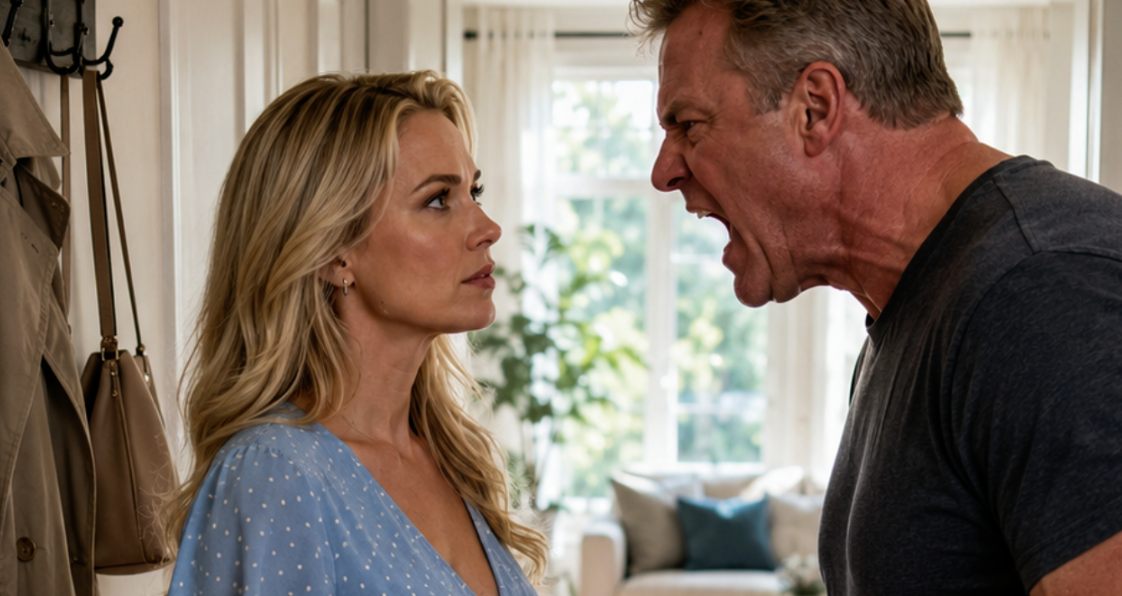
The morning sunlight filtered through the smudged windowpanes of the kitchen, casting long, sharp shadows across the linoleum floor.
“Where exactly are you going with all that paint on your face? Wipe it off immediately—you look cheap, like some country bumpkin.”
Maxim loomed in the kitchen doorway. His broad shoulders seemed to absorb the light, his posture rigid beneath a crumpled, slept-in T-shirt. In his right hand, he clutched a mug of black coffee, his knuckles white with tension. He stared at his wife not with the gaze of an equal partner, but with the cold, assessing glare of an owner evaluating a suddenly defective piece of property.
Sonya did not turn around right away. Instead, she stood frozen before the cheap hallway mirror, her fingers delicately fastening a small pearl drop earring. It was a relic from a previous lifetime—purchased back when she possessed her own income, her own agency, and the undisputed right to dictate her own wardrobe. She noticed her reflection in the glass. Her hands were perfectly steady. Not a single tremor betrayed the magnitude of the moment. That profound stillness surprised even her.
“Maxim, I am going to a job interview,” she stated. Her voice was remarkably level, a placid lake betraying none of the turbulent currents beneath.
“What job interview?” He slammed the mug onto the windowsill with such sudden, violent force that the dark liquid splashed over the porcelain rim, staining the white paint. “I didn’t give you permission.”
There it hung in the stale morning air. The word that had defined her existence for thirty-six months. During their three years of marriage, she had absorbed that word so frequently that it had dissolved into the background noise of her life, much like the musty odor of an unventilated room. Yet today, it struck her eardrums with a deafening resonance. It was louder. Sharper. Unforgivable.
Sonya pivoted slowly. She observed her husband with a detached, almost clinical curiosity. The fear had evaporated, replaced by the cool detachment of a scientist observing a highly predictable organism.
“Did you just say ‘permission’?” she asked softly.
“You heard me. Stay home. Where do you think you’re going all dressed up?”
Something intricate and heavy shifted within her chest. It was not a dramatic explosion, but rather the quiet, definitive click of a complex tumbler lock finally giving way to the correct key. She smoothly picked up her leather handbag, verified her phone’s presence, and slipped her keys into her coat pocket.
“Sonya!” His baritone thickened with menace. “I am speaking to you!”
“And I can hear you,” she replied effortlessly. She stepped over the threshold.
The heavy front door did not slam in a theatrical display of rage. It merely swung shut on its oiled hinges, closing with a soft, final click. To Maxim, that quiet closure was infinitely more infuriating than a screaming match. He stormed to the window, peering down at the gray asphalt of the courtyard. Below, Sonya was a shrinking figure in a tailored blue dress, marching steadily toward the bus stop without a single backward glance. He scoffed, taking a bitter sip of his coffee. She would return. They always returned. He had no inkling that, in twenty minutes, his absolute certainty would be shattered by a neatly folded note taped to the refrigerator.
Beneath the city streets, the metro train rattled through the subterranean darkness. Sonya stared at her own ghostly reflection in the opposing windowpane. She cataloged her appearance: the elegant blue fabric, the luminous pearls, the immaculate chignon she had woven at six in the morning while her husband snored. For three years, she had existed as a shadow in her own home. She had learned to wake silently, cook invisibly, and speak in a perpetual whisper. She had abandoned her marketing seminars because he deemed them frivolous. She had alienated her vibrant social circle because he labeled them toxic. She had surrendered her promising career at a bustling advertising agency because he had relentlessly insisted that a woman’s true empire was her domestic hearth.
She had nearly swallowed the lie whole. Almost.
The resurrection of her ambition had arrived three weeks prior via a succinct digital message from Vera Alexandrovna, her former university mentor. “Sonya, a project coordinator role has opened up. You were my first thought. Come speak with us.” Sonya had read those words fifteen times, memorized the phone number, and immediately purged the message from her device, terrified of Maxim’s invasive audits. She had scheduled the interview from the sterile safety of a corner pharmacy, whispering into the receiver while pretending to scrutinize a bottle of vitamins.
The agency was housed in a meticulously restored nineteenth-century mansion, breathing an atmosphere of roasted espresso beans and polished oak. Vera Alexandrovna emerged to greet her, her sharp eyes scanning Sonya’s slightly diminished frame. During the ensuing hour, Sonya spoke of past campaigns, demographic analytics, and conversion rates. To her immense relief, the knowledge was all there. Three years of enforced domesticity had not eroded her intellect; it had merely preserved it under a layer of frost. She walked out of the grand double doors with a signed employment offer in her pocket.
Ignoring the twelve missed calls from her husband, she texted him the location of the car keys and instructed him not to contact her. The meticulously drafted note left on the refrigerator offered no apologies, no dramatic ultimatums, and no invitations for dialogue.
When Sonya arrived at her childhood home, her mother, Lyudmila Sergeyevna, opened the door before the bell could even be rung. There was no barrage of hysterical questions. She simply brewed strong black tea, set out a porcelain dish of shortbread cookies, and offered the quiet sanctuary of the kitchen.
“I left him,” Sonya murmured, gazing out at the ancient, sprawling linden trees framing the courtyard.
“It was about time,” her mother replied, nodding with the solemnity of a judge delivering a long-overdue verdict.
Sonya’s escape was not the product of spontaneous rebellion. The seeds had been sown eight months prior, during a freezing January afternoon when she discovered a crumpled jewelry store receipt in the pocket of Maxim’s winter coat. The exorbitant sum printed on the thermal paper was for a piece she had never received. She had said nothing. Instead, she had meticulously architected her independence. Maxim controlled all their visible finances, dispensing meager cash allowances for groceries as if managing a nineteenth-century estate. Yet, he was entirely ignorant of a dormant bank account she had opened prior to their nuptials.
With surgical precision, she began diverting fractions of her household allowance into this hidden ledger. A few thousand rubles here, saved by substituting expensive cuts of meat for clever stews; a few thousand there, hoarded by walking instead of taking taxis. Maxim, entirely consumed by his own ego, noticed nothing. While he lethargically consumed endless hours of televised sports, she sat bathed in the blue light of her laptop, fiercely absorbing modern project management methodologies and digital marketing algorithms.
The following Saturday, exploiting Maxim’s predictable routine of visiting his friend Boris, Sonya returned to their apartment. Moving with the efficiency of a phantom, she packed her authentic life into two suitcases—her favorite literature, her academic credentials, and her professional wardrobe. By the time Maxim returned to find his apartment stripped of her subtle warmth—the missing bedroom mirror, the vanished blue kitchen mug—the stark reality of his isolation finally settled over him.
Sonya’s integration into her new professional life was seamless, but the ghosts of her marriage were not quite finished haunting her. One crisp evening, an anonymous message materialized on her screen: “We need to talk.” After a brief exchange, the sender was revealed as Elena Borisovna, Maxim’s formidable, domineering mother—a retired municipal bureaucrat who had forged her son into a vessel of control and emotional sterility.
They met in a neutral coffee house. Elena, sitting perfectly erect in a tailored gray blazer, wasted no time on pleasantries.
“He took out a loan. An enormous one,” the older woman stated, her voice entirely devoid of maternal warmth. “Three months ago. He forged your signature on the joint marital documents.”
The words dropped like lead weights into the tranquil pond of Sonya’s new life. The financial sum Elena quoted was staggering, a ruinous debt tethered directly to Sonya’s name. For a fraction of a second, the bustling street outside the cafe window seemed to blur. But Sonya refused to grant panic a foothold. She immediately enlisted the expertise of Pavel Ignatyevich, a seasoned family lawyer recommended by Vera. With methodical brilliance, the tired-eyed attorney dissected the banking procedures, exposing the glaring lack of Sonya’s formal written consent.
The subsequent legal battle spanned four grueling months, culminating in a definitive court ruling that severed Sonya entirely from Maxim’s fraudulent financial ruin. On the day the judge declared the debt to be Maxim’s sole burden, Sonya walked out of the courthouse, tilting her face toward the pale autumn sun. Maxim lingered behind, a hollow shell of the tyrant he had once been.
By December, Sonya had single-handedly delivered a wildly successful marketing campaign. She stood in the kitchen of her new, sunlit fourth-floor apartment, her hands wrapped around a new blue porcelain mug. A miniature Christmas tree rested on the windowsill, adorned with exactly three simple ornaments.
Her mother visited on a snowy evening, bringing freshly baked pastries and the rich scent of winter pine. “You have changed,” Lyudmila observed, her eyes crinkling with genuine warmth.
Sonya smiled, watching the delicate snowflakes drift past the glass. “For the better?”
“No,” her mother corrected gently. “Into yourself.”
Sonya realized that for three long years, she had kept her eyes glued to the floor, terrified of navigating the minefield of her husband’s temper. Now, finally, she had the profound luxury of simply looking out the window, entirely captivated by the quiet, beautiful vastness of her own unwritten future.