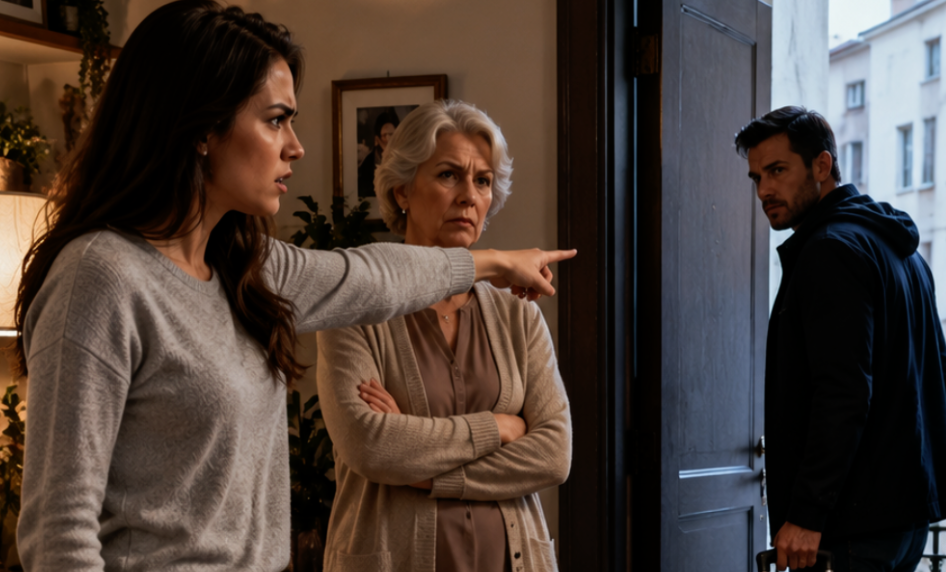
“Enough! It’s either her or me!” Olga’s voice fractured into a shrill crescendo, completely abandoning the composed timbre she had initially aimed for. “I flatly refuse to continue living in my own home as though I were a tenant awaiting eviction!”
Maria Ivanovna, her mother-in-law, did not flinch. Sitting perched on the absolute edge of the velvet sofa in thick, hand-knitted woolen socks, she presented the optical illusion of a harmless, fragile elder. Yet, her eyes told a different story. Her gaze was a honed blade—sharp, calculating, and chillingly cold. It was the specific kind of stare designed to instantly weaponize guilt, capable of making even a casual visitor feel as though they had committed a grave moral trespass.
“Oh, is that the reality of the situation?” the older woman murmured, her voice dangerously quiet as she meticulously adjusted the heavy woven shawl draped over her narrow shoulders. “So I, the mother of your husband, am the unwanted pestilence? The frail old woman who stubbornly prevents the young queen from reigning in peace?”
“You are not a frail old woman—you are a garrison commander,” Olga hissed, pressing her trembling palms flat against the armrests of her chair to ground herself. “This morning alone, I scrubbed the kitchen floor three times because you arbitrarily decided you ‘didn’t care for the shine.’ Following that, you unilaterally replaced the living room curtains, and to crown the afternoon, you declared that my child ‘breathes too loudly’! I am utterly depleted. You have resided with us for a mere three months, yet the atmosphere is so suffocating that I feel like an intruder in my own sanctuary!”
“My son built this house, need I remind you,” Maria Ivanovna countered, leaning back into the cushions with a triumphant squint. “With my seasoned advice and, partially, my financial contribution. The mortgage bears his name. Therefore, I suggest you cease referring to it as ‘my home.’ You reside here by his grace, not the inverse.”
“By his grace?” Olga let out a hollow, bitter laugh that echoed harshly against the walls. “I was the one who negotiated the loan terms. I supervised the grueling renovations while your son was perpetually ‘deliberating on where to source cheaper tiles.’ I sat awake until dawn drafting architectural blueprints so the careless construction crew wouldn’t irreparably ruin the foundation. All you contributed was unsolicited advice, delivered with the arrogant certainty of someone who assumes omniscience. Frankly, Maria Ivanovna, your ‘advice’ frequently makes me want to howl at the moon.”
From the kitchen, the monotonous, rhythmic dripping of a leaky faucet punctuated the heavy silence. Pyotr, Olga’s husband, stood with his back rigid against them, seemingly hypnotized by the sink, as if the running tap water could magically dissolve his marital and filial obligations. He feigned intense preoccupation with drying a single ceramic mug, actively maintaining his cowardly distance.
“Petya, for the love of God, say something,” Olga finally snapped, directing her ire at his broad back. “You can clearly see she is methodically attempting to drive me out. Every single day brings a fresh, absurd complaint. The porcelain plates ‘clatter too aggressively,’ or I ‘boil the pasta too sluggishly.’ What does that even signify? Are we participating in some demented culinary championship?”
Pyotr remained frozen. Finally, without rotating his shoulders, he muttered softly to the tiles: “Mom, perhaps you really should… moderate your tone slightly. You do cross the line on occasion.”
“Ah, so the betrayal begins!” Maria Ivanovna flared, her voice trembling with theatrical indignation. “I am now the obstacle! The two of you have formally allied against one defenseless old woman! I see the conspiracy clearly—she has poisoned your mind against me! Modern women are all cut from the same wretched cloth. The exact second a man signs a marriage certificate, his devoted mother is instantly branded the enemy. It is immediately ‘discard her, erase her, bury her.’ Have you conveniently forgotten who meticulously ironed your shirts during your university years? Who worked herself into an early grave so you could stand there today as a respectable member of society?”
“Mom, I simply desire a peaceful existence,” Pyotr pleaded, his voice heavy with a profound exhaustion that overshadowed any genuine desire to mediate the conflict. “Without these endless theatrical scenes.”
“Peaceful?” Olga closed the distance between them. “Do you define ‘peaceful’ as someone deliberately blasting the radio at maximum volume at dawn because ‘silence is depressing’? Or when, at nine o’clock at night, I hear through the closed door, ‘Someone should amputate my daughter-in-law’s hands for ruining this sauce’? Is that your definition of a tranquil home? Are you genuinely comfortable with your mother casually confiscating my personal belongings? Yesterday, I spent an hour searching for my woolen sweater, only to find her wearing it. Do you know what her justification was? She claimed the sweater ‘felt more comfortable with her.’ Does that sound like the behavior of a rational houseguest?”
Maria Ivanovna snorted dismissively. “It is incredibly pathetic to be so territorial over a simple woven rag. I required something warmer, so I took it. You, Olenka, hoard possessions like a paranoid magpie.”
“Because you constantly snatch things directly from my hands!” Olga shouted. “In my own home, I am reduced to a disobedient schoolgirl standing before a tyrannical headmistress!”
A dense, suffocating silence settled over the room. The vintage wall clock struck nine. The autumn air outside carried the scent of wet asphalt—a lethargic season incapable of making the decisive transition into winter.
“That is enough,” Pyotr stated wearily. “Let us cease this hostility. Mom, try to be gentler. And you, Olya, stop escalating the situation. This is temporary. Once the renovations on her apartment are finalized, she will depart.”
“Really?” Olga asked, her voice dropping to a dangerous whisper. “Tell me the absolute truth—do you genuinely believe that narrative yourself?”
Pyotr did not answer. He simply opened his hands in a gesture of profound helplessness.
The following morning brought a renewed offensive. Maria Ivanovna stood by the window, loudly narrating her dismal worldview. “What a grotesque nightmare this world has become. Society is disintegrating because humanity has misplaced its conscience. Nobody respects their elders anymore…”
Olga calmly stirred her tea. Then, the dam broke. “Perhaps that is because certain elders derive sadistic pleasure from transforming family life into a tragic theater production.”
“What an insolent, wretched woman!” the older woman shrieked. “You are the one intentionally torturing me! You are a certified shrew!”
“Enough!” Olga slammed her open palm violently against the wooden table. “We are concluding this today. Either you secure alternative living arrangements, or I pack my child’s belongings and relocate to my mother’s home.”
Pyotr emerged from the hallway, his face pale. “Can we not drop this?” he practically begged.
“No, Petya. I am done functioning as the diplomatic buffer.” Olga slowly slid her gold wedding band from her finger. The metal felt heavy as she tossed it onto the kitchen table. “Sort this out yourselves. I am leaving.”
Five agonizingly long, sticky days followed. The silence in the house rang louder than any screaming match. Pyotr existed in a purgatory between two daily phone calls: his wife in the morning, his mother in the evening.
Meanwhile, Olga had rented a sterile, one-room apartment on the city’s gray outskirts. Despite the thin walls, she slept with a profound, unbroken peace. She sought the counsel of a lawyer—a meticulous man whose desk was arranged with the precise geometry of an army barracks.
“Your mother-in-law has no legal registration at the property, whereas the deed is jointly held by you and your husband. Legally, you possess the absolute right to have her removed,” he explained calmly.
“And practically?” Olga inquired.
“Practically, it will involve an official report, a formal application, and guaranteed noise.”
Olga walked out into the damp, gray city. Noisy it is, then, she thought. But this time, I hold the gavel.
On Friday evening, Olga crossed the threshold of her home. Maria Ivanovna sat squarely at the dining table, wearing the martyred expression of a saint awaiting execution.
“So, you have graced us with your return,” the older woman muttered.
“I simply ceased rushing back,” Olga replied with chilling neutrality. Behind her stood the lawyer.
“Are you evicting an old woman onto the streets?” Maria Ivanovna cried.
“Mom, nobody is throwing you onto the street,” Pyotr intervened. “Just… stay with Aunt Lyuba in Mytishchi for a while. Let the fire die down.”
“It is not his choice to make; it is mine,” Olga stated firmly. “Because if I do not establish this boundary now, I will be the one packing my bags permanently.”
Maria Ivanovna released a dry laugh. “A brilliant strategist. You seized my son, you seized the house, and now you demand the moral high ground. Keep your official report. I will depart voluntarily. But mark my words: your marriage will inevitably follow this exact destructive script.”
“There are indeed men who cannot exist without their mothers,” Olga said softly, looking directly into Pyotr’s eyes. “But a man without character is a far more terrifying prospect.”
Within the hour, the suitcase was packed. When the heavy front door finally clicked shut, a profound vacuum filled the house.
“Are you finally happy?” Pyotr asked, staring blankly out the window.
“No,” Olga replied honestly. “But it is finally peaceful. We can now discover if this marriage can survive when there is no third person left to blame.”
Weeks turned into the frozen stillness of winter. A tentative equilibrium settled over the household. One evening, a parcel arrived from Mytishchi. Inside rested a jar of homemade raspberry jam, woolen socks, and a small note:
“Olenka, may your tea be sweet. I simply do not know how to exist any differently. Take care of my son, and may he take care of you.”
Olga slowly spread the dark, slightly burnt jam over a slice of bread. Pyotr watched her carefully.
“Is it bitter?” he asked softly.
“No,” she smiled, a genuine warmth reaching her eyes. “It tastes exactly right.”
The silence in the kitchen was no longer a weapon; it was a sanctuary. To preserve a family, one must sometimes raze the corrupted foundation to the ground and rebuild it brick by painful brick—without screaming, without fear, but with absolute, unwavering respect.