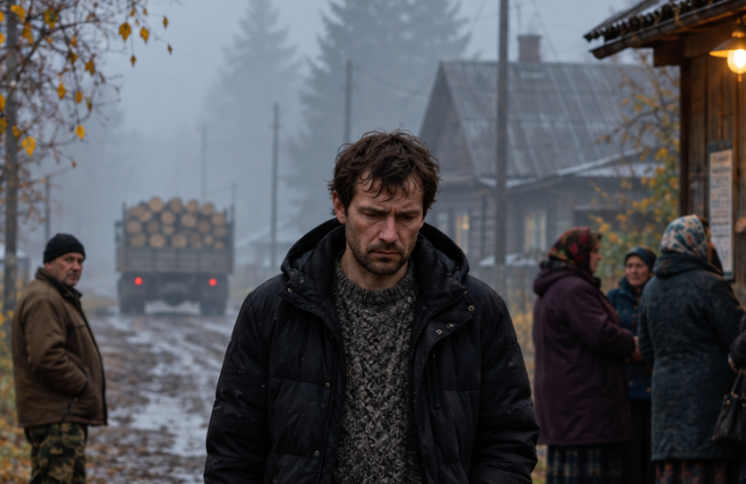
A damp November fog stretched from the river in a thick, milky curtain, swallowing the occasional bark of a dog and the distant hum of logging trucks rumbling along the far highway. Ilya Kostromin walked down the battered village street on his way to buy bread. Tall and broad-shouldered at thirty-four, Ilya had always kept his posture straight, his wide shoulders back, and met others’ eyes head-on since he was a boy. Yet for the past six months, even this familiar road through his hometown had become a real ordeal for him.
Coming from the direction of the post office was the head of the sawmill crew, Uncle Mityay. Stocky and sinewy at sixty-two, he had once been Ilya’s mentor: teaching the young man the right way to handle an axe and how to fell mature trees by making the cut close to the root. Ilya slowed his pace and, as usual, lifted his hand in greeting to his elder teammate.
“Hello, Zakharych.”
Uncle Mityay didn’t even glance his way. Slowing down on purpose, he spat right into the cold, reddish mud at his feet, shoved his hands defiantly into the pockets of his brown corduroy jacket, and fixed his heavy gray eyes on the tops of the pines beyond the village edge. Then he passed so close that his shoulder bumped Ilya’s, acting as if he was brushing past empty air instead of a living person.
Two neighbors stood near the store. When they saw Ilya, the women instantly fell silent mid-sentence, pressed their lips tightly together, and turned to the notice board, pretending to study the sun-bleached posters that had hung there for half a year. Inside, the shopkeeper didn’t lift her brown eyes as she wordlessly tossed a loaf of rye bread onto the counter. She snatched the bill from his hand quickly, and counted out the change with such force it sounded like she was building a metal fence between them, protecting herself from someone contagious.
The village had settled into a true boycott—cold, silent, and merciless.
It all began in May. Ilya worked as a foreman at the state-owned forestry site and absolutely refused to sign forged papers to write off forty hectares of mature pine. The trees were to be listed as lost to ‘windfall and wildfire,’ but that phrase hid another truth entirely.
The scheme was simple. City middlemen offered local men, led by Zakharych, a way to ensure the inspection found nothing amiss. They planned to secretly log the valuable timber, haul the logs away in secret, and split the millions they’d make among village families. People didn’t have much, every penny mattered, so many were already thinking of how they’d use the easy money. Some dreamed of new tractors, others of fancy fences, and still others just wanted to pay off their debts. The money felt as good as theirs already.
But Ilya stood in their way. At the big meeting in the office, he openly spoke out against the plan, staring into the angry, flushed faces of his fellow villagers.
“I won’t let you steal! Our grandfathers protected this taiga. If you destroy the water protection area, the river will dry up, fertile land will turn into sand, and in ten years, all that will be left of our village is ashes. I refuse to answer for this in court – and I won’t let you carry such a heavy burden on your conscience either.”
After this, Ilya went to the district center and filed an official report, laying out exactly what happened. An inspection was carried out, the area was closed off from logging, and strict state supervision was established. The forest was saved, and the middlemen were forced to leave with nothing.
But for Ilya, his victory turned out to be a heavy punishment. He was met with grim, quiet peasant vengeance. In the eyes of the village, he became someone who had betrayed his own people, depriving them of a way to earn a living.
“Oh, you think you’re a saint! Judas! You betrayed your own, left us without a bite to eat!” the women hissed by the well.
Over the next six months, the Kostromin family was almost erased from village life. Men stopped greeting Ilya, and even his thirty-one-year-old wife Elena was no longer allowed to buy groceries on credit at the local shop till payday. Six-year-old Yegorka was chased away from the communal log slide by the neighborhood boys, who shouted at him.
“Your dad’s a snitch! Get out of here, you can’t play on our swings!”
It was as if the family was trapped in icy jaws. The Kostromins began to shut themselves away within the four walls of their small log house, trying not to cross paths with the neighbors and friends who, not long ago, were part of their everyday life. Ilya silently bore the humiliation, clenching his teeth. He kept telling himself that sooner or later, things would change. Time would put everything in its place, anger would fade, and the villagers would understand that he hadn’t doomed them but had actually saved them from serious trouble and, possibly, jail time.
But at the end of November, a tragedy happened—so dire that all the village’s anger seemed like innocent mischief in comparison.
Yegorka fell ill suddenly. At first, he just had a slight fever and a runny nose—just a regular cold, like so many others during the long northern autumn. It seemed like there was nothing serious and that the child would soon recover.
But after three days, the boy’s condition sharply worsened. He started having trouble breathing. Little, skinny Yegorka lay in bed, desperately trying to catch a breath with bluish lips. The brightness had faded from his eyes, and his cheeks were burning with a dry, alarming heat.
When the young district paramedic arrived in his old UAZ and pressed his stethoscope to the child’s chest to listen to his breathing, his face turned pale. He realized the situation was much more serious than an ordinary cold—and he swore quietly through his teeth.
“Severe myocarditis. After the viral infection, a terrible complication developed in his heart; cardiac conduction is failing. Ilya, Lena, there’s nothing more we can do on our own. The medications aren’t working — we can’t keep his heart rhythm stable. Egorka urgently needs endovascular intervention and a special pediatric occluder placed in the vessels. If we don’t act, his heart could stop at any moment. The regional hospital won’t have any available quotas until spring, but we don’t have that long. Our only option is to get him to the capital’s cardiology center, in the private ward. They have the equipment and specialists ready for him as soon as tomorrow.”
“How much will it cost?” Ilya asked hoarsely, feeling like an icy void had opened up inside him.
“Seven hundred and fifty thousand,” the paramedic answered quietly, looking away. “That covers the surgery, transport by intensive care ambulance, and post-op recovery. There’s just no way it’ll be cheaper. You need to find the money, guys. You have one day—two at the very most. After that, there may be no one left to transport.”
The paramedic left to arrange for a specialized ambulance for the day after tomorrow. A heavy, almost tangible silence filled the house. It was broken only by the harsh, wheezing breaths of the child who was fading away before his parents’ eyes.
Elena sank to her knees beside her son’s bed, pressed her face to the edge of his blue flannel pajamas, and began to wail. It was a terrifying, muffled howl without a single tear. In her despair, she dug her nails into the wooden bed frame. How could ordinary villagers ever come up with so much money? The Kostromins’ entire family savings amounted to just one hundred forty thousand. They had saved it for a long time, planning to replace the rotten foundation beam of their house.
Ilya paced the room like a trapped animal. He grabbed his phone and, panicked, started calling all the local banks. Each time, he was rejected: the automated lending system declined every request because of his small salary as a farm worker. Then, desperate, he ran to the old garage, where his one truly valuable possession stood — a ten-year-old workhorse Niva car. Ilya called a highway used car dealer.
“Take it for two hundred thousand, right now! All the papers are in order. Just bring the cash within the hour!”
The buyer showed up, bargained the price down to one hundred eighty thousand, shoved a crumpled bundle of cash into Ilya’s hands, and towed the car away.
By evening, they had gathered three hundred twenty thousand on the table. And then—a dead end. To Ilya, it felt as if a solid stone wall had risen in front of him, impossible to break through. They were still more than four hundred thousand short of what they needed.
A freezing, impenetrable night settled over the village. Outside, the icy wind howled, pelting prickly snow against the dark windows. Egorka was delirious—sometimes calling for his mother, sometimes asking for the dog. His fingers were growing cold, and his pulse beneath the thin skin of his neck was barely detectable. It thudded weakly and irregularly, like a wounded bird fighting with all its strength to stay alive.
Elena sat motionless beside her son. In just a single day, it was as if she had aged ten years. Dark strands had fallen from her once-neat ponytail, and her brown eyes stared blankly, made glassy by all the sorrow she had endured.
Ilya stood by the window, pressing his burning forehead against the cool glass. A lump in his throat made it hard to breathe. What pride could possibly matter now? What use was his masculine dignity? All his principles meant nothing in the face of his only son’s fading life. Everything he once believed in, everything he treasured, crumbled to dust in an instant.
He made up his mind that he would leave the house and go door to door, even to the ones who had turned their backs on him and spat in his direction these past six months. He would fall to his knees in the frozen mud, beg for forgiveness, and kiss their boots if he had to. If anyone could give even a thousand, even a hundred—any amount that could help save Yegorka.
Ilya had already grabbed the doorknob, about to step out into the darkness, when the porch suddenly echoed with heavy footsteps. It sounded like dozens of people had gathered outside. The stairs creaked. Nobody knocked; instead, the front door flew open decisively, and a rush of cold, frosty air blasted into the hallway.
Ilya stepped back, blocking the path to the bedroom. Men started coming into the entryway.
The first to appear was Uncle Mityay in his usual corduroy jacket. Next came Semyon, the head of the logging crew, tractor driver Pashka, and old beekeeper Grandpa Grisha. And behind them, out in the frosty twilight of the yard, women’s headscarves and dark jacketed figures could be seen. It looked like half the village had come.
No one spoke. The men took off their caps, awkwardly twisting them in their rough hands, hands blackened from oil and hard work. There was no mockery or anger on their faces—only exhaustion, drawn expressions, and guilt.
“What do you want?” Ilya managed to choke out, clenching his fists in frustration. “Why are you here? Have you come to finish us off? My son is dying, do you hear me?! Leave! I have no time for you right now!”
Uncle Mityay exhaled heavily, walked to the kitchen table, and set down an old, large tin cookie box with a dull thud. The lid was slightly open. Inside were bundles of money held together with pharmacy rubber bands: neat stacks of brand-new large bills, smaller wrinkled notes, and pensions savings wrapped in torn squares from school notebooks.
The house was so quiet you could clearly hear Yegorka’s interrupted sobs drifting from the bedroom, as he tossed and turned in feverish dreams.
“Easy, Ilya,” Uncle Mityay spoke quietly. He didn’t look at Ilya, his eyes fixed on the edge of the table. “Don’t yell. We know everything. The medic ran out of the health post and told us what happened. The women sounded the alarm too… Two hours ago we gathered at the office for a meeting.”
He fell silent. The muscles in his thick neck twitched nervously. The old man ran his rough palm over his face, as if trying to wipe away some invisible cobweb, then finally looked up at Ilya with a heavy, sorrowful gaze filled with unwavering sadness.
— Here’s six hundred and twenty thousand. It’s everything we could gather from the village homes. Grandma Marfa brought the money she’d been saving for her own funeral—even gave every last coin she had. The tractor drivers chipped in from their savings. The village council allocated funds from the mutual aid fund. It should be enough for the clinic and the medicine in the city. Tomorrow morning, Semyon will drive you into town in his warm minivan. The medic will go with you, and the oxygen tank will be ready. Everything’s arranged.
Ilya stood frozen, as if his feet were glued to the floorboards. He stared at the old box and the crumpled banknotes people had scraped together from their salaries and pensions, and just couldn’t manage to draw a full breath.
From the bedroom, Elena slowly shuffled out, barely able to move her feet. When she saw the box on the table and the men silently standing with their hats in hand, she gasped without a sound, covered her face, and began to collapse to the floor. Ilya caught his wife by the elbows just in time, keeping her from falling.
— Why?.. — he whispered.
For the first time in thirty-four years, hot tears streamed down the weathered, stubbly cheeks of the man. He didn’t try to hide them or wipe his face. The tears rolled right onto the collar of his gray sweater.
— But you all… For half a year, you looked at me as if I were your enemy. Turned away, spat at my back. Why are you helping us now?..
Uncle Mityai frowned, his jaw muscles tensing under his skin. He stepped right up to Ilya, put his heavy hand on his shoulder, and gripped it firmly.
— We were fools, Ilya. Anger blinded us. Because of that cursed money, we were ready to tear each other apart. But you did the right thing back then—saved us from disgrace. And yet we went after you like a pack of wild dogs. The community, we claimed, was offended! What kind of community is that, if our own pride would lead a child to an early grave? We’re people, Ilya, not wild beasts. If your boy stops breathing tomorrow, how will we walk our street afterward? How can we look each other in the eye? A village without conscience is just a pile of rotten logs. Forgive us, if you can, man. Please forgive us. Save Egorka.
Someone behind them loudly sniffled. Young tractor driver Pashka turned away, and another villager coughed quietly into his fist. No one tried to say anything poetic.
Uncle Mityai turned toward the door, already speaking in a businesslike tone as he walked out:
— At six in the morning, Semyon will pull the car right up to the porch. The cabin’s already being warmed up. Lena, pack things for the boy. Take all the money. If it’s not enough, we’ll rally the whole district center and find the rest. Egorka will live. The whole village will be praying for him.
The men left as quietly as they had arrived, carefully closing the door behind them.
A month went by.
In the last days of December, right before the harsh Nikolskiye frosts, a blue minivan quietly pulled up to the Kostromins’ house. Ilya was the first one out of the car. He had noticeably lost weight, dark circles under his eyes, but his face was beaming with such a bright, genuine smile as his fellow villagers had never seen before.
The man gently slid open the door and lifted little Egorka into his arms, wrapped snugly in a thick down blanket.
Elena followed, carrying a bag with their things. The boy clung tightly to his new plush teddy bear—a gift from the surgeons at the city clinic. Egorka’s cheeks were rosy again, his breathing calm and even, and his blue eyes sparkled with curiosity and life from beneath his knitted hat. The operation had gone well, his heartbeat was steady, and the doctors said he could finally go home to celebrate New Year’s with his family.
At the gate, their neighbors were already waiting. As if on cue, almost half the village came outside. The women had brought hot pies wrapped in towels, jars of lingonberry jam and salted mushrooms. The men shuffled on the crunchy snow, hiding shy smiles behind their mustaches, unsure how to start the conversation.
Uncle Mityai stood in front of everyone.
Egorka spotted the old foreman and suddenly shouted out for the whole frosty street to hear, still bundled up in his warm blanket:
“Uncle Mityai! They fixed the motor in my chest in the city! Now I’ll be able to ski faster than Pashka!”
For a moment, the whole village fell silent. Then, everyone burst out laughing at once. It was a relieved, genuine laughter that seemed to wipe away old grievances, unspoken words, and months of pointless quarrels.
Uncle Mityai came up to Ilya and gently, with the rough tips of his fingers, touched the boy’s round cheek. Then he took a deep breath and quietly said:
“Run, Egorushka. Run in good health, son. That’s what we live for.”
Ilya stepped toward the old man and embraced him tightly, holding him by the shoulders in a manly hug.
On that frosty northern morning, an amazing calm settled over the snow-covered village. The echoes of old grudges and the heavy shadows of feuds faded away. All that could be heard was the strong, steady beat of a child’s heart—a reminder that human kindness can work real miracles.